12 results for "Future Technology"

The Singularity Is Nearer

Kurzweil, Ray
"This successor volume to The Singularity Is Near explores how technology will refashion the human race in the decades to come. In this entirely new book, Ray Kurzweil brings a fresh perspective to advances in the singularity-assessing the progress of many of his predictions and examining the novel advancements that, in the near future, will bring a revolution in knowledge and an expansion of human potential. Among the topics he discusses are rebuilding the world atom by atom with devices like nanobots; radical life extension beyond the current age limit of 120; reinventing intelligence by expanding biological capacity with nonbiological intelligence in the cloud; how life is improving with declines in poverty and violence; and the growth of technologies that can be applied to everything from clothes to building materials to growing human organs. He also considers the potential perils of biotechnology, nanotechnology, and artificial intelligence, including such topics as how AI will impact unemployment and the safety of autonomous cars, and "After Life" technology, which will reanimate people who have passed away through a combination of data and DNA"--
Penguin USA 2025-06-03 432 pages

How the End Begins The Road to a Nuclear World War III

Ron Rosenbaum
In this startling book, now in paperback, the bestselling author of Explaining Hitler warns that a nuclear World War III is not only the most massive and imminent threat to existence as we know it, but also one of the most ignored. While Russian aggression grows and North Korean nuclear ambitions increase unabated, tensions continue to escalate between India and Pakistan and in the Middle East. Meanwhile, Iran remains committed to developing its nuclear program despite international sanctions. No other writer has assembled the extraordinary array of sources and experiences that Ron Rosenbaum calls on to inform his examination of nuclear war. While working from both historical and contemporary perspectives to explore the people and events that could shape the form of a third world war, he suggests humans have never before been so close to annihilation. In this book, Rosenbaum examines both the paranoia and very real set of possibilities that informs our view of nuclear war and asks whether we can “undream” the nightmare.
Simon and Schuster 2012-02-21 320 pages

Microtrends The Small Forces Behind Tomorrow's Big Changes

Mark Penn
The adviser to Senator Hillary Clinton, Bill Gates, and President Bill Clinton proves that small is big by identifying 75 hidden-in-plain-sight trends that are moving America, revealing that the nation is no longer a melting pot but a collection of communities with many individual tastes and lifestyles. "The ideas in his book will help you see the world in a new way." --Bill Clinton "Mark Penn has a keen mind and a fascinating sense of what makes America tick, and you see it on every page of Microtrends ." --Bill Gates In 1982, readers discovered Megatrends . In 2000, The Tipping Point entered the lexicon. Now, in Microtrends , one of the most respected and sought-after analysts in the world articulates a new way of understanding how we live. Mark Penn, the man who identified "Soccer Moms" as a crucial constituency in President Clinton's 1996 reelection campaign, is known for his ability to detect relatively small patterns of behavior in our culture-microtrends that are wielding great influence on business, politics, and our personal lives. Only one percent of the public, or three million people, is enough to launch a business or social movement. Relying on some of the best data available, Penn identifies more than 70 microtrends in religion, leisure, politics, and family life that are changing the way we live. Among them: People are retiring but continuing to work. Teens are turning to knitting. Geeks are becoming the most sociable people around. Women are driving technology. Dads are older than ever and spending more time with their kids than in the past. You have to look at and interpret data to know what's going on, and that conventional wisdom is almost always wrong and outdated. The nation is no longer a melting pot. We are a collection of communities with many individual tastes and lifestyles. Those who recognize these emerging groups will prosper. Penn shows readers how to identify the microtrends that can transform a business enterprise, tip an election, spark a movement, or change your life. In today's world, small groups can have the biggest impact.
Grand Central Publishing 2007-09 448 pages

Inevitable surprises: thinking ahead in a time of turbulence

Peter Schwartz
The world we live in today is more volatile than ever. The security of free nations is threatened by rogue states, the global economy is in flux, and the rapid advance of technology forces constant reevaluation of our society. With so many powerful forces at work and seemingly unpredictable events occurring, to many the future seems dark, and its possibilities frightening. Peter Schwartz disagrees. A world-renowned visionary in the field of scenario planning, Schwartz’s startling—and accurate— predictions have been employed by government agencies and major corporations for more than twenty-five years. He argues that the future is foreseeable, and that by examining the dynamics at work today we can predict the “inevitable surprises” of tomorrow. Timely and thought-provoking, Inevitable Surprises is a book that no one with an interest in business—or the future of our society—can afford to miss.
Gotham Books 2004-05-24 247 pages

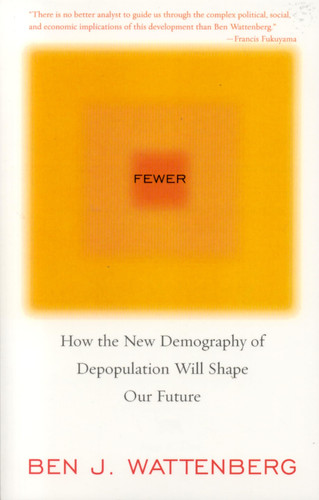
Fewer How the New Demography of Depopulation Will Shape Our Future

Ben J. Wattenberg
For at least 650 years, since the time of the Black Plague, the world's population has headed in only one direction: up. But within a few decades the number of people on earth will level off and then will likely decline over an extended period of time. In Fewer, the author explains how and why birthrates and fertility rates are now falling at an alarming rate in countries throughout the world--both modern and less developed. And he explores the major implications--for world politics, the environment, and the international economy--of this momentous shift. Illustrated with 23 clarifying charts.
Bloomsbury Academic 2004 241 pages

Don't Burn Anyone at the Stake Today

Alderman, Naomi
What’s the most useful thing you could know about your own life? In this era-defining book, developed from her groundbreaking Radio 4 essay series, Naomi Alderman turns her boundless curiosity and incisive thinking to a question that affects us all: how do we understand, and navigate, the epoch we’re living through? She calls this epoch the Information Crisis. The internet has flooded us with more knowledge, opinions, ideas, opportunities, as well as verbal attacks and misinformation, than ever before. It lets us learn more quickly and also spread falsehood more quickly, it brings us together and also divides us in new ways, it is now the lens through which we perceive and understand the world. There is no going back. But we have been here before. In fact, this is humanity’s third information crisis. The first, the invention of writing 5,000 years ago, and the second, the invention of the printing press 600 years ago, drastically reshaped our perceptions, interactions and mental landscapes in ways that feel acutely familiar. Overwhelmed by information, people become afraid and angry, unsettled and distressed, as well as more knowledgeable, educated and curious. By looking at those previous information crises, both the turmoil and the advances, Alderman asks what we can learn from the past to better understand our present, and prepare for our future. Drawing on the work of philosophers and historians, Don’t Burn Anyone at the Stake Today explores how new technology opens up new ways of being and helps us chart a way forward (once again), through the turbulent seas of information overload.[Bokinfo]
Penguin 2026-05-07 224 pages

Serious Games

Clark C. Abt
The author explores the ways in which games can be used to instruct and inform as well as provide pleasure. He uses innovative approaches to problem solving through individualized game techniques. Topics improving education with games; educational games for the physical and social sciences; games for the learning disadvantaged; games for occupational choice and training; games for planning and problem solving in government and industry; and the future of serious games. This book was originally published in 1970 by Viking Press.
Viking Press 1971 176 pages

The Republic of Technology Reflections on Our Future Community

Daniel Joseph Boorstin
In this lively book, Pulitzer prize-winning historian Boorstin, author of the widely acclaimed trilogy The Americans, illuminates our everyday concerns with his reflections on the new meaning of technology for America and of America for technology. He gives us a bold new view of the two kinds of revolution - the political and technological - and shows us how and why they are different, and why technological revolutions are irreversible. We are a center from which radiate forces that converge human experience everywhere. Though people around the world may not love one another any more than they did, yet their ways of life tend to become more and more alike. These same overwhelming forces of technology that homogenize the culture of the human race have disrupted the international community of nations; large and small nations become "equal," but each day the word "nation" grows more meaningless. Ideology, tribalism, nationalism, the crusading spirit in religion, bigotry, censorship, racism, persecution, immigration and emigration restriction, tariffs, and chauvinism do interpose barriers. For reasons which we are only beginning to discover, and which Boorstin explores in this controversial book, these barriers will only be temporary. The converging powers of technology will eventually triumph.
Harper & Row 1978 105 pages

The Justice Motive in Social Behavior Adapting to Times of Scarcity and Change

Melvin J. Lerner,Sally C. Lerner
This volume was conceived out of the concern with what the imminent future holds for the "have" countries ... those societies, such as the United States, which are based on complex technology and a high level of energy consumption. Even the most sanguine projection includes as base minimum relatively rapid and radical change in all aspects of the society, reflecting adaptation or reactions to demands created by poten tial threat to the technological base, sources of energy, to the life-support system itself. Whatever the source of these threats-whether they are the result of politically endogeneous or exogeneous forces-they will elicit changes in our social institutions; changes resulting not only from attempts to adapt but also from unintended consequences of failures to adapt. One reasonable assumption is that whatever the future holds for us, we would prefer to live in a world of minimal suffering with the greatest opportunity for fulfilling the human potential. The question then becomes one of how we can provide for these goals in that scenario for the imminent future ... a world of threat, change, need to adapt, diminishing access to that which has been familiar, comfortable, needed.
Springer US 2013-06-19 494 pages

Ivory Bridges Connecting Science and Society

Gerhard Sonnert,Gerald Holton
A study of two bridges between science and society: governmental science policy and scientists' voluntary public-interest associations. According to a widespread stereotype, scientists occupy an ivory tower, isolated from other parts of society. To some extent this is true, and the resulting freedom to pursue curiosity-driven research has made possible extraordinary scientific advances. The spinoffs of "pure" science, however, have also had powerful impacts on society, and the potential for future impacts is even greater. The public and many policymakers, as well as many researchers, have paid insufficient attention to the mechanisms for interchange between science and society that have developed since World War II. Ivory Bridges examines two such mechanisms: governmental science policy (often involving the participation of "scientist administrators") and scientists' voluntary public-interest associations. The examination of science policy is guided by the notion of "Jeffersonian science"---defined as basic research on topics identified as being in the national interest. The book illustrates the concept with a historical case study of the Press-Carter Initiative of the late 1970s and proposes that a Jeffersonian approach would make a valuable addition to future science policy. The book also looks at the activities of citizen-scientists who have organized themselves to promote the welfare of society. It shows that their numerous and diverse organizations have made major contributions to the commonweal and that they have helped to prevent science from becoming either too subservient to government or too autonomous. An extensive appendix profiles a wide variety of these organizations.
MIT Press 2002-03-15 240 pages

Continuity And Change In Rural Russia A Geographical Perspective

Ioffe, G. V.
Contrary to the viewpoint of many Western scholars, the authors of this penetrating analysis argue that private farming is not a viable option in Russia's future. Instead, a convergence of Soviet-style subsidiary farming with traditional and reorganized collective farms is the most plausible path of evolution in most rural areas.Grigory Ioffe and Tatyana Nefedova arrive at this conclusion by a careful examination of ongoing reform efforts in Russian agriculture against the backdrop of European and Russian agrarian history and rural spatial development since the late nineteenth century. The comparisons at the national level are then filled in with consideration of a number of Russian provinces (oblasti) and regions (raiony). Their research reveals the substantial negative impact of rural depopulation on the Russian agrarian economy. Seventy original maps richly complement and support the narrative.
Routledge 2019-06-13 327 pages