21 results for "Future Technology"

The age of surveillance capitalism: the fight for a human future at the new frontier of power

Zuboff, Shoshana
"Shoshana Zuboff, named "the true prophet of the information age" by the Financial Times, has always been ahead of her time. Her seminal book In the Age of the Smart Machine foresaw the consequences of a then-unfolding era of computer technology. Now, three decades later she asks why the once-celebrated miracle of digital is turning into a nightmare. Zuboff tackles the social, political, business, personal, and technological meaning of "surveillance capitalism" as an unprecedented new market form. It is not simply about tracking us and selling ads, it is the business model for an ominous new marketplace that aims at nothing less than predicting and modifying our everyday behavior--where we go, what we do, what we say, how we feel, who we're with. The consequences of surveillance capitalism for us as individuals and as a society vividly come to life in The Age of Surveillance Capitalism's pathbreaking analysis of power. The threat has shifted from a totalitarian "big brother" state to a universal global architecture of automatic sensors and smart capabilities: A "big other" that imposes a fundamentally new form of power and unprecedented concentrations of knowledge in private companies--free from democratic oversight and control"--
PublicAffairs 2020-03-03 691 pages

The age of AI: and our human future

Kissinger, Henry,Schmidt, Eric,Huttenlocher, Daniel P.
"Artificial Intelligence (AI) is transforming human society in fundamental and profound ways. Not since the Age of Reason have we changed how we approach security, economics, order, and even knowledge itself. In the Age of AI, three deep and accomplished thinkers come together to consider what AI will mean for us all."
Back Bay Books, Little, Brown and Company 2022 266 pages

Alone together: why we expect more from technology and less from each other

Turkle, Sherry
In "Alone Together," MIT technology and society professor Sherry Turkle explores the power of our new tools and toys to dramatically alter our social lives. It's a nuanced exploration of what we are looking for--and sacrificing--in a world of electronic companions and social networking tools, and an argument that, despite the hand-waving of today's self-described prophets of the future, it will be the next generation who will chart the path between isolation and connectivity.
Basic Books 2012-10-02 360 pages

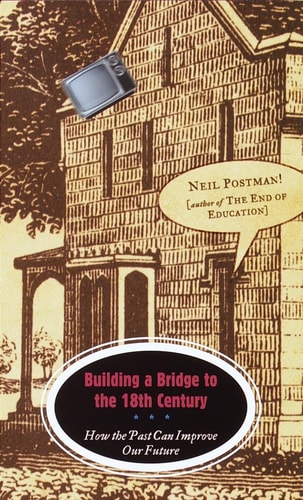
Building a bridge to the 18th century: how the past can improve our future

Postman, Neil
In Building a Bridge to the 18th Century , acclaimed cultural critic Neil Postman offers a cure for the hysteria and hazy values of the postmodern world. Postman shows us how to reclaim that balance between mind and machine in a dazzling celebration of the accomplishments of the Enlightenment-from Jefferson's representative democracy to Locke's deductive reasoning to Rousseau's demand that the care and edification of children be considered an investment in our collective future. Here, too, is the bold assertion that Truth is invulnerable to fashion or the passing of time. Provocative and brilliantly argued, Building a Bridge to the 18th Century illuminates a navigable path through the Information Age-a byway whose signposts, it turns out, were there all along.
Knopf 2000-10-10 213 pages

The big nine: how the tech titans and their thinking machines could warp humanity

Webb, Amy
In this book, Amy Webb reveals the pervasive, invisible ways in which the foundations of AI - the people working on the system, their motivations, the technology itself - is broken. Within our lifetimes, AI will, by design, begin to behave unpredictably, thinking and acting in ways which defy human logic. The big nine corporations may be inadvertently building and enabling vast arrays of intelligent systems that don't share our motivations, desires, or hopes for the future of humanity.
PublicAffairs 2020-03-03 324 pages

Liquid surveillance: a conversation

Bauman, Zygmunt
Today the smallest details of our daily lives are tracked and traced more closely than ever before, and those who are monitored often cooperate willingly with the monitors. From London and New York to New Delhi, Shanghai and Rio de Janeiro, video cameras are a familiar and accepted sight in public places. Air travel now commonly involves devices such as body-scanners and biometric checks that have proliferated in the wake of 9/11. And every day Google and credit-card issuers note the details of our habits, concerns and preferences, quietly prompting customized marketing strategies with our active, all too often zealous cooperation. In today's liquid modern world, the paths of daily life are mobile and flexible. Crossing national borders is a commonplace activity and immersion in social media increasingly ubiquitous. Today's citizens, workers, consumers and travellers are always on the move but often lacking certainty and lasting bonds. But in this world where spaces may not be fixed and time is boundless, our perpetual motion does not go unnoticed. Surveillance spreads in hitherto unimaginable ways, responding to and reproducing the slippery nature of modern life, seeping into areas where it once had only marginal sway. In this book the surveillance analysis of David Lyon meets the liquid modern world so insightfully dissected by Zygmunt Bauman. Is a dismal future of moment-by-moment monitoring closing in, or are there still spaces of freedom and hope? How do we realize our responsibility for the human beings before us, often lost in discussions of data and categorization? Dealing with questions of power, technology and morality, this book is a brilliant analysis of what it means to be watched - and watching - today.
Polity Press 2013 182 pages

Tomorrowland: our journey from science fiction to science fact

Kotler, Steven
New York Times , Wired , Atlantic Monthly , Discover bestselling author Steven Kotler has written extensively about those pivotal moments when science fiction became science fact...and fundamentally reshaped the world. Now he gathers the best of his best, updated and expanded upon, to guide readers on a mind-bending tour of the far frontier, and how these advances are radically transforming our lives. From the ways science and technology are fundamentally altering our bodies and our world (the world's first bionic soldier, the future of evolution) to those explosive collisions between science and culture (life extension and bioweapons), we're crossing moral and ethical lines we've never faced before. As Kotler writes, "Life is tricky sport--and that's the emotional core of this story, the real reason we can't put Pandora back in the box. When you strip everything else away, technology is nothing more than the promise of an easier tomorrow. It's the promise of hope. And how do you stop hope?" Join Kotler in this fascinating exploration of our incredible next: a deep dive into those future technologies happening now--and what it means to be a part of this brave new world.
Amazon Publishing 2022-02 306 pages

Present shock: when everything happens now

Rushkoff, Douglas
"An award-winning author explores how the world works in our age of "continuous now" Back in the 1970s, futurism was all the rage. But looking forward is becoming a thing of the past. According to Douglas Rushkoff, "presentism" is the new ethos of a society that's always on, in real time, updating live. Guided by neither history nor long term goals, we navigate a sea of media that blend the past and future into a mash-up of instantaneous experience. Rushkoff shows how this trend is both disorienting and exhilarating. Without linear narrative we get both the humiliations of reality TV and the associative brilliance of The Simpsons. With no time for long term investing, we invent dangerously compressed derivatives yet also revive sustainable local businesses. In politics, presentism drives both the Tea Party and the Occupy movement. In many ways, this was the goal of digital technology--outsourcing our memory was supposed to free us up to focus on the present. But we are in danger of squandering this cognitive surplus on trivia. Rushkoff shows how we can instead ground ourselves in the reality of the present tense. "--
Penguin Books 2014-02-25 296 pages

Bad Ideas? An Arresting History of Our Inventions

Robert Winston,Robert M. L. Winston
We are born with the instinct to create and invent. Indeed our ability to do so is what separates we humans from the rest of the animal world. The moment man first converted a stone to a useful tool set him on a relentless path toward greater control and power over his environment. But have our creative ideas always produced desirable results in line with their original good intention? How many ill-effects and dangers have they brought about along the way? And have they really served us well? Bad Ideas? traces the fascinating history of our attempts at self-improvement but also questions their value. The dubious consequences of the development of weaponry, for example, is self-evident from the primitive but lethal sling to the devastating nuclear bomb. But what of apparently more innocuous inventions such as farming, writing or medicine? All were initiated for the greater good but have nonetheless produced unforeseen fallout that continues to this day. What are their undesirable side-effects, how did they emerge over the years and where will they take us in the future? Written against a huge historical canvas, we join Robert Winston on a thrilling and inspiring journey from our earliest days to the present. We learn about the history of modern science, engineering, IT and much more, following the unexpected twists and turns of their progress. We meet the individuals who played a key role in their development, and share quirky anecdotes about their lives and brainwaves. Inspiring, unusual, and at times controversial, Bad Ideas? enables us by appreciating the past to look forward to the technological opportunities and ethical challenges of the future. In so doing it celebrates man's extraordinary capacity for achievement whilst warning us that his good intentions can sometimes end up as thoroughly bad ideas.
Bantam 2010 417 pages

Work mate marry love: how machines shape our human destiny

Spar, Debora L.
A crucial guide to life before—and after—Tinder, IVF, and robots. What will happen to our notions of marriage and parenthood as reproductive technologies increasingly allow for newfangled ways of creating babies? What will happen to our understanding of gender as medical advances enable individuals to transition from one set of sexual characteristics to another, or to remain happily perched in between? What will happen to love and sex and romance as our relationships migrate from the real world to the Internet? Can people fall in love with robots? Will they? In short, what will happen to our most basic notions of humanity as we entangle our lives and emotions with the machines we have created? In Work Mate Marry Love , Harvard Business School professor and former Barnard College president Debora L. Spar offers an incisive and provocative account of how technology has transformed our intimate lives in the past, and how it will do so again in the future. Surveying the course of history, she shows how marriage as we understand it resulted from the rise of agriculture, and that the nuclear family emerged with the industrial revolution. In their day, the street light, the car, and later the pill all upended courtship and sex. Now, as we enter an era of artificial intelligence and robots, how will our deepest feelings and attachments evolve? In the past, the prevailing modes of production produced a world dominated by heterosexual, mostly-monogamous, two-parent families. In the future, however, these patterns are almost certain to be reshaped, creating entirely new norms for sex and romance, and for the construction of families and the raising of children. Steering clear of both techno-euphoria and alarmism, Spar offers a bold and inclusive vision of how our lives might be changed for the better.
Farrar, Straus and Giroux 2021-08-17 384 pages

The best that money can't buy: beyond politics, poverty, & war

Fresco, Jacque
Jacque Fresco envisions a global civilization in which science and technology are applied with human and environmental concern to secure, protect, and encourage a more humane world for all people. This book offers a possible way out of our recurring cycles of boom and recession, famine, poverty, a declining environment, and territorial conflicts where peace is merely the interval between wars. It outlines an attainable, humane social design of the near future where human rights are no longer paper proclamations but a way of life. The Best That Money Can't Buy is a challenge to all people to work toward a society in which all of the world's resources become the common heritage of all of the earth's people. It is accompanied by 70 color photos of Fresco's original designs, which illuminate the fulfilling lifestyle of a global, resource-based economy.
Global Cyber-Visions 2002 168 pages

Everything is miscellaneous: the power of the new digital disorder

Weinberger, David
From A to Z, Everything Is Miscellaneous will completely reshape the way you think - and what you know - about the world. Includes information on alphabetical order, Amaxon.com, animals, Aristotle, authority, Bettmann Archive, blogs (weblogs), books, broadcasting, British Broadcasting Corporation (BBC), business, card catalog, categories and categorization, clusters, companies, Colon Classification, conversation, Melvil Dewey, Dewey Decimal Classification system, Encyclopaedia Britannica, encyclopedia, essentialism, experts, faceted classification system, first order of order, Flickr.com, Google, Great Books of the Western World, ancient Greeks, health and medical information, identifiers, index, inventory tracking, knowledge, labels, leaf and leaves, libraries, Library of Congress, links, Carolus Linnaeus, lumping and splitting, maps and mapping, marketing, meaning, metadata, multiple listing services (MLS), names of people, neutrality or neutral point of view, New York Public Library, Online Computer Library Center (OCLC), order and organization, people, physical space, everything having place, Plato, race, S.R. Ranganathan, Eleanor Rosch, Joshua Schacter, science, second order of order, simplicity, social constructivism, social knowledge, social networks, sorting, species, standardization, tags, taxonomies, third order of roder, topical categorization, tree, Uniform Product Code (UPC), users, Jimmy Wales, web, Wikipedia, etc. Philosopher Weinberger shows how the digital revolution is radically changing the way we make sense of our lives. Human beings constantly collect, label, and organize data--but today, the shift from the physical to the digital is mixing, burning, and ripping our lives apart. In the past, everything had its one place--the physical world demanded it--but now everything has its places: multiple categories, multiple shelves. Everything is suddenly miscellaneous. Weinberger charts the new principles of digital order that are remaking business, education, politics, science, and culture. He examines how Rand McNally decides what information not to include in a physical map (and why Google Earth is winning that battle), how Staples stores emulate online shopping to increase sales, why your children's teachers will stop having them memorize facts, and how the shift to digital music stands as the model for the future. --
Holt 2008-04-29 277 pages

Too much magic: wishful thinking, technology, and the fate of the nation

Kunstler, James Howard
""Too Much Magic" is what Kunstler sees in the bright visions of a future world dreamed up by optimistic souls who believe technology will solve all our problems. In Too Much Magic, Kunstler articulates a number of issues relating to the unsustainability of our high-energy lifestyle, including: The pernicious cult of "Happy Motoring" and our desire to preserve an ailing and backwards automotive industry at all costs; The upcoming demise of suburbia and the mass migration and demographic shifts that will ensue; The inadequacy of both renewable energy sources and alternative fossil fuels such as biodiesel, tar sands, and shale oil and gas to make up the energy shortfall when our conventional sources of fuel dry; The effect of the continuing increase in global population even after resource shortfalls of oil and fossil fuels become acute; How the diminishing returns of technology collide with hypercomplexity to scuttle our wishes for an easy way out of our epochal predicaments. With vision and clarity of thought, and an antic, comic spirit, Kunstler argues that the time for magical thinking and hoping for miracles is over, and the time to begin preparing for the long emergency has begun."--Jacket.
Atlantic Monthly Press 2012 245 pages

Too big to know: rethinking knowledge now that the facts aren't the facts, experts are everywhere, and the smartest person in the room is the room

Weinberger, David
We used to know how to know. We got our answers from books or experts. We'd nail down the facts and move on. But in the Internet age, knowledge has moved onto networks. There's more knowledge than ever, of course, but it's different. Topics have no boundaries, and nobody agrees on anything. Yet this is the greatest time in history to be a knowledge seeker, if you know how. In Too Big to Know, Internet philosopher David Weinberger shows how business, science, education, and the government are learning to use networked knowledge to understand more than ever and to make smarter decisions than they could when they had to rely on mere books and experts. This groundbreaking book shakes the foundations of our concept of knowledge -- from the role of facts to the value of books and the authority of experts -- providing a compelling vision of the future of knowledge in a connected world. - Publisher.
Basic Books 2011 231 pages

Future imperfect: technology and freedom in an uncertain world

Friedman, David D.
Future Imperfect describes and discusses a variety of technological revolutions that might happen over the next few decades, their implications, and how to deal with them. Topics range from encryption and surveillance through biotechnology and nanotechnology to life extension, mind drugs, virtual reality, and artificial intelligence. One theme of the book is that the future is radically uncertain. Technological changes already begun could lead to more or less privacy than we have ever known, freedom or slavery, effective immortality or the elimination of our species, and radical changes in life, marriage, law, medicine, work, and play. We do not know which future will arrive, but it is unlikely to be much like the past. It is worth starting to think about it now.
Cambridge University Press 2008-07-21 351 pages

The Republic of Technology Reflections on Our Future Community

Daniel Joseph Boorstin
In this lively book, Pulitzer prize-winning historian Boorstin, author of the widely acclaimed trilogy The Americans, illuminates our everyday concerns with his reflections on the new meaning of technology for America and of America for technology. He gives us a bold new view of the two kinds of revolution - the political and technological - and shows us how and why they are different, and why technological revolutions are irreversible. We are a center from which radiate forces that converge human experience everywhere. Though people around the world may not love one another any more than they did, yet their ways of life tend to become more and more alike. These same overwhelming forces of technology that homogenize the culture of the human race have disrupted the international community of nations; large and small nations become "equal," but each day the word "nation" grows more meaningless. Ideology, tribalism, nationalism, the crusading spirit in religion, bigotry, censorship, racism, persecution, immigration and emigration restriction, tariffs, and chauvinism do interpose barriers. For reasons which we are only beginning to discover, and which Boorstin explores in this controversial book, these barriers will only be temporary. The converging powers of technology will eventually triumph.
Harper & Row 1978 105 pages

Competing for the future: how digital innovations are changing the world

Kressel, Henry
Everybody knows that digital technology has revolutionized our economy and our lifestyles. But how many of us really understand the drivers behind the technology - the significance of going digital; the miniaturization of circuit boards; the role of venture capital in financing the revolution; the importance of research and development? How many of us understand what it takes to make money from innovative technologies? Should we worry about manufacturing going offshore? What is the role of India and China in the digital economy? Drawing on a lifetime's experience in the industry, as an engineer, a senior manager and as a partner in a venture capital firm, Henry Kressel offers an expert personalized answer to all these questions. He explains how the technology works, why it matters, how it is financed and what the key lessons are for public policy.
Cambridge University Press 2007-04-16 399 pages

Cyberculture

Lévy, Pierre
Needing guidance and seeking insight, the Council of Europe approached Pierre Lévy, one of the world's most important and well-respected theorists of digital culture, for a report on the state (and, frankly, the nature) of cyberspace. The result is this extraordinary document, a perfectly lucid and accessible description of cyberspace-from infrastructure to practical applications-along with an inspired, far-reaching exploration of its ramifications. A window on the digital world for the technologically timid, the book also offers a brilliant vision of the philosophical and social realities and possibilities of cyberspace for the adept and novice alike. In an overview, Lévy discusses the distinguishing features of cyberspace and cyberculture from anthropological, philosophical, cultural, and sociological points of view. An optimist about the future potential of cyberspace, he eloquently argues that technology-and specifically the infrastructure of cyberspace, the Internet-can have a transformative effect on global society. Some of the issues he takes up are new art forms; changes in relationships to knowledge, education, and training; the preservation of linguistic and cultural differences; the emergence and implications of collective intelligence; the problems of social exclusion; and the impact of new technology on the city and democracy in general. In considerable detail, Lévy describes the ways in which cyberspace will help promote the growth of democracy, primarily through the participation of individuals or groups. His analysis is enlivened by his own personal impressions of cyberculture-garnered from bulletin boards, mailing lists, virtual reality demonstrations, andsimulations. Immediate in its details, visionary in its scope, deeply informed yet free of unnecessary technical language, Cyberculture is the book we require in our digital age. --Publisher.
University of Minnesota Press 2001 259 pages

Ivory Bridges Connecting Science and Society

Gerhard Sonnert,Gerald Holton
A study of two bridges between science and society: governmental science policy and scientists' voluntary public-interest associations. According to a widespread stereotype, scientists occupy an ivory tower, isolated from other parts of society. To some extent this is true, and the resulting freedom to pursue curiosity-driven research has made possible extraordinary scientific advances. The spinoffs of "pure" science, however, have also had powerful impacts on society, and the potential for future impacts is even greater. The public and many policymakers, as well as many researchers, have paid insufficient attention to the mechanisms for interchange between science and society that have developed since World War II. Ivory Bridges examines two such mechanisms: governmental science policy (often involving the participation of "scientist administrators") and scientists' voluntary public-interest associations. The examination of science policy is guided by the notion of "Jeffersonian science"---defined as basic research on topics identified as being in the national interest. The book illustrates the concept with a historical case study of the Press-Carter Initiative of the late 1970s and proposes that a Jeffersonian approach would make a valuable addition to future science policy. The book also looks at the activities of citizen-scientists who have organized themselves to promote the welfare of society. It shows that their numerous and diverse organizations have made major contributions to the commonweal and that they have helped to prevent science from becoming either too subservient to government or too autonomous. An extensive appendix profiles a wide variety of these organizations.
MIT Press 2002-03-15 240 pages

Ursula Franklin speaks: thoughts and afterthoughts, 1986-2012

Franklin, Ursula M.,Freeman, Sarah Jane
As a distinguished scientist, pacifist, and feminist, Ursula Franklin has been regularly invited by diverse groups to share her insights into the social and political impacts of science and technology. This collection contains twenty-two of Franklin's speeches and five interviews from 1986 to 2012 that have been retrieved and restored from audio and visual recordings with the help of her collaborator, Jane Freeman. These speeches and interviews, available here in print for the first time, stress the increased need for discernment and principled dialogue among Canadians. Although civic life for many Canadians has changed drastically in the past five decades, the basic principles of building and maintaining peaceful communities remain unchanged. Addressing practices of education, research, and civic life, Franklin looks to the past as well as the future to suggest collective ways of cultivating discernment and of advancing human betterment. As a whole, the collection reveals the evolution of Franklin's perspective: a perspective that is further elaborated in her afterthoughts that form the book's introduction and conclusion. Although her speeches and interviews are often critical of the status quo, Ursula Franklin Speaks is a fundamentally optimistic book, grounded in the conviction of the human capacity for compassion and understanding.
McGill-Queen's University Press 2014 256 pages