

5 results for "History"

In defense of the national interest: a critical examination of American foreign policy

Genesis: Truman, American Jews, and the origins of the Arab/Israeli conflict
"A probing look at one of the most incendiary subjects of our time--the relationship between the United States and Israel. There has been more than half a century of raging conflict between Jews and Arabs--a violent, costly struggle that has had catastrophic repercussions in a critical region of the world. In Genesis, John B. Judis argues that, while Israelis and Palestinians must shoulder much of the blame, the United States has been the principal power outside the region since the end of World War II and as such must account for its repeated failed efforts to resolve this enduring strife. The fatal flaw in American policy, Judis shows, can be traced back to the Truman years. What happened between 1945 and 1949 sealed the fate of the Middle East for the remainder of the century. As a result, understanding that period holds the key to explaining almost everything that follows--right down to George W. Bush's unsuccessful and ill-conceived effort to win peace through holding elections among the Palestinians, and Barack Obama's failed attempt to bring both parties to the negotiating table. A provocative narrative history animated by a strong analytical and moral perspective, and peopled by colorful and outsized personalities, Genesis offers a fresh look at these critical postwar years, arguing that if we can understand how this stalemate originated, we will be better positioned to help end it"--

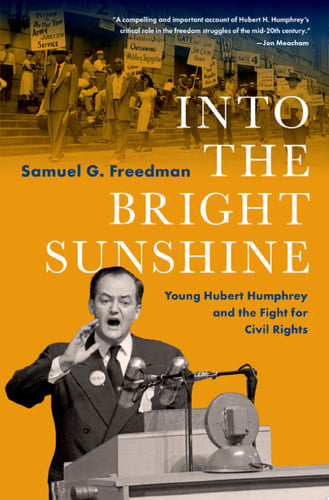
Into the bright sunshine: young Hubert Humphrey and the fight for civil rights
"Hubert Humphrey, a fallen hero and a dying man, rose on rickety legs to approach the podium of the Philadelphia Convention Hall, his pulpit for the commencement address at the University of Pennsylvania. He clutched a sheaf of paper with his speech for the occasion, typed and double-spaced by an assistant from his extemporaneous dictation, and then marked up in pencil by Humphrey himself. A note on the first page, circled to draw particular attention, read simply, "30 years ago--Here." In this place, at that time, twenty-nine years earlier to be precise, he had made history. From the dais now, Humphrey beheld five thousand impending graduates, an ebony sea of gowns and mortarboards, broken by one iconoclast in a homemade crown, two in ribboned bonnets, and another whose headgear bore the masking-tape message HI MA PA. In the horseshoe curve of the arena's double balcony loomed eight thousand parents and siblings, children, and friends. Wearing shirtsleeves and cotton shifts amid the stale heat, they looked like pale confetti from where Humphrey stood, and their flash cameras flickered away, a constellation of pinpricks"--
Peace for Palestine: first lost opportunity
"This is a work of genuine discovery that uses both the methods and sources of first-rate scholarship. It is a valuable addition to the 'new thinking' about the Middle East, [although] there are many who will refute its contribution without so much as a glance at its first page because it was written by Elmer Berger. The loss is theirs. Who will gain are those, like Berger himself, with an open mind and a willingness to become familiar with new perspectives on an ancient controversy."--From the Foreword by Don Peretz, professor of political science, SUNY-Binghamton At the outset of the 1949 armistice negotiations between Israel and its Arab neighbors, acting UN mediator Ralph Bunche expressed his hope that the talks would "chart the road to a peace for Palestine," an outcome apparently as elusive today as when he spoke those words more than forty years ago. Perhaps the most significant aspect of this meticulously documented analysis of those negotiations is its relevance for today's headlines. Relating the proposals and counterproposals, the conspiracies and power plays to present-day Israeli and Middle East policies, Berger suggests that the basic negotiating strategies of the main players have persisted almost unchanged into the present, a "near rigidity" that has defeated all efforts to achieve peace in the Middle East's central conflict. Berger is a controversial rabbi, an avowed anti-Zionist who proves himself capable of examining highly flammable issues and events with objectivity, insight, and rigorous scholarship. Drawing upon newly released material from official Israeli and U.S. archives, Berger manages to paint both the large picture and the telling detail--the frustrations of the conscientious and highly respected Bunche, the pathetically unprepared Arab negotiators, the well-informed Israeli diplomats, the intrigue of the Israel-Transjordan alliance. The work will serve serious observers of the prolonged conflict over Palestine as a guide to applicable international law and to the attitudes and negotiating policies of the countries involved. Elmer Berger has for twenty-five years been president of American Jewish Alternatives to Zionism, Inc., and has written and edited a number of books on Judaism and Jewish nationalism. At the outset of the 1949 armistice negotiations between Israel and its Arab neighbors, acting UN mediator Ralph Bunche expressed his hope that the talks would "chart the road to a peace for Palestine," an outcome apparently as elusive today as when he spoke those words more than forty years ago. Perhaps the most significant aspect of this meticulously documented analysis of those negotiations is its relevance for today's headlines. Relating the proposals and counterproposals, the conspiracies and power plays to present-day Israeli and Middle East policies, Berger suggests that the basic negotiating strategies of the main players have persisted almost unchanged into the present, a "near rigidity" that has defeated all efforts to achieve peace in the Middle East's central conflict. Berger is a controversial rabbi, an avowed anti-Zionist who proves himself capable of examining highly flammable issues and events with objectivity, insight, and rigorous scholarship. Drawing upon newly released material from official Israeli and U.S. archives, Berger manages to paint both the large picture and the telling detail--the frustrations of the conscientious and highly respected Bunche, the pathetically unprepared Arab negotiators, the well-informed Israeli diplomats, the intrigue of the Israel-Transjordan alliance. The work will serve serious observers of the prolonged conflict over Palestine as a guide to applicable international law and to the attitudes and negotiating policies of the countries involved. Elmer Berger has for twenty-five years been president of American Jewish Alternatives to Zionism, Inc., and has written and edited a number of books on Judaism and Jewish nationalism.
