7 results for "History"

The weekly standard: a reader, 1995-2005

William Kristol
Almost from the moment its inaugural issue appeared in September 1995, The Weekly Standard has been widely considered the nation's preeminent journal of political opinion and cultural commentary -- and the one magazine you've absolutely got to read if you want to keep up with American conservatism. Beyond reporting the events of the times, The Weekly Standard has played a central role in every major political drama of the past decade. In fact, so influential has it proved in Washington -- year in and year out, no matter which party controlled the White House -- that it's become a must-read for anyone who wants to understand American politics and society as a whole. Now, in The Weekly Standard: A Reader, editor William Kristol gathers together some of the very best articles and essays the magazine has published in its first decade. The dramas are here, of course: the "Republican Revolution" in Congress; Monica Lewinsky; the Florida recount of 2000; and, above all, 9/11 and the war on terrorism. And on hand to recount and reflect on them is The Weekly Standard's matchless, all-star stable of writers: Fred Barnes, David Brooks, Tucker Carlson, and P. J. O'Rourke, to name just a few. But there's always been much more to The Weekly Standard than just the week's news. So The Weekly Standard: A Reader is not merely an anthology of unsurpassed opinion journalism. Here readers will find an enormous treasury of timeless writing about dozens of subjects -- art, books, music, movies, you name it -- each handled with the same unique blend of insider savvy, reflective wisdom, and mordant wit that's earned The Weekly Standard an authoritative place in American public life.
HarperCollins 2005-09-06 538 pages

The age of Clinton: America in the 1990s

Troy, Gil
"The 1990s was a decade of extreme change. Shifts in culture, politics, and technology radically altered the way Americans did business, expressed themselves, and thought about their role in the world. At the center of it all was Bill Clinton, the charismatic and flawed baby boomer president, along with his polarizing but increasingly popular wife, Hillary. Although it was in many ways a Democratic Gilded Age, the 1990s was also a time of great anxiety. The Cold War was over. America was stable and prosperous. Yet Americans felt more unmoored and isolated. This was the era of glitz and grunge, when we relished living in the Republic of Everything even as we feared it might degenerate into the Republic of Nothing. Bill Clinton dominated this era, but his complex legacy has yet to be clearly defined. Historian Gil Troy examines Clinton's presidency alongside the decade's cultural changes. Taking the '90s year by year, Troy shows how the culture of the day shaped the Clintons even as the Clintons shaped it, offering answers to two enduring questions about Bill Clinton's legacy: How did such a talented politician leave Americans thinking he accomplished so little when he actually accomplished so much? And to what extent was Clinton responsible for the catastrophes of the following decade, specifically 9/11 and the collapse of the housing market? Even more relevant as we head toward the 2016 election, The Age of Clinton will appeal to readers on both sides of the aisle as it chronicles the wild, transformative decade and the president at its center"--
Thomas Dunne Books/St. Martin's Press 2015-10-06 368 pages

And nothing but the truth

Sekulow, Jay
In the 1960s a shadow of religious persecution fell across America. Public schools became as hostile to religion as their counterparts in Communist countries. Christians were stunned and dismayed. And this persecution increased for decades after that -- and continues even today. The government threatens intervention if workers display Bibles on their desks or mention their faith to coworkers. Local zoning committees deny churches protection against zoning laws that allow bars in their vicinity. Local governments ban films by Christians like James Dobson in public facilities. In And Nothing But the Truth you will learn how you can be a part of the new revolution of religious freedom sweeping our country. And you will discover what you can do to reclaim your community and your own rights.
T. Nelson Publishers 1996 276 pages

It's the stupidity, stupid: why (some) people hate Clinton and why the rest of us have to watch

Shearer, Harry
"In the aftermath of, shall we say, certain events, it seems almost cretinous to ask why some people hate the forty-second president of the United States. Bill Clinton let down his friends and followers and subordinates, caused no end of legal fees to many of them, and, more ominously, made it possible for William Bennett to unleash upon the public yet another bilious stream of self-righteous posturings. . . ." But there's more there than meets the eyewitness news. Now, in this shrewd, on-target, wickedly funny book, Harry Shearer unbuckles the Beltway to examine why, of all people, Bill Clinton has inspired such profound and persistent loathing in a sufficient number of Americans to propel his presidency to the "kinda like Nixon" section of the history books. Is it because our leader hides behind women's skirts? is seen as a traitor to his race by his southern compatriots? represents the immoral Woodstock generation to those who have fond memories of the depression? Shearer investigates every avenue (and back alley) and, along the way, debunks Hillary's vast right-wing conspiracy theory ("A conspiracy by its nature should be a fairly tightly controlled operation, like the Mafia or Scientology"), explores the animosity inspired by lawyers and journalists, and asks the question on everyone's lips: Is there any real difference between sucking a prostitute's toes and being a news analyst for Rupert Murdoch?
Ballantine Pub. Group 1999 104 pages

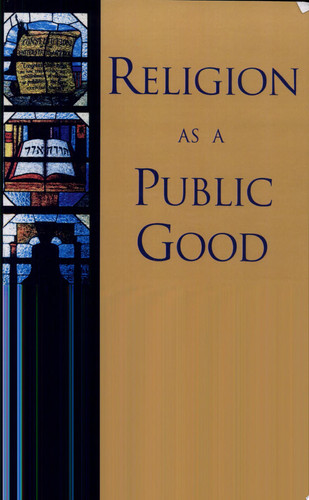
Religion as a public good: Jews and other Americans on religion in the public square

Alan Mittleman
Religion as a Public Good: Jews and Other Americans on Religion in the Public Square explores the often controversial topic of how religion ought to relate to American public life. The sixteen distinguished contributors, both Jewish and Christian, reflect on the topic out of their own disciplines-social ethics, political theory, philosophy, law, history, theology, and sociology. and take a stand based on their religious convictions and political beliefs. The volume is at once scholarly and committed, polemic and civil, reflective and activist. Written in the shadow of 9/11, it invites a new consideration of how religion enhances democratic public life with full awareness of the dangers that religion can sometimes pose. The volume is polemical, as befits the topic, but also civil, as befits a dialogue about an issue of profound significance for democratic citizenship.
Rowman & Littlefield 2003-12-09 336 pages