92 results for "History"

Too Big to Fail

Andrew Ross Sorkin
A brilliantly reported true-life thriller that goes behind the scenes of the financial crisis on Wall Street and in Washington. In one of the most gripping financial narratives in decades, Andrew Ross Sorkin-a New York Times columnist and one of the country's most respected financial reporters-delivers the first definitive blow- by-blow account of the epochal economic crisis that brought the world to the brink. Through unprecedented access to the players involved, he re-creates all the drama and turmoil of these turbulent days, revealing never-before-disclosed details and recounting how, motivated as often by ego and greed as by fear and self-preservation, the most powerful men and women in finance and politics decided the fate of the world's economy.
Viking 2009 352 pages

Working People Talk about what They Do All Day and how They Feel about what They Do

Studs Terkel
"When it was first published in 1974, Studs Terkel's oral history about "what people do all day and how they feel about it" became a best seller, was hailed as an instant classic, and eventually inspired a Broadway musical. Today, in this new edition with a foreword by the New York Times' Adam Cohen, it remains as relevant as ever: a masterpiece that reveals how "ordinary" Americans - that is, all of us - ceaselessly search for, but only sometimes find, satisfaction in our work."--Dust jacket back cover.
MJF Books 2004 589 pages

The great transformation: the political and economic origins of our time

Polanyi, Karl
"In this classic work of economic history and social theory, Karl Polanyi tracks the economic and social changes brought about by the "great transformation" of the Industrial Revolution. He pays particular attention to capitalism's rise and its role in fundamentally altering life after the Industrial Revolution. This seminal analysis explains not only the deficiencies of the self-regulating market, but the potentially dire social consequences of untempered market capitalism"-- Provided by publisher.
Beacon Press 2025-07-08 360 pages

America's bitter pill: money, politics, backroom deals, and the fight to fix our broken healthcare

Brill, Steven
NEW YORK TIMES BESTSELLER • A NEW YORK TIMES NOTABLE BOOK • “A tour de force . . . a comprehensive and suitably furious guide to the political landscape of American healthcare . . . persuasive, shocking.” — The New York Times America’s Bitter Pill is Steven Brill’s acclaimed book on how the Affordable Care Act, or Obamacare, was written, how it is being implemented, and, most important, how it is changing—and failing to change—the rampant abuses in the healthcare industry. It’s a fly-on-the-wall account of the titanic fight to pass a 961-page law aimed at fixing America’s largest, most dysfunctional industry. It’s a penetrating chronicle of how the profiteering that Brill first identified in his trailblazing Time magazine cover story continues, despite Obamacare. And it is the first complete, inside account of how President Obama persevered to push through the law, but then failed to deal with the staff incompetence and turf wars that crippled its implementation. But by chance America’s Bitter Pill ends up being much more—because as Brill was completing this book, he had to undergo urgent open-heart surgery. Thus, this also becomes the story of how one patient who thinks he knows everything about healthcare “policy” rethinks it from a hospital gurney—and combines that insight with his brilliant reporting. The result: a surprising new vision of how we can fix American healthcare so that it stops draining the bank accounts of our families and our businesses, and the federal treasury. Praise for America’s Bitter Pill “An energetic, picaresque, narrative explanation of much of what has happened in the last seven years of health policy . . . [Brill] has pulled off something extraordinary.” —The New York Times Book Review “A thunderous indictment of what Brill refers to as the ‘toxicity of our profiteer-dominated healthcare system.’ ” — Los Angeles Times “A sweeping and spirited new book [that] chronicles the surprisingly juicy tale of reform.” — The Daily Beast “One of the most important books of our time.” —Walter Isaacson “Superb . . . Brill has achieved the seemingly impossible—written an exciting book about the American health system.” — The New York Review of Books
Random House 2015-08-18 528 pages

How Soccer Explains the World

Foer, Franklin
“Step aside Tom Friedman, Sam Huntington, and Amy Chua. Franklin Foer’s dark and witty tale of the soccer world reveals the meaning of globalization in all its joys and horrors.”—Robert Kagan Just in time for the 2026 World Cup in North America—a reissue of the bestselling sports classic, featuring a new preface from the author. With the 2026 World Cup in all three nations of North America, the power and scope of soccer has truly become global. In this remarkably insightful, wide-ranging work, Franklin Foer argues that soccer is much more than a game, or even a way of life. It is a unique window into the crosscurrents of modern globalization, with all of its benefits and pitfalls. Soccer clubs don’t represent geographic areas; they stand for social classes and political ideologies. Unlike baseball or tennis, soccer is freighted with ancient hatreds and history. It’s a sport with real stakes—a catalyst capable of ruining regimes and launching liberation movements. Foer takes us on a surprising tour through the world of soccer, shattering myths and dire predictions. Instead of destroying local cultures, as the left warned, globalization has revived tribalism. Far from the triumph of capitalism that the right anticipated, it has entrenched corruption. From Brazil to Bosnia, Italy to Iraq, How Soccer Explains the World is an eye-opening chronicle of how a beautiful sport and its fanatical followers can illuminate the fault lines of a society, whether it’s terrorism, poverty, anti-Semitism, authoritarianism, or radical Islam—issues that continue to affect all of us. At a time when globalization is under attack and many Americans yearn for retrenchment and retreat from the world, this remarkable book—filled with blazing intelligence, colorful characters, wry humor, and an equal passion for soccer and humanity—continues to make sense of our troubled times.
HarperCollins Publishers LLC 2026-04-07 288 pages

The coming of post-industrial society: a venture in social forecasting

Bell, Daniel
In 1976, Daniel Bell€™s historical work predicted a vastly different society developing—one that will rely on the “economics of information€ rather than the “economics of goods.€ Bell argued that the new society would not displace the older one but rather overlie some of the previous layers just as the industrial society did not completely eradicate the agrarian sectors of our society. The post-industrial society€™s dimensions would include the spread of a knowledge class, the change from goods to services and the role of women. All of these would be dependent on the expansion of services in the economic sector and an increasing dependence on science as the means of innovating and organizing technological change.Bell prophetically stated in The Coming of the Post-Industrial Society that we should expect “ new premises and new powers, new constraints and new questions—with the difference that these are now on a scale that had
Basic Books 1973-07-12 507 pages

The three trillion dollar war: the true cost of the Iraq conflict

Stiglitz, Joseph E.
The true cost of the Iraq War is $3 trillion rather than the $50 billion projected by the White House. Apart from its tragic human toll, the Iraq War will be staggeringly expensive in financial terms. This sobering study by Nobel Prize winner Joseph E. Stiglitz and Harvard professor Linda J. Bilmes casts a spotlight on expense items that have been hidden from the U.S. taxpayer, including not only big-ticket items like replacing military equipment (being used up at six times the peacetime rate) but also the cost of caring for thousands of wounded veterans for the rest of their lives. Shifting to a global focus, the authors investigate the cost in lives and economic damage within Iraq and the region. Finally, with the chilling precision of an actuary, the authors measure what the U.S. taxpayer's money would have produced if instead it had been invested in the further growth of the U.S. economy. Written in language as simple as the details are disturbing, this book will forever change the way we think about the war.
W.W. Norton 2008-02-17 311 pages

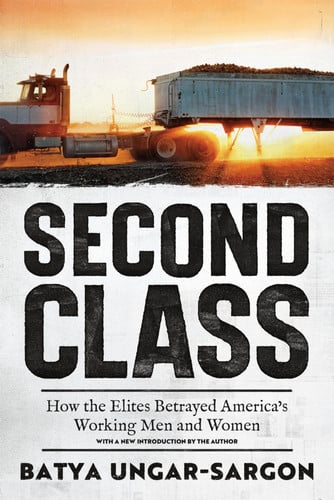
Second class: how the elite betrayed America's working men and women

Ungar-Sargon, Batya
A personal, journalistic ethnography of the modern American working class, based on the travels and interactions of the author through the American heartland. " Second Class is the most important book you will read all year. A political realignment is coming, and it's my hope that the end result will work in favor of our all-too-neglected American working class. When that realignment comes, Batya and her book will help lead the way." --Greg Lukianoff, CEO of the Foundation for Individual Rights in Education, and co-author of The Coddling of the American Mind Who is the American working class? Do they still have a fair shot at the American Dream? What do they think about their chances to secure the hallmarks of a middle-class life? While writing this book, Batya Ungar-Sargon visited states across the nation to speak with members of the American working class who are fighting tooth and nail to survive. In Second Class , working-class Americans of all races, political orientations, and occupations share their stories--cleaning ladies, health care aides, cops, truck drivers, fast food workers, electricians, and more. In their own words, these working-class Americans explain the struggles and triumphs of their increasingly precarious lives--as well as what policies they think would improve them. Second Class combines deep reporting with a look at the data and expert opinions on America's emergent class divide, in which the most basic elements of a secure and stable life are increasingly out of reach for those without a college education. America has broken its contract with its laboring class. So, how do we get back to the American Dream? How do we once again become the land of opportunity, the promised land, where hard work and commitment to family are enough to protect you from poverty? It's not that hard actually. All it would take, as this book illustrates, is for those in power to once again respect the dignity of work--and the American worker.
Encounter Books 2025 248 pages

Stone age economics

Sahlins, Marshall David
Stone Age Economics is a classic study of anthropological economics, first published in 1974. As Marshall Sahlins stated in the first edition, "It has been inspired by the possibility of 'anthropological economics,' a perspective indebted rather to the nature of the primitive economies than to the categories of a bourgeois science." Ambitiously tackling the nature of economic life and how to study it comparatively, the book includes six studies which reflect the author's ideas on revising traditional views of the hunter-gatherer and so-called primitive societies, revealing them to be the original affluent society. The book examines notions of production, distribution and exchange in early communities and examines the link between economics and cultural and social factors. It consists of a set of detailed and closely related studies of tribal economies, of domestic production for livelihood, and of the submission of domestic production to the material and political demands of society at large. Marshall Sahlins is one of the most prominent American anthropologists of our time. He holds the title of Charles F. Grey Distinguished Service Professor of Anthropology at the University of Chicago. His most recent book is How Natives Think: About Captain Cook, for Example.
Transaction Publishers 2011 348 pages

The spirit of green: the economics of collisions and contagions in a crowded world

Nordhaus, William D.
"From a Nobel Prize-winning pioneer in environmental economics, an innovative account of how and why "green thinking" could cure many of the world's most serious problems-from global warming to pandemics Solving the world's biggest problems-from climate catastrophe and pandemics to wildfires and corporate malfeasance-requires, more than anything else, coming up with new ways to manage the powerful interactions that surround us. For carbon emissions and other environmental damage, this means ensuring that those responsible pay their full costs rather than continuing to pass them along to others, including future generations. In The Spirit of Green, Nobel Prize-winning economist William Nordhaus describes a new way of green thinking that would help us overcome our biggest challenges without sacrificing economic prosperity, in large part by accounting for the spillover costs of economic collisions. In a discussion that ranges from the history of the environmental movement to the Green New Deal, Nordhaus explains how the spirit of green thinking provides a compelling and hopeful new perspective on modern life. At the heart of green thinking is a recognition that the globalized world is shaped not by isolated individuals but rather by innumerable interactions inside and outside the economy. He shows how rethinking economic efficiency, sustainability, politics, profits, taxes, individual ethics, corporate social responsibility, finance, and more would improve the effectiveness and equity of our society. And he offers specific solutions-on how to price carbon, how to pursue low-carbon technologies, how to design an efficient tax system, and how to foster international cooperation through climate clubs. The result is a groundbreaking new vision of how we can have our environment and our economy too"--
Princeton University Press 2021-05-18 355 pages

The Idealist Jeffrey Sachs and the Quest to End Poverty

Nina Munk
A powerful portrayal of Jeffrey Sachs's ambitious quest to end extreme global poverty, now a Signal paperback. "The poor you will always have with you," according to Matthew 26:11. But Jeffrey Sachs, economics superstar, special advisor to the Secretary General of the UN and the author of The End of Poverty , vehemently disagrees. In his view, poverty -- especially the extreme deprivation of sub-Saharan Africa -- can easily be eradicated. The vast sums spent in foreign aid over the decades has not come close to alleviating the dire subsistence problems of Africans. Sachs believed he knew the reason: the developed world simply hadn't spent enough. In 2006, Sachs, backed by tens of millions of donor dollars, launched the five-year Millennium Villages Project. Sachs would test his theories in villages in different African countries, then, with each success, scale up until until the program was continent-wide. His first village "make-over" was a small community in Sauri, Kenya, and the immediate effect was encouraging. With that first inkling of success achieved, Sachs rolled out a dozen model Millennium villages in ten countries. For the past six years, Nina Munk has reported deeply on the Project, following Sachs on official trips and listening in on conversations with heads of states, rival organisations and potential donors. And she has immersed herself in the lives of people in two of the remote villages: Ruhiira, in southwest Uganda, and Dertu, in the arid borderland between Kenya and Somalia. Accepting hospitality from these camel herders and smallhold farmers, and sharing in their struggles, Munk came to understand the on-the-ground issues challenging Sachs' one-size-fits-all approach to global poverty. The Idealist is the profound and moving story of what happened when the abstract theories of a brilliant, driven man met messy human reality.
McClelland & Stewart 2014-10-07 288 pages

John Maynard Keynes

Minsky, Hyman P.
â Today, Mr. Minsky's view [of economics] is more relevant than ever.â - The New York Times â Indeed, the Minsky moment has become a fashionable catch phrase on Wall Street.â -The Wall Street Journal John Maynard Keynes offers a timely reconsideration of the work of the revered economics icon. Hyman Minsky argues that what most economists consider Keynesian economics is at odds with the major points of Keynes's The General Theory of Employment, Interest, and Money. Keynes and Minsky refuse to ignore pervasive uncertainty. Once uncertainty is given center stage, recurring episodes of financial system crises are all but inescapable. As Robert Barbera notes in a new preface, â Benign economic circumstancesâ ¦invite increasingly aggressive financial market wagers. Innovation in finance is a signature development in a capitalist economy. Once leveraged wagers are in place, small disappointments can have exaggerated consequences.â Thus for Minsky economic calm on Main Street engenders financial system fragility which, in turn, ensures a perpetuation of boom and bust cycles. Minsky colleagues Dimitri B. Papadimitriou and L. Randall Wray write in a new introduction, â We offer this new edition, in the hope that it will contribute to the reformation of economic theory so that it can address the world in which we actually live-the world that was always the topic of Minsky's analysis.â
Columbia University Press 1975 181 pages

In an uncertain world: tough choices from Wall Street to Washington

Rubin, Robert Edward
Publisher's description: Robert Rubin was sworn in as the seventieth U.S. Secretary of the Treasury in January 1995 in a brisk ceremony attended only by his wife and a few colleagues. As soon as the ceremony was over, he began an emergency meeting with President Bill Clinton on the financial crisis in Mexico. This was not only a harbinger of things to come during what would prove to be a rocky period in the global economy; it also captured the essence of Rubin himself--short on formality, quick to get into the nitty-gritty. From his early years in the storied arbitrage department at Goldman Sachs to his current position as chairman of the executive committee of Citigroup, Robert Rubin has been a major figure at the center of the American financial system. He was a key player in the longest economic expansion in U.S. history.
Random House 2003 427 pages

MASTERING THE BASICS OF BITCOIN AND CRYPTO: GO FROM CRYPTO CURIOUS TO CRYPTO COMPETENT WITH JUST ONE BOOK

Shrem, Charlie,Kimelman, Michael
Whether you are brand spanking new to bitcoin and crypto or already understand the basics and want to expand your knowledge, this is the book for you! “Mastering the Basics” is a one-stop guide to help you immediately go from “crypto curious” to “crypto competent.” We know how confusing bitcoin and crypto looks to the uninitiated. The potential is massive and world-changing, but it's intimidating and you don't know where to start. That’s why we wrote this step-by-step guide in simple, plain-English terms that anyone can grasp. After completing this book, you will have a comprehensive working knowledge of the concepts and technologies that make digital assets possible. We’ll take away the mystery and empower you with the knowledge and ability to understand bitcoin and profitably buy, sell, secure, and trade cryptos with ease. This is incredibly valuable knowledge taught by two of the most respected experts in the space with over a decade long track record of success. With one book you can equip yourself with the expertise that only a tiny fraction of people alive today possess. There’s no time like the present to get started and get savvy about the greatest opportunity in history for financial success and personal freedom. It starts here. It starts today. What are you waiting for?
Independently published 2022-06-19 191 pages

Minds wide shut: how the new fundamentalisms divide us

Morson, Gary Saul,Schapiro, Morton Owen
A timely exploration of intellectual dogmatism in politics, economics, religion, and literature—and what can be done to fight it Polarization may be pushing democracy to the breaking point. But few have explored the larger, interconnected forces that have set the stage for this crisis: namely, a rise in styles of thought, across a range of fields, that literary scholar Gary Saul Morson and economist Morton Schapiro call “fundamentalist.” In Minds Wide Shut , Morson and Schapiro examine how rigid adherence to ideological thinking has altered politics, economics, religion, and literature in ways that are mutually reinforcing and antithetical to the open-mindedness and readiness to compromise that animate democracy. In response, they propose alternatives that would again make serious dialogue possible. Fundamentalist thinking, Morson and Schapiro argue, is not limited to any one camp. It flourishes across the political spectrum, giving rise to dueling monologues of shouting and abuse between those who are certain that they can’t be wrong, that truth and justice are all on their side, and that there is nothing to learn from their opponents, who must be evil or deluded. But things don’t have to be this way. Drawing on thinkers and writers from across the humanities and social sciences, Morson and Schapiro show how we might begin to return to meaningful dialogue through case-based reasoning, objective analyses, lessons drawn from literature, and more. The result is a powerful invitation to leave behind simplification, rigidity, and extremism—and to move toward a future of greater open-mindedness, moderation, and, perhaps, even wisdom.
Princeton University Press 2023-01-31 307 pages