34 results for "History"

I survived the battle of D-Day, 1944

Tarshis, Lauren
"It was a battle that would change the course of World War II ... Eleven-year-old Paul's French village has been under Nazi control for years. His Jewish best friend has disappeared. Food is scarce. And there doesn't seem to be anything Paul can do to make things better. Then Paul finds an American paratrooper in a tree near his home. The soldier says the Allies have a plan to crush the Nazis once and for all, but the soldier needs Paul's help. This is Paul's chance to make a difference. Soon he finds himself in the midst of the largest invasion in history. Can he do his part to turn horror into hope?"--Back cover
Thorndike Press, a part of Gale, a Cengage Company 2020-02 185 pages

Allies

Gratz, Alan
"A rousing and humane tribute to D-Day troops" -New York Times Book Review From Alan Gratz, the highly acclaimed, New York Times bestselling author of the blockbuster Refugee, comes another thrilling multi-perspective novel, this time centered around D-Day. D-Day, June 6, 1944: the most expansive military endeavor in history. No less than world cooperation would bring down Hitler and the Axis powers. And so people -- and kids -- across the globe lent their part. From the young US soldiers in the boats to spies in the French countryside, the coordination of thousands came together. Alan Gratz, author of the New York Times bestselling Refugee, explores the necessity of teamwork and heroism in dismantling tyranny in this epic, yet personal, look at D-Day in time for the 75th anniversary of the operation. PRAISE FOR ALLIES "Both an excellent, inclusive narration of important historical events and a fast-paced, entertaining read." - Kirkus "A tautly paced and multifaceted portrait of the D-Day invasion."- Publishers Weekly "The stories and characters are meticulously researched, honest, and do not avoid the horror of the invasion. As well, despite the historical time setting, the issues the characters face are still timely." - School Library Journal "Gratz manages to provide distinct, complex personalities and a nail-biting plot."- BCCB "This excellent resource will allow teachers to collaborate across both the language arts and history curriculum due to its meditative look at the global scope, outcome, and human costs of war. Highly recommended."- School Library Connection
Scholastic 2019 322 pages

Clouds of glory: the life and legend of Robert E. Lee

Korda, Michael
"Portrait of Lee as a brilliant general, a devoted family man, and principled gentleman who disliked slavery and disagreed with secession, yet who refused command of the Union Army in 1861 because he could not "draw his sword" against his beloved Virginia. Well-rounded and realistic, Clouds of Glory analyzes Lee's command during the Civil War and explores his responsibility for the fatal stalemate at Antietam, his defeat at Gettysburg (as well the many troubling controversies still surrounding it) and ultimately, his failed strategy for winning the war. As Korda shows, Lee's dignity, courage, leadership, and modesty made him a hero on both sides of the Mason-Dixon Line and a revered American icon who is recognized today as the nation's preeminent military leader" --
Harper 2014-05-13 785 pages

Killing Rommel

Pressfield, Steven
An unputdownable and incredibly evocative military novel full of thrilling battle scenes and flesh and blood characters from Steven Pressfield, author of The Sunday Times Bestseller Gates of Fire. \"A terrific read...this is historical fiction at its very best.\" -- JAMES HOLLAND \"A splendid tour-de-force...it should not be missed\" -- WASHINGTON POST \"Both a captivating history lesson and rousing guts-n-glory saga\" -- ENTERTAINMENT WEEKLY \"Compelling...the narrative is a page turner\" -- ***** Reader review \"Mr Pressfield is a true craftsman in the best possible way. You LIVE the story while he is telling it\" -- ***** Reader review \"Simply a brilliant read\" -- ***** Reader review **************************************************** NORTH AFRICA, 1942. AN ELITE BRITISH ARMY UNIT IS ON A DEADLY MISSION. Autumn, 1942 - Hitler's legions have swept across Europe. Soviet Russia reels under the German onslaught while across the channel, Britain struggles on. And in North Africa , Field Marshall Erwin Rommel and his Afrika Korps have routed the 8th Army, threatening the oil fields of the Middle East. The war hangs in the balance... Out of this, the British hatch a desperate plan - to send a small, highly mobile fighting force behind enemy lines to strike a blow that will stop Rommel's army in its tracks. It is to be called the Long Range Desert Group and its exploits will become the stuff of legend. Based on real events, Steven Pressfield's bold novel brings to pulse-racing life the ingenuity and daring of this maverick commando unit - a disparate, dedicated 'band of brothers' who sacrificed so much for the sake of freedom...
Bantam 2009 410 pages

Alone: Britain, Churchill, and Dunkirk : defeat into victory

Korda, Michael
"Combining epic history with rich family stories, Michael Korda chronicles the outbreak of World War II and the great events that led to Dunkirk. In an absorbing work peopled with world leaders, generals, and ordinary citizens who fought on both sides of World War II, Alone brings to resounding life perhaps the most critical year of twentieth-century history. For, indeed, May 1940 was a month like no other, as the German war machine blazed into France while the supposedly impregnable Maginot Line crumbled, and Winston Churchill replaced Neville Chamberlain as prime minister in an astonishing political drama as Britain, isolated and alone, faced a triumphant Nazi Germany. Against this vast historical canvas, Michael Korda relates what happened and why, and also tells his own story, that of a six-year-old boy in a glamorous movie family who would himself be evacuated. Alone is a work that seamlessly weaves a family memoir into an unforgettable account of a political and military disaster redeemed by the evacuation of more than 300,000 men in four days--surely one of the most heroic episodes of the war. "The incredible, almost miraculous story of what happened at Dunkirk in the year 1940--and why--is unfolded in Alone with great narrative skill and superb delineation of a highly interesting cast of characters, including, importantly, the author himself and his own remarkable family." -- David McCullough
Liveright Publishing Corporation, a division of W. W. Norton & Company 2017-09-19 525 pages

Patton: legendary commander

Blumenson, Martin
Shortly after World War II, when the Allies interrogated Field Marshal Gerd von Rundstedt, the senior commander who opposed the Allied invasion of France, they asked him to rate the skills of his opponents. He is reputed to have said, "Patton, he was your best." Praise for his performance was precisely what George Smith Patton, Jr., had sought all his life. As a cadet at the Virginia Military Institute and West Point, he was already searching for what he called "the undefinable difference" that distinguished a great general from the good ones. He led a mechanized attack in Mexico and a tank battalion during World War I. In World War II he turned American fortunes around in North Africa, chased the Germans out of Sicily, and sparked the breakout and liberation of France. When the Germans attacked the American First Army in the Battle of the Bulge, Patton turned his army north and smashed the German salient. He then drove into the heart of Germany and reached Czechoslovakia by war's end. Brilliant yet flawed, Patton's leadership style drove himself and his men to acts of bravery and victory. Half uncouth, provincial cowboy and half cultured sophisticate, the man behind the warrior mask was a complex and paradoxical person. He became an icon of the American military leader and the uncompromising individual.
Potomac Books 2008 117 pages

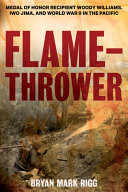
Flamethrower: Medal of Honor recipient Woody Williams, Iwo Jima, and World War II in the Pacific

Rigg, Bryan Mark
"Imagine strapping on a highly flammable 70-pound pack and entering combat as a surefire walking target-and you'd only begin to understand the job, and the horror, of Marine Corps flamethrower man. That's precisely what Hershel "Woody" Williams did in World War II, most importantly in February 1945 on Iwo Jima, one of the Pacific War's toughest battles. A few days into the battle, Marines were fighting hard for an airfield, and his captain asked Woody if he could do anything. He responded, "I'll try"-and for the next four hours, he virtually singlehandedly took on and ultimately destroyed seven enemy pillboxes and helped secure the airfield. Accomplished military historian Bryan Mark Rigg reconstructs Williams' remarkable story, from his youth in West Virginia to his experiences on Guadalcanal, Saipan, Guam, and most significantly Iwo Jima. In Rigg's telling, Williams's Medal of Honor action is not "just" a brave deed, but one of only a few strategically significant brave deeds-one that secured a strategic objective during a major campaign. Rigg tells Williams' story vividly, and objectively, and places it in the context of the broader Pacific theater of World War II."--
Stackpole Books 2020 544 pages

Somme: into the breach

Sebag-Montefiore, Hugh
The notion of battles as the irreducible building blocks of war demands a single verdict of each campaign--victory, defeat, stalemate. But this kind of accounting leaves no room to record the nuances and twists of actual conflict. In Somme: Into the Breach, the noted military historian Hugh Sebag-Montefiore shows that by turning our focus to stories of the front line--to acts of heroism and moments of both terror and triumph--we can counter, and even change, familiar narratives. Planned as a decisive strike but fought as a bloody battle of attrition, the Battle of the Somme claimed over a million dead or wounded in months of fighting that have long epitomized the tragedy and folly of World War I. Yet by focusing on the first-hand experiences and personal stories of both Allied and enemy soldiers, Hugh Sebag-Montefiore defies the customary framing of incompetent generals and senseless slaughter. In its place, eyewitness accounts relive scenes of extraordinary courage and sacrifice, as soldiers ordered "over the top" ventured into No Man's Land and enemy trenches, where they met a hail of machine-gun fire, thickets of barbed wire, and exploding shells. Rescuing from history the many forgotten heroes whose bravery has been overlooked, and giving voice to their bereaved relatives at home, Hugh Sebag-Montefiore reveals the Somme campaign in all its glory as well as its misery, helping us to realize that there are many meaningful ways to define a battle when seen through the eyes of those who lived it.--
The Belknap Press of Harvard University Press 2016-08-15 607 pages

The duel for France, 1944: the men and battles that changed the fate of Europe

Blumenson, Martin
For the Allies, D day was only the beginning. Having succeeded in that epic venture, they faced the prospect of moving beyond the beaches of France.For the Germans who had failed to halt the Allies at the water's edge, the question was how to stop the enemy from further advance before it was too late.Martin Blumenson never forgets that the Allies' spectacular dash from their Normandy beachhead to the German border in the summer of 1944 was accomplished by men of flesh and blood—and led by officers with human doubts, limitations, and determination. He shows us how war is conducted, makes us share the pressures and responsibilities of the commanders, and unforgettably opens us to the hopes and fears of the men who constantly faced the imminence of death. Here are the familiar figures, but revealed in new perspective—Eisenhower, Montgomery, Bradley, Patton, Rommel. This is a masterly and dramatic military narrative in the great tradition—and a moving human record of a turning point in history.
Da Capo Press 2000-06-30 432 pages

Lincoln's generals

Gabor S. Boritt
From the moment the battle ended, Gettysburg was hailed as one of the greatest triumphs of the Union army. Celebrations erupted across the North as a grateful people cheered the victory. But Gabor Boritt turns our attention away from the rejoicing millions to the dark mood of the White House--where Lincoln cried in frustration as General Meade let the largest Confederate army escape safely into Virginia. Such unexpected portraits abound in Lincoln's Generals, as a team of distinguished historians probes beyond the popular anecdotes and conventional wisdom to offer a fascinating look at Lincoln's relationship with his commanders. In Lincoln's Generals, Boritt and his fellow contributors examine the interaction between the president and five key generals: McClellan, Hooker, Meade, Sherman, and Grant. In each chapter, the authors provide new insight into this mixed bag of officers and the president's tireless efforts to work with them. Even Lincoln's choice of generals was not as ill-starred as we think, writes Pulitzer Prize-winner Mark E. Neely, Jr.: compared to most Victorian-era heads of state, he had a fine record of selecting commanders (for example, the contemporary British gave us such bywords for incompetence as "the charge of the Light Brigade," while Napoleon III managed to lose the entire French army). But the president's relationship with his generals was never easy. In these pages, Stephen Sears underscores McClellan's perverse obstinancy as Lincoln tried everything to drive him ahead. Neely sheds new light on the president's relationship with Hooker, arguing that he was wrong to push the general to attack at Chancellorsville. Boritt writes about Lincoln's prickly relationship with the victor of Gettysburg, "old snapping turtle" George Meade. Michael Fellman reveals the political stress between the White House and William T. Sherman, a staunch conservative who did not want blacks in his army but who was crucial to the war effort. And John Y. Simon looks past the legendary camaraderie between Lincoln and Grant to reveal the tensions in their relationship. Perhaps no other episode has been more pivotal in the nation's history than the Civil War--and yet so much of these massive events turned on a few distinctive personalities. Lincoln's Generals is a brilliant portrait that takes us inside the individual relationships that shaped the course of our most costly war.
Oxford University Press 1994 248 pages

1920 diary

Babelʹ, I.
The Russian writer Isaac Babel (1894-1940) is widely acknowledged to be one of the great masters of twentieth-century literature, hailed as a genius by such critics as Lionel Trilling and Irving Howe. The work for which he is best known is a cycle of stories called Red Cavalry, which depicts the exploits of the Cossack cavalry during the Polish-Soviet war of 1919-1920 and is based on Babel's experiences as he rode with the Cossacks during the campaign. Throughout this period Babel kept a diary, in which he recorded the devastation of the war, the extreme cruelty of the Polish and Red armies alike toward the Jewish population in Ukraine and eastern Poland, and his own conflicted role as both Soviet revolutionary and Jew. The 1920 Diary, a vital source for Red Cavalry as well as a compelling narrative, is now published in English for the first time
Yale University Press 1995 126 pages

Leaders in war: West Point remembers the 1991 Gulf War

Frederick W. Kagan,Christian Kubik
Leaders in War present unique first-person perspectives across the spectrum of American combat operations during the 1991 Persian Gulf War. From division commanders to platoon leaders, the authors deliver an insider's view of tough leadership challenges, tragic failures, and triumphant victories. Leaders in War captures the essence of the post-Cold War US Army: how an all-volunteer army, equipped with new weapons systems and adjusting to new battle doctrine, mounted one of history's most successful military campaigns. Described here are the details of the tremendous logistical challenges, innovations in intelligence, ground combat operations from platoon to division, and a wide range of combat support operations. Leaders in War focuses not just on the successes, but on the failures as well, in operations ranging from violent tank battles against the vaunted Iraqi Republican Guard to train-and-fill operations thousands of miles away. Leaders in War illustrates how US Army leaders adapted to the psychological strains of combat, the fog of war, unforeseeable challenges, and the fury of tank warfare during the Persian Gulf War.
Frank Cass 2005 200 pages

Jefferson Davis's generals

G. S. Boritt
Confederate General P.G.T.Beauregard once wrote that ""no people ever warred for independence with more relative advantages than the Confederates."" If there was any doubt as to what Beauregard sought to imply, he later to chose to spell it out: the failure of the Confederacy lay with the Confederate president Jefferson Davis. In Jefferson Davis's Generals, a team of America's most distinguished Civil War historians present fascinating examinations of the men who led the South through the nation's bloodiest conflict, focusing in particular on Jefferson Davis's relationships with five key ge
Oxford University Press 2000 217 pages

The Eagle and the Rising Sun: the Japanese-American war, 1941-1943, Pearl Harbor through Guadalcanal

Schom, Alan
On Saturday, August 2, 1941, the Washington Post reported that President Franklin D. Roosevelt would depart the next day for a fishing vacation aboard his yacht, Potomac. By the morning of August 5, the Potomac was sailing toward the fishing waters off Cape Cod -- but the president was not on board. Having quietly disembarked in the middle of the night, the president, now joined by his top military advisors, was headed for Newfoundland, where the U.S. and British governments would meet in a secret summit to coordinate their military efforts, although the United States had yet to declare war on Germany. The British were appalled at the state of American preparedness, one British colonel remarking, "They have a long way to go before they can play any decisive part in the war." But ready or not, the United States would be catapulted into World War II within a matter of months. Alan Schom's superb histories and biographies have been lauded for their dramatic sweep, their focus on extraordinary personalities, and their refreshingly iconoclastic perspective. Schom begins this magisterial account of World War II in the Pacific by demonstrating an ironic paradox: on one hand, the American government and people were as inadequately prepared for war as any major power ever has been; on the other, the Japanese high command plunged headlong into the Pacific campaign despite clear evidence -- from their own analysts -- that Japan had too little oil and too feeble an economy to prevail against the United States. It was a war that should not have been fought. Schom recounts a tense saga of diplomatic maneuvering, strategic blunders, and pivotal successes played out in the halls of the White House, Downing Street, and the Imperial Palace, as well as on the seas and shores of the Pacific. Key figures in the war come vividly to life in a series of brilliant biographical sketches: Emperor Hirohito, a devotee of Western pursuits such as golf and jazz, who hungered to expand Japan's global reach; the destructively egotistical General Douglas MacArthur, whose splendid achievements in World War I stood in stark contrast to his incompetent leadership in the Philippines; Rear Admiral Kelly Turner, whose realism and tactical savvy played a crucial role in turning the tide of the war; and the cool-headed Admiral Tanaka Raizo, who repeatedly slipped through the Allied net, transporting troops and supplies to and from Guadalcanal. The Eagle and the Rising Sun embraces the broad strategic concerns of the war and the telling details and turning points of individual engagements. As Rear Admiral Thomas Marfiak, Ret., CEO and publisher of the U.S. Naval Institute, writes in the Foreword: "From time to time, we are privileged to be given extraordinary insights into the history of our age. Alan Schom has given us a tapestry, into which he has woven figures of immense proportions, yet he has not lost sight of their humanity. He writes ... in the grand tradition of Barbara Tuchman's The Guns of August." Book jacket.
W.W. Norton 2004 540 pages

World War II writings

Liebling, A. J.
One of the most gifted and influential American journalists of the 20th century, A. J. Liebling spent five years reporting the dramatic events and myriad individual stories of World War II. As a correspondent for The New Yorker, Liebling wrote with a passionate commitment to Allied victory, an unfailing attention to telling details, and an appreciation for the literary challenges presented by the discursive, centrifugal, both repetitive and disparate nature of war. This volume brings together three books along with 26 uncollected New Yorker pieces and two excerpts from The Republic of Silence (1947), Liebling's collection of writing from the French Resistance. The Road Back to Paris (1944) narrates Liebling's experiences from September 1939 to March 1943, including his shock at the fall of France and dismay at isolationist indifference in the United States; it contains classic accounts of a winter voyage on a Norwegian tanker during the Battle of the Atlantic, visits to front-line airfields in North Africa, and the defeat of a veteran panzer division by American troops in Tunisia. Mollie and Other War Pieces (1964) brings together Liebling's portrait of a legendary nonconformist American soldier in North Africa with his eyewitness account of Omaha Beach on D-Day, evocative reports from Normandy, and investigation of a German atrocity in rural France. In Normandy Revisited (1958) Liebling writes about his return to France in 1955 and recalls the joyous liberation of his beloved Paris while exploring with bittersweet perception how wartime experience is transformed into memory. The selection of uncollected New Yorker pieces includes a profile of an RAF ace, surveys of the French underground press, and an encounter with a captured collaborator in Brittany, as well as postwar reflections on battle fatigue, Ernie Pyle, and the writing of military history. With maps and chronology. LIBRARY OF AMERICA is an independent nonprofit cultural organization founded in 1979 to preserve our nation’s literary heritage by publishing, and keeping permanently in print, America’s best and most significant writing. The Library of America series includes more than 300 volumes to date, authoritative editions that average 1,000 pages in length, feature cloth covers, sewn bindings, and ribbon markers, and are printed on premium acid-free paper that will last for centuries.
Library of America 2008-02-28 1089 pages