31 results for "History"

The children of Willesden Lane: beyond the kindertransport: a memoir of music, love, and survival

Golabek, Mona
This inspiring true story of how classical music saved a young girl's life during World War II is a book for history and music lovers and the perfect choice for book clubs. Mona Golabek tells the tale of her mother Lisa Jura Golabek's escape from Nazi-controlled Austria to England on the infamous Kindertransport. Jewish musical prodigy Lisa Jura has a wonderful life in Vienna. But when the Nazis start closing in on the city, life changes irreversibly. Although he has three daughters, Lisa's father is able to secure only one berth on the Kindertransport. The family decides to send Lisa to London so that she may pursue her dreams of a career as a concert pianist. Separated from her beloved family, Lisa bravely endures the trip and a disastrous posting outside London before finding her way to the Willesden Lane Orphanage. Her music inspires the other orphanage children, and they, in turn, cheer her on in her efforts to make good on her promise to her family to realize her musical potential. Through hard work and sheer pluck, Lisa wins a scholarship to study piano at the Royal Academy. As she supports herself and studies, she makes a new life for herself and dreams of reconnecting with the family she was forced to leave behind. The resulting tale delivers a message of the power of music to uplift the human spirit and to grant the individual soul endurance, patience, and peace. *Includes a reading group guide*
Warner 2004 272 pages

Boy alone: a sibling journey through autism

Greenfeld, Karl Taro
Karl Taro Greenfeld knew from an early age that his little brother, Noah, was not like other children. He couldn't crawl, and he had trouble making eye contact or interacting with his family. As Noah grew older, his differences became even more pronounced—he was unable to communicate verbally, use the toilet, or tie his shoes, and despite his angelic demeanor, he often had violent outbursts. No doctor, social worker, or specialist could pinpoint what was wrong with Noah beyond a general diagnosis: autism. The boys' parents, Josh and Foumi, dedicated their lives to caring for their younger son with myriad approaches—a challenging, often painful experience that the devoted father detailed in a bestselling trilogy of books. Now, for the first time, acclaimed journalist Karl Taro Greenfeld speaks out about growing up in the shadow of his autistic brother, revealing the complex mix of rage, confusion, and love that defined his childhood. Boy Alone is his brutally honest memoir of the hopes, dreams, and realities of life with a mentally disabled sibling. Seamlessly weaving together the social history of autism and autism research—as the Greenfelds lived through it in seeking treatment for Noah—with the deeply affecting story of two very different boys growing up side by side, this book raises crucial philosophical questions: Can relationships exist without language? How should aging parents care for a nonverbal, violent child, and then a grown man who is not self-sufficient? Is there anything that can be done to help an extremely autistic child or adult become a member of mainstream society? Haunting, tragic, and unforgettable, this chronicle of autism is a beautiful, wholly original exploration of what it means to be a family, a brother, and a person.
HarperCollins 2009-05-12 355 pages

My Cubs: a love story

Simon, Scott
"NPR's Scott Simon's personal, heartfelt reflections on his beloved Chicago Cubs, replete with club lore, memorable anecdotes, frenetic fandom and wise and adoring intimacy that have made the world champion Cubbies baseball's most tortured--and now triumphant--franchise. No metaphor is necessary; the Chicago Cubs have been the living example of disappointment and failure for more than a century--until now. The Cubs' 2016 World Series win marked the end of a 108-year drought in the team's history, and Game 7 will forever be remembered as one of the most thrilling, monumental moments in sports history. For Scott Simon, host of NPR's Weekend Edition Saturday and a lifelong Cubs fan, it was a moment he never thought he'd live to see. MY CUBS chronicles Simon's adolescence in Chicago as a die-hard fan to tell the story of the relationship between the team and the neighborhood and city, and how the condition of Cubness has both charmed and haunted the lives of so many fans. From theories and curses to jinxes and myths, Simon chronicles how a team of "loveable losers" inspired such fervor and dedication from their fans, and how their 2016 win transcended sports to become an underdog narrative for the whole nation"--
Blue Rider Press 2017 145 pages

Alone: Britain, Churchill, and Dunkirk : defeat into victory

Korda, Michael
"Combining epic history with rich family stories, Michael Korda chronicles the outbreak of World War II and the great events that led to Dunkirk. In an absorbing work peopled with world leaders, generals, and ordinary citizens who fought on both sides of World War II, Alone brings to resounding life perhaps the most critical year of twentieth-century history. For, indeed, May 1940 was a month like no other, as the German war machine blazed into France while the supposedly impregnable Maginot Line crumbled, and Winston Churchill replaced Neville Chamberlain as prime minister in an astonishing political drama as Britain, isolated and alone, faced a triumphant Nazi Germany. Against this vast historical canvas, Michael Korda relates what happened and why, and also tells his own story, that of a six-year-old boy in a glamorous movie family who would himself be evacuated. Alone is a work that seamlessly weaves a family memoir into an unforgettable account of a political and military disaster redeemed by the evacuation of more than 300,000 men in four days--surely one of the most heroic episodes of the war. "The incredible, almost miraculous story of what happened at Dunkirk in the year 1940--and why--is unfolded in Alone with great narrative skill and superb delineation of a highly interesting cast of characters, including, importantly, the author himself and his own remarkable family." -- David McCullough
Liveright Publishing Corporation, a division of W. W. Norton & Company 2017-09-19 525 pages

Hitler, my neighbor: memories of a Jewish childhood

Feuchtwanger, E. J.
"An eminent historian recounts the Nazi rise to power from his unique perspective as a young Jewish boy in Munich, living with Adolf Hitler as his neighbor. Watching events unfold from his window, Edgar bore witness to the Night of the Long Knives, the Anschluss, and Kristallnacht. Jews were arrested; his father was imprisoned at Dachau. In 1939 Edgar was sent on his own to England, where he would make a new life, a career, have a family, and strive to forget the nightmare of his past--a past that came rushing back when he decided, at the age of eighty-eight, to tell the story of his buried childhood and his infamous neighbor"--Provided by publisher.
Other Press 2017-11-07 209 pages

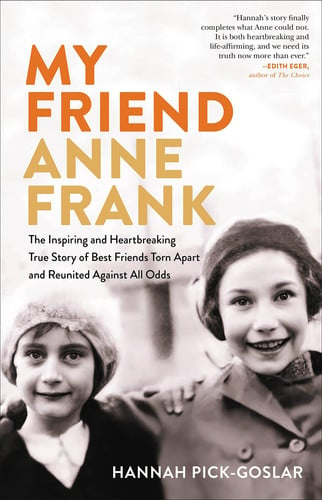
My friend Anne Frank: the inspiring and heartbreaking true story of best friends torn apart and reunited against all odds

Pick-Goslar, Hannah,Kraft, Dina
"In 1933, Hannah Pick-Goslar and her family fled Nazi Germany to live in Amsterdam, where she struck up a close friendship with her next-door neighbor, an outspoken and fun-loving young girl named Anne Frank. For several years, the inseparable pair enjoyed a carefree childhood of games, sleepovers, and treats with the other children in their neighborhood of Rivierenbuurt. But in 1942, Hannah and Anne's lives abruptly changed forever. As the Nazi occupation of Amsterdam progressed, Anne and the Frank family seemingly vanished, leaving behind unmade beds and dishes in the sink--but no trace of Anne's precious diary. Torn from her dear friend without warning, Hannah spent the next two years tormented by questions about Anne's fate, wondering if she had, by some miracle, managed to escape danger. In this long-awaited memoir, Hannah shares the story of her childhood during the Holocaust, from the introduction of anti-Jewish laws in Amsterdam to the gradual disappearance of classmates and, eventually, the Frank family, to Hannah and her family's imprisonment in the Bergen-Belsen concentration camp. As Hannah chronicles the experiences of her own life during and after the war, she provides a searing look at what countless children endured at the hands of the Nazi regime, as well as an intimate, never-before-seen portrait of the most recognizable victim of the Holocaust. Culminating in an astonishing fateful reunion, My Friend Anne Frank is the profoundly moving story of childhood and friendship during one of the darkest periods in the world's history"--Dust jacket flap.
Little, Brown Spark 2023 313 pages

The fall of the house of Roosevelt: brokers of ideas and power from FDR to LBJ

Janeway, Michael
In the 1930s a band of smart and able young men, some still in their twenties, helped Franklin D. Roosevelt transform an American nation in crisis. They were the junior officers of the New Deal. Thomas G. Corcoran, Benjamin V. Cohen, William O. Douglas, Abe Fortas, and James Rowe helped FDR build the modern Democratic Party into a progressive coalition whose command over power and ideas during the next three decades seemed politically invincible. This is the first book about this group of Rooseveltians and their linkage to Lyndon Johnson's Great Society and the Vietnam War debacle. Michael Janeway grew up inside this world. His father, Eliot Janeway, business editor of Time and a star writer for Fortune and Life magazines, was part of this circle, strategizing and practicing politics as well as reporting on these men. Drawing on his intimate knowledge of events and previously unavailable private letters and other documents, Janeway crafts a riveting account of the exercise of power during the New Deal and its aftermath. He shows how these men were at the nexus of reform impulses at the electoral level with reform thinking in the social sciences and the law and explains how this potent fusion helped build the contemporary American state. Since that time efforts to reinvent government by "brains trust" have largely failed in the U.S. In the last quarter of the twentieth century American politics ceased to function as a blend of broad coalition building and reform agenda setting, rooted in a consensus of belief in the efficacy of modern government. Can a progressive coalition of ideas and power come together again? The Fall of the House of Roosevelt makes such a prospect both alluring and daunting.
Columbia University Press 2004 284 pages

A boy from Georgia: coming of age in the segregated South

Jordan, Hamilton
When Hamilton Jordan died of peritoneal mesothelioma in 2008, he left behind a mostly finished memoir, a book on which he had been working for the last decade. Jordan's daughter, Kathleen - with the help of her brothers and mother - took up the task of editing and completing the book. A Boy from Georgia - the result of this posthumous father-daughter collaboration - chronicles Hamilton Jordan's childhood in Albany, Georgia, charting his moral and intellectual development as he gradually discovers the complicated legacies of racism, religious intolerance, and southern politics, and affords his readers an intimate view of the state's wheelers and dealers. Jordan's middle-class childhood was bucolic in some ways and traumatizing in others. As Georgia politicians battled civil rights leaders, a young Hamilton straddled the uncomfortable line between the southern establishment to which he belonged and the movement in which he believed. Fortunate enough to grow up in a family that had considerable political clout within Georgia, Jordan went into politics to put his ideals to work. Eventually he became a key aide to Jimmy Carter and was the architect of Carter's stunning victory in the presidential campaign of 1976; Jordan later served as Carter's chief of staff. Clear eyed about the triumphs and tragedies of Jordan's beloved home state and region, A Boy from Georgia tells the childhood story of a remarkable life in a voice that is witty, vivid, and honest. -- from dust jacket.
University of Georgia Press 2015 228 pages

Mosaic: memoirs

Kirstein, Lincoln
Mosaic: Memoirs, Lincoln Kirstein's long-awaited autobiography, is a compelling, often highly subjective evocation of his astonishing youth. The book's scenes move from the old mansions of Brahmin Boston to the waterfront bars of Brooklyn, George Gurdjieff's Institute for the Harmonious Development of Man at Fontainebleau, and the brothels of Marrakesh. It culminates with thrilling suspense in 1933, when Kirstein visits Paris, hoping to lure George Balanchine to the United States. Kirstein shapes his numinous memories into the story of a young man's quest to fuse his various roles into a unified self. Mosaic is the epic history of his ultimately triumphant search for a vocation. As a chapter in the growth of modernism, and as a contribution to cultural history - and the history of assimilation - this superbly written, humorous, and candid book is unique and invaluable.
Farrar, Straus & Giroux 1994-05-01 269 pages

Footnote to history

Laszlo, Andrew
Memoirs of a Jew who was born in 1926 in the village of Bikoly and grew up in the town of Pápa, west of Budapest. Pp. 99-221 deal with the Holocaust period. At first, Hungary's anti-Jewish policies did not affect the family much, but the situation changed drastically with the German occupation in March 1944. A ghetto was established in Pápa, and in June 1944 Laszlo was drafted into a military labor service unit. While he was working at Kőszeg, his parents were deported. After his labor unit was destroyed by the Soviets in Jibou, northwestern Romania, Laszlo fled to Budapest, then under the control of the Arrow Cross. In October 1944 Laszlo was deported to Bergen-Belsen, and then to Theresienstadt. There he met his father, who died shortly after the liberation; the rest of his family had perished earlier. After the war he settled in the USA.
University Press of America 2002 334 pages

A childhood under Hitler and Stalin: memoirs of a "certified" Jew

Wieck, Michael
A bestseller in Germany, Michael Wieck's account of his childhood in Königsberg recalls a German city obliterated by fire-bombing during the Second World War. As the child of a Jewish mother and Gentile father, Wieck was persecuted first as a "certified Jew" by the Nazis, then as a German by the Russian occupiers, including horrific internment in the Rothenstein concentration camp. His emigration to the West in 1948 marked the end of the 408-year history of the Jewish community in Königsberg. From the earliest delights of a childhood filled with music, family, and the smell of pines and the sea, Wieck retraces his life. He tells of his school days and their sudden end, the shock of Kristallnacht, his Aunt Fanny being sent by train to a destination unknown, the chemical factory where Jewish workers gradually disappeared, the bombs falling on Königsberg. The Russian occupation was anything but the expected delivery from the horrors of the war. In the midst of privation, savagery, and death, there were moments of absurdity, and Wieck powerfully depicts them in this unforgettable memoir.
the University of Wisconsin Press 2003 293 pages

Red diaper baby: a boyhood in the age of McCarthyism

Laxer, James
"Red Diaper Baby is James Laxer's compelling and extraordinary memoir of growing up in a communist family during the height of the Cold War. When Jim was born in a Montreal hospital, his father was living in hiding under an assumed name. And when it came time to begin school in Ottawa, Jim was enrolled under a false birth date. Throughout his childhood he was repeatedly instructed not to tell anyone what his father did for work. Laxer's parents were dedicated members of the Communist Party, true believers in an ideology that was generally reviled and had been outlawed during much of World War II. From an early age, Laxer was collecting signatures on ban-the-bomb petitions, delivering Party flyers door to door, attending eccentric left-wing Camp Naivelt, and campaigning for the charismatic J. B. Salsberg, a Communist MPP in the Ontario legislature. Dramatic, humorous, and full of period detail, Red Diaper Baby offers a rare look at the McCarthy years through the eyes of a child. It also explains a great deal about Laxer's eventual and crucial role in the founding of the Waffle faction of the NDP, his continued engagement with the left, and his evolution into one of Canada's preeminent intellectuals."--
House of Anansi Press Inc 2019 189 pages

For solo violin: a Jewish childhood in fascist Italy : a memoir

Zargani, Aldo
" For Solo Violin is a gracefully written, elegiac memoir of childhood."— The Los Angeles Times "An eloquent tribute to [and] a moving account of those who, despite the cruelty of so many around them, found ways to rejoice and trust in the kindness of a few. One is instantly reminded of Life Is Beautiful ."—André Aciman, author of Out of Egypt In an extraordinary literary debut, Aldo Zargani reconstructs the lost world of his Jewish childhood during the perilous years 1938–45 when he and his family fled from Fascists and Nazis in northern Italy. His haunting memoir acquires a cinematic intensity as he crosscuts from the blood-red stone spires of Basel, where his father failed to find refuge for his family in 1939, to fiery scenes of the Allied bombing of Turin in 1942, to the freezing winter of 1943–44, which Zargani and his brother spent hidden in a Catholic boarding school deep in the countryside. For Solo Violin is filled with colorful portraits of Italian aristocrats and peasants, priests and soldiers, teachers and students, informers and partisans. At its heart is Zargani's vivid depiction of his father, a concert violinist forced to give up his career when the Fascists came to power. In this time of persecution, the Zargani family survived through their own resourcefulness and through the efforts of the many Italians who came to their aid, from the young doctor who helped them escape from Turin to the shepherd who supplied them with milk during the last year of the war, when they lived among the partisans in a remote Piedmont valley. Looking back over a distance of fifty years, Zargani rediscovers the enchantment of childhood shining in "fable-like constellations" even amidst the inferno of war. Lullabies and school games, fairy tales and family jokes are interwoven with the events of terror and oppression. Lyrical, humorous, tender, and wise, For Solo Violin is a testament to resilience and hope during the darkest period in human history. "A broad panorama of Italian-Jewish history in [the last] century. Elegant in its style and, however tragic, also rich with understatement, irony, and wit, For Solo Violin counts among the great, enduring works of art."— Focus Magazine , Germany "A tragic, deeply engaging, delicious book—yes delicious, too. (Reading it makes you smile.) It's a miracle…It makes one think of the wit of Kafka!"— L'Espresso , Italy "Zargani depicts a wealth of sad, despairing, but often also incredibly funny episodes…But vibrating along with the humor is always the sense of threat, and behind it opens the abyss of terror."— Neue Zürcher Zeitung , Switzerland
Paul Dry Books 2002 326 pages

Mother's boy

Jacobson, Howard
"Howard Jacobson's funny, revealing and tender memoir of his path to becoming a writer. It's my theory that only the unhappy, the uncomfortable, the gauche, the badly put together, aspire to make art. Why would you seek to reshape the world unless you were ill-at-ease in it? And I came out of the womb in every sense the wrong way round. In Mother's Boy, Booker-Prize winner Howard Jacobson reveals how he became a writer. It is an exploration of belonging and not-belonging, of being an insider and outsider, both English and Jewish. Jacobson was forty when his first novel was published. In Mother's Boy he traces the life that brought him there. Born to a working-class family in 1940s Manchester, the great-grandson of Lithuanian and Russian immigrants, Jacobson was raised by his mother, grandmother and aunt Joyce. His father was a regimental tailor, as well as an upholsterer, a market-stall holder, a taxi driver, a balloonist, and a magician. Grappling always with his family's history and his Jewish identity, Jacobson takes us from the growing pains of childhood to studying at Cambridge under F.R. Leavis, and landing in Sydney as a maverick young professor on campus." --
Jonathan Cape 2022 279 pages