10 results for "History"

PAUL Vs JAMES The Battle That Shaped Christianity and Changed the World

Barrie A Wilson, PhD,BARRIE A. WILSON
Explore the angry world of early Christianity through the eyes of one of the earliest followers of Jesus, a member of the Jewish group headed by James. Enter into the controversy with Paul, a person who never knew Jesus and who radically changed the religion of Jesus to one about him.
CreateSpace Independent Publishing Platform 2018-08-17 192 pages

James the Brother of Jesus and the Dead Sea Scrolls II

Robert H. Eisenman
In this concluding volume of James the Brother of Jesus and the Dead Sea Scrolls II: The Damascus Code, the Tent of David, the New Covenant, and the Blood of Christ, renowned biblical scholar Robert Eisenman compresses in a more reader-friendly format the results of previous work, creating a more comprehensive picture of Jesus' brother James as "the pivotal Opposition Leader" of the time leading up to the War against Rome (66-70 CE). Is there an interconnecting code between the New Testament and the Dead Sea Scrolls? Eisenman - who broke the Scrolls monopoly and was the first to identify the so-called "James Ossuary" as fraudulent - shows that there is. Moreover, in this newly-revised volume, he 'decodes' many beloved and famous sayings of the Gospels, such as "Every plant which My Heavenly Father has not planted shall be uprooted," "A man shall not be known by what goes into his mouth but by what comes out of it," "Do not throw Holy Things to dogs," etc. including chapters like "The Dogs who Licked Poor Lazarus' Sores" or "Rabbi Eliezer's Bad Breath and Lazarus' Stinking Body." In identifying the Scrolls as the literature of "the Messianic Movement in Palestine"; he not only connects "James the Brother of Jesus" to the Leadership of 'Early Christianity' in Palestine, but also to "the Righteous Teacher" in the Scrolls. Offering a point-by-point analysis of James' relationship to the Habakkuk Commentary, The Damascus Document, The War Scroll, etc., he also illumines the subjects "the Pella Flight and raising the Fallen Tent of David," "Paul as an Herodian," "the Wilderness Camps," and "Peter"'s role as "a prototypical Essene" but in Acts as a mouthpiece for anti-Semitism. In doing so he, not only clarifies the true history of Palestine in the First Century, but deciphers the way 'the picture' of "Jesus" was put together in the Gospels and, as a consequence, what can be known about the real "Jesus." He also covers subjects like "the New Covenant in the Land of Damascus" and Paul's attack on James on the Temple steps, extending it to the competition between Paul and "the Party of James" over "Circumcision" in Antioch and the conversion of Queen Helen Adiabene and her sons in Northern Syria, who led the "famine relief" effort ascribed to Paul in Acts. Moreover, he will show the figure of James to have been so influential and highly-regarded in the Jerusalem of his day that his death was the capstone event leading up to the Jewish Revolt against Rome. In making these arguments and exposing actual 'overwrites', a crucial new point that emerges is his identification of the Qumran document called by scholars "MMT" as a 'Jamesian' Letter to "the Great King of the Peoples beyond the Euphrates." At the same time, he unravels the real "code" behind the pivotal New Testament allusion: "This is the Cup of the New Covenant in My Blood," connecting it to "the New Covenant in the Land of Damascus" and "giving the Cup of the Right Hand of the Lord ( "the Cup of Divine Wrath") to drink" in both the Damascus Document and Habakkuk Pesher in the Scrolls. Did Paul know the meaning of the famous Damascus Document (discovered in Cairo in the Nineteenth Century) "to set the Holy Things up according to their precise specifications" - or the reverse of it, as Peter is presented as being made to understand by "a Voice out of Heaven" and "a Tablecloth" descending out of it - "to make no distinctions between Holy and profane" - on a rooftop in Gaza? In this series, Eisenman's revelations will extend far beyond these examples. James the Brother of Jesus and the Dead Sea Scrolls, both I and II, will complete the task of rescuing James from the oblivion into which he was cast, either intentionally or via benign neglect. His conclusion will, therefore, definitively bear on the problem of "the Historical Jesus" "Who and whatever James was, so was Jesus." Eisenman's many readers will not be disappointed.
Grave Distractions Publications 2012-09 476 pages

Love, Sex, Fear, Death The Inside Story of the Process Church of the Final Judgment

Adam Parfrey,Timothy R. Wyllie
The Process Church of the Final Judgment was the apocalyptic shadow side of the flower-powered '60s and perhaps the most notorious cult of modern times. Hundreds of black-cloaked devotees, often wearing a satanic Goat of Mendes and a swastika-like mandala, swept the streets of London, New York, Boston, Chicago, New Orleans, and Toronto, selling magazines and books with titles like Fear and Humanity is the Devil. And within the group's Chapters, members would participate in Midnight Meditations beneath photographs of the Christ-like leader. Celebrities like Marianne Faithful, James Coburn, and Mick Jagger participated in Process publications, and Funkadelic, in its Maggot Brain album, reprinted Process' Fear Issue. Process' Death Issue interviewed the freshly-imprisoned Charles Manson leading to conspiracy hysteria in such books as Ed Sanders' The Family and Maury Terry's The Ultimate Evil. A lawsuit against Sanders' Manson book led to the removal of its Process-themed chapter by Dutton. Love, Sex, Fear, Death is the shocking, surprising, and secretive inside story of the Process Church, which later transformed into Foundation Faith of the Millennium, and most recently as the Utah-based animal sanctuary, Best Friends. Included will be text by Timothy R. Wyllie, a formative member of the Process and Foundation Faith organizations; interviews with other former Processeans; rare reproductions of Process magazines; never-before-seen photographs; and fascinating transcripts from holy books and legal actions. The special limited edition will be hardcover, signed, numbered, and slipcased, and will include a facsimile edition of the notorious Death Issue.
Feral House 2009-07 380 pages

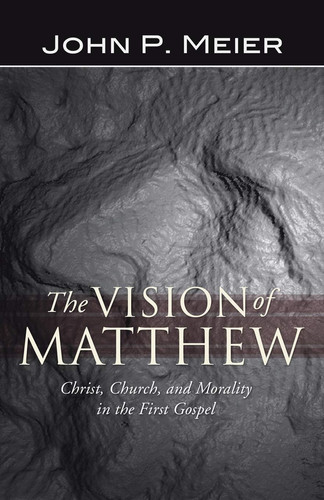
The Vision of Matthew Christ, Church, and Morality in the First Gospel

John P. Meier
In this volume Father Meier explores how Matthew remodeled the form, the Christological message, and the moral demand of the gospel. Part I shows Matthew's church in crisis. It was experiencing a shift in its Christian existence: from a narrow Jewish-Christian past to a universal Gentile future. To preserve yet reinterpret the particularistic traditions of that Jewish-Christian past, Matthew drew up a model of salvation history and then reshaped the gospel message to fit it. Part II offers a mini-commentary on the whole gospel to illustrate this reshaping of the message. Pericope by pericope, Matthew presents Jesus as Son of God and Son of Man, and therefore as 'the' definitive teacher of his Church. Indeed, the nexus between Christ and his Church emerges as the outstanding characteristic of Matthew's gospel. Part III studies Matthew's construction of a unified moral vision on the basis of this connection between Christ and Church. The basic stance of Jesus and his disciples towards the Mosaic Law is one of fulfillment - a 'prophetic' fulfillment which involves at times a deepening of, at times the abrogation of, the letter of the Law.
Wipf and Stock Publishers 2004-09-30 280 pages

John Paul II and Interreligious Dialogue

Byron L. Sherwin,Harold Kasimow
In the first book to explore Pope John Paul II's view on interreligious dialogue, leading scholars from Buddhism, Islam, and Judaism respond to his writings and speeches on their respective traditions, and the relationship between those faiths and Catholicism. Contributors: -Pope John Paul II -The XIV Dalai Lama -Robert Aitken -Masao Abe -Jose Ignacio Cabezon -David M. Gordis -Mahmoud Ayoub -Ibrahim M. Abu-Rabi -Michael L. Fitzgerald -Wayne Teasdale
Wipf and Stock Publishers 2005-09-30 252 pages

The Covenant A Theology of Human Destiny

Jakob Jocz
Why does God speak to human beings? Is it to impart information? Is it to unveil the secret of His Being? Is it to pronounce judgment? When we probe deeply into these questions, the author contends, we find that God does not speak to mortals simply to satisfy their curiosity or sense of guilt. He speaks to his people in order to establish with them a personal, covenantal relationship. God reassures them, He claims them for Himself, He gives Himself to humankind, He holds on to them as a Father to an unruly child. The covenant as a theological category opens up the whole aspect of human destiny and puts mortals and creation in a new perspective. This doctrine is so fundamental to theological reasoning, the author argues, that we may describe it as the axiom of biblical faith. From this axiom he goes on to define such other biblical themes and doctrines as the relation between evil and sin; the "plan," meaning, and time of salvation; the fall, the cross, and the sacraments; the covenant as creation and as revelation; history as a moral testing ground; Christ as the End of time; and the new age.
Wipf and Stock Publishers 1999-10-13 320 pages