13 results for "History"

Memories of the Southern civil rights movement

Lyon, Danny
In the summer of 1962, 20-year-old Danny Lyon packed his cameras and hitchhiked south. Within a week he was in jail in Georgia, looking through the bars at another prisoner, Dr. Martin Luther King, Jr. Lyon's photos and text are more just a record of marches, jailings, and protests, they take us behind the scenes to chronicle the southern Civil Rights movement firsthand.
Published for the Center for Documentary Studies, Duke University, by the University of North Carolina Press 1992 192 pages

Freedom rider diary: smuggled notes from Parchman Prison

Silver, Carol Ruth
Arrested as a Freedom Rider in June of 1961, Carol Ruth Silver, a twenty-two-year-old recent college graduate originally from Massachusetts, spent the next forty days in Mississippi jail cells, including the Maximum Security Unit at the infamous Parchman Prison Farm. She chronicled the events and her experiences on hidden scraps of paper which amazingly she was able to smuggle out. These raw written scraps she fashioned into a manuscript, which has waited, unread for more than fifty years. Freedom Rider Diary is that account. Freedom Riders were civil rights activists who rode inte
University Press of Mississippi 2014-01-23 225 pages

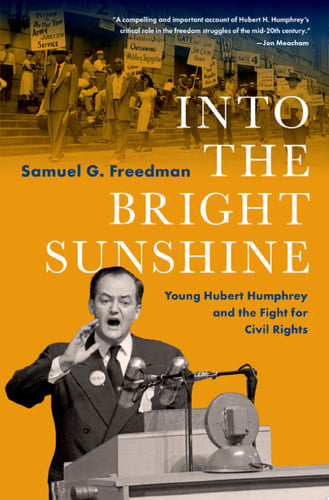
Into the bright sunshine: young Hubert Humphrey and the fight for civil rights

Freedman, Samuel G.
"Hubert Humphrey, a fallen hero and a dying man, rose on rickety legs to approach the podium of the Philadelphia Convention Hall, his pulpit for the commencement address at the University of Pennsylvania. He clutched a sheaf of paper with his speech for the occasion, typed and double-spaced by an assistant from his extemporaneous dictation, and then marked up in pencil by Humphrey himself. A note on the first page, circled to draw particular attention, read simply, "30 years ago--Here." In this place, at that time, twenty-nine years earlier to be precise, he had made history. From the dais now, Humphrey beheld five thousand impending graduates, an ebony sea of gowns and mortarboards, broken by one iconoclast in a homemade crown, two in ribboned bonnets, and another whose headgear bore the masking-tape message HI MA PA. In the horseshoe curve of the arena's double balcony loomed eight thousand parents and siblings, children, and friends. Wearing shirtsleeves and cotton shifts amid the stale heat, they looked like pale confetti from where Humphrey stood, and their flash cameras flickered away, a constellation of pinpricks"--
Oxford University Press 2023 488 pages

My mantelpiece: a memoir of survival and social justice

Goodman, Carolyn,Angelou, Maya
Carolyn Goodmans life was punctuated by tragedy, including a brothers premature death, childhood molestation, a fathers suicide, and a sons infamous murder. But hers is foremost a tale of survival, of turning personal anguish into social conscience. When her twenty-year-old son, Andy, was one of three civil rights volunteers to disappear in Mississippi in the summer of 1964, the story galvanized the nation. A half century after the Mississippi murders, this is the first time that a victims family member has expounded about the experience and the myriad emotions--from guilt to resolve--that it spawned. More than simply a memoir, My Mantelpiece is the story of a centurys seminal progressive movements seen through the lens of a remarkable womans singular journey. **Along with a foreword by National Book Award-winner Maya Angelou, MY MANTELPIECE includes back-cover testimonials from Senator Elizabeth Warren, Congressman John Lewis, former New York City mayor Michael Bloomberg, and performer-activist Harry Belafonte.
Why Not Books 2014 200 pages

The hands of peace

Ingram, Marione,Henderson, Thelton E.
"Born in Hamburg in the 1930s, Marione Ingram survived the Holocaust in Nazi Germany, only to find when she came to the United States that racism was as pervasive in the American South as anti-Semitism was in Europe. Moving first to New York and then to Washington, DC, Marione joined the burgeoning civil rights movement, protesting discrimination in housing, employment, education, and other aspects of life in the nation's capital, including the denial of voting rights. She was a volunteer in the legendary March on Washington, where Martin Luther King Jr. gave his iconic "I Have a Dream" speech, and she was an organizer of an extended sit-in to support the Mississippi Freedom Party. In 1964, at the urging of civil rights leader Fannie Lou Hamer, Marione went south to Mississippi. There, she worked for the Student Nonviolent Coordinating Committee and taught African American youth at one of the country's controversial freedom schools. With her boldness came threats--white supremacists made ominous calls and left a blazing cross in front of her school--and an arrest and conviction. She narrowly escaped a three-month prison sentence. As a white woman and a Holocaust escapee, Marione was perhaps the most unlikely of heroes in the American civil rights movement; and yet, her core belief in the equality of all people, regardless of race or religion, did not waver and she refused to be quieted, refused to accept bigotry. This empowering, true story offers a rare up close view of the civil rights movement. It is a story of conviction and courage--a reminder of how far the rights movement has come and the progress that still needs to be made."--Page 2 of book jacket.
Skyhorse Publishing 2015 177 pages

Fight for the right to read: Samuel Wilbert Tucker and the 1939 Sit-Down Strike for library reading equality

Gottesfeld, Jeff,Green, Michelle Y.
"Banning people from libraries is even worse than banning books! Decades before the Civil Rights Movement, Samuel Wilbert Tucker, a Black lawyer in Virginia, organized a peaceful read-in at the local public library, which was segregated. He wanted to affirm the right of everyone to use the library. Thanks to efforts like his, we can all sit at a table, any table, pick up a book, any book, and read."--Back cover.
Creston Books 2025-09-09 36 pages

Heeding the call: Jewish voices in America's civil rights struggle

Finkelstein, Norman H.
"Heeding the Call: Jewish Voices in America's Civil Rights Struggle" chronicles the multifaceted role of Jewish Americans in the difficult struggle for civil rights. Their story will inspire the next generation of young Jews and African Americans to renew the legacy of cooperation which once united both groups. The struggle for equal rights in America forged a close connection between African Americans and Jews. But in recent years, that once amicable relationship has become strained. In "Heeding the Call," young people will discover how much the shared history of both groups unites rather than divides them.
Jewish Publication Society 1997 208 pages

Crossing the barriers: the autobiography of Allan H. Spear

Spear, Allan H.
Allan Spear had a long and distinguished career as a historian and as a Minnesota state senator. Perhaps best known for coming out as openly gay during his first term in the Minnesota Senate-becoming one of the first elected officials in the nation to do so-Spear was also a leader of Eugene McCarthy's run for the presidency, an organizer against the war in Vietnam, and a key proponent for the establishment of the African-American studies department at the University of Minnesota. Spear's memoirs are fascinating and moving: in early chapters on his childhood and college years, he writes with great introspection about his growing self-awareness of being gay. Later he writes about his development as an intellectual, particularly as a white man fighting to win legitimacy for the study of African-American history and culture. During his time at the University of Minnesota, Spear became deeply involved with the Minnesota Democratic-Farmer-Labor Party (DFL) and the antiwar movement. At the same time, Spear became increasingly active in the emerging gay rights movement and began the process of coming out to his friends and colleagues. After a failed run for the Minnesota House in 1968, Spear was elected to the Minnesota Senate in 1972 and served as Senate president from 1993-2000. In 1993, he was instrumental in the passage of the Minnesota Human Rights Act, which protected LGBT people from discrimination in housing, education, and employment-an achievement he considered one of the finest of his career. A skilled parliamentarian, he remained a progressive leader in the legislature until his retirement in 2000. Spear passed away on October 11, 2008, leaving his memoir slightly incomplete. A stirring afterword by John Milton completes the story of Spear's life, chronicling the recognition of his accomplishments as a politician and activist during his final years.
University of Minnesota Press 2010 455 pages