4 results for "History"

Decolonizing Israel, liberating Palestine: Zionism, settler colonialism, and the case for one democratic state

Halper, Jeff
Explores how the concept of settler colonialism provides a clearer understanding of the Zionist movement's project to establish a Jewish state in Palestine, displacing the Palestinian Arab population and marginalizing its cultural presence. Halper argues that the only way out of a colonial situation is decolonization: the dismantling of Zionist structures of domination and control and their replacement by a single democratic state, in which Palestinians and Israeli Jews forge a new civil society and a shared political community. To show how this can be done, Halper uses the 10-point program of the One Democratic State Campaign as a guide for thinking through the process of decolonization to its post-colonial conclusion. --From publisher description.
Pluto Press 2021 244 pages

Democratization in America: a comparative-historical analysis

Desmond King,Robert C. Lieberman,Gretchen Ritter,Laurence Whitehead
The essays in this volume examine democracy’s development in the United States, demonstrating how that process has shaped—and continues to shape—the American political system. Scholars of American politics commonly describe the political development of the United States as exceptional and distinct from that of other advanced industrial democracies. They point to the United States as the longest-lived and most stable liberal democracy in history. What they often fail to mention, though, is that it took considerable time to extend democracy throughout the country. The contributors to this volume suggest that it is intellectually fruitful to consider the U.S. case in comparison to other countries. They argue that the development of democracy is ongoing in America; that even with a written constitution grounded in liberal democracy, the meaning and significance of U.S. democracy are still evolving. This volume shows that democratization and the pursuit of democracy are processes affected by multiple and continuing challenges—including such issues as citizenship, race, institution building, and political movements—as patterns and practices of politics and governance continue to change. This innovative approach contributes significantly to comparative democratization studies, a field normally confined to Latin America and former communist countries. The U.S. case is a unique reference point for students of American political development and comparative democratization.
Johns Hopkins University Press 2009-08-05 337 pages

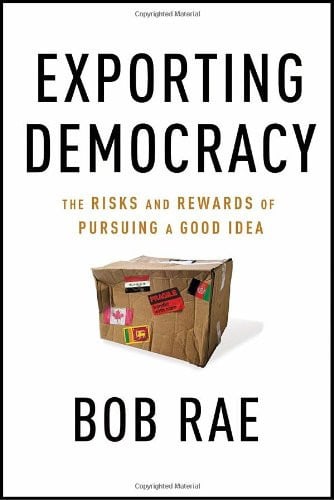
Exporting democracy: the risks and rewards of pursuing a good idea

Rae, Bob
The way most Western politicians talk, democracy is the pinnacle of civilization, the best political system there is. Many think it's the system the rest of the world ought to adopt. Bob Rae is not one of them. He is too well informed about the difficulties and dangers of implanting democracy in foreign lands. Exporting Democracy is an eloquently argued book in which Rae brings his lively, nuanced understanding to bear on the history and current fortunes of this powerful idea. He shows how it and the related ideas of freedom, human rights, and federalism have been pushed to centre stage by the collapse of Soviet communism and by ongoing wars to topple secular and religious dictatorships in the Middle East. He's also witnessed attempts to implant democracy in three countries riven by tribal and ethnic divisions, Iraq, Afghanistan, and Sri Lanka, and offers readers a cool appraisal of the effort.
McClelland & Stewart 2010 275 pages