
2 results for "History"

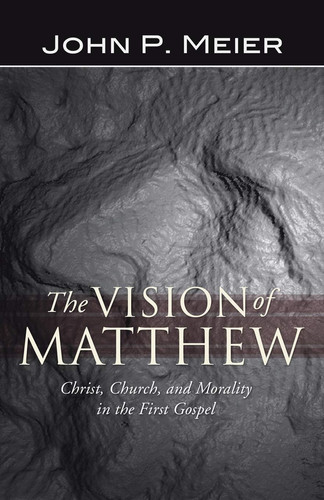
The Vision of Matthew Christ, Church, and Morality in the First Gospel

John P. Meier
In this volume Father Meier explores how Matthew remodeled the form, the Christological message, and the moral demand of the gospel. Part I shows Matthew's church in crisis. It was experiencing a shift in its Christian existence: from a narrow Jewish-Christian past to a universal Gentile future. To preserve yet reinterpret the particularistic traditions of that Jewish-Christian past, Matthew drew up a model of salvation history and then reshaped the gospel message to fit it. Part II offers a mini-commentary on the whole gospel to illustrate this reshaping of the message. Pericope by pericope, Matthew presents Jesus as Son of God and Son of Man, and therefore as 'the' definitive teacher of his Church. Indeed, the nexus between Christ and his Church emerges as the outstanding characteristic of Matthew's gospel. Part III studies Matthew's construction of a unified moral vision on the basis of this connection between Christ and Church. The basic stance of Jesus and his disciples towards the Mosaic Law is one of fulfillment - a 'prophetic' fulfillment which involves at times a deepening of, at times the abrogation of, the letter of the Law.
Wipf and Stock Publishers 2004-09-30 280 pages

The Covenant A Theology of Human Destiny

Jakob Jocz
Why does God speak to human beings? Is it to impart information? Is it to unveil the secret of His Being? Is it to pronounce judgment? When we probe deeply into these questions, the author contends, we find that God does not speak to mortals simply to satisfy their curiosity or sense of guilt. He speaks to his people in order to establish with them a personal, covenantal relationship. God reassures them, He claims them for Himself, He gives Himself to humankind, He holds on to them as a Father to an unruly child. The covenant as a theological category opens up the whole aspect of human destiny and puts mortals and creation in a new perspective. This doctrine is so fundamental to theological reasoning, the author argues, that we may describe it as the axiom of biblical faith. From this axiom he goes on to define such other biblical themes and doctrines as the relation between evil and sin; the "plan," meaning, and time of salvation; the fall, the cross, and the sacraments; the covenant as creation and as revelation; history as a moral testing ground; Christ as the End of time; and the new age.
Wipf and Stock Publishers 1999-10-13 320 pages