97 results for "History"

Neverwhere

Gaiman, Neil
A hardcover edition of this book was published in 2015... First William Morrow paperback edition published 2016. Second William Morrow paperback edition published 2021."--Title page verso./ Includes the novella How the marquis got his coat back./ Published in 1997, Neil Gaiman's first novel, Neverwhere is the story of Richard Mayhew, a young London businessman with a good heart and an ordinary life, which is changed forever when he discovers a girl bleeding on the sidewalk. He stops to help her -- an act of kindness that plunges him into a world he never dreamed existed. Slipping through the cracks of reality, Richard lands in Neverwhere -- a London of shadows and darkness, monsters and saints, murderers and angels that exists entirely in a subterranean labyrinth. Neverwhere is home to Door, the mysterious girl Richard helped in the London Above. Here in Neverwhere, Door is a powerful noblewoman who has vowed to find the evil agent of her family's slaughter and thwart the destruction of this strange underworld kingdom. If Richard is ever to return to his former life and home, he must join Lady Door's quest to save her world -- and may well die trying.
William Morrow Company 2021-01-19 464 pages

The Dark Knight Trilogy The Batman Screenplays

Christopher Nolan,David S. Goyer
(Book). At nearly six hundred pages, The Dark Knight Trilogy , a behemoth of script and storyboards, captures on the page the dark mythic expanse of the cinematic Batman. These definitive, vibrant film blueprints published on the heels of the final film's closely guarded release are destined to be enshrined on every fan's bedside table, studied in universities, and emulated by filmmakers.
Opus 2012 553 pages

O brother, where art thou?

Coen, Ethan
Joel and Ethan Coen are among America's best-loved and most lauded independent filmmakers. With their latest work, O Brother, Where Art Though? , The Oscar-winning team returns to the period-piece films of their earlier career ( Miller's Crossing , Barton Fink , The Hudsucker Proxy ) and showcase once-again their pitch-perfect ear for hilarious and outrageous dialogue, as well as their penchant for the fantastic. Based on Homer's Odyssey, the movie stars George Clooney as Ulysses Everett McGill, along with Coen-mainstay John Turturro, and Tim Blake Nelson as fugitives from a chain gang who embark on a mystical and musical journey through 1930s Mississippi. History and allegory are expertly entwined as, along the way, the three escapees encounter a blind prophet, are tempted by sirens, do battle with a Cyclops (in the form of a one-eyed Klansman), fall in with George "Baby Face" Nelson on a bank heist, and cut a blues record with a young guitar prodigy who bears a striking resemblance to the real-life Robert Johnson.
Faber 2000 111 pages

Leopoldstadt

Stoppard, Tom
"At the beginning of the 20th Century, Leopoldstadt was the old, crowded Jewish quarter of Vienna. But Hermann Merz, a manufacturer and baptised Jew married to Catholic Gretl, has moved up in the world. Gathered in the Merz apartment in a fashionable part of the city, Hermann's extended family are at the heart of Tom Stoppard's epic yet intimate drama. By the time we have taken leave of them, Austria has passed through the convulsions of war, revolution, impoverishment, annexation by Nazi Germany and - for Austrian Jews - the Holocaust in which 65,000 of them were murdered. It is for the survivors to pass on a story which hasn't ended yet"--Back cover
Faber & Faber 2020 105 pages

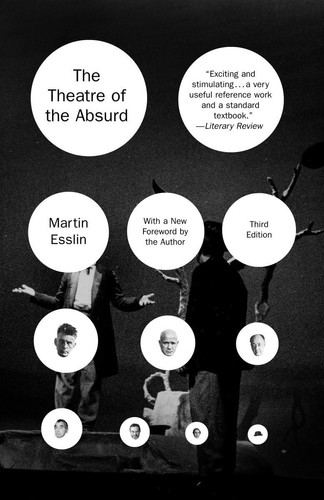
The theatre of the absurd

Esslin, Martin
In 1953, Samuel Beckett’s Waiting for Godot premiered at a tiny avant-garde theatre in Paris; within five years, it had been translated into more than twenty languages and seen by more than a million spectators. Its startling popularity marked the emergence of a new type of theatre whose proponents—Beckett, Ionesco, Genet, Pinter, and others—shattered dramatic conventions and paid scant attention to psychological realism, while highlighting their characters’ inability to understand one another. In 1961, Martin Esslin gave a name to the phenomenon in his groundbreaking study of these playwrights who dramatized the absurdity at the core of the human condition. Over four decades after its initial publication, Esslin’s landmark book has lost none of its freshness. The questions these dramatists raise about the struggle for meaning in a purposeless world are still as incisive and necessary today as they were when Beckett’s tramps first waited beneath a dying tree on a lonely country road for a mysterious benefactor who would never show. Authoritative, engaging, and eminently readable, The Theatre of the Absurd is nothing short of a classic: vital reading for anyone with an interest in the theatre.
Vintage Books 2004-01-06 480 pages

A Bright Room Called Day

Tony Kushner
From the Pulitzer Prize-winning author of Angels in America comes this powerful portrayal of individual dissolution and resolution in the face of political catastrophe. "Tony Kushner's A BRIGHT ROOM CALLED DAY ... is unabashedly political, thought-provoking, a little scary, and frequently a good deal of theatrical fun ... BRIGHT ROOM is ... an examination of Nazi Germany in an attempt to shed insight on our own time. It's brash, audacious, and, depending on your politics, anything from infuriatingly naïve to intoxicatingly visionary. In its 1932-33 span, it tells of a group of Berlin artists and friends, with varying degrees of communist leanings, and of the changes in their lives as democracy falls and Adolph Hitler takes over." -Sid Smith, Chicago Tribune "It's fun to see a show this engaged. This passionate and ready to talk. Wild, uneven, pugnacious, ragged, committed, smart, dumb, satirical, and utterly serious ... Always dramatically and intellectually forceful. And most important, always passionately committed. More than a diatribe against Reagan or a falling-into-the-Nazi-abyss history play, A BRIGHT ROOM CALLED DAY is an assertion of the need for commitment." -Anthony Adler, The Reader
Broadway Play Publishing 2015 102 pages

Frost/nixon

Morgan, Peter
By 1972 Richard Nixon had ended the Vietnam war, achieved diplomatic breakthroughs with Russia and China, presided over a period of economic stability at home, and was on the verge of a landslide re-election . . . until he decided to cover up a third-rate burglary. Watergate was one of the largest scandals in American history and two years later Nixon would resign the presidency—but with neither an admission of guilt nor any sign of remorse. In a drama "as thought-provoking as it is gripping and entertaining" (Charles Spencer, Th e Daily T e l e graph ), acclaimed screenwriter Peter Morgan examines how a British playboy, talk-show host managed what no other journalist or prosecutor could: to extract a confession from our most notorious statesman.
Faber and Faber 2007 82 pages

China Doll

David Mamet
A very wealthy businessman buys a plane to carry his fianc�e, a non-US citizen, into Canada. However, an unexpected landing of the plane prompts an investigation into the man's affairs based on his tax payment history. As his assistant tries to help him put things back together, secrets are revealed, and it is discovered the man is a powerful political insider who's been evading tax law. The investigation deepens and his future is even more at risk.
Concord Theatricals 2017 66 pages

Broken glass

Miller, Arthur
This Student Edition of Broken Glass is perfect for students of literature and drama and offers an unrivalled and comprehensive guide to Miller's play. It features an extensive introduction by Alan Ackerman which includes a chronology of Miller's life and times, a summary of the plot and commentary on the characters, themes, language, context and production history of the play. Together with over twenty questions for further study and detailed notes on words and phrases from the text, this is the definitive edition of the play. Set in Brooklyn in 1938, Broken Glass is Miller's moving study of marital relations, Jewish identity and anti-Semitism that won the Olivier Award for Best New Play in 1994. Sylvia Gellburg is stricken by a mysterious paralysis in her legs for which the doctor can find no cause. He soon realises that she is obsessed by the devastating news from Germany, where government thugs have begun smashing Jewish stores. But through a series of meetings with her husband Phillip he learns that this experience is intermeshed with their strange relationship and the deceptions and hostilities that lie at the heart of their marriage. Professor Alan Acklerman's expertly edited edition of the play provides a wide-ranging study of Kristallnacht, and of American and European responses to the Holocaust, the situation of Jews in America from the 1930s to the 1990s, the Great Depression and other Holocaust and Jewish drama.
Methuen Drama 2011 100 pages

Songs of a Semite The Dance to Death, and Other Poems

Emma Lazarus
Unlike some other reproductions of classic texts (1) We have not used OCR(Optical Character Recognition), as this leads to bad quality books with introduced typos. (2) In books where there are images such as portraits, maps, sketches etc We have endeavoured to keep the quality of these images, so they represent accurately the original artefact. Although occasionally there may be certain imperfections with these old texts, we feel they deserve to be made available for future generations to enjoy.
HardPress 2012 96 pages

Marx in Soho: a play on history

Zinn, Howard
Howard Zinn, author of the best-selling A People's History of the United States and respected veteran of the civil rights and anti-war movements, brings the ideas of Karl Marx to life in this witty and brilliant "play on history". Combining his vast knowledge of political philosophy and history with a vibrant sense of humor and irony, Zinn vividly explores the relevance of Marx's ideas for contemporary society. Through Marx's own voice, Zinn brings this larger-than-life personality down to earth, imaginatively recounting the important influences on his thinking, crafting a moving portrait of his family life in London, and providing a provocative and practical exposition of his ideas, still urgently vital today. Marx in Soho deserves to be widely read, both for its ideas and for the sheer pleasure of its style. Truly a match made in political heaven, Zinn's creative collaboration with Marx's thought will thoroughly engage its readers' minds and passions. The book includes an afterword by Zinn and an annotated bibliography for those interested in finding out more about Marx's life, ideas, and influence.
South End Press 1999 55 pages

Stella Adler on America's master playwrights: Eugene O'Neill, Thornton Wilder, Clifford Odets, William Saroyan, Tennessee Williams, William Inge, Arthur Miller, Edward Albee

Adler, Stella
Stella Adler was one of the most influential acting teachers of all time, a legendary force of nature whose generations of students include Marlon Brando, Karl Malden, Anthony Quinn, Diana Ross, Robert De Niro, Warren Beatty, Annette Benning, and Mark Ruffalo. This long-awaited companion to her book on the master European playwrights brings to life America’s most revered playwrights, whom she knew, loved, and worked with. Brilliantly edited by Barry Paris, Adler’s lectures on the giants of twentieth-century theater feature her indispensable insights into such classic plays as “Long Day’s Journey into Night,” “The Skin of Our Teeth,” “A Streetcar Named Desire,” “Come Back, Little Sheba,” “The Glass Menagerie,” and “Death of a Salesman,” while shedding new light on such lesser known gems as Tennessee Williams’s “The Lady of Larkspur Lotion” and Arthur Miller’s “After the Fall.” Illuminating, revelatory, inspiring—this is Stella Adler at her electrifying best.
Vintage Books 2013-09-10 400 pages

Sweet smell of success

Odets, Clifford
The Faber Classic Screenplay Series presents the very best writing from the history of cinema. Sweet Smell of Success is the smartest, most cynical American film of the 1950s. Written by Ernest Lehman ( North by Northwest , The Sound of Music ) and the celebrated leftist playwright Clifford Odets, it is a vicious dissection of the world of public relations and journalism which conjures up a wprld of creeping hysteria and acid disenchantment. Tony Curtis playing the Scuttling press agent Sidney Falco, and Burt Lancaster as the colimnist J.J. Hunsecker, gave the performances of their careers. With a specially commissioned introduction by Lehman, and an appreciation of the film's director, Alexander Mackendrick, by James Mangold. The Faber Classic Screenplay Series presents the very best writing from the history of cinema. Sweet Smell of Success is the smartest, most cynical American film of the 1950s. Written by Ernest Lehman ( North by Northwest , The Sound of Music ) and the celebrated leftist playwright Clifford Odets, it is a vicious dissection of the world of public relations and journalism which conjures up a wprld of creeping hysteria and acid disenchantment. Tony Curtis playing the Scuttling press agent Sidney Falco, and Burt Lancaster as the colimnist J.J. Hunsecker, gave the performances of their careers. With a specially commissioned introduction by Lehman, and an appreciation of the film's director, Alexander Mackendrick, by James Mangold.
Faber 1998 178 pages

Arthur Miller plays. 4. The Golden Years, The Man Who Had All the Luck, I Can't Remember Anything, Clara

Miller, Arthur
"Listen to the dialogue: no other American dramatist has this feel for the ordinary talk of ordinary people, or the knowledge of what they do. This is more than a writer's craft, it is a psychological and moral openness to humanity, an act not of imitating, but of sharing". Sunday Times This fourth anthology features Arthur Miller's two early plays, The Golden Years , a historical tragedy about Montezuma's destruction at the hands of Cortez, and The Man Who Had All the Luck , a fable about human freedom and individual responsibility, are brought together in this volume. It also features two of his contemporary shorter plays, I Can't Remember Anything and Clara , first presented on a double bill as Danger! Memory . The latter focus on the importance and dangers of remembering the past, while the early plays, written at the time of the Second World War, mark the emergence of a drama in which public issues are rooted in private anxieties and chart the beginning of Miller's career that was one of the most distinguished in dramatic history. First produced in 1944 and revived in London in 2008, The Man Who Had All the Luck is a mesmerising drama in which the author's brilliance and characteristic qualities are already evident: The fourth volume of Miller's plays has been reissued with a new cover and features an introduction by the author and a chronology of his work.
Bloomsbury Methuen Drama 2023-02-09 279 pages