70 results for "History"

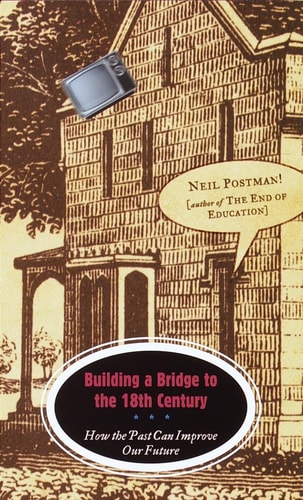
Building a bridge to the 18th century: how the past can improve our future

Postman, Neil
In Building a Bridge to the 18th Century , acclaimed cultural critic Neil Postman offers a cure for the hysteria and hazy values of the postmodern world. Postman shows us how to reclaim that balance between mind and machine in a dazzling celebration of the accomplishments of the Enlightenment-from Jefferson's representative democracy to Locke's deductive reasoning to Rousseau's demand that the care and edification of children be considered an investment in our collective future. Here, too, is the bold assertion that Truth is invulnerable to fashion or the passing of time. Provocative and brilliantly argued, Building a Bridge to the 18th Century illuminates a navigable path through the Information Age-a byway whose signposts, it turns out, were there all along.
Knopf 2000-10-10 213 pages

The Evolution Of Physics

Albert Elnstein,Leopold Infeld
This work has been selected by scholars as being culturally important, and is part of the knowledge base of civilization as we know it. This work is in the "public domain in the United States of America, and possibly other nations. Within the United States, you may freely copy and distribute this work, as no entity (individual or corporate) has a copyright on the body of the work. Scholars believe, and we concur, that this work is important enough to be preserved, reproduced, and made generally available to the public. We appreciate your support of the preservation process, and thank you for being an important part of keeping this knowledge alive and relevant.
Creative Media Partners, LLC 2022-10-26 342 pages

God's Harvard A Christian College on a Mission to Save America

Hanna Rosin
Since 2000, America s most ambitious young evangelicals have been making their way to Patrick Henry College, a small Christian school just outside the nation s capital. Most of them are homeschoolers whose idealism and discipline put the average American teenager to shame. At "God s Harvard" they are groomed to become tomorrow s elite. Diplomas in hand, they are dispatched to the front lines of politics, entertainment, and science, where they will lead the battle to take back a godless nation. Hanna Rosin spent a year and a half embedded at the college, following students from the campus to the White House, Congress, conservative think tanks, Hollywood, and other centers of influence. Her account captures this nerve center of the evangelical movement at a moment of maximum influence and also of crisis, as it struggles to avoid the temptations of modern life and still remake the world in its own image. "
HarperCollins Publishers 2008-09-08 312 pages

Find the Constellations

Hans Augusto Rey
Containing star charts, a guide to the constellations, and details about seasons and the movement of the objects we see in the sky, this classic book makes H. A. Rey's passion for astronomy evident on every page. New updates concentrate on the planetary and solar system information in the latter part of the book. Facts and figures for each planet have been revised, and new scientific information has been added, such as Pluto's reclassification as a dwarf planet. There's also a new online resource that allows readers to track the positions of the planets in the night sky till the year 2100.
Houghton Mifflin Harcourt 2016 72 pages

The Unanswered Question Six Talks at Harvard

Leonard Bernstein
The varied forms of Leonard Bernstein's musical creativity have been recognized and enjoyed by millions. These lectures, Mr. Bernstein's most recent venture in musical explication, will make fascinating reading as well. Virgil Thomson says of the lectures: "Nobody anywhere presents this material so warmly, so sincerely, so skillfully. As musical mind-openers they are first class; as pedagogy they are matchless". Mr. Bernstein considers music ranging from Hindu ragas through Mozart and Ravel, to Copland, suggesting a worldwide, innate musical grammar. Folk music, pop songs, symphonies, modal, tonal, atonal, well-tempered and ill-tempered works all find a place in these discussions. Each, Mr. Bernstein suggests, has roots in a universal language central to all artistic creation. Using certain linguistic analogies, he explores the ways in which this language developed and can be understood as an aesthetic surface. Drawing on his insights as a master composer and conductor, Mr. Bernstein also explores what music means below the surface: the symbols and metaphors which exist in every musical piece, of whatever sort. And, finally, Mr. Bernstein analyzes twentieth century crises in the music of Schoenberg and Stravinsky, finding even here a transformation of all that has gone before, as part of the poetry of expression, through its roots in the earth of human experience. Phonograph records are included in this book, with Mr. Bernstein's own speaking and playing of certain sections, in which musical sounds are crucial for understanding. These talks, written and delivered when Leonard Bernstein was Charles Eliot Norton Professor of Poetry at Harvard University, are the newest of the author's literary achievements. In addition to a distinguished career as conductor, pianist, and composer, Mr. Bernstein is the recipient of many television Emmys for the scripts of his Young People's Concerts, Omnibus programs, and others, and is the author of The Infinite Variety of Music and The Joy of Music, for which he received the Christopher Award.
Harvard University Press 1976 428 pages

Command The Politics of Military Operations from Korea to Ukraine

Lawrence Freedman
Using examples from a wide variety of conflicts, Lawrence Freedman shows that successful military command depends on the ability not only to use armed forces effectively but also to understand the political context in which they are operating. Command in war is about forging effective strategies and implementing them, making sure that orders are appropriate, well-communicated, and then obeyed. But it is also an intensely political process. This is largely because how wars are fought depends to a large extent on how their aims are set. It is also because commanders in one realm must possess the ability to work with other command structures, including those of other branches of the armed forces and allies. In Command, Lawrence Freedman explores the importance of political as well as operational considerations in command with a series of eleven vivid case studies, all taken from the period after 1945. Over this period, the risks of nuclear escalation led to a shift away from great power confrontations and towards civil wars, and advances in communication technologies made it easier for higher-level commanders to direct their subordinates. Freedman covers defeats as well as victories. Pakistani generals tried to avoid surrender as they were losing the eastern part of their country to India in 1971. Iraq's Saddam Hussein turned his defeats into triumphant narratives of victory. Osama bin Laden escaped the Americans in Afghanistan in 2001. The UK struggled as a junior partner to the US in Iraq after 2003. We come across insubordinate generals, such as Israel's Arik Sharon, and those in the French army in Algeria, so frustrated with their political leadership that they twice tried to change it. At the other end of the scale, Che Guevara in Congo in 1966 and Igor Girkin in Ukraine in 2014 both tried to spark local wars to suit their grandiose objectives. Freedman ends the book with a meditation on the future of command in a world that is becoming increasingly reliant on technologies like artificial intelligence. A wide-ranging and insightful history of the changing nature of command in the postwar era, this will stand as a definitive account of a foundational concept in both military affairs and politics.
Oxford University Press 2023-11-16 624 pages

America-Lite How Imperial Academia Dismantled Our Culture (and Ushered In the Obamacrats)

David Gelernter
America-Lite (where we all live) is just like America, only turned into an amusement park or a video game or a supersized Pinkberry, where the past and future are blank and there is only a big NOW. How did we come to expect no virtue and so much cynicism from our culture, our leaders—and each other? In this refreshingly judgmental book, David Gelernter connects the historical dots to reveal a stealth revolution carried out by post-religious globalist intellectuals who, by and large, “can’t run their own universities or scholarly fields, but are very sure they can run you.” These imperial academics have deployed their students into the top echelon of professions once monopolized by staid and steady WASPs. In this simple way, they have installed themselves as the new designated drivers of American culture. Imperial academics live in a world of theory; they preach disdain for mere facts and for old-fashioned fact-based judgments like true or false. Schoolchildren are routinely taught theories about history instead of actual history—they learn, for example, that all nations are equally nice except for America, which is nearly always nasty. With academic experts to do our thinking for us, we’ve politely shut up and let second-raters take the wheel. In fact, we have handed the keys to the star pupil and teacher’s pet of the post-religious globalist intellectuals, whose election to the presidency of the United States constituted the ultimate global group hug. How do we finally face the truth and get back into the driver’s seat? America-Lite ends with a one-point plan.
Encounter Books 2013-10-14 200 pages

American Exceptionalism A Double Edged Sword

Seymour Martin Lipset
"American values are quite complex," writes Seymour Martin Lipset, "particularly because of paradoxes within our culture that permit pernicious and beneficial social phenomena to arise simultaneously from the same basic beliefs."Born out of revolution, the United States has always considered itself an exceptional country of citizens unified by an allegiance to a common set of ideals, individualism, anti-statism, populism, and egalitarianism. This ideology, Professor Lipset observes, defines the limits of political debate in the United States and shapes our society.American Exceptionalism explains why socialism has never taken hold in the United States, why Americans are resistant to absolute quotas as a way to integrate blacks and other minorities, and why American religion and foreign policy have a moralistic, crusading streak.
W.W. Norton 1998 354 pages

Beyond the university: why liberal education matters

Roth, Michael S.
From the president of Wesleyan University, an eloquent defense of liberal education, seen against the backdrop of its contested history in America Winner of the 2016 Frederic W. Ness Book Award sponsored by the Association of American Colleges and Universities Contentious debates over the benefits--or drawbacks--of a liberal education are as old as America itself. From Benjamin Franklin to the Internet pundits, critics of higher education have attacked its irrelevance and elitism, often calling for more vocational instruction. Thomas Jefferson, by contrast, believed that nurturing a student's capacity for lifelong learning was useful for science and commerce while also being essential for democracy. In this provocative contribution to the disputes, university president Michael S. Roth focuses on important moments and seminal thinkers in America's long-running argument over vocational vs. liberal education. Conflicting streams of thought flow through American intellectual history: W. E. B. Du Bois's humanistic principles of pedagogy for newly emancipated slaves developed in opposition to Booker T. Washington's educational utilitarianism, for example. Jane Addams's emphasis on the cultivation of empathy and John Dewey's calls for education as civic engagement were rejected as impractical by those who aimed to train students for particular economic tasks. Roth explores these arguments (and more), considers the state of higher education today, and concludes with a stirring plea for the kind of education that has, since the founding of the nation, cultivated individual freedom, promulgated civic virtue, and instilled hope for the future.
Yale University Press 2015 228 pages

Pipeline to the Pros

Ben Kaplan,Danny Parkins
Jeff Van Gundy. Brad Stevens. Frank Vogel. Mike Budenholzer. Tom Thibodeau. Sam Presti. Leon Rose. Before you knew his name, before he drafted your favorite player, before he guided your team to a championship, he had a playing career of his own at an NCAA Division III college. He didn't play for fortune - the NBA was out of reach, and his school didn't even give athletic scholarships. He didn't play for fame - his games weren't televised, and the stands were rarely full. Whatever the motivation, he simply couldn't give up the game of basketball. And that didn't change after graduation, when it was time to pick a career path. For the first time in league history, NBA coaches and general managers are just as likely to have played Division III basketball as they are to have played in the NBA. While the number of former D3 players working in the NBA is higher than ever, small college alums have served in leadership positions since the league's founding. They shaped the NBA into what it is today, playing integral roles in the Lakers' initial success in Los Angeles, the inception of several expansion franchises, the creation of the popular All-Star Weekend dunk contest, the globalization of the league, and more. Their improbable and inspiring journeys tell a bigger story - the history of small college athletics, the evolution of coaching and management in the NBA, and the hiring practices in the most competitive fields. Their alma maters were small, but their impact on the game, and the implications of their success, loom large.
Triumph Books 2024-04-16 272 pages

Howard Zinn on democratic education

Zinn, Howard
Perhaps no other historian has had a more profound and revolutionary impact on American education than Howard Zinn. This is the first book devoted to his views on education and its role in a democratic society. Howard Zinn on Democratic Education describes what is missing from school textbooks and in classrooms-and how we move beyond these deficiencies to improve student education. Critical skills of citizenship are insufficiently developed in schools, according to Zinn. Textbooks and curricula must be changed to transcend the recitation of received wisdom too common today in schools. In these respects, recent Bush Administration and educational policies of most previous US presidents have been on the wrong track in meeting educational needs. This book seeks to redefine national goals at a time when public debates over education have never been more polarised--nor higher in public visibility and contentious debate. Zinn's essays on education-many never before published--are framed in this book by a dialogue between Zinn and Donaldo Macedo, a distinguished critic of literacy and schooling, whose books with Paulo Freire, Noam Chomsky and other authors have received international acclaim.
Paradigm Publishers 2005 213 pages

One, Two, Three Absolutely Elementary Mathematics

David Berlinski
The acclaimed author of A Tour of the Calculus and The Infinite Ascent offers an enlightening and enthralling tour of the basics of mathematics, and reveals a world of fascination in fundamental mathematical ideas. One, Two, Three is David Berlinski’s captivating exploration of the foundation of mathematics, its fundamental ideas, and why they matter. By unraveling the complex answers to these most elementary questions—What is a number? How do addition, subtraction, and other functions actually work? What are geometry and logic?—Berlinski reveals the intricacy behind their seemingly simple exteriors. Peppered with enlightening historical anecdotes and asides on some of history’s most fascinating mathematicians, One, Two, Three, revels in the beauty of numbers as Berlinski shows us how and why these often slippery concepts are as essential to the field of mathematics as to who we are.
Knopf Doubleday Publishing Group 2012-05-01 224 pages

How to Educate a Citizen The Power of Shared Knowledge to Unify a Nation

Jr. E. D. Hirsch
"Profound, vital and correct. Hirsch highlights the essence of our American being and the radical changes in education necessary to sustain that essence. Concerned citizens, teachers, and parents take note! We ignore this book at our peril."-- Joel Klein, former Chancellor of New York City Public Schools Now in paperback, the bestselling author of Cultural Literacy delivers a powerful manifesto on the failures of America's early education system and its impact on our current national malaise, advocating for a shared knowledge curriculum students everywhere can be taught--an educational foundation that can help improve and strengthen America's unity, identity, and democracy. In How to Educate a Citizen, E.D. Hirsch continues the conversation he began thirty years ago with his classic bestseller Cultural Literacy, urging America's public schools, particularly at the elementary level, to educate our children more effectively to help heal and preserve the nation. Since the 1960s, our schools have been relying on "child-centered learning." History, geography, science, civics, and other essential knowledge have been dumbed down by vacuous learning "techniques" and "values-based" curricula; indoctrinated by graduate schools of education, administrators and educators have believed they are teaching reading and critical thinking skills. Yet these cannot be taught in the absence of strong content, Hirsch argues. The consequence is a loss of shared knowledge that would enable us to work together, understand one another, and make coherent, informed decisions. A broken approach to school not only leaves our children under-prepared and erodes the American dream but also loosens the spiritual bonds and unity that hold the nation together. Drawing on early schoolmasters and educational reformers such as Noah Webster and Horace Mann, Hirsch charts the rise and fall of the American early education system and provides a blueprint for closing the national gap in knowledge, communications, and allegiance. Critical and compelling, How to Educate a Citizen galvanizes our schools to equip children with the power of shared knowledge.
HarperCollins Publishers 2021-09-07 224 pages

An American Saga The Story of Helen Thomas and Simon Flexner

James T. Flexner
This tale of two families is set on a grand scale, as James Thomas Flexner brings his talents to bear on his own noteworthy heritage. An American Saga is an historical narrative, grounded on documentary sources, which ends with the marriage of Helen Thomas and Simon Flexner. The account deals equally with the lives and the backgrounds of husband and wife, the author's parents. Simon Flexner was the famous medical investigator, discoverer of the "Flexner vacillus" and the "Flexner serum," who became the creating director of the Rockefeller Institute for Medical Research (now Rockefeller University) and eventually acknowledged leader of American medical science. The Kentucky-born son of impoverished German Jewish immigrants, he grew up in penury. As he never completed the eighth grade, he was almost completely self-educated when he appeared at the Johns Hopkins University before its celebrated medical school had been founded. Almost instantly he began making the discoveries that soon made him the leading younger medical scientist in the United States.
Fordham University Press 1993 494 pages