79 results for "History"

Iron Curtain The Crushing of Eastern Europe, 1944-1956

Anne Applebaum
At the end of WWII, the Soviet Union, to its surprise and delight, found itself in control of a huge swath of territory in Central Europe. It set out to convert a dozen radically different countries to a completely new political and moral system, Communism. Iron Curtain describes how the communist regimes of Eastern Europe were created, and what daily life was like once they were complete. Applebaum draws on newly opened European archives and personal accounts translated for the first time to portray in devestating detail millions of individuals trying to adjust to a way of life that challenged their every belief, rendered worthless their every qualification, and took everything away they had accumulated. Today the Soviet Block is a lost civilization, once whose cruelty, paranoia, bizarre morality and strange aethestics Applebaum captures in the electrifying pages of this book.
McClelland & Stewart 2012-10-30 608 pages

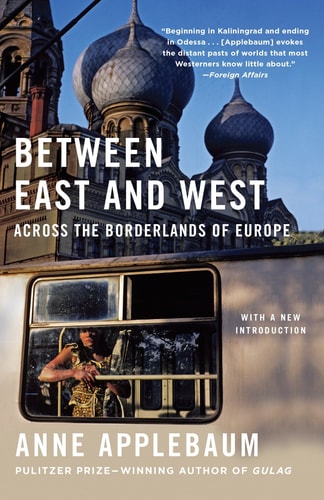
Between East and West Across the Borderlands of Europe

Anne Applebaum
In the summer and fall of 1991, Anne Applebaum, Pulitzer Prize-winning author of Gulag and Iron Curtain , took a three month road trip through the freshly independent borderlands of Eastern Europe. She deftly weaves the harrowing history of the region and captures the effects of political upheaval on a personal level. An extraordinary journey into the past and present of the lands east of Poland and west of Russia—an area defined throughout its history by colliding empires. Traveling from the former Soviet naval center of Kaliningrad on the Baltic to the Black Sea port of Odessa, Anne Applebaum encounters a rich range of competing cultures, religions, and national aspirations. In reasserting their heritage, the inhabitants of the borderlands attempt to build a future grounded in their fractured ancestral legacies. In the process, neighbors unearth old conflicts, devote themselves to recovering lost culture, and piece together competing legends to create a new tradition. Rich in surprising encounters and vivid characters, Between East and West brilliantly illuminates the soul of the borderlands and the shaping power of the past.
National Geographic Books 2017-06-13 336 pages

Historic Heston

Blumenthal, Heston
British gastronomy has a grand old tradition that has been lost over time. Now England's most inventive chef is out to reclaim it. Heston Blumenthal, whose name is synonymous with cutting-edge cuisine, nonetheless finds his greatest source of inspiration in the unique and delicious food that the sceptered isle once produced. This has been the secret to his success at world-famous restaurants The Fat Duck and Dinner, where a contrast between old and new, modern and historic, is key. Historic Heston charts a quest for identity through the best of British cooking that stretches from medieval to late-Victorian recipes. Start with thirty historic dishes, take them apart, put them together again, and what have you got? A sublime twenty-firstcentury take on delicacies including meat fruit (1500), quaking pudding (1660), and mockturtle soup (1892). Heston examines the history behind each one's invention and the science that makes it work. He puts these dishes in their social context and follows obscure culinary trails, ferreting out such curious sources as The Queen-like Closet from 1672 (which offers an excellent method for drying goose). What it adds up to is an idiosyncratic culinary history of Britain. This glorious tome also gives a unique insight into the way that Heston works, with signature dishes from both The Fat Duck and Dinner. Illustrated by Dave McKean and with some of the most superb food photography you'll ever see, Historic Heston is a book to treasure. You think you know about British cooking? Think again.
Bloomsbury USA 2014-10-14 432 pages

Essayes. Translated by John Florio, 1603; 1

Michel Montaigne,John ?- Florio
This work has been selected by scholars as being culturally important and is part of the knowledge base of civilization as we know it. This work is in the public domain in the United States of America, and possibly other nations. Within the United States, you may freely copy and distribute this work, as no entity (individual or corporate) has a copyright on the body of the work. Scholars believe, and we concur, that this work is important enough to be preserved, reproduced, and made generally available to the public. To ensure a quality reading experience, this work has been proofread and republished using a format that seamlessly blends the original graphical elements with text in an easy-to-read typeface. We appreciate your support of the preservation process, and thank you for being an important part of keeping this knowledge alive and relevant.
LEGARE STREET Press 2021-09-09 438 pages

The Jewish Odyssey of George Eliot

Gertrude Himmelfarb
It is one of the curiosities of history that the most remarkable novel about Jews and Judaism, predicting the establishment of the Jewish state, should have been written in 1876 by a non-Jew - a Victorian woman and a formidable intellectual, who is generally regarded as one of the greatest of English novelists. And it is still more curious that Daniel Deronda , George Eliot's last novel, should have been dismissed, by many of her admirers at the time and by some critics since, as something of an anomaly, an inexplicable and unfortunate turn in her life and work. Yet Eliot herself was passionately committed to that novel, having prepared herself for it by an extraordinary feat of scholarly research in five languages (including Hebrew), exploring the ancient, medieval, and modern sources of Jewish history. Three years later, to reenforce that commitment, she wrote an essay, the very last of her writing, reaffirming the heritage of the Jewish "nation" and the desirability of a Jewish state - this well before the founders of Zionism had conceived of that mission. Why did this Victorian novelist, born a Christian and an early convert to agnosticism, write a book so respectful of Judaism and so prescient about Zionism? And why at a time when there were no pogroms or persecutions to provoke her? What was the general conception of the "Jewish question," and how did Eliot reinterpret that "question," for her time as well as ours? Gertrude Himmelfarb, a leading Victorian scholar, has undertaken to unravel the mysteries of Daniel Deronda . And the mysteries of Eliot herself: a novelist who deliberately wrote a book she knew would bewilder many of her readers, a distinguished woman who opposed the enfranchisement of women, a moralist who flouted the most venerable of marital conventions - above all, the author of a novel that is still an inspiration or provocation to readers and critics alike.
Encounter Books 2012-05 192 pages

Rembrandt's Eyes

Simon Schama
For Rembrandt as for Shakespeare, all the world was indeed a stage, and he knew in exhaustive detail the tactics of its performance; the strutting and mincing; the wardrobe and the face paint; the full repertoire of gesture and grimace; the flutter of hands and the roll of the eyes; the belly laugh and the half-stifled sob. He knew what it looked like to seduce, to intimidate, to wheedle, and to console; to strike a pose or preach a sermon; to shake a fist or uncover a breast; how to sin and how to atone; how to commit murder and how to commit suicide. No artist had ever been so fascinated by the fashioning of personae, beginning with his own. No painter ever looked with such unsparing intelligence or such bottomless compassion at our entrances and our exits and the whole rowdy show in between. More than three centuries after his death, Rembrandt remains the most deeply loved of all the great masters of painting, his face so familiar to us from the self-portraits painted at every stage in his life, yet still so mysterious. As with Shakespeare, the facts of his life are hard to come by; the Leiden miller's son who briefly found fame in Amsterdam, whose genius was fitfully recognized by his contemporaries, who fell into bankruptcy and died in poverty. So there is probably no other painter whose life has engendered more legends, nor to whom more unlikely pictures have been attributed (a process now undergoing rigorous reversal). "Rembrandt's Eyes," about which Simon Schama has been thinking for more than twenty years, shows that the true biography of Rembrandt is to be discovered in his pictures. Though a succession of superbly incisive descriptions and interpretations of Rembrandt'spaintings threaded into his narrative, he allows us to see Rembrandt's life clearly and to think about it afresh. But this book moves far beyond the bounds of conventional biography or art history. With extraordinary imaginative sympathy, Schama conjures up the world in which Rembrandt moved -- its sounds, smells and tastes as well as its politics; the influences on him of the wars of the Protestant United Provinces against Spain, of the extreme Calvinism of his native Leiden, of the demands of patrons and the ambitions of contemporaries; the importance of his beloved Saskia and, after her death (Rembrandt was later forced to sell her grave, so complete was his ruin), of his mistress Hendrickje Stoffels; and, above all, the profound effect on him of the great master of the immediately preceding generation, the Catholic painter from Antwerp, Peter Paul Rubens: "the prince of painters and the painter of princes" with whom Rembrandt was obsessed for the first part of his life, and whose career was the shaping force that drove Rembrandt to test the farthest reaches of his own originality. "Rembrandt's Eyes" shows us "why" Rembrandt is such a thrilling painter, so revolutionary in his art, so penetrating of the hearts of those who have looked for three hundred years at his pictures. Above all, Schama's understanding of Rembrandt's mind and the dynamic of his life allows him to re-create Rembrandt's life on the page. Through a combination of scholarship and literary skill, Schama allows us to actually see that life through Rembrandt's own eyes. In overcoming the paucity of conventional historical evidence, it is the most intelligently true biography of Rembrandt that has ever beenwritten, and the most dazzling achievement to date of the art historian whose work has been hailed as "marvelously rich and eloquent" ... "rare, imaginative" ... "provocative" ... "astoundingly learned with verve, humor, and an unflagging sense of delight" ... that of "a master storyteller ... and a master of history."* Quotes from the "New York Times Book Review, Time," the "New York Times, The Independent on Sunday," and "Nature," respectively. "From the Hardcover edition."
Alfred A. Knopf 1999 750 pages

Jean-Paul Sartre and the Jewish Question Anti-Antisemitism & the Politics of the French Intellectual

Jonathan Judaken
Jean-Paul Sartre and the Jewish Question examines the image of "the Jew" in Sartre's work to rethink not only his oeuvre but also the role of the intellectual in France and the politics and ethics of existentialism. It explores more broadly how French identity is defined through the abstraction and allegorization of "the Jew" and examines the role anti-antisemitic intellectuals play in this process. Jonathan Judaken reconsiders the origins of the intellectual in France in the context of the Dreyfus affair and Sartre's interventions in the parallel Franco-French conflicts in the 1930s and during the Vichy regime. He considers what it was possible to say on behalf of Jews and Judaism during the German occupation, Sartre's contribution after the war to the Vichy syndrome, his positions on the Arab-Israeli conflict, and the ways Sartre's reflections on the Jewish Question served as a template for his shift toward Marxism, his resistance to colonialism, and for the defining of debates about Jews and Judaism in postwar France by both Jewish and non-Jewish intellectuals. Judaken analyzes the texts that Sartre devoted to these issues and argues that "the Jew" constituted a foil Sartre consistently referenced in reflecting on politics in general and on the role of the intellectual in particular.
University of Nebraska Press 2009-04-17 408 pages

Language, Nation and State Identity Politics in a Multilingual Age

T. Judt,D. Lacorne
This edited collection examines the role that language has played in forming modern European nations. With language an omnipresent issue within the European Union, the importance languages have played within the histories and present situations of member nations is a crucial topic. Drawing on an international cast of contributors, the book explores the issues of monolingualism vs. plurilingualism within individual nations, the revival of languages in nations such as former soviet republics, and concludes with a look at language in the electronic age.
Palgrave Macmillan US 2004-12-16 249 pages

The Little Virtues

Natalia Ginzburg
“As far as the education of children is concerned,” states Natalia Ginzburg in this collection of her finest and best-known short essays, “I think they should be taught not the little virtues but the great ones. Not thrift but generosity and an indifference to money; not caution but courage and a contempt for danger; not shrewdness but frankness and a love of truth; not tact but a love of one’s neighbor and self-denial; not a desire for success but a desire to be and to know.” Whether she writes of the loss of a friend, Cesare Pavese; or what is inexpugnable of World War II; or the Abruzzi, where she and her first husband lived in forced residence under Fascist rule; or the importance of silence in our society; or her vocation as a writer; or even a pair of worn-out shoes, Ginzburg brings to her reflections the wisdom of a survivor and the spare, wry, and poetically resonant style her readers have come to recognize. “A glowing light of modern Italian literature . . . Ginzburg’s magic is the utter simplicity of her prose, suddenly illuminated by one word that makes a lightning streak of a plain phrase. . . . As direct and clean as if it were carved in stone, it yet speaks thoughts of the heart.” — The New York Times Book Review
Arcade 2013-08-01 184 pages

Double Agent The Critic and Society

Morris Dickstein
Double Agent is a watershed in the recent revival of interest in the role of the public critic and intellectual who writes about culture, politics, and the arts for an intelligent general audience. Offering acute portraits of critics both famous and neglected, Dickstein traces the evolution of cultural criticism over the last century from Matthew Arnold to New Historicism. He examines the development of practical criticism, the rise and fall of literary journalism, and the growth of American Studies, and rereads the work of critics like Arnold, Walter Pater, I.A. Richards, Roland Barthes, Edmund Wilson, R.P. Blackmur, Lionel Trilling, Alfred Kazin, and George Orwell. In essays and books that are themselves works of literature, these writers made criticism central to the public sphere, balancing social and literary values, politic commitment and aesthetic judgment. Though marginalized or ignored by academic histories of criticism, their example has proved immensely valuable for younger critics eager to find a personal voice and reach a wider public. Dickstein concludes with a lively and provocative dialogue that weighs the claims of recent literary theory and the importance of renewing public culture.
Oxford University Press 1996-07 244 pages

Palgrave's Golden Treasury

Francis Turner Palgrave
This work has been selected by scholars as being culturally important, and is part of the knowledge base of civilization as we know it. This work is in the "public domain in the United States of America, and possibly other nations. Within the United States, you may freely copy and distribute this work, as no entity (individual or corporate) has a copyright on the body of the work. Scholars believe, and we concur, that this work is important enough to be preserved, reproduced, and made generally available to the public. We appreciate your support of the preservation process, and thank you for being an important part of keeping this knowledge alive and relevant.
Creative Media Partners, LLC 2022-10-26 370 pages

Ursprung Des Deutschen Trauerspiels

Walter Benjamin
Aus dem Buch: "Die notwendige Richtung aufs Extreme, als welche in philosophischen Untersuchungen die Norm der Begriffsbildung gibt, hat für eine Darstellung vom Ursprung des deutschen Barocktrauerspiels zweierlei zu besagen. Erstens weist sie die Forschung an, unbefangen die Breite des Stoffes ins Auge zu fassen. Angesichts der ohnedies nicht allzu großen Fülle der dramatischen Produktion, soll ihr Anliegen nicht darin bestehen, in ihm, wie die Literaturgeschichte mit Recht dies täte, nach Schulen der Dichter, Epochen des oeuvres, Schichten der Einzelwerke zu suchen." Walter Benjamin (1892-1940) war ein deutscher Philosoph, Kulturkritiker und Übersetzer der Werke von Honoré de Balzac, Charles Baudelaire und Marcel Proust. Als undogmatisch positionierter Denker und durch die enge Freundschaft zu u. a. Theodor W. Adorno kann er zum assoziierten Wirkungskreis der Frankfurter Schule gerechnet werden.
E-Artnow 2018-04-16 116 pages

Quixote

Ilan Stavans
A groundbreaking cultural history of the most influential, most frequently translated, and most imitated novel in the world. The year 2015 marks the four hundredth anniversary of the publication of the complete Don Quixote of La Mancha —an ageless masterpiece that has proven unusually fertile and endlessly adaptable. Flaubert was inspired to turn Emma Bovary into “a knight in skirts.” Freud studied Quixote’s psyche. Mark Twain was fascinated by it, as were Kafka, Picasso, Nabokov, Borges, and Orson Welles. The novel has spawned ballets and operas, poems and plays, movies and video games, and even shapes the identities of entire nations. Spain uses it as a sort of constitution and travel guide; and the Americas were conquered, then sought their independence, with the knight as a role model. In Quixote , Ilan Stavans, one of today’s preeminent cultural commentators, explores these many manifestations. Training his eye on the tumultuous struggle between logic and dreams, he reveals the ways in which a work of literature is a living thing that influences and is influenced by the world around it.
National Geographic Books 2016-09-13 288 pages

Rousseau and Revolution A History of Civilization in France, England, and Germany from 1756, and in the Remainder of Europe from 1715 to 1789

Will Durant,Ariel Durant
Rousseau and Revolution, " Volume 10 of Willand Ariel Durant's" Story of Civilization, " ranges over a Europe in ferment, but centers on the passionate rebel--philosopher Jean-Jacques Rousseau, the great exponent of the romantic impulse toward self-exploration and social revolt, who contended with the great rationalist, Voltaire, for the mind of Europe. Rousseau condemned civilization as a disease, glorified the noble savage, proclaimed to the world with equal intensity his own love affairs and the natural Rights of Man, and became the patron Saint of the Revolution and the worldwide social upheavals of two centuries.
MJF Books 1993-03 1091 pages

Simon Wiesenthal

Tom Segev
This first fully documented biography of Simon Wiesenthal, the legendary Nazi hunter, is also a brilliant character study of a man whose life was part invention but wholly dedicated to ensuring both that the Nazis be held responsible for their crimes and that the destruction of European Jewry never be forgotten. Like most Jews in Eastern Europe on the eve of Hitler's invasion of Poland, twenty-four-year-old Simon Wiesenthal did not grasp the nature of the Nazi threat. But six years later, when a skeletal Wiesenthal was liberated from the concentration camp at Mauthausen, he fully fathomed the crimes of the Nazis. Within days he had assembled a list of nearly 150 Nazi war criminals, the first of dozens of such lists he would make over a lifetime as a Nazi hunter. A hero in the eyes of many, Wiesenthal was also attacked for his unrelenting pursuit of the past, when others preferred to forget. For this new biography, rich in newsworthy revelations, historian and journalist Tom Segev has obtained access to Wiesenthal's private papers and to sixteen archives, including records of the U.S., Israeli, Polish, and East German secret services. Segev is able to reveal the intriguing secrets of Wiesenthal's life, including his stunning role in the capture of Adolf Eichmann, his relationship with Israel's Mossad, his controversial investigative techniques, his unlikely friendships with Kurt Waldheim and Albert Speer, and the nature of his rivalry with Elie Wiesel. Segev's challenge in writing this biography was Wiesenthal's own complicated relationship to truth. Wiesenthal told many versions of his life, his suffering in the camps, and his involvement with the arrest of individual Nazis. Segev shows that in order to gain the information he sought and twist the arms of reluctant government figures, Wiesenthal needed to seem more influential than he really was. For two generations of Americans, Simon Wiesenthal was a Jewish superhero--depicted on film by Ben Kingsley and Laurence Olivier--and the muse for a Frederick Forsyth thriller. Now Segev demonstrates that the truth of Wiesenthal's existence is as compelling as the fiction. "Simon Wiesenthal" is an unforgettable life of one of the great men of the twentieth century.
Jonathan Cape Ltd 2010-09 480 pages

The Double Garden

Maurice Maeterlinck,Alexander Teixeira De Mattos
Escape into the world of nature with this beautiful collection of essays by Maurice Maeterlinck. The Double Garden explores the wonder and mystery of the natural world through Maeterlinck's signature style of poetic prose. An enchanting read for anyone who finds themselves drawn to the beauty of nature. This work has been selected by scholars as being culturally important, and is part of the knowledge base of civilization as we know it. This work is in the "public domain in the United States of America, and possibly other nations. Within the United States, you may freely copy and distribute this work, as no entity (individual or corporate) has a copyright on the body of the work. Scholars believe, and we concur, that this work is important enough to be preserved, reproduced, and made generally available to the public. We appreciate your support of the preservation process, and thank you for being an important part of keeping this knowledge alive and relevant.
Creative Media Partners, LLC 2023-07-18 348 pages

Indian Ink

Tom Stoppard
From Tony Award-winning playwright Tom Stoppard, Indian Ink is a rich and moving portrait of intimate lives set against one of the great shafts of history--the emergence of the Indian subcontinent from the grip of Europe. The play follows free-spirited English poet Flora Crewe on her travels through India in the 1930s, where her intricate relationship with an Indian artist unfurls against the backdrop of a country seeking its independence. Fifty years later, in 1980s England, her younger sister Eleanor attempts to preserve the legacy of Flora's controversial career, while Flora's would-be biographer is following a cold trail in India. Fresh from the critically acclaimed off-Broadway performance in 2014, Indian Ink is reemerging as an important part of Stoppard's oeuvre and the global dramatic canon, a fascinating, time-hopping masterwork.
Grove Press 2017 144 pages