2 results for "History"

Translating the Enlightenment: Scottish civic discourse in eighteenth-century Germany

Oz-Salzberger, Fania
This is a study of the transmission of political ideas across languages and cultures, and in particular of a notably fruitful encounter between two distinct branches of eighteenth-century political discourse: the reception of Scottish civic ideas, developed most powerfully in the works of theEdinburgh historian-philosopher Adam Ferguson, by Geman intellectuals of the Enlightenment and Romantic eras.Fania Oz-Salzberger's detailed and challenging analysis places Ferguson in the context of the Scottish Enlightenment, and explores the impact of his theories on German Enlightenment thinkers. She traces the passage of Ferguson's civic humanism across linguistic and cultural borders, and highlightsthe linguistic stumbling-blocks and conceptual tensions that resulted. Dr Oz-Salzberger argues that there resulted a complex and largely unintentional shift of Scottish civic concepts into a German vocabulary of spiritual perfection and inner life, and that the misreading of Ferguson and otherScottish thinkers contributed much to the richness of German intellectual life in the late eighteenth and early nineteenth centuries.
Clarendon Press 1995-01 356 pages

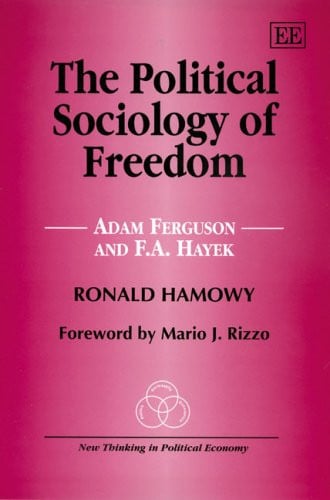
The political sociology of freedom: Adam Ferguson and F.A. Hayek

Hamowy, Ronald
Adam Ferguson and Friedrich Hayek, separated by a period of almost two hundred years, made original but similar contributions to the field of theoretical sociology. In this collection of essays, Ronald Hamowy explores the life and work of these two thinkers, giving special emphasis to their insights into the diffusion of knowledge. Ferguson, a giant of the Scottish Enlightenment, can be credited with laying the foundations of theoretical history by first proposing the idea that social institutions undergo evolutionary change. He theorized that while these institutions are formed by the actions of human beings, they are not the product of human design. Less than two centuries later, Hayek extended this insight to dealing with economic and social interaction, arguing that the knowledge requisite for structuring the social institutions under which we live is far too complex to be comprehended by any one mind or group of thinkers, and that these institutions had in fact evolved over long periods of time without deliberate design. Hayek was also the first to introduce the notion that market processes are a function of all participants contributing the limited knowledge that each possesses, out of which an orderly arrangement of enormous complexity emerges. Scholars and students of sociology, economics, history and political theory will find The Political Sociology of Freedom a unique and provocative read.
Edward Elgar 2005 265 pages