11 results for "History"

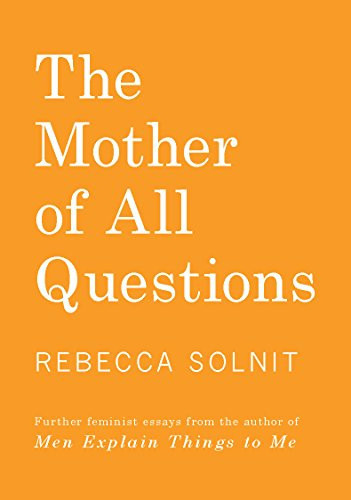
The Mother of All Questions

Rebecca Solnit
In a timely follow-up to her national bestseller Men Explain Things to Me, Rebecca Solnit offers indispensable commentary on women who refuse to be silenced, misogynistic violence, the fragile masculinity of the literary canon, the gender binary, the recent history of rape jokes, and much more. In characteristic style, Solnit mixes humor, keen analysis, and powerful insight in these essays.
Haymarket Books 2019-09-20 192 pages

Let there be laughter: a treasury of great Jewish humor & what it all means

Krasny, Michael
"Krasny delves deeply into the themes, topics and forms of Jewish humor: chauvinism undercut by irony and self-mockery; the fear of losing cultural identity through assimilation; the importance of vocal inflection in joke-telling; and calls to communal memory, including the use of Yiddish."--Book jacket.
William Morrow, An Imprint HarperCollins Publishers 2016-09-27 279 pages

The Jewish Joke A Short History-with Punchlines

Devorah Baum
Comedy is full of famously funny Jews, from Groucho Marx to Larry David to Sarah Silverman. This smart and funny book includes tales from many of these much-loved comics, and will appeal to their broad audience, while revealing the history, context, and wider culture of Jewish joking.The Jewish joke is as old as Abraham, and like the Jews themselves it has wandered over the world, learned countless new languages, worked with a range of different materials, been performed in front of some pretty hostile crowds, and yet still retained its own distinctive identity. So what is it that animates the Jewish joke? Why are Jews so often thought of as "funny"? And how old can a joke get?With jokes from Lena Dunham to Woody Allen, as well as Freud and Marx (Groucho, mostly), Baum balances serious research with light-hearted humor and provides fascinating insight into this wellknown and much loved cultural phenomenon.
Pegasus Books 2019-11-12 208 pages

Secret Ingredients The New Yorker Book of Food and Drink

David Remnick
The New Yorker dishes up a feast of delicious writing–food and drink memoirs, short stories, tell-alls, and poems, seasoned with a generous dash of cartoons. “To read this sparely elegant, moving portrait is to remember that writing well about food is really no different from writing well about life.”— Saveur (Ten Best Books of the Year) Since its earliest days, The New Yorker has been a tastemaker—literally. In this indispensable collection, M.F.K. Fisher pays homage to “cookery witches,” those mysterious cooks who possess “an uncanny power over food,” and Adam Gopnik asks if French cuisine is done for. There is Roald Dahl’s famous story “Taste,” in which a wine snob’s palate comes in for some unwelcome scrutiny, and Julian Barnes’s ingenious tale of a lifelong gourmand who goes on a very peculiar diet. Selected from the magazine’s plentiful larder, Secret Ingredients celebrates all forms of gustatory delight. A sample of the menu: Roger Angell on the art of the martini • Don DeLillo on Jell-O • Malcolm Gladwell on building a better ketchup • Jane Kramer on the writer’s kitchen • Chang-rae Lee on eating sea urchin • Steve Martin on menu mores • Alice McDermott on sex and ice cream • Dorothy Parker on dinner conversation • S. J. Perelman on a hollandaise assassin • Calvin Trillin on New York’s best bagel Whether you’re in the mood for snacking on humor pieces and cartoons or for savoring classic profiles of great chefs and great eaters, these offerings from The New Yorker ’s fabled history are sure to satisfy every taste.
Random House Publishing Group 2009-11-03 608 pages

Schmucks! LP Our Favorite Fakes, Frauds, Lowlifes, Liars, the Armed and Dangerous, and Good Guys Gone Bad

Jackie Mason,Raoul Felder
Jackie Mason, one of the true kings of comedy, and his partner in crime, former federal prosecutor and celebrity attorney Raoul Felder, go after America's lowlifes, scumbags, and everyone else who really gets on their nerves. This book spares no one. Politicians, sports stars, celebrities, corporations, publishers, crossing guards—they're all fair game. If you are a Schmuck, or just someone who Jackie and Raoul find annoying, there is a fair chance you are on the list. Schmucks! combines Mason's and Felder's nails-to-the-wall political satire—impeccable timing with insightful observations on the foibles of modern life—to create material that will leave you crying with laughter. Just a few of the Schmucks included: Bill Clinton Mel Gibson Barbra Streisand Katie Couric Barry Bonds And a cast of hundreds
Harper Collins 2007-03-27 288 pages

˜Theœ Apprenticeship of a Mathematician

Weil, André
"Extremely readable recollections of the author... A rare testimony of a period of the history of 20th century mathematics. Includes very interesting recollections on the author's participation in the formation of the Bourbaki Group, tells of his meetings and conversations with leading mathematicians, reflects his views on mathematics. The book describes an extraordinary career of an exceptional man and mathematicians. Strongly recommended to specialists as well as to the general public." EMS Newsletter (1992) "This excellent book is the English edition of the author's autobiography. ... This very enjoyable reading is recommended to all mathematicians." Acta Scientiarum Mathematicarum (1992)
Springer Basel 2012-10-09 197 pages

Berlin! Berlin! Dispatches from the Weimar Republic

Kurt Tucholsky
Berlin! Berlin! is a satirical selection from the "man with the acid pen and the perfect pitch for hypocrisy," as New York author and Tucholsky-expert Peter Wortsman writes. This book os a complete collection of Tucholsky's news stories, features, satirical pieces, and poems about his hometown Berlin. It depicts Weimar Berlin, its cabarets, its policies, its follies, its ticks, and its celebrities, such as Pola Negri, Gussy Holl, Bert Brecht, Max Reinhardt, or Heinrich Zille. The book contains some of Tucholsky's most famous pieces, among them Berlin! Berlin!, a feature of the stereotypical Berliner on the phone, on vacation or doing "bizness", more than one satirical biography of the author himself, and some of his most famed stories such as where the holes in the cheese come from, or about the lion who escaped the Berlin zoo. Herr Wendriner, the chatty Berlin businessman makes an appearance, as well as Lottchen, the flapper, modelled after one of Tucholsky's real-life gilrfriends. Also Tucholsky's long-term friends Karlchen and Jakopp are part of this book. In Weimar Germany, Tucholsky was big, the most brilliant, prolific and witty cultural journalist of his time. He poured scorn on the reactionary institutions of the old regime, the follies of the Weimar Republic, and the peculiarities of the German character. - William Grimes, The New York Times Imagine a writer with the acid voice of Christopher Hitchens and the satirical whimsy of Jon Stewart. That's Tucholsky in a nutshell. - Anne Nelson, author of "The Red Orchestra" and "The Guys" Kurt Tucholsky was one of the most brilliant German-Jewish writers of his time. Today's Berliners adore him as one of their greatest sons. The world has yet to discover his genius. -Peter Schneider, author of "The Wall Jumper" and "Eduard's Homecoming" A selection from the man with the acid pen and the perfect pitch for hypocrisy, who was as much the voice of 1920s Berlin as Georg Grosz was its face. - Peter Wortsman, author of "Ghost Dance in Berlin" . . . a small, fat Berliner, who wanted to stop a catastrophe with his typewriter. -Erich Kästner, author of "Emil and the Detectives"
Berlinica 2017-05 202 pages

Fisch Stories Reflections on Life, Liberty, and the Pursuit of Happiness

Robert O. Fisch
"I have been a Jew during Fascism, a bourgeois under Communism, a rebel defeated in an uprising, a refugee among the free, and a have-not amid plenty. This book contains over 60 stories that range from my youth in Hungary, the ordeal of a death march and concentration camps, the oppression of the Communist dictatorship, the promise and defeat of the Hungarian Revolution and, finally, my American years"--Preminary pages
R. Fisch 2009 154 pages

Germany? Germany! Satirical Writings: The Kurt Tucholsky Reader

KURT. TUCHOLSKY
Kurt Tucholsky was a brilliant satirist, poet, storyteller, lyricist, pacifist, and Democrat; a fighter, lady's man, reporter, and early warner against the Nazis who hated and loathed him and drove him out of Germany after his books were burned in 1933. His contemporary Erich Kaestner called him a "small, fat Berliner," who "wanted to stop a catastrophe with his typewriter." The New York Times hailed him as "one of the most brilliant writers of republican Germany. He was a poet as well as a critic and was so versatile that he used five or six pen names. As Peter Panter he was an outstanding essayist who at one time wrote topical sketches in the Vossische Zeitung, which ceased to appear under the Nazi regime; as Theobald Tiger he wrote satirical poems that were frequently interpreted by popular actors in vaudeville and cabartes, and as Ignatz Wrobel he contributed regularly to the Weltbühne, an independent weekly that was one of the first publications prohibited by the Hitler government." Tucholsky, who occupied the center stage in the tumultuous political and cultural world of 1920s Berlin, still emerges as an astonishingly contemporary figure. As an angry truth-teller, he pierced the hypocrisy and corruption around him with acute honesty. Imagine a writer with the acid voice of Christopher Hitchens and the satirical whimsy of Jon Stewart, combined with the iconoclasm of Bill Maher. That's Tucholsky in a nutshell. Like Hitchens, Tucholsky wrote a mixture of literary essays, social observations, and political commentary. His irony made the line between his "serious writing" and his "entertainments" almost invisible. The fashionable outsider watched the political "center" disappear, and, in the end, he found himself catapulted out of society altogether. His career was sandwiched between the two most deadly events of his century: the bloodbath of World War I and the scourge of Nazism. Just as the first war launched Hemingway's lifelong career as a wounded tough guy with a soft spot for guns and broads, Tucholsky discovered the reflexes of an escape artist. He was equally elusive as a writer. In today's world, a journalist isn't supposed to write plays, and a playwright isn't welcomed as a novelist. But in 1920s Berlin, Tucholsky was dealing with postwar realities that required shouting from the rooftops, and any rooftop would do. Kurt Tucholsky is one of Weimar Germany's most celebrated literary figures, loved by his many readers and hated by the Nazis. The poet, journalist, and satirist who was at the center of the tumultuous political and cultural world of 1920s Berlin still emerges as an astonishingly contemporary figure. But he was more than just an angry truth-teller; he was also one of the funniest satirical writers of his era, depicting everyday lives during the rise of modernity.The iconic translation of Harry Zohn, a literary figure from Vienna himself, presented Tucholsky to an American audience for the first time. Long out of print, Zohn's book is now being republished in a new edition.
Berlinica 2017-06 208 pages

Herblock Special Report

Herbert Block
This book obviously does not set out a complete record of the Nixon scandals or of the Nixon career. It doesn't even include all the cartoons about Nixon or relating to him--which probably number more than those Block did on almost any other public figure (good or bad), including such long-in-the-limelight persons as Franklin D. Roosevelt and Joseph Stalin. It does include a large number of the Nixon cartoons, along with dates of some incidents, and comments and recollections about their subject--a political career which in some way has affected all of us.
W. W. Norton, Incorporated 1976-09 260 pages