22 results for "History"

Bag man: the wild crimes, audacious cover-up & spectacular downfall of a brazen crook in the White House

Maddow, Rachel,Yarvitz, Michael
"The knockdown, drag-out, untold story of the other scandal that rocked Nixon's White House, and reset the rules for crooked presidents to come-with new reporting that expands on Rachel Maddow's Peabody Award-nominated podcast. Is it possible for a sitting vice president to direct a vast criminal enterprise within the halls of the White House? To have one of the most brazen corruption scandals in American history play out while nobody's paying attention? And for that scandal to be all but forgotten decades later? The year was 1973, and Spiro T. Agnew, the former governor of Maryland, was Richard Nixon's second-in-command. Long on firebrand rhetoric and short on political experience, Agnew had carried out a bribery and extortion ring in office for years, when-at the height of Watergate-three young federal prosecutors discovered his crimes and launched a mission to take him down before it was too late, before Nixon's impending downfall elevated Agnew to the presidency. The self-described "counterpuncher" vice president did everything he could to bury their investigation: dismissing it as a "witch hunt," riling up his partisan base, making the press the enemy, and, with a crumbling circle of loyalists, scheming to obstruct justice in order to survive. In this blockbuster account, Rachel Maddow and Michael Yarvitz detail the investigation that exposed Agnew's crimes, the attempts at a cover-up-which involved future president George H. W. Bush-and the backroom bargain that forced Agnew's resignation but also spared him years in federal prison. Based on the award-winning hit podcast, Bag Man expands and deepens the story of Spiro Agnew's scandal and its lasting influence on our politics, our media, and our understanding of what it takes to confront a criminal in the White House."--
Crown 2020-12-08 291 pages

Stephen Hawking

Mlodinow, Leonard
An icon of the last fifty years, Stephen Hawking seems to encapsulate genius- not since Albert Einstein has a scientific figure held such a position in popular consciousness. In this enthralling memoir, writer and physicist Leonard Mlodinow tells the story of his friend and their friendship, offering an intimate account of this giant of science. The two met in 2003, when Stephen asked Leonard if he would consider writing a book with him, the follow up to the bestselling A Brief History of Time. As they spent years working on a second book, The Grand Design, they forged a deep connection and Leonard gained a much better understanding of Stephen's daily life and struggles, as well as his compassion and good humour. Together they obsessed over the perfect sentence, debated the physics, and occasionally punted on Cambridge's waterways with champagne and strawberries. In time, Leonard was able to finish Stephen's jokes, chide his sporadic mischief, and learn how the hardships of his illness helped forge that unique perspective on the universe. By weaving together their shared story with a clear-sighted portrayal of Hawking's scientific achievements, Mlodinow creates a beautiful portrait of Stephen Hawking as a brilliant, impish and generous man whose life was not only exceptional but also genuinely inspiring.
Allen Lane 2020 219 pages

Thanks, Obama: my hopey changey White House years

Litt, David
"A different kind of White House memoir, presidential speechwriter David Litt's comic account of his years spent working with Barack Obama and his reflection on Obama's legacy in the age of Trump. Like many twentysomethings, David Litt frequently embarrassed himself in front of his boss's boss. Unlike many twentysomethings, Litt's boss's boss was President Obama. At age twenty-four, Litt became one of the youngest White House speechwriters in history. Along with remarks on issues like climate change and criminal justice reform, he was the president's go-to writer for comedy. As the lead on the White House Correspondents' Dinner speech (the "State of the Union of jokes"), he was responsible for some of President Obama's most memorable moments, including Keegan-Michael Key's appearance as Luther, Obama's "anger translator." With a humorist's eye for detail and a convert's zeal, Litt takes us inside his eight years on the front lines of Obamaworld. In his political coming-of-age story, he goes from starry-eyed college student--a self-described "Obamabot"--to nervous junior speechwriter to White House senior staff. His behind-the-scenes anecdotes answer questions you never knew you had: What's the classiest White House men's room? What's the social scene like on Air Force One? How do you force the National Security Council to stop hitting reply-all on every e-mail? In between lighthearted observations, Litt uses his experience to address one of today's most important issues: the legacy and future of the Obama movement in the age of Donald Trump"--
Ecco 2017-09-19 310 pages

Thanks, Obama: my hopey changey White House years

Litt, David
"A different kind of White House memoir, presidential speechwriter David Litt's comic account of his years spent working with Barack Obama and his reflection on Obama's legacy in the age of Trump. Like many twentysomethings, David Litt frequently embarrassed himself in front of his boss's boss. Unlike many twentysomethings, Litt's boss's boss was President Obama. At age twenty-four, Litt became one of the youngest White House speechwriters in history. Along with remarks on issues like climate change and criminal justice reform, he was the president's go-to writer for comedy. As the lead on the White House Correspondents' Dinner speech (the "State of the Union of jokes"), he was responsible for some of President Obama's most memorable moments, including Keegan-Michael Key's appearance as Luther, Obama's "anger translator." With a humorist's eye for detail and a convert's zeal, Litt takes us inside his eight years on the front lines of Obamaworld. In his political coming-of-age story, he goes from starry-eyed college student--a self-described "Obamabot"--to nervous junior speechwriter to White House senior staff. His behind-the-scenes anecdotes answer questions you never knew you had: What's the classiest White House men's room? What's the social scene like on Air Force One? How do you force the National Security Council to stop hitting reply-all on every e-mail? In between lighthearted observations, Litt uses his experience to address one of today's most important issues: the legacy and future of the Obama movement in the age of Donald Trump"--
Ecco 2018-09-04 310 pages

First cameraman: documenting the Obama presidency in real time

Chaudhary, Arun
"The first official White House videographer chronicles his time capturing behind-the-scenes moments of the president and his administrationFrom the early months of the 2008 campaign and through the first two and a half years of the Obama administration, Arun Chaudhary had a unique perspective on the president of the United States. "I'm sort of like President Obama's wedding videographer," he explains, "if every day was a wedding with the same groom but a constantly rotating set of hysterical guests."Some of the moments Chaudhary captures are small, like the president throwing warm-up pitches deep inside Busch Stadium in St. Louis before the All-Star game. Some are intensely emotional, as when Obama comforts a grieving teenager whose father had died in a devastating tornado. And some are just plain bizarre--like getting thrown out of the Indian parliament by his belt, or being trapped in a White House bathroom while Obama conducts a YouTube town hall on the other side of the door. Film and politics have been intertwined ever since the first Edison reels rattled in projection halls a century ago. But with the advent of new technologies and a new public that is hungry for images of their leaders, Chaudhary has been in the right place at the right time to participate in the interplay of film and politics at the very highest level. His entertaining and eye-opening book--which includes stories and images of key players such as Barack and Michelle Obama, Joe Biden, and Hillary Clinton, among others--gives readers a unique view of their government and their president in these historic and challenging times"--
Times Books 2012-08-21 306 pages

True believer: Stalin's last American spy

Marton, Kati
“Relevant...fascinating...vividly reconstructed.” — The New York Times Book Review “Riveting reading...a mesmerizing look at Cold War espionage.” — USA TODAY This astonishing real-life spy thriller, filled with danger, misplaced loyalties, betrayal, treachery, and pure evil, with a plot twist worthy of John le Carré, is relevant today as a tale of fanaticism and the lengths it takes us to. True Believer reveals the life of Noel Field, an American who betrayed his country and crushed his family. Field, once a well-meaning and privileged American, spied for Stalin during the 1930s and '40s. Then, a pawn in Stalin’s sinister master strategy, Field was kidnapped and tortured by the KGB and forced to testify against his own Communist comrades. How does an Ivy League-educated, US State Department employee, deeply rooted in American culture and history, become a hardcore Stalinist? The 1930s, when Noel Field joined the secret underground of the International Communist Movement, were a time of national collapse: ten million Americans unemployed, rampant racism, retreat from the world just as fascism was gaining ground, and Washington—pre FDR—parched of fresh ideas. Communism promised the righting of social and political wrongs and many in Field’s generation were seduced by its siren song. Few, however, went as far as Noel Field in betraying their own country. With a reporter’s eye for detail, and a historian’s grasp of the cataclysmic events of the twentieth century, Kati Marton captures Field’s riveting quest for a life of meaning that went horribly wrong. True Believer is supported by unprecedented access to Field family correspondence, Soviet Secret Police records, and reporting on key players from Alger Hiss, CIA Director Allen Dulles, and World War II spy master, “Wild Bill” Donovan—to the most sinister of all: Josef Stalin. A story of another time, this is a tale relevant for all times.
Simon & Schuster 2016-09-06 289 pages

Counselor: a life at the edge of history

Sorensen, Theodore C.
In this gripping memoir, John F. Kennedy's closest advisor recounts in full for the first time his experience counseling Kennedy through the most dramatic moments in American history.... from the decision to go to the moon to the Cuban Missile Crisis, when JFK requested that the thirty-four-year-old Sorensen draft the key letter to Khrushchev at the most critical point of the world's first nuclear confrontation. After Kennedy was assassinated, Sorensen stayed with President Johnson for a few months before leaving to write a biography of JFK. In 1968 he returned to Washington to help run Robert Kennedy's presidential campaign. Through it all, Sorensen never lost sight of the ideals that brought him to Washington and to the White House, working tirelessly to promote and defend free, peaceful societies.--From publisher's description.
Harper 2008-05-06 556 pages

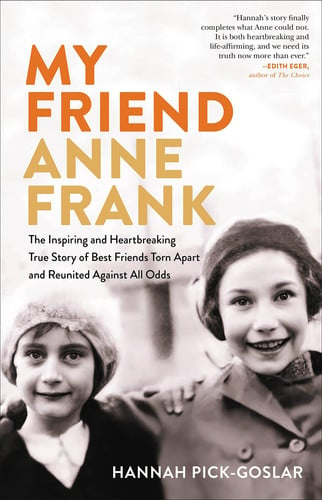
My friend Anne Frank: the inspiring and heartbreaking true story of best friends torn apart and reunited against all odds

Pick-Goslar, Hannah,Kraft, Dina
"In 1933, Hannah Pick-Goslar and her family fled Nazi Germany to live in Amsterdam, where she struck up a close friendship with her next-door neighbor, an outspoken and fun-loving young girl named Anne Frank. For several years, the inseparable pair enjoyed a carefree childhood of games, sleepovers, and treats with the other children in their neighborhood of Rivierenbuurt. But in 1942, Hannah and Anne's lives abruptly changed forever. As the Nazi occupation of Amsterdam progressed, Anne and the Frank family seemingly vanished, leaving behind unmade beds and dishes in the sink--but no trace of Anne's precious diary. Torn from her dear friend without warning, Hannah spent the next two years tormented by questions about Anne's fate, wondering if she had, by some miracle, managed to escape danger. In this long-awaited memoir, Hannah shares the story of her childhood during the Holocaust, from the introduction of anti-Jewish laws in Amsterdam to the gradual disappearance of classmates and, eventually, the Frank family, to Hannah and her family's imprisonment in the Bergen-Belsen concentration camp. As Hannah chronicles the experiences of her own life during and after the war, she provides a searing look at what countless children endured at the hands of the Nazi regime, as well as an intimate, never-before-seen portrait of the most recognizable victim of the Holocaust. Culminating in an astonishing fateful reunion, My Friend Anne Frank is the profoundly moving story of childhood and friendship during one of the darkest periods in the world's history"--Dust jacket flap.
Little, Brown Spark 2023 313 pages

Ex-friends

Podhoretz, Norman
Allen Ginsberg, Lionel and Diana Trilling, Lillian Hellman, Hannah Arendt, and Norman Mailer -- all are ex-friends of Norman Podhoretz, the renowned editor and critic and leading member of the group of New York intellectuals who came to be known as "the Family." As only a family member could, Podhoretz tells the story of these friendships, once central to his life, and shows how the political and cultural struggles of the past fifty years made them impossible to sustain. With wit, piercing insight, and startling honesty, we are introduced as never before to a type of person for whom ideas were often matters of life and death, and whose passing from the scene has left so large a gap in American culture. Podhoretz was the trailblazer of the now-famous journey of a number of his fellow intellectuals from radicalism to conservatism -- a journey through which they came to exercise both cultural and political influence far beyond their number. With this fascinating account of his once happy and finally troubled relations with these cultural icons, Podhoretz helps us understand why that journey was undertaken and just how consequential it became. In the process we get a brilliantly illuminating picture of the writers and intellectuals who have done so much to shape our world. Combining a personal memoir with literary, social, and political history, this unique gallery of stern and affectionate portraits is as entertaining as a novel and at the same time more instructive about postwar American culture than a formal scholarly study. Interwoven with these tales of some of the most quixotic and scintillating of contemporary American thinkers are themes that are introduced, developed, and redeveloped in a variety of contexts, with each appearance enriching the others, like a fugue in music. It is all here: the perversity of brilliance; the misuse of the mind; the benightedness of people usually considered especially enlightened; their human foibles and olympian detachment; the rigors to be endured and the prizes to be won and the prices to be paid for the reflective life. Most people live their lives in a very different way, and at one point, in a defiantly provocative defense of the indifference shown to the things by which intellectuals are obsessed, Norman Podhoretz says that Socrates' assertion that the unexamined life was not worth living was one of the biggest lies ever propagated by a philosopher. And yet, one comes away from Ex-Friends feeling wistful for a day when ideas really mattered and when there were people around who cared more deeply about them than about anything else. Reading of a time when the finest minds of a generation regularly gathered in New York living rooms to debate one another with an articulateness, a passion, and a level of erudition almost extinct, we come to realize how enviable it can be to live a life as poignantly and purposefully examined as Norman Podhoretz's is in Ex-Friends.
Free Press 1999-02-21 244 pages

Icon of evil: Hitler's Mufti and the rise of radical Islam

Dalin, David G.
A political biography of Haj Amin al-Husaini (1895-1974), the Palestinian Arab nationalist leader and one-time Mufti of Jerusalem. Husaini adopted aggressive antisemitism in his youth, while studying in Cairo. He bears responsibility for the bloody anti-Jewish riots in the Land of Israel in 1920, 1921, and 1929, and was an instigator of the Arab revolt of 1936-39 in the country. In the 1930s he was close with Nazi leaders, with whom he shared extreme antisemitism and the goal of annihilation of the Jews. In the 1940s Husaini was instrumental in the establishment of pro-Nazi Muslim military formations in Europe, among them the Bosnian SS division "Handschar", which killed 12,600 Bosnian Jews. Argues that Husaini's legacy is alive in the modern Muslim world. He was the link between World War II antisemitism and the modern Islamic one, as well as a founding father of radical Islamic antisemitism. Dwells on the latter, which adopted from the West belief in the "Protocols of the Elders of Zion", blood libels, Holocaust denial, etc.
Transaction Publishers 2009 227 pages

The fall of the house of Roosevelt: brokers of ideas and power from FDR to LBJ

Janeway, Michael
In the 1930s a band of smart and able young men, some still in their twenties, helped Franklin D. Roosevelt transform an American nation in crisis. They were the junior officers of the New Deal. Thomas G. Corcoran, Benjamin V. Cohen, William O. Douglas, Abe Fortas, and James Rowe helped FDR build the modern Democratic Party into a progressive coalition whose command over power and ideas during the next three decades seemed politically invincible. This is the first book about this group of Rooseveltians and their linkage to Lyndon Johnson's Great Society and the Vietnam War debacle. Michael Janeway grew up inside this world. His father, Eliot Janeway, business editor of Time and a star writer for Fortune and Life magazines, was part of this circle, strategizing and practicing politics as well as reporting on these men. Drawing on his intimate knowledge of events and previously unavailable private letters and other documents, Janeway crafts a riveting account of the exercise of power during the New Deal and its aftermath. He shows how these men were at the nexus of reform impulses at the electoral level with reform thinking in the social sciences and the law and explains how this potent fusion helped build the contemporary American state. Since that time efforts to reinvent government by "brains trust" have largely failed in the U.S. In the last quarter of the twentieth century American politics ceased to function as a blend of broad coalition building and reform agenda setting, rooted in a consensus of belief in the efficacy of modern government. Can a progressive coalition of ideas and power come together again? The Fall of the House of Roosevelt makes such a prospect both alluring and daunting.
Columbia University Press 2004 284 pages

Philip Roth: stung by life

Zipperstein, Steven J.
"Philip Roth (1933-2018) is one of the most celebrated American writers of his age. Born in Newark, New Jersey -- where his short stories and thirty-one books were often set -- he wrote with immense ambition and drive, along with a keen awareness of what must be done to produce great literature. Yet despite rubbing shoulders with the Kennedys and engaging in a spate of famous and infamous romances, he viewed himself as socially withdrawn, living much like an "unchaste monk" (his words). In this original and lucid biography, Steven J. Zipperstein captures Roth's complex life and the astonishing range of his self-reflective writings-from "Goodbye, Columbus" and "Portnoy's complaint" to the Pulitzer Prize-winning "American pastoral" and "The plot against America." Employing extensive archival research and well over one hundred interviews, including conversations with Roth himself, Zipperstein provides an intimate and probing look at one of the twentieth century's most influential authors, placing his work in the context of Jewishness, freedom, and sexuality in America"-- Provided by publisher.
Yale University Press 2025-10-14 346 pages

Adventures of a bystander

Drucker, Peter F.
"It is [a] belief in diversity and pluralism and the uniqueness of each person that underlies all my writings . . . " -from the Preface. Regarded as the most influential and widely read thinker on modern organizations and their management, Peter Drucker has also established himself as an unorthodox and independent analyst of politics, the economy, and society. A man of impressive scope and expertise, he has paved significant inroads in a number of key areas, sharing his knowledge and keen insight on everything from the plight of the employee and the effects of technology to the vicissitudes of the markets and the future of the new world order. Adventures of a Bystander is Drucker's rich collection of autobiographical stories and vignettes, in which this legendary figure paints a portrait of his remarkable life, and of the larger historical realities of his time. In a style that is both unique and engaging, Drucker conveys his life story -from his early teen years in Vienna through the interwar years in Europe, the New Deal era, World War II, and the postwar period in America-through intimate profiles of a host of fascinating people he's known through the years. Their personal histories are, as Drucker tells us, the beads for which his own life serves as the string. A colorful group, these diverse, often unpredictable, always multidimensional individuals were chosen "because each of them, in his or her own highly personal way, reflects and refracts the thirty crucial years from the end of World War I to the first post-World War II decade-the thirty years that largely formed the world in which we now live." An amazing pageant of characters, both famous and otherwise, springs from these pages, illuminating and defining one of the most tumultuous periods in world history. Along with bankers and courtesans, artists, aristocrats, prophets, and empire-builders, we meet members of Drucker's own family and close circle of friends, among them such prominent figures as Sigmund Freud, Henry Luce, Alfred Sloan, John Lewis, and Buckminster Fuller. Playing to perfection their roles as those who "reflect and refract" the customs, beliefs, and attitudes of the times, these singular personalities lend Adventures of a Bystander a striking "you-are-there" feel. A brief encounter with Freud becomes the catalyst for an absorbing, multidimensional description of the economics, politics, and social psychology of pre-World War II Europe. Drucker introduces us to Fritz Kraemer, a brilliant, monocle-wearing eccentric who became an influential mentor to the young Henry Kissinger. His personal memoir of Henry Luce documents the development of modern journalism, while in "The Indian Summer of Innocence," he rescues and preserves the very heart of the American experience during the last New Deal years before World War II. Shedding light on a turbulent and important era, Adventures of a Bystander also reflects Peter Drucker himself as a man of imaginative sympathy and enormous interest in people, ideas, and history. These enthralling stories complement and complete the groundbreaking analytical writing for which he is so revered. Luminous autobiographical stories by one of the greatest thinkers of our time "The cast of characters among whom Drucker moves is superbly rich, and the informed glimpse he provides of a vanished social and political universe is an education in itself. Adventures of a Bystander is better than a novel, more lively than an essay, and as thoughtful as both at their best." -The Harvard Business Review. "Adventures of a Bystander is a virtuoso performance in which Drucker displays a dazzling diversity of personal interests and knowledge, an awesome power of recall, and a crisp, highly readable writing style." -BusinessWeek. "Adventures of a Bystander appears in a stroke to have restored the art of the memoir and of the essay. It will doubtless be a while before its like comes round again." -The Washington Post.
Wiley 1997 344 pages

The work of mourning

Derrida, Jacques
Jacques Derrida is, in the words of the New York Times , "perhaps the world's most famous philosopher—if not the only famous philosopher." He often provokes controversy as soon as his name is mentioned. But he also inspires the respect that comes from an illustrious career, and, among many who were his colleagues and peers, he inspired friendship. The Work of Mourning is a collection that honors those friendships in the wake of passing. Gathered here are texts—letters of condolence, memorial essays, eulogies, funeral orations—written after the deaths of well-known figures: Roland Barthes, Paul de Man, Michel Foucault, Louis Althusser, Edmond Jabès, Louis Marin, Sarah Kofman, Gilles Deleuze, Emmanuel Levinas, Jean-François Lyotard, Max Loreau, Jean-Marie Benoist, Joseph Riddel, and Michel Servière. With his words, Derrida bears witness to the singularity of a friendship and to the absolute uniqueness of each relationship. In each case, he is acutely aware of the questions of tact, taste, and ethical responsibility involved in speaking of the dead—the risks of using the occasion for one's own purposes, political calculation, personal vendetta, and the expiation of guilt. More than a collection of memorial addresses, this volume sheds light not only on Derrida's relation to some of the most prominent French thinkers of the past quarter century but also on some of the most important themes of Derrida's entire oeuvre-mourning, the "gift of death," time, memory, and friendship itself. "In his rapt attention to his subjects' work and their influence upon him, the book also offers a hesitant and tangential retelling of Derrida's own life in French philosophical history. There are illuminating and playful anecdotes—how Lyotard led Derrida to begin using a word-processor; how Paul de Man talked knowledgeably of jazz with Derrida's son. Anyone who still thinks that Derrida is a facetious punster will find such resentful prejudice unable to survive a reading of this beautiful work."—Steven Poole, Guardian "Strikingly simpa meditations on friendship, on shared vocations and avocations and on philosophy and history."— Publishers Weekly
University of Chicago Press 2003-09-15 262 pages

Virgil: a life

Levi, Peter
Born in 70 BC, in a small village near Mantua, Publius Vergilius Maro—Virgil—grew up to be hailed as the greatest Roman poet. And although his work has influenced Western literature for two millennia, little is known about the man himself. Who was the man who created the Aeneid—one of the most important poems in Western literature—and such universal phrases as “love conquers all” and “fortune favors the bold?” Peter Levi here reconstructs the poet's life, from a childhood largely shrouded in mystery to his work as a great literary genius and revolutionary poet, by examining archaeological and historical evidence from Augustan Rome, as well as through close readings of the poet's own work. “Virgil is an intensely personal poet, yet he is anonymous . . . My aim is not so ambitious as to try and restore his prestige single-handed. It has simply been to try to understand him in his original context.” In this highly acclaimed, nowclassic biography, Peter Levi discards the myths and brilliantly reveals the life of Virgil and the extraordinary times during which he lived.
Tauris Parke Paperbacks 2012-05-08 261 pages

Go-betweens for Hitler

Urbach, Karina
This is the untold story of how some of Germany's top aristocrats contributed to Hitler's secret diplomacy during the Third Reich, providing a direct line to their influential contacts and relations across Europe, especially in Britain, where their contacts included the press baron and Daily Mail owner Lord Rothermere and the future King Edward VIII. Using previously unexplored sources from Britain, Germany, the Netherlands, the Czech Republic, and the USA, this book unravels the story of top-level go-betweens such as the Duke of Coburg, grandson of Queen Victoria, and the seductive Stephanie von Hohenlohe, who rose from a life of poverty in Vienna to become a princess and an intimate of Adolf Hitler. As Urbach shows, Coburg and other senior aristocrats were tasked with some of Germany's most secret foreign policy missions from the First World War onwards, culminating in their role as Hitler's trusted go-betweens, as he readied Germany for conflict during the 1930s and later, in the Second World War. Tracing what became of these high-level go-betweens in the years after the Nazi collapse in 1945, from prominent media careers to sunny retirements in Marbella, the book concludes with an assessment of their overall significance in the foreign policy of the Third Reich.
Oxford University Press 2015 389 pages

An almost English life

Gross, Miriam
Miriam Gross, as a journalist and editor, has worked with some of the most influential figures of the 20th century poets, philosophers, playwrights and politicians. This book offers recollections from 40 years at the heart of English cultural life. Brought up in wartime Jerusalem, she was deposited by her parents, speaking no English, at the bohemian Dartington Hall School; and then continued her education at Oxford where eschewing her quiet, tea-drinking contemporaries at St Anne s she found her way into more glamorous academic circles. From there it was a short hop to pre-spell-check Fleet Street. Her descriptions whether she is having to mend her boss's bra on her first day at work, or rewriting Angus Wilson's slapdash book reviews, or being asked to make the women s pages of the Observer more raunchy show a merciless eye for the bogus and the absurd. Alongside reflections on everything from feminism and motherhood to education and anti-semitism, she recounts her numerous infatuations, both requited and unrequited, with the sort of self-deprecating candour that makes this memoir a classic of its kind.
Short Books 2012 200 pages