6 results for "History"

Settler colonialism and the transformation of anthropology: the politics and poetics of an ethnographic event

Wolfe, Patrick
This work analyzes the politics of anthropological knowledge from critical perspective that alters existing understandings of colonialism. At the same time, it produces insights into the history of anthropology. Organized around an historical reconstruction of the great anthropological controversy over doctrines of virgin birth, the book argues that the allegation a great deal about European colonial discourse and little if anything about indigenous beliefs. By means of an Australian example, the book shows not only that the alleged ignorance was an artefact of the anthropological theory that produced it, but also that the anthropology was an artefact of the anthropological theory that produced it, but also that the anthropology concerened has been closely tied into both the historical dispossesion and the continuing oppresion of native peoples. The author explores the links between metropolitan anthropological theory and local colonial politics from the 19th century up to the present, settler colonialism, and the ideological and sexual regimes that characterize it.
Cassell 1999-01-01 246 pages

The Indian Wars: battles, bloodshed, and the fight for freedom on the American Frontier

Treuer, Anton
From Lakota warrior Crazy Horse to legendary Geronimo of the Apache Wars, this sweeping history of the American West tells the story of those who defended Native American lands-and the Native American way of life-from the 1850s through the end of the nineteenth century. This majestic narrative reveals little-known tales of Native American history, setting each event in the larger historical context of the transformation of the West. In elegant National Geographic style, hundreds of illustrations, maps, photographs, and artwork lay bare the bloody conflicts between Native Americans and European encroachment. Five stirring chapters reveal the five major types of conflicts involving Native Americans- the wars of resistance, the wars between empires, the wars betweeen the tribes, the wars of conquest, and the wars of survival. Within each chapter, vivid accounts of each battle tell the gripping stories of the major players, the point of combustion, and the tragic results. Readers will also get to know each tribe as distinct people, ranging from the so-called "civilized tribes" to the more aggressive warrior cultures. Rarely seen photographs and illustrations paint a vivid portrait of the time, featuring such notable figures as Kit Carson and Sitting Bull. Filled with original National Geographic maps, informative timelines, and a complete index, this extraordinary book captures one of the most significant moments in American history.
National Geographic 2016 319 pages

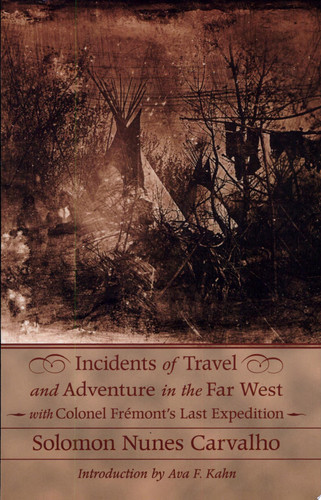
Incidents of travel and adventure in the Far West: with Colonel Fremont's last expedition across the Rocky Mountains, including three months' residence in Utah, and a perilous trip across the great American desert to the Pacific

Carvalho, Solomon Nunes
n August 1853, an American-born Sephardic Jew, Solomon Nunes Carvalho, accepted John Fremont's invitation to join his fifth expedition to find the best overland route to California. A Baltimore artist, inventor, and daguerreotypist, Carvalho was given the job of creating a photographic record of the lands and peoples along the way. Fremont's party left the Missouri on September 14, 1853, traveled up the Kansas River, overland to the Arkansas, upriver past Bent's Fort to the Huerfano, and traversed the Sandhill Pass into the Rocky Mountains. Beset by heavy snows and intense cold, they were reduced to eating their horses and mules and the occasional beaver or porcupine while making their way in midwinter across the Grand, Green, and Sevier Rivers. Suffering from frostbite, scurvy, and dysentery, Carvalho left the expedition in Utah; spent four months among the Mormons in Salt Lake City, where he observed with keen interest their system of spiritual wives; and reached California in 1854. Carvalho became the first Jewish writer to publish accounts of the Great American West and was also one of the first people to photograph the American West. Although only one of his plates is known to survive, others became the models for wood and steel engravings that broadcast the image of the West throughout the world. This Bison Books edition restores the discourses on Mormon doctrine omitted from previous twentieth-century editions. Ava F. Kahn is a visiting scholar at the California Studies Center, University of California, Berkeley. Her books include Jewish Voices of the California Gold Rush: A Documentary History, 1849-1880; Jewish Life in the American West: Perspectives on Migration, Settlement, and Community; and California Jews (coedited with Marc Dollinger).
University of Nebraska Press 2004-01-01 130 pages

The capture of Black Bart: gentleman bandit of the Old West

Finkelstein, Norman H.
"Black Bart was not the Old West's only stagecoach robber, but he was the most famous. To many people, he was a folk hero: a robber who didn't threaten or harm passengers. He was a bandit with a sense of humor who wrote poetry. In robbing at least 28 Wells Fargo stagecoaches across northern California between 1875 and 1883, he never fired a shot or injured anyone. His gun, it turned out, was never loaded. Newspaper stories about the poet robber's exploits and about Jim Hume, the unyielding chief detective of Wells Fargo, became popular reading throughout the West. Black Bart seemed to enjoy the chase. During one robbery the driver told him "They'll catch you one of these days." Bart answered, "Perhaps, but in the meantime give my regards to J. B. Hume, will you?" For eight years, each new robbery--and each new story--made Hume even more determined to track him down. Resources include a list of all Bart's robberies, notes, and bibliography, making this a rich resource for all Wild West readers."--Provided by publisher.
Chicago Review Press 2019 150 pages