6 results for "History"

Traces of God: seeing God in Torah, history and everyday life

Gillman, Neil
A Probing and Powerful Look at the Role You Play in Shaping Your Relationship with God "No matter how hard we look, the God of Israel cannot be seen. Looking is not seeing, and seeing God is not like seeing an apple. It is much more like making a medical diagnosis on the basis of looking at a complex set of symptoms. Each of the symptoms is a dot. We can look at the dots and still miss the pattern." --from Part I The Torah is replete with references to hearing God but precious few references to seeing God. Seeing is complicated. What we look for and see are traces of God's presence in the world and in history, but not God. In order to identify those traces as reflections of divine presence, we need to re-examine how we see, what we see, and how we interpret that information. In this challenging and inspiring look at the dynamics of the religious experience, award-winning author and theologian Neil Gillman guides you into a new way of seeing the complex patterns in the Bible, history, and everyday experiences and helps you interpret what those patterns mean to you and your relationship with God. Examining faith and doubt, revelation and law, suffering and redemption, Gillman candidly deconstructs familiar biblical moments in order to help you develop and refine your own spiritual vision, so that you are able to discern the presence of God in unanticipated ways.
Jewish Lights Pub 2006 216 pages

Of God who comes to mind

Lévinas, Emmanuel
The thirteen essays collected in this volume investigate the possibility that the word “God” can be understood now, at the end of the twentieth century, in a meaningful way. Nine of the essays appear in English translation for the first time. Among Levinas’s writings, this volume distinguishes itself, both for students of his thought and for a wider audience, by the range of issues it addresses. Levinas not only rehearses the ethical themes that have led him to be regarded as one of the most original thinkers working out of the phenomenological tradition, but he also takes up philosophical questions concerning politics, language, and religion. The volume situates his thought in a broader intellectual context than have his previous works. In these essays, alongside the detailed investigations of Husserl, Heidegger, Rosenzweig, and Buber that characterize all his writings, Levinas also addresses the thought of Kierkegaard, Marx, Bloch, and Derrida. Some essays provide lucid expositions not available elsewhere to key areas of Levinas’s thought. “God and Philosophy” is perhaps the single most important text for understanding Levinas and is in many respects the best introduction to his works. “From Consciousness to Wakefulness” illuminates Levinas’s relation to Husserl and thus to phenomenology, which is always his starting point, even if he never abides by the limits it imposes. In “The Thinking of Being and the Question of the Other,” Levinas not only addresses Derrida’s Speech and Phenomenon but also develops an answer to the later Heidegger’s account of the history of Being by suggesting another way of reading that history. Among the other topics examined in the essays are the Marxist concept of ideology, death, hermeneutics, the concept of evil, the philosophy of dialogue, the relation of language to the Other, and the acts of communication and mutual understanding.
Stanford University Press 1998 211 pages

Peoples of an almighty god: competing religions in the ancient world

Goldstein, Jonathan A.
Some ancient civilizations, notably the Babylonians and the Israelites, held fast to the belief that their particular god (or gods) were stronger than all other heavenly powers and gods combined, supremely able to protect their well-being and success as a nation. This belief (which resounds in the modern-day rallying cry "God is on our side") led to some foolhardy and rash decisions, particularly when it came to war. For a nation defeated or conquered by a foreign power inevitably faced the profound, perplexing question: "Why did our God, who has sworn to protect us, allow this to happen?" Jonathan A. Goldstein turns to the religious literature of these ancient peoples to discover how they reconciled their beliefs with the realities of history. In a magnificent blend of several academic disciples (literary criticism, political theory, biblical and classical history), he compares and contrasts the responses of different eras and nations–from the Israelites, Babylonians, and Egyptians to the Zoroastrians, Iranians, and Persians under Alexander the Great. Goldstein’s close readings of literature written following such devastating events as the fall of the Israelites to the Assyrians and the Babylonians demonstrate that theology, far from being a static and unchanging set of beliefs, evolves with the course of history. Revealing how each defeat helped to shape and define the religious beliefs of the conquered, Peoples of an Almighty God clearly demonstrates that no belief can remain unchanged or untouched by the beliefs of other people.
Yale University Press 2009 575 pages

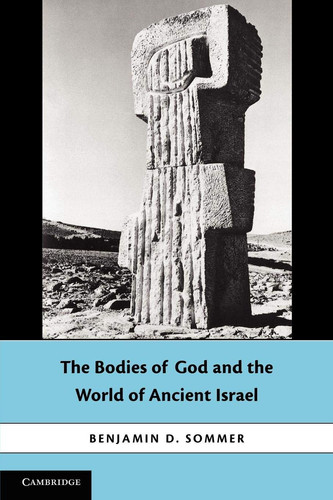
The bodies of God and the world of ancient Israel

Sommer, Benjamin D.
Sommer utilizes a lost ancient Near Eastern perception of divinity according to which a god has more than one body and fluid, unbounded selves. Though the dominant strains of biblical religion rejected it, a monotheistic version of this theological intuition is found in some biblical texts. Later Jewish and Christian thinkers inherited this ancient way of thinking; ideas such as the sefirot in Kabbalah and the trinity in Christianity represent a late version of this theology. This book forces us to rethink the distinction between monotheism and polytheism, as this notion of divine fluidity is found in both polytheistic cultures (Babylonia, Assyria, Canaan) and monotheistic ones (biblical religion, Jewish mysticism, Christianity), whereas it is absent in some polytheistic cultures (classical Greece). The Bodies of God and the World of Ancient Israel has important repercussions not only for biblical scholarship and comparative religion but for Jewish-Christian dialogue.
Cambridge University Press 2011-01-17 334 pages

God and the poets: the Gifford lectures, 1983

Daiches, David
Now available in paperback, this highly acclaimed work, hailed by The New York Times as "graceful, fluid, and extremely accessible," is a study of the ways in which poets from the biblical age to the present have addressed the subject of the nature and existence of God. The book treats such authors as Dante, the medieval Hebrew religious poets, the 17th-century religious poets, and the 18th century Nature poets, and discusses, among other topics, the influence of Calvinism and the poetry of stoicism, agnosticism, and atheism. Throughout the work, Daiches examines the tensions generated when a traditional religious belief which the poet accepts, or feels he should accept, runs counter to the hard facts of his own experience. The author also considers the particular problems which have emerged in this century for the religious poet who cannot accept any specific religious creed, and for readers who are unable to appreciate a poet's set of beliefs. God and the Poets does not set out to provide a comprehensive account of the poetic portrayals of God, but offers the reader a wealth of illuminating reflections on a subject which has obsessed poets over the ages.
Clarendon 1984 227 pages