30 results for "History"

The lost city of Z: a tale of deadly obsession in the Amazon

Grann, David
#1 NEW YORK TIMES BESTSELLER • From the author of Killers of the Flower Moon and The Wager comes a masterpiece of narrative nonfiction “with all the pace and excitement of a movie thriller”( The New York Times ) that unravels the greatest exploration mystery of the twentieth century—the story of the legendary British explorer who ventured into the Amazon jungle in search of a fabled civilization and never returned. "[Grann is] one of the preeminent adventure and true-crime writers working today."— New York Magazine After stumbling upon a hidden trove of diaries, acclaimed writer David Grann set out to determine what happened to the British explorer Percy Fawcett and his quest for the Lost City of Z. For centuries Europeans believed the Amazon, the world’s largest rain forest, concealed the glittering kingdom of El Dorado. Thousands had died looking for it, leaving many scientists convinced that the Amazon was truly inimical to humankind. In 1925 Fawcett ventured into the Amazon to find an ancient civilization, hoping to make one of the most important discoveries in history. Then he vanished. Over the years countless perished trying to find evidence of his party and the place he called “The Lost City of Z.” In this masterpiece, journalist David Grann interweaves the spellbinding stories of Fawcett’s quest for “Z” and his own journey into the deadly jungle. Look for David Grann’s latest bestselling book, The Wager !
Vintage book 2010-01-26 400 pages

Wanderlust

Solnit, Rebecca
Drawing together many histories-of anatomical evolution and city design, of treadmills and labyrinths, of walking clubs and sexual mores-Rebecca Solnit creates a fascinating portrait of the range of possibilities presented by walking. Arguing that the history of walking includes walking for pleasure as well as for political, aesthetic, and social meaning, Solnit focuses on the walkers whose everyday and extreme acts have shaped our culture, from philosophers to poets to mountaineers. She profiles some of the most significant walkers in history and fiction-from Wordsworth to Gary Snyder, from Jane Austen's Elizabeth Bennet to Andre Breton's Nadja-finding a profound relationship between walking and thinking and walking and culture. Solnit argues for the necessity of preserving the time and space in which to walk in our ever more car-dependent and accelerated world.
Verso 2002 326 pages

The pursuit of happiness: how classical writers on virtue inspired the lives of the founders and defined America

Rosen, Jeffrey
"The Declaration of Independence identified "the pursuit of happiness" as one of our unalienable rights, along with life and liberty. Jeffrey Rosen, the president of the National Constitution Center, profiles six of the most influential founders--Benjamin Franklin, George Washington, John Adams, Thomas Jefferson, James Madison, and Alexander Hamilton--to show what pursuing happiness meant in their lives, and to give us the "best and most readable introduction to the ideas of the Founders that we have" (Gordon Wood, author of Power and Liberty). By reading the classical Greek and Roman moral philosophers who inspired the Founders, Rosen shows us how they understood the pursuit of happiness as a quest for being good, not feeling good--the pursuit of lifelong virtue, not short-term pleasure. Among those virtues were the habits of industry, temperance, moderation, and sincerity, which the Founders viewed as part of a daily struggle for self-improvement, character development, and calm self-mastery. They believed that political self-government required personal self-government. For all six Founders, the pursuit of virtue was incompatible with enslavement of African Americans, although the Virginians betrayed their own principles." -- From the publisher's website.
Simon & Schuster Paperbacks 2025-09-02 355 pages

Ghostbusters: the ultimate visual history

Wallace, Daniel,Aykroyd, Dan,Reitman, Ivan
"Who you gonna call? The Ghostbusters saga has been thrilling fans around the world for over three decades, from the original movies to the animated shows, comics, video games, toys, and other collectibles. For the first time, Ghostbusters: The Ultimate Visual History takes a comprehensive look at the entire franchise, telling the complete story behind the creation of a true pop culture phenomenon. Beginning with an in-depth look at the original film, Ghostbusters: The Ultimate Visual History delves into the archives to showcase a wealth of never-before-seen concept art and photography that will take fans into the production of a true classic. Also featuring a large section on Ghostbusters II, the book brings together exclusive interviews with the key players from both films, including director Ivan Reitman; stars Dan Aykroyd, Ernie Hudson, and Sigourney Weaver; and producers Michael C. Gross and Joe Medjuck."--Provided by Amazon.com.
Insight Editions 2015-10-27 222 pages

A monetary history of the United States, 1867-1960

Friedman, Milton
Writing in the June 1965 issue of the "Economic Journal", Harry G. Johnson begins with a sentence seemingly calibrated to the scale of the book he set himself to review: 'The long-awaited "Monetary History of the United States" by Friedman and Schwartz is in every sense of the term a monumental scholarly achievement - monumental in its sheer bulk, monumental in the definitiveness of its treatment of innumerable issues, large and small ...monumental, above all, in the theoretical and statistical effort and ingenuity that have been brought to bear on the solution of complex and subtle economic issues'.Friedman and Schwartz marshaled massive historical data and sharp analytics to support the claim that monetary policy - steady control of the money supply - matters profoundly in the management of the nation's economy, especially in navigating serious economic fluctuations. In their influential chapter 7, "The Great Contraction" - which Princeton published in 1965 as a separate paperback - they address the central economic event of the century, the Depression. According to Hugh Rockoff, writing in January 1965: 'If Great Depressions could be prevented through timely actions by the monetary authority (or by a monetary rule), as Friedman and Schwartz had contended, then the case for market economies was measurably stronger.' Milton Friedman won the Nobel Prize in Economics in 2000 for work related to "A Monetary History " as well as to his other Princeton University Press book, "A Theory of the Consumption Function" (1957). Review: "A monumental scholarly accomplishment... [sets] a new standard for the writing of monetary history.
Princeton University Press 1971 860 pages

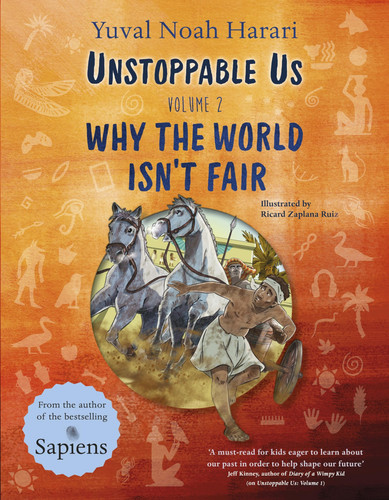
Unstoppable us: volume 2: why the world isn't fair

Harari, Yuval N.
Something really strange happened 10,000 years ago, and it changed everything. Why did millions of people agree to obey a few leaders? Where did kings and kingdoms come from? The answer to that is one of the strangest tales you'll ever hear. And it's a true story. Have you ever wondered how we got here? From gathering berries and hunting mammoths, to shopping at supermarkets and letting people tell us what to do? You might hear a lot of people say 'the world isn't fair'. But why isn't it? And how did it become so? In Unstoppable Us- Volume 1 , we learned how humans told stories to become rulers of the world - for good and bad. Now, in this next chapter of the incredible true tale of the Unstoppables, find out how humans learned to control animals like dogs, chicken and cows . . . And how a handful of humans learned to control everyone else. With full-colour illustrations showing the relentless rise and rise of the human race, this is history like you've never experienced it before.
Puffin Books 2024-03-07 187 pages

The second coming of the KKK: the Ku Klux Klan of the 1920s and the American political tradition

Gordon, Linda
A New York Times Book Review Editors’ Choice Selection An urgent examination into the revived Klan of the 1920s becomes “required reading” for our time ( New York Times Book Review ). Extraordinary national acclaim accompanied the publication of award-winning historian Linda Gordon’s disturbing and markedly timely history of the reassembled Ku Klux Klan of the 1920s. Dramatically challenging our preconceptions of the hooded Klansmen responsible for establishing a Jim Crow racial hierarchy in the 1870s South, this “second Klan” spread in states principally above the Mason-Dixon line by courting xenophobic fears surrounding the flood of immigrant “hordes” landing on American shores. “Part cautionary tale, part expose” ( Washington Post ), The Second Coming of the KKK “illuminates the surprising scope of the movement” ( The New Yorker ); the Klan attracted four-to-six-million members through secret rituals, manufactured news stories, and mass “Klonvocations” prior to its collapse in 1926—but not before its potent ideology of intolerance became part and parcel of the American tradition. A “must-read” ( Salon ) for anyone looking to understand the current moment, The Second Coming of the KKK offers “chilling comparisons to the present day” ( New York Review of Books ).
Liveright Publishing Corporation 2018-11-06 272 pages

American amnesia: how the war on government led us to forget what made America prosper

Hacker, Jacob S.,Pierson, Paul
In the past, government and business were as much partners as rivals, resulting in broad-based growth and healthy social development. But advocates of anti-government market fundamentalism are intent on scrapping the instrument of nearly a century of unprecedented economic and social progress. Hacker and Pierson examine why what's good for American business elites and what's good for Americans have become misaligned.
Simon & Schuster Paperbacks 2017-02-14 455 pages

Justice accused: antislavery and the judicial process

Cover, Robert M.
What should a judge do when he must hand down a ruling based on a law that he considers unjust or oppressive? This question is examined through a series of problems concerning unjust law that arose with respect to slavery in nineteenth-century America. "Cover's book is splendid in many ways. His legal history and legal philosophy are both first class. . . . This is, for a change, an interdisciplinary work that is a credit to both disciplines."--Ronald Dworkin, Times Literary Supplement "Scholars should be grateful to Cover for his often brilliant illumination of tensions created in judges by changing eighteenth- and nineteenth-century jurisprudential attitudes and legal standards. . . An exciting adventure in interdisciplinary history."--Harold M. Hyman, American Historical Review "A most articulate, sophisticated, and learned defense of legal formalism. . . Deserves and needs to be widely read."--Don Roper, Journal of American History "An excellent illustration of the way in which a burning moral issue relates to the American judicial process. The book thus has both historical value and a very immediate importance."--Edwards A. Stettner, Annals of the American Academy of Political and Social Science "A really fine book, an important contribution to law and to history."--Louis H. Pollak
Yale University Press 1975-01-01 322 pages

Virgin: the untouched history

Blank, Hanne
"A well-researched history of virginity...In an era marked by a �chaotic maelstrom of virginities,' Blank's book is a useful...antidote to our confusion."� New York Times Book Review Hanne Blank's revolutionary, rich, and entertaining survey of an astonishing untouched history reveals why humans have been fixated on an indefinable state of being since the dawn of time. As the butt of innumerable jokes, center of spiritual mysteries, locus of teenage angst, popular genre for pornography, and nucleus around which the world's most powerful government has created an unprecedented abstinence policy, Virgin also shows how utterly important to contemporary times the topic is.
Bloomsbury USA 2007 290 pages

How I made a hundred movies in Hollywood and never lost a dime

Corman, Roger
This revealing autobiography details Roger Corman's rise from Twentieth Century-Fox messenger to antistudio maverick and producer of low-budget "exploitation" films. With such memorable titles as The Little Shop of Horrors, Attack of the Crab Monsters and The Beast with 1,000 Eyes, Corman carved his niche in the history of Hollywood. Photographs.
Dell publishing 1991-10 237 pages

Conversos, Inquisition and the expulsion of the Jews from Spain

Roth, Norman
The Jewish community of medieval Spain was the largest and most important in the West for more than a thousand years, participating fully in cultural and political affairs with Muslim and Christian neighbors. This stable situation began to change in the 1390s, and through the next century hundreds of thousands of Jews converted to Christianity. Norman Roth argues here with detailed documentation that, contrary to popular myth, the conversos were sincere converts who hated (and were hated by) the remaining Jewish community. Roth examines in depth the reasons for the Inquisition against the conversos, and the eventual expulsion of all Jews from Spain. “With scrupulous scholarship based on a profound knowledge of the Hebrew, Latin, and Spanish sources, Roth sets out to shatter all existing preconceptions about late medieval society in Spain.”—Henry Kamen, Journal of Ecclesiastical History “Scholarly, detailed, researched, and innovative. . . . As the result of Roth’s writing, we shall need to rethink our knowledge and understanding of this period.”—Murray Levine, Jewish Spectator “The fruit of many years of study, investigation, and reflection, guaranteed by the solid intellectual trajectory of its author, an expert in Jewish studies. . . . A contribution that will be particularly valuable for the study of Spanish medievalism.”—Miguel Angel Motis Dolader, Annuario de Estudios Medievales
University of Wisconsin Press 2002-12-27 483 pages

Walled: Israeli society at an impasse

Cypel, Sylvain
"Walled examines the contemporary state of mind of Israel's citizens, tracing the history of the state of Israel back to the Jewish national movement and the beginnings of Zionism. Sylvain Cypel offers a lucid analysis of the Israeli-Palestinian situation and powerfully demonstrates that the wall of protection erected in the West Bank by Israel is the most visible symptom of a society in peril. Those who are walled, Cypel argues, are first and foremost the Israelis themselves, who have chosen to ignore rather than acknowledge the existence and rights of their neighbors."--Jacket.
Other 2006 574 pages

The gifts of Athena

Mokyr, Joel
The growth of technological and scientific knowledge in the past two centuries has been the overriding dynamic element in the economic and social history of the world. Its result is now often called the knowledge economy. But what are the historical origins of this revolution and what have been its mechanisms? In The Gifts of Athena , Joel Mokyr constructs an original framework to analyze the concept of "useful" knowledge. He argues that the growth explosion in the modern West in the past two centuries was driven not just by the appearance of new technological ideas but also by the improved access to these ideas in society at large--as made possible by social networks comprising universities, publishers, professional sciences, and kindred institutions. Through a wealth of historical evidence set in clear and lively prose, he shows that changes in the intellectual and social environment and the institutional background in which knowledge was generated and disseminated brought about the Industrial Revolution, followed by sustained economic growth and continuing technological change. Mokyr draws a link between intellectual forces such as the European enlightenment and subsequent economic changes of the nineteenth century, and follows their development into the twentieth century. He further explores some of the key implications of the knowledge revolution. Among these is the rise and fall of the "factory system" as an organizing principle of modern economic organization. He analyzes the impact of this revolution on information technology and communications as well as on the public's state of health and the structure of households. By examining the social and political roots of resistance to new knowledge, Mokyr also links growth in knowledge to political economy and connects the economic history of technology to the New Institutional Economics. The Gifts of Athena provides crucial insights into a matter of fundamental concern to a range of disciplines including economics, economic history, political economy, the history of technology, and the history of science.
Princeton University Press 2002 359 pages

The Western illusion of human nature: with reflections on the long history of hierarchy, equality and the sublimation of anarchy in the West, and comparative notes on other conceptions of the human condition

Sahlins, Marshall
Reflecting the decline in college courses on Western Civilization, Marshall Sahlins aims to accelerate the trend by reducing "Western Civ" to about two hours. He cites Nietzsche to the effect that deep issues are like cold baths; one should get into and out of them as quickly as possible. The deep issue here is the ancient Western specter of a presocial and antisocial human nature: a supposedly innate self-interest that is represented in our native folklore as the basis or nemesis of cultural order. Yet these Western notions of nature and culture ignore the one truly universal character of human sociality: namely, symbolically constructed kinship relations. Kinsmen are members of one another: they live each other's lives and die each other's deaths. But where the existence of the other is thus incorporated in the being of the self, neither interest, nor agency or even experience is an individual fact, let alone an egoistic disposition. -- Description from http://www.press.uchicago.edu (Oct. 24, 2011).
Prickly Paradigm Press 2008-06-24 112 pages

Diario de Oaxaca

Kuper, Peter
Painting a vivid, personal portrait of social and political upheaval in Oaxaca, Mexico, this unique memoir employs comics, bilingual essays, photos, and sketches to chronicle the events that unfolded around a teachers' strike and led to a seven-month siege. When award-winning cartoonist Peter Kuper and his wife and daughter moved to the beautiful, 15th-century colonial town of Oaxaca in 2006, they planned to spend a quiet year or two enjoying a different culture and taking a break from the U.S. political climate under the Bush administration. What they hadn't counted on was landing in the epicenter of Mexico's biggest political struggle in recent years. Timely and compelling, this extraordinary firsthand account presents a distinct artistic vision of Oaxacan life, from explorations of the beauty of the environment to graphic portrayals of the fight between strikers and government troops that left more than 20 people dead, including American journalist Brad Will.
PM Press 2009 208 pages