38 results for "History"

The weight of ink

Kadish, Rachel
"An intellectual and emotional jigsaw puzzle of a novel for readers of A. S. Byatt's Possession and Geraldine Brooks's People of the Book Set in London of the 1660s and of the early twenty-first century, The Weight of Ink is the interwoven tale of two women of remarkable intellect: Ester Velasquez, an emigrant from Amsterdam who is permitted to scribe for a blind rabbi, just before the plague hits the city; and Helen Watt, an ailing historian with a love of Jewish history. As the novel opens, Helen has been summoned by a former student to view a cache of seventeenth-century Jewish documents newly discovered in his home during a renovation. Enlisting the help of Aaron Levy, an American graduate student as impatient as he is charming, and in a race with another fast-moving team of historians, Helen embarks on one last project: to determine the identity of the documents' scribe, the elusive"Aleph."Electrifying and ambitious, sweeping in scope and intimate in tone, The Weight of Ink is a sophisticated work of historical fiction about women separated by centuries, and the choices and sacrifices they must makein order to reconcile the life of the heart and mind"--
Houghton Mifflin Harcourt 2017 567 pages

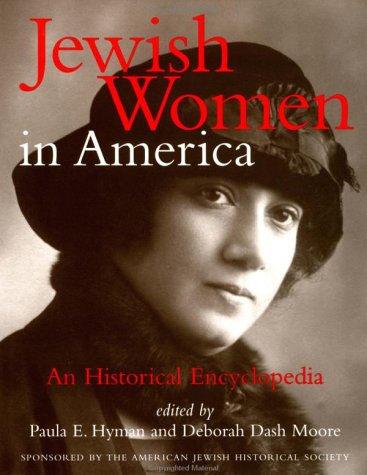
Jewish women in America: an historical encyclopedia

Paula Hyman,Deborah Dash Moore,Phyllis Holman Weisbard,American Jewish Historical Society
This encyclopedia provides the first standard reference work on the lives, history and activities of Jewish women in the United States. Covering a period which extends from the arrival of the first Jewish women in North America in 1654 to the present, this two-volume set presents the most comprehensive and detailed portrait of American Jewish women ever published, and brings together for the first time the wealth of recent scholarship on this subject. Includes: * Biographical entries on over 800 individual women. * 128 topical articles on organizations such as Hadassah, the National Council of Jewish Women, Mizrachi, and the Ladies' Garment Workers' Union. * Major essays on Jewish women's participation in the movement for women's suffrage, social reform, civil rights, and the recent women's movement. * The activities of Jewish women in politics, business, education, the arts, and religion. * A readable, inviting format with over 500 large photographs. * Bibliographies at the end of each entry which include overviews of major scholarship in the field, complete citations of more general works and citations of additional bibliographical and reference sources. * The comprehensive index includes citations to every substantive discussion in the entries as well as all proper names appearing in the text, such as organizations, book, song and film titles, schools, and individuals. The "Encyclopedia" provides information on American Jewish women in all fields of endeavor, and pays special attention to the work of women in the arts, academics, law, the labor movement, education, science, medicine, journalism and publishing, and on the lives of ordinary Jewish women during all time periods and in all regions of the United States.
Routledge 1997 1770 pages

Rahel Varnhagen: the life of a Jewish woman

Arendt, Hannah
"Rahel Varnhagen: The Life of a Jewish Woman was Hannah Arendt's first book, largely completed when she went into exile from Germany in 1933, though it would not be published until the 1950s. It is the biography of a remarkable, complicated, troubled, passionate woman, an important figure in German romanticism, the person who in a sense founded the Goethe cult that would become central to German cutural life in the nineteenth century, as well as someone who confronted and bore the burden of being both a woman in a man's world and an assimilated Jew in Germany with unusual determination. Rahel Levin Varnhagen, was, Hannah Arendt writes, "neither beautiful nor attractive... and possessed no talents with which to employ her extraordinary intelligence and passionate originality." Arendt sets out to tell the story of Rahel's life as Rahel might have told it and, in doing so, to reveal the way in which intellectual and social assimilation works out in one person's destiny. On her deathbed Rahel is reported to have said, "The thing which all my life seemed to me the greatest shame, which was the misery and misfortune of my life--having been born a Jewess--this I should on no account now wish to have missed." Only because she had remained both a Jew and a pariah, Hannah Arendt observes, "did she find a place in the history of European humanity.""--
New York Review Books 2021 236 pages

You never call! You never write! a history of the Jewish mother

Antler, Joyce
In You Never Call, You Never Write, Joyce Antler provides an illuminating and often amusing history of one of the best-known figures in popular culture--the Jewish Mother. Whether drawn as self-sacrificing or manipulative, in countless films, novels, radio and television programs, stand-up comedy, and psychological and historical studies, she appears as a colossal figure, intensely involved in the lives of her children. Antler traces the odyssey of this compelling personality through decades of American culture. She reminds us of a time when Jewish mothers were admired for their tenacity and nurturance, as in the early twentieth-century image of the "Yiddishe Mama," a sentimental figure popularized by entertainers such as George Jessel, Al Jolson, and Sophie Tucker, and especially by Gertrude Berg, whose amazingly successful "Molly Goldberg" ruled American radio and television for over 25 years. Antler explains the transformation of this Jewish Mother into a "brassy-voiced, smothering, and shrewish" scourge (in Irving Howe's words), detailing many variations on this negative theme, from Philip Roth's Portnoy's Complaint and Woody Allen's Oedipus Wrecks to television shows such as "The Nanny," "Seinfeld," and "Will and Grace." But she also uncovers a new counter-narrative, leading feminist scholars and stand-up comediennes to see the Jewish Mother in positive terms. Continually revised and reinvented, the Jewish Mother becomes in Antler's expert hands a unique lens with which to examine vital concerns of American Jews and the culture at large. A joy to read, You Never Call, You Never Write will delight anyone who has ever known or been nurtured by a "Jewish Mother," and it will be a special source of insight for modern parents. As Antler suggests, in many ways "we are all Jewish Mothers" today.
Oxford University Press 2007 321 pages

You never call! you never write! a history of the Jewish mother

Antler, Joyce
In You Never Call, You Never Write, Joyce Antler provides an illuminating and often amusing history of one of the best-known figures in popular culture--the Jewish Mother. Whether drawn as self-sacrificing or manipulative, in countless films, novels, radio and television programs, stand-up comedy, and psychological and historical studies, she appears as a colossal figure, intensely involved in the lives of her children.Antler traces the odyssey of this compelling personality through decades of American culture. She reminds us of a time when Jewish mothers were admired for their tenacity and nurturance, as in the early twentieth-century image of the "Yiddishe Mama," a sentimental figure popularized by entertainers such as George Jessel, Al Jolson, and Sophie Tucker, and especially by Gertrude Berg, whose amazingly successful "Molly Goldberg" ruled American radio and television for over 25 years. Antler explains the transformation of this Jewish Mother into a "brassy-voiced, smothering, and shrewish" scourge (in Irving Howe's words), detailing many variations on this negative theme, from Philip Roth's Portnoy's Complaint and Woody Allen's Oedipus Wrecks to television shows such as "The Nanny," "Seinfeld," and "Will and Grace." But she also uncovers a new counter-narrative, leading feminist scholars and stand-up comediennes to see the Jewish Mother in positive terms. Continually revised and reinvented, the Jewish Mother becomes in Antler's expert hands a unique lens with which to examine vital concerns of American Jews and the culture at large.A joy to read, You Never Call, You Never Write will delight anyone who has ever known or been nurtured by a "Jewish Mother," and it will be a special source of insight for modern parents. As Antler suggests, in many ways "we are all Jewish Mothers" today.
Oxford University Press 2007-04-02 321 pages

The significance of Yavneh and other essays in Jewish hellenism

Cohen, Shaye J. D.
This volume collects thirty essays by Shaye J.D. Cohen. First published between 1980 and 2006, these essays deal with a wide variety of themes and texts: Jewish Hellenism; Josephus; the Synagogue; Conversion to Judaism; Blood and Impurity; the boundary between Judaism and Christianity. What unites them is their philological orientation. Many of these essays are close studies of obscure passages in Jewish and Christian texts. The essays are united too by their common assumption that the ancient world was a single cultural continuum; that ancient Judaism, in all its expressions and varieties, was a Hellenism; and that texts written in Hebrew share a world of discourse with those written in Greek. Many of these essays are well-known and have been much discussed in contemporary scholarship. Among these are: The Significance of Yavneh (the title essay), Patriarchs and Scholarchs, Masada: Literary Tradition, Archaeological Remains, and the Credibility of Josephus, Epigraphical Rabbis, The Conversion of Antoninus, Menstruants and the Sacred in Judaism and Christianity, and A Brief History of Jewish Circumcision Blood.
Mohr Siebeck 2010 614 pages

The art of the Jewish family: a history of women in early New York in five objects

Leibman, Laura Arnold
In The Art of the Jewish Family, Laura Arnold Leibman examines five objects owned by a diverse group of Jewish women who all lived in New York in the years between 1750 and 1850: a letter from impoverished Hannah Louzada seeking assistance; a set of silver cups owned by Reyna Levy Moses; an ivory miniature owned by Sarah Brandon Moses, who was born enslaved and became one of the wealthiest Jewish women in New York; a book created by Sarah Ann Hays Mordecai; and a family silhouette owned by Rebbetzin Jane Symons Isaacs. These objects offer intimate and tangible views into the lives of Jewish American women from a range of statuses, beliefs, and lifestyles--both rich and poor, Sephardi and Ashkenazi, slaves and slaveowners. Each chapter creates a biography of a single woman through an object, offering a new methodology that looks past texts alone to material culture in order to further understand early Jewish American women's lives and restore their agency as creators of Jewish identity. While much of the available history was written by men, the objects that Leibman studies were made for and by Jewish women. Speaking to American Jewish life, women's studies, and American history, The Art of the Jewish Family sheds new light on the lives and values of these women, while also revealing the social and religious structures that led to Jewish women being erased from historical archives.
Bard Graduate Center 2020 289 pages

The receiving: reclaiming Jewish women's wisdom / Tirzah Firestone

Firestone, Tirzah
The Receiving is the literal translation of the word Kabbalah, the body of Jewish Mysticism that has been passed down from men to men for centuries. Ironically, the art of receiving, that is, opening to the divine spirit as it manifests in the here and now, is one of the undocumented triumphs of women's spirituality. Now, re-spected rabbi and Jungian therapist Tirzah Firestone sets out to correct the enormous error of history that has omitted the contributions of Jewish women mystics, sages, and holy women from the Jewish annals. In what might be called an act of spiritual archaeology, Firestone searches for the traces of the divine feminine in the Jewish tradition in order to answer the question, "What is a woman's way to God?" Drawing on the remarkable stories of seven historical holy women -- who, despite all the obstacles, found ways to embrace the sacred feminine in their lives -- Firestone teaches us the mysteries of Jewish Kabbalah from a woman's vantage point. This groundbreaking book finally empowers women to reclaim their rightful -- and historic -- connection to the mystical lineage within Judaism. This is a provocative work of scholarship and passion that restores the forgotten voices of Jewish women mystics, using their remarkable journeys as a spring-board into the feminine mysteries that have been hidden from women's use for millennia. In The Receiving, these ancient teachings have finally been made available in a relevant, accessible, and life-enriching manner for women -- and men -- of all spiritual persuasions.
HarperSanFrancisco 2002 280 pages

Pepper, silk & ivory: amazing stories about Jews and the Far East

Tokayer, Marvin,Rodman, Ellen
There is a missing page in Jewish history. We tend to assume that Jewish history is to be found in the Middle East, Europe, North Africa, and the Americas - but not in the Far East. "Pepper, silk & ivory" has discovered that missing page, revealing the amazing stories of Jews who both benefitted from and contributed to the Far East. Consummate storyteller Marvin Tokayer, Lifetime Honorary Rabbi of Japan's Jewish community, draws on half a century of personal experiences and a wealth of knowledge as he, in concert with writer and television producer Dr. Ellen Rodman, weaves together the characters and history of the Jews of the Far East into this fascinating book.
Gefen Publishing House 2014 316 pages

Jewish radical feminism: voices from the women's liberation movement

Antler, Joyce
Jewish women were undeniably instrumental in shaping the women’s liberation movement of the 1960s, 70s, and 80s. Yet historians and participants themselves have overlooked their contributions as Jews. This has left many vital questions unasked and unanswered—until now. Delving into archival sources and conducting extensive interviews with these fierce pioneers, Joyce Antler has at last broken the silence about the confluence of feminism and Jewish identity.Antler’s exhilarating new book features dozens of compelling biographical narratives that reveal the struggles and achievements of Jewish radical feminists in Chicago, New York and Boston, as well as those who participated in the later, self-consciously identified Jewish feminist movement that fought gender inequities in Jewish religious and secular life. Disproportionately represented in the movement, Jewish women’s liberationists helped to provide theories and models for radical action that were used throughout the United States and abroad. Their articles and books became classics of the movement and led to new initiatives in academia, politics, and grassroots organizing. Other Jewish-identified feminists brought the women’s movement to the Jewish mainstream and Jewish feminism to the Left. For many of these women, feminism in fact served as a “portal” into Judaism.Recovering this deeply hidden history, Jewish Radical Feminism places Jewish women’s activism at the center of feminist and Jewish narratives. The stories of over forty women’s liberationists and identified Jewish feminists—from Shulamith Firestone and Susan Brownmiller to Rabbis Laura Geller and Rebecca Alpert—illustrate how women’s liberation and Jewish feminism unfolded over the course of the lives of an extraordinary cohort of women, profoundly influencing the social, political, and religious revolutions of our era.
New York University Press 2018 453 pages

Anything but yes: a novel of Anna del Monte, Jewish citizen of Rome, 1749

Davidow, Joie
"This beautiful work of historical fiction was inspired by the diary of an actual 18th-century Roman Jewish girl, imprisoned by the Catholic Church because someone with a grudge offered her to the Church. Anything But Yes is the true story of a young woman's struggle to defend her identity in the face of relentless attempts to destroy it. In 1749, 18-year-old Anna del Monte was seized at gunpoint from her home in Rome's Jewish ghetto and thrown into a convent cell at the Casa dei Convertiti, the house of converts. With no access to the outside world, she withstood isolation, sleep deprivation, endless lectures, and threats and promises. If Anna were to utter the simple word "yes," she would risk forced baptism, which meant never returning to her home and losing contact with any Jew-including her own family-for the rest of her life. Even in Italy today, few people know the full story of Rome's Jewish ghetto, the abduction of Jews, or the popes who were intent on forcibly converting every non-Catholic living in the long shadow of the Vatican. Young girls and small children were the primary targets of these forced conversions, for they were most vulnerable. But Anna del Monte was different. She was strong, brilliant, and educated, and wrote a diary of her experiences. Her diary became lost for more than 200 years but was rediscovered in Israel in 1989. Anything But Yes is based on Anna's diary and Joie Davidow's extensive research on life in the 18th-century Roman Jewish ghetto and its personalities, traditions, foods, and dialect"--
Monkfish Book Publishing Company 2023 233 pages

Book of Rachel

David, Esther
Winner of the Sahitya Akademi Award 2010 A gripping story of a lone Jewish woman battling land sharks to keep her community alive Rachel lives alone by the sea. Her children have long migrated to Israel as have her Bene Israel Jew neighbours. Taking care of the local synagogue and preparing exquisite traditional Jewish dishes sustains Rachel's hope of seeing the community come together again at a future time. When developers make moves to acquire the synagogue and its surrounding land, Rachel's vehement opposition takes the synagogue committee and the town by surprise. Written with warmth and humour, Book of Rachel is a captivating tale of a woman's battle to live life on her own terms. Continuing the saga of the unique Bene Israel Jews in India, it adds to Esther David's reputation as a writer of grace and power.
Penguin 2018-07-20 197 pages

Divorcing

Taubes, Susan
"A stunning novel about childhood, marriage, and divorce by one of the most interesting minds of the 20th century, now back in print for the first time since 1969. Sophie Blind is starting a new life. She has left her husband Ezra and taken her three children to Paris. She has lovers there and another in New York. She is lecturing and writing. And she is compulsively reviewing her own history, having resumed the "lifelong struggle" of "coming into consciousness." The task of reclaiming her existence is all the more urgent because, even as Sophie Blind undertakes this necessary transformation-Sophie Blind is dead. Dream and reality overlap in Divorcing, a book in which divorcing is not just a matter of marital collapse but names a rift that runs right through the inner and outer worlds of its brilliant but desperate protagonist. Can the rift be mended? Perhaps in the form of a novel, one that goes back from present day New York to her childhood in pre-World War II Budapest, that revisits the divorce between her Freudian father and her fickle mother, and finds a place for a host of further tensions and contradictions of Sophie's life now. The question that haunts Divorcing, however, is whether any novel can be fleet and bitter and true and light enough to gather up all the darkness of a given life. Susan Taubes's startlingly original novel was published in 1969 but largely ignored; after the author's tragic early death, it was forgotten. Its republication presents a chance to rediscover a dazzling intense and inventive writer whose work in many ways anticipates the fragmentary, glancing, lyrical novels that Renata Adler and Elizabeth Hardwick would write in the 1970s"--
New York Review Books 2020-10-27 265 pages

The journey home

Antler, Joyce
In recent decades, prominent American Jewish women like Bella Abzug and Betty Friedan have made headlines and history, challenging the constraints facing women in American public life. Few realize that these women embody a hundred-year legacy of remarkable activism. From suffrage to birth control, from trade unionism to higher education, from civil rights to feminism to every aspect of popular culture, Jewish women have been in the vanguard, leading key social movements.
Schocken 1998 410 pages

Ballots, babies, and banners of peace: American Jewish women's activism, 1890-1940

Klapper, Melissa R.
Uncovers the powerful effects of 20th-century Jewish women's social and political activism on contemporary American life Winner of the 2013 National Jewish Book Award, Women's Studies Ballots, Babies, and Banners of Peace explores the social and political activism of American Jewish women from 1890 to the beginnings of World War II. Written in an engaging style, the book demonstrates that no history of the birth control, suffrage, or peace movements in the United States is complete without analyzing the impact of Jewish women's presence. The volume is based on years of extensive primary source research in more than a dozen archives and among hundreds of primary sources, many of which have previously never been seen. Voluminous personal papers and institutional records paint a vivid picture of a world in which both middle-class and working-class American Jewish women were consistently and publicly engaged in all the major issues of their day and worked closely with their non-Jewish counterparts on behalf of activist causes. This extraordinarily well-researched volume makes a unique contribution to the study of modern women's history, modern Jewish history, and the history of American social movements.
New York University Press 2014-08-22 290 pages