12 results for "History"

Revolutionary Jews from Spinoza to Marx: the fight for a secular world of universal and equal rights

Israel, Jonathan
"In the eighteenth and early nineteenth centuries a small but conspicuous fringe of the Jewish population became the world's most resolute, intellectually driven, and philosophical revolutionaries, among them the pre-Marxist Karl Marx. Yet the roots of their alienation from existing society and determination to change it extend back to the very heart of the Enlightenment, when Spinoza and other philosophers living in a rigid, hierarchical society colored by a deeply hostile theology first developed a modern revolutionary consciousness. Leading intellectual historian Jonathan Israel shows how the radical ideas in the early Marx's writings were influenced by this legacy, which, he argues, must be understood as part of the Radical Enlightenment. He traces the rise of a Jewish revolutionary tendency demanding social equality and universal human rights throughout the Western world. Israel considers how these writers understood Jewish marginalization and ghettoization and the edifice of superstition, prejudice, and ignorance that sustained them. He investigates how the quest for Jewish emancipation led these thinkers to formulate sweeping theories of social and legal reform that paved the way for revolutionary actions that helped change the world from 1789 onward-but hardly as they intended"--
University of Washington Press 2021 549 pages

Jews and power

Wisse, Ruth R.
From the Kingdom of David to the Oslo Accords, Ruth Wisse offers a radical new way to think about the Jewish relationship to power. Traditional Jews believed that upholding the covenant with God constituted a treaty with the most powerful force in the universe; this later transformed itself into a belief that, unburdened by a military, Jews could pursue their religious mission on a purely moral plain. Wisse, an eminent professor of comparative literature at Harvard, demonstrates how Jewish political weakness both increased Jewish vulnerability to scapegoating and violence, and unwittingly goaded power-seeking nations to cast Jews as perpetual targets. Although she sees hope in the State of Israel, Wisse questions the way the strategies of the Diaspora continue to drive the Jewish state, echoing Abba Eban's observation that Israel was the only nation to win a war and then sue for peace. And then she draws a persuasive parallel to the United States today, as it struggles to figure out how a liberal democracy can face off against enemies who view Western morality as weakness. This deeply provocative book is sure to stir debate both inside and outside the Jewish world. Wisse's narrative offers a compelling argument that is rich with history and bristling with contemporary urgency.
Nextbook, Schocken 2020-02-04 231 pages

Jews and the American public square: debating religion and republic

Mittleman, Alan
Jews and the American Public Square is a study of how Jews have grappled with the presence of religion, both their own and others, in American public life. It surveys historical Jewish approaches to church-state relations and analyzes Jewish responses to the religion clauses of the First Amendment. The book also explores how the contemporary sociological and political characteristics of American Jews bear on their understanding of the public dimensions of American religion. In addition to a descriptive and analytic approach. the volume is also critical and polemical. Its contributors attack and defend prevailing views, raise critical questions about the political and intellectual positions favored by American Jews, and propose new syntheses. This book captures the current mood of the Jewish community: both committed to the separation of church and state and perplexed about its scope and application. It provides the necessary background for a principled reconsideration of the problem of religion in the public square.
Rowman & Littlefield 2002 375 pages

The scepter shall not depart from Judah: perspectives on the persistence of the political in Judaism

Mittleman, Alan
The title of political theorist Alan L. Mittleman's captivating new book is drawn from the patriarch Jacob's blessing to his children and grandchildren. The blessing contains the promise that Judah will become a royal house, perhaps forever. Kings, of course, ceased in Israel, but politics did not. Regime replaced regime. National independence was compromised and lost, regained and lost again. Yet the attention to things political was never lost. Old texts were applied to new political realities. Political awareness and thought, constantly transformed and adapted to new historical exigencies, persisted among the Jews. In The Scepter Shall Not Depart from Judah , Mittleman looks at some of the central problems of political philosophy-such as fundamental rights and the common good-from the point of view of rabbinic Judaism. At the same time, he considers conceptual issues in Judaism-such as covenant and tradition-from the perspective of political philosophy. Mittleman's sources range from the ancient rabbis to contemporary political theorists, making this volume an important one for courses and research in both Jewish studies and political theory.
Lexington Books 2000-02-09 185 pages

Judaism and the challenges of modern life

Moshe Halbertal,Donniel Hartman
Much more than a particular period in world history, modernity has fundamentally transformed how we think and live, and especially how we understand and relate to religious traditions. As the 'ghetto walls' have fallen, both empirically and metaphorically, Judaism is compelled to compete in an open marketplace of ideas. Jews can no longer count on an assumedly necessary Jewish identity or commitment, nor on the rallying force of anti-Semitism to ensure an individual and collective sense of belonging. Rather Jewish moral, spiritual and historical values and ideas must be read with new eyes and challenged to address modernity's proliferating array of questions and realities. The pertinent questions modern Jewry faces are how to embrace modernity as Jews and what such an embrace means for the meaning and future of Jewish life. This collection of essays, authored by scholars of the Shalom Hartman Institute, addresses three critical challenges posed to Judaism by modernity: the challenge of ideas, the challenge of diversity, and the challenge of statehood, and provides insights and ideas for the future direction of Judaism. Providing readers with new insights into Judaism and the Jewish people in contemporary times, the collection explores a wide range of issues that includes: the significance of Israel for the future of Judaism; the Jewish people as a people; the relationship between monotheism and violence; revelation and ethics; Judaism and the feminist challenge; and Judaism and homosexuality.
Continuum 2007-12-11 192 pages

Jewish legal theories: writings on state, religion, and morality

Leora Batnitzky,Yonatan Brafman
"Contemporary arguments about Jewish law uniquely reflect both the story of Jewish modernity and a crucial premise of modern conceptions of law generally: the claim of autonomy for the intellectual subject and practical sphere of the law. [This book] collects representative modern Jewish writings on law and provides short commentaries and annotations on these writings that situate them within Jewish thought and history, as well as within modern legal theory. The topics addressed by these documents include Jewish legal theory from the modern nation-state to its adumbration in the forms of Orthodox, Conservative, and Reform Judaism in the German-Jewish context; the development of Jewish legal philosophy in Eastern Europe beginning in the eighteenth century; ultra-Orthodox views of Jewish law premised on the rejection of the modern nation-state; the role of Jewish law in Israel; and contemporary feminist legal theory."--
Brandeis University Press 2018-01-02 260 pages

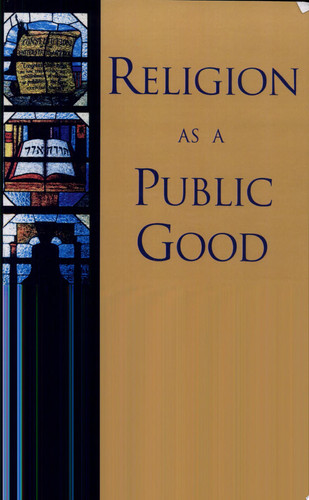
Religion as a public good: Jews and other Americans on religion in the public square

Alan Mittleman
Religion as a Public Good: Jews and Other Americans on Religion in the Public Square explores the often controversial topic of how religion ought to relate to American public life. The sixteen distinguished contributors, both Jewish and Christian, reflect on the topic out of their own disciplines-social ethics, political theory, philosophy, law, history, theology, and sociology. and take a stand based on their religious convictions and political beliefs. The volume is at once scholarly and committed, polemic and civil, reflective and activist. Written in the shadow of 9/11, it invites a new consideration of how religion enhances democratic public life with full awareness of the dangers that religion can sometimes pose. The volume is polemical, as befits the topic, but also civil, as befits a dialogue about an issue of profound significance for democratic citizenship.
Rowman & Littlefield 2003-12-09 336 pages

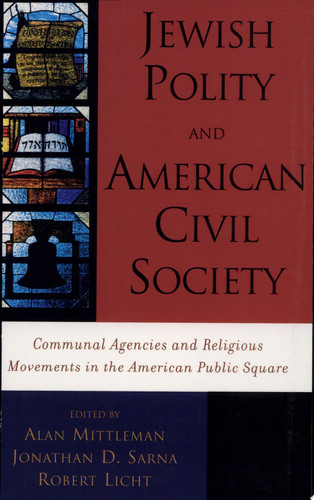
Jewish polity and American civil society: communal agencies and religious movements in the American public sphere

Alan Mittleman,Robert Licht,Jonathan D. Sarna
Jewish Polity and American Civil Society is a study of the civic and political engagements of American Jews as mediated by their communal and denominational institutions. The book explores how the various branches of the organized Jewish community seek to influence public affairs. Over the course of the last century, Jewish agencies and religious movements have tried to shape public debate and public policy on such issues as civil rights, church-state relations, and American foreign policy. The book sets the history of Jewish engagement in these areas into historical context; analyzes the motives, strategies, and tactics of various Jewish groups, and evaluates their successes and failures. The book also explores the underlying idea-the public philosophy-that informs American Jews' understanding of civic and political engagement.
Rowman & Littlefield 2002-07-23 420 pages

Offence: the Jewish case

Klug, Brian
Part of an ongoing series published in cooperation with the Index on Censorship that deals with religion and free expression, The Jewish Case is distinctive in several ways. To begin with, even calling Judaism a religion is problematic. The breadth of Judaism, combined with its antiquity, gives Jewish sensibility a complexity that defies the simple distinction between "religious" and "secular." That complexity affects the entire discussion of the Jewish case on tolerance and censorship--especially today, when Israel and its relationship to Zionism are central political and social concerns. In the light of this difficulty, Brian Klug in The Jewish Case develops a critique of Jewish sensibilities from within--confronting Judaism with itself--rather than attacking it from the outside. Focusing on the current controversy over Israel, and drawing on three basic features of Judaism--iconoclasm, commitment to argument, and respect for human dignity--Klug makes a Jewish case for outspokenness.
Seagull Books 2009 101 pages

The politics of Torah: the Jewish political tradition and the founding of Agudat Israel

Mittleman, Alan
Founded in Germany in 1912, Agudat Israel was the first comprehensive, international political movement among Orthodox Jews. This study examines the forces that led to its formation, setting its history into the context of both the millennial Jewish political tradition and the Jewish struggle with the disenchanting effects of modernity. Mittleman shows that from its formation to the present, Agudah has represented the political interests of the most traditional members of the Jewish community. This book addresses the question of why such arch-traditionalists turned to politics, examines in detail the conflicts that shaped the movement's character, and explores the movement's relationship with prior expressions of Jewish political thought and practice.
State University of New York Press 1996-01-01 200 pages