6 results for "History"

Call it English: the languages of Jewish American literature

Wirth-Nesher, Hana
Call It English identifies the distinctive voice of Jewish American literature by recovering the multilingual Jewish culture that Jews brought to the United States in their creative encounter with English. In transnational readings of works from the late-nineteenth century to the present by both immigrant and postimmigrant generations, Hana Wirth-Nesher traces the evolution of Yiddish and Hebrew in modern Jewish American prose writing through dialect and accent, cross-cultural translations, and bilingual wordplay. Call It English tells a story of preoccupation with pronunciation, diction, translation, the figurality of Hebrew letters, and the linguistic dimension of home and exile in a culture constituted of sacred, secular, familial, and ancestral languages. Through readings of works by Abraham Cahan, Mary Antin, Henry Roth, Delmore Schwartz, Bernard Malamud, Saul Bellow, Cynthia Ozick, Grace Paley, Philip Roth, Aryeh Lev Stollman, and other writers, it demonstrates how inventive literary strategies are sites of loss and gain, evasion and invention. The first part of the book examines immigrant writing that enacts the drama of acquiring and relinquishing language in an America marked by language debates, local color writing, and nativism. The second part addresses multilingual writing by native-born authors in response to Jewish America's postwar social transformation and to the Holocaust. A profound and eloquently written exploration of bilingual aesthetics and cross-cultural translation, Call It English resounds also with pertinence to other minority and ethnic literatures in the United States.
Princeton University Press 2008-11-09 224 pages

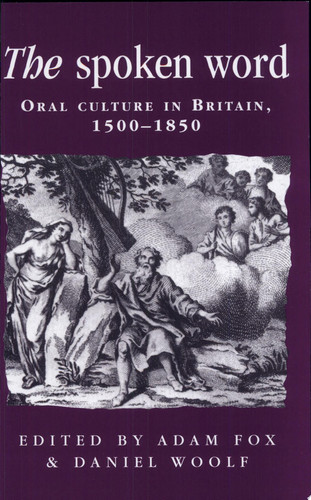
The spoken word: oral culture in Britain, 1500-1850

Adam Fox,Daniel Woolf
"The early modern period was of great significance throughout Europe with respect to its gradual transition from a largely oral to a fundamentally literate society. On the one hand, the spoken word remained of the utmost importance to the dissemination of ideas, the communication of information and the transmission of the cultural repertoire. On the other hand, the proliferation of written documents of all kinds, the development of printing and the spread of popular literacy combined to transform the nature of communication. Studies previous to this have traditionally focused on individual countries or regions, and emphasised the contradictions between oral and literate culture. The essays in this fascinating collection depart from these approaches in several ways. By examining not only English, but also Scottish and Welsh oral culture, they provide the first pan-British study of the subject. The authors also emphasise the ways in which oral and literate culture continued to compliment and inform each other, rather than focusing exclusively on their incompatibility, or on the 'inevitable' triumph of the written word. The chronological focus, ranging from the sixteenth to the mid-nineteenth century, with glances ahead to the twentieth, set the problem against a longer chronological span than most other studies, providing a link between early modern and modern oral and literate cultures. This book it will be of interest to students and scholars of British history, Linguistics, Literary Studies and Folklore Studies"--Publisher's description.
Manchester University Press 2002 286 pages

Silk Road linguistics: the birth of Yiddish and the multiethnic Jewish peoples on the Silk Roads, 9-13th centuries : the indispensable role of the Arabs, Chinese, Germans, Iranians, Slavs and Turks

Wexler, Paul
In this comprehensive study Paul Wexler demonstrates that Yiddish is a Slavic language largely relexified to genuine and artificial German and Hebrew, as a cryptic language of trade in the Khazar Empire in the 9-10th centuries for the use of multilingual Jewish merchants, who enjoyed special privileges on the Afro-Eurasian Silk Roads until the 13th century. Other Judaized trade languages (Turkic, Chinese, Arabic) were also coined at this time in the Khazar and Iranian Empires. In both empires, Yiddish absorbed over 5,000 overt influ-ences mainly from Judaized Persian, and secondarily from Judaized Turkic and Chinese. Yiddish mainly has Hebraisms wherever Persian employs Arabisms (but has almost no overt Arabisms) and preserves Asianisms with greater accuracy and volume than most Iranianized non-Jewish target languages. Until c. 1000, almost all Jews in the world resided in the Iranian Empire and were mainly of Iranian and only partly of Palestinian Judaean descent. Conversion to Judaism was common among Iranians, Turks, Slavs and Berbers (because of a desire to participate in the lucrative Silk Road trade dominated by Jews, and to escape the status of slavery often imposed on them); conversion led to the rise of new diverse Jewish "ethnicities" and forms of Judaism. The book also examines the Iranianization of other cryptic Jewish trade languages, of Slavic and German, and the common Hebrew-like lexicon used by all Jewish merchants to overcome varied language backgrounds. Yiddish can help to reconstruct the Iranian speech of mixed Irano-Slavic confederations (such as the Galician White Croats).
Harrassowitz Verlag 2021 1412 pages

Autochthonous texts in the Arabic dialect of the Jews of Tiberias

Geva-Kleinberger, Aharon
The soul of this book is not just linguistic. The author creates an innovative approach, combining language with anthropology and history, and this can serve a medley of researchers in interdisciplinary fields. The texts introduce the long and rich inheritance of the Arabic-speaking Jews of Tiberias. They have lived there for centuries with only brief interruptions, and have spoken Arabic as their mother tongue. The author continues here his research on other communities in Galilee where Arabic has been spoken by Jews, such as Haifa, Safed and Pqi'in. The book pays homage to these people, their heritage and language, before all sink, alas, into the limbo of forgotten things. These are the last vanishing voices, which speak out, tell and still breathe. Hopefully they will still serve as evidence in the future of a once glorious but dying culture, whose existence, paradoxically, may even come to be doubted in future times.
Harrassowitz 2009 229 pages