17 results for "History"

Our revolution: a future to believe in

Sanders, Bernie
"When Bernie Sanders began his race for the presidency, it was considered by the political establishment and the media to be a "fringe" campaign, something not to be taken seriously. After all, he was just an independent senator from a small state with little name recognition. His campaign had no money, no political organization, and it was taking on the entire Democratic Party establishment. By the time Sanders's campaign came to a close, however, it was clear that the pundits had gotten it wrong. Bernie had run one of the most consequential campaigns in the modern history of the country. He had received more than 13 million votes in primaries and caucuses throughout the country, won twenty-two states, and more than 1.4 million people had attended his public meetings. Most important, he showed that the American people were prepared to take on the greed and irresponsibility of corporate America and the 1 percent. In Our Revolution, Sanders shares his personal experiences from the campaign trail, recounting the details of his historic primary fight and the people who made it possible. And for the millions looking to continue the political revolution, he outlines a progressive economic, environmental, racial, and social justice agenda that will create jobs, raise wages, protect the environment, and provide health care for all--and ultimately transform our country and our world for the better. For him, the political revolution has just started. The campaign may be over, but the struggle goes on"--Provided by publisher.
Thomas Dunne Books 2017-08-29 450 pages

Bobby Kennedy: the making of a liberal icon

Tye, Larry
“A multilayered, inspiring portrait of RFK . . . [the] most in-depth look at an extraordinary figure whose transformational story shaped America.”—Joe Scarborough, The Washington Post NEW YORK TIMES BESTSELLER • Soon to be a Hulu original series starring Chris Pine. Larry Tye appears on CNN’s American Dynasties: The Kennedys . “We are in Larry Tye’s debt for bringing back to life the young presidential candidate who . . . almost half a century ago, instilled hope for the future in angry, fearful Americans.”—David Nasaw, The New York Times Book Review Bare-knuckle operative, cynical White House insider, romantic visionary—Robert F. Kennedy was all of these things at one time or another, and each of these aspects of his personality emerges in the pages of this powerful and perceptive biography. History remembers RFK as a racial healer, a tribune for the poor, and the last progressive knight of a bygone era of American politics. But Kennedy’s enshrinement in the liberal pantheon was actually the final stage of a journey that began with his service as counsel to the red-baiting senator Joseph McCarthy. In Bobby Kennedy, Larry Tye peels away layers of myth and misconception to capture the full arc of his subject’s life. Tye draws on unpublished memoirs, unreleased government files, and fifty-eight boxes of papers that had been under lock and key for forty years. He conducted hundreds of interviews with RFK intimates, many of whom have never spoken publicly, including Bobby’s widow, Ethel, and his sister, Jean. Tye’s determination to sift through the tangle of often contradictory opinions means that Bobby Kennedy will stand as the definitive biography about the most complex and controversial member of the Kennedy family. Praise for Bobby Kennedy “A compelling story of how idealism can be cultivated and liberalism learned . . . Tye does an exemplary job of capturing not just the chronology of Bobby’s life, but also the sense of him as a person.” — Los Angeles Review of Books “Captures RFK’s rise and fall with straightforward prose bolstered by impressive research.” — USA Today “[Tye] has a keen gift for narrative storytelling and an ability to depict his subject with almost novelistic emotional detail.” —Michiko Kakutani, The New York Times “Nuanced and thorough . . . [RFK’s] vision echoes through the decades.” — The Economist
Random House 2016 580 pages

The Hellfire Club

Tapper, Jake
"Charlie Marder, a World War II veteran and popular academic, is an unlikely congressman. Thrust into office by his power-broker father's connections, Charlie is determined to use his new position for good. He quickly learns, however, that in 1950s Washington, little is as it seems. Struggling to navigate the treacherous waters alongside real-life figures such as President Dwight Eisenhower, Senator John F. Kennedy, and Roy Cohn, Charlie is confronted by a world in the throes of McCarthyism, where no one trusts anyone. His education in the compromising and occasionally illegal ways of Washington makes him question his own ethical compass and the morality of men he admires, including his father. Alongside his pregnant wife, Margaret, a zoologist with ambitions of her own, Charlie struggles to do what is right while learning more about the mysterious circumstances of his predecessor's death. Amid the swirl of glamorous and powerful politicians and businessmen, a fatal car accident plunges Charlie and Margaret into an underworld of backroom deals, secret societies, and a conspiracy that could change the course of history. When Charlie learns too much, he has to fight not only for his principles and his newfound political career... but for his life.--
Little, Brown and Company 2018 342 pages

Getting to the heart of the matter: my 36 years in the Senate

Levin, Carl
"Representing Michigan for thirty-six years in the U.S. Senate, Carl Levin, the longest-serving senator in Michigan history, was known for his dogged pursuit of the truth, his commitment to holding government accountable, and his basic decency. Getting to the Heart of the Matter: My 36 Years in the Senate is his story - from his early days in Detroit as the son of a respected lawyer to the capstone of his career as chair of both the Senate Armed Services Committee and the Senate Permanent Subcommittee on Investigations. Levin's career placed him at the center of some of our nation's most critical points in modern times: from the aftermath of the 1967 Detroit riots, to the Clinton impeachment, through 9/11 and the wars in Iraq and Afghanistan, and the 2008 financial crisis. He met with numerous world leaders, including Egypt's Anwar Sadat and China's Jiang Zemin. Getting to the Heart of the Matter recounts Levin's experiences, thoughts, and actions during these historic moments. Consisting of seventeen chapters, the book takes the reader through Levin's early life in Detroit of the 1940s, 50s, and 60s where he met his wife, started a family, practiced law and served as the first General Counsel for the newly created Michigan Civil Rights Commission and the chief appellate defender for Detroit's Legal Aid Office. Elected to the Detroit City Council in 1969, where Levin served for eight years including four as Council president, the book describes how his fight against the Department of Housing and Urban Development's devastating housing practices in the neighborhoods of Detroit led him to run for the U.S. Senate with a pledge to make government work more effectively. Winning election six times, Levin had an illustrious career in the Senate where he challenged leaders in government and the private sector for the greater good of the nation. Levin describes how, as a Democrat, throughout his time in the Senate, he worked with Republican senators who often held different policy positions in order to find common ground to achieve national goals, and how he and his Senate staff searched for creative solutions to trade issues, support for the auto industry and manufacturing sector, U.S. military action in Iraq and Afghanistan, and efforts to protect the Great Lakes and the environment, among many other issues. Levin's hope in writing this memoir is that by sharing his deeply held beliefs about the responsibility of elected officials, the book will serve as a resource for people beginning a career in, or contemplating running for, public office. Readers with an interest in politics, history, facts, and perseverance will find kinship in this book" -- provided by the publisher
Wayne State University Press 2021 338 pages

The shadow president: Ted Kennedy in opposition

Hersh, Burton
At the heart of The Shadow President is a controversial idea - that, more than is brothers, Ted Kennedy has come to be the most influential political figure of this generation. His challenge to Jimmy Carter in the 1980 primaries, his bitter rearguard defense of social programs during the Reagan-Bush years, and the many upheavals in his personal life are all fully treated here.
Steerforth Press 1997-05-01 219 pages

Jack Kemp: the bleeding-heart conservative who changed America

Kondracke, Morton,Barnes, Fred
"THE PURPOSE OF POLITICS IS NOT TO DEFEAT YOUR OPPONENT AS MUCH AS IT IS TO PROVIDE SUPERIOR LEADERSHIP AND BETTER IDEAS THAN THE OPPOSITION." --JACK KEMP The late 1970s were miserable for America. It was the post-Vietnam, post-Watergate era, a time of high unemployment, ruinous inflation, gasoline lines, Communist advances, and bottomed-out U.S. morale. In the 1980s, it all turned around: "stagflation" ended and nearly two decades of prosperity ensued. The Soviet Union retreated, then collapsed. America again believed in itself. And around the world, democratic capitalism was deemed "the end of history." Ronald Reagan's policies sparked the American renaissance, but the Gipper's leadership is only part of the story. The economic theory that underpinned America's success was pioneered by a star professional quarterback turned self-taught intellectual and "bleeding-heart conservative": Jack Kemp. Kemp's role in a pivotal period in American history is at last illuminated in this first-ever biography, which also has lessons for the politics of today. Kemp was the congressional champion of supply-side economics--the idea that lowering taxes would foster growth. Even today, almost no one advocates a return to a top income tax rate of 70 percent. Kemp didn't just challenge the Democratic establishment. He also encouraged his fellow Republicans to be growth (not austerity) minded, open their tent to minorities and blue-collar workers, battle poverty and discrimination, and once again become "the party of Lincoln." Kemp approached politics the same way he played quarterback for the Buffalo Bills: with a refusal to accept defeat. Yet he also was incapable of personal attack, arguing always on the level of ideas. He regarded opponents as adversaries, not enemies, and often cooperated with them to get things done. Despite many ups and downs, including failed presidential and vice-presidential bids, he represented a positive, idealistic, compassionate Republicanism. Drawing on never-published papers and more than one hundred Kemp Oral History Project interviews, noted journalists Morton Kondracke and Fred Barnes trace Kemp's life, from his childhood through his pro football career to his influential years as a congressman and cabinet secretary. As the American Dream seems to be waning and polarized politics stifles Washington, Kemp is a model for what politics ought to be. The Republican party and the nation are in desperate need of another Kemp.
Sentinel 2015 390 pages

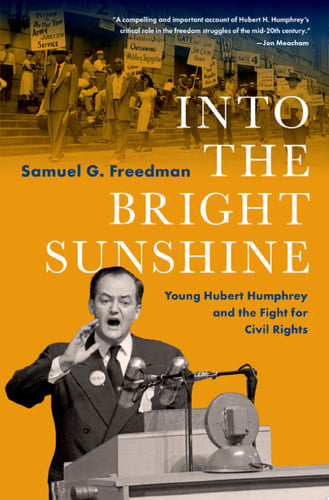
Into the bright sunshine: young Hubert Humphrey and the fight for civil rights

Freedman, Samuel G.
"Hubert Humphrey, a fallen hero and a dying man, rose on rickety legs to approach the podium of the Philadelphia Convention Hall, his pulpit for the commencement address at the University of Pennsylvania. He clutched a sheaf of paper with his speech for the occasion, typed and double-spaced by an assistant from his extemporaneous dictation, and then marked up in pencil by Humphrey himself. A note on the first page, circled to draw particular attention, read simply, "30 years ago--Here." In this place, at that time, twenty-nine years earlier to be precise, he had made history. From the dais now, Humphrey beheld five thousand impending graduates, an ebony sea of gowns and mortarboards, broken by one iconoclast in a homemade crown, two in ribboned bonnets, and another whose headgear bore the masking-tape message HI MA PA. In the horseshoe curve of the arena's double balcony loomed eight thousand parents and siblings, children, and friends. Wearing shirtsleeves and cotton shifts amid the stale heat, they looked like pale confetti from where Humphrey stood, and their flash cameras flickered away, a constellation of pinpricks"--
Oxford University Press 2023 488 pages

Judah Benjamin: counselor to the confederacy

Traub, James
Judah P. Benjamin (1811-1884) was a brilliant and successful lawyer in New Orleans, and one of the first Jewish members of the U.S. Senate. He then served in the Confederacy as secretary of war and secretary of state, becoming the confidant and alter ego of Jefferson Davis. In this new biography, author James Traub grapples with the difficult truth that Benjamin, who was considered one of the greatest legal minds in the United States, was a slave owner who deployed his oratorical skills in defense of slavery. How could a man as gifted as Benjamin, knowing that virtually all serious thinkers outside the American South regarded slavery as the most abhorrent of practices, not see that he was complicit with evil? This biography makes a serious moral argument both about Jews who assimilated to Southern society by embracing slave culture and about Benjamin himself, a man of great resourcefulness and resilience who would not, or could not, question the practice on which his own success, and that of the South, was founded.
Yale University Press 2021 185 pages

Love in black and white: a memoir of race, religion, and romance

Cohen, William S.
Streaming Video on Love In Black & White now available at Expandedbooks.com Most Americans regard the World War II period as belonging to the "greatest generation," but it was also a time when religious intolerance and racial violence flourished. Shamefully, it was commonplace to see signs that read "Whites Only" or "Jews Not Allowed." It is within this world that this compelling memoir is set. William Cohen, born in Bangor, Maine, was the eldest son of a Jewish father and a Protestant Irish mother. Janet Langhart, an African-American, was raised in Indianapolis, Indiana by her single parent mother, a Southern Baptist. The book draws fascinating parallels between the histories of two people from different regions, races, and religions, as both are witnesses to and targets of the social tensions of the day. Throughout Love in Black and White, readers accompany Bill and Janet in their struggle to overcome to the barriers of ethnic and racial bigotry and hatred. The stories are rich and profound. At times they are amusing. Other times, harrowing. Against impossible odds, Bill would be elected to serve his country as a U.S. Congressman and Senator, and Janet would become a prominent television personality, activist, and highly respected businesswoman and author. Opposites in so many ways―in color, faith and culture―seemingly a bundle of contradictions, they meet in 1974, become friends, and eventually fall in love. They decide to marry on Valentine's Day 1996 in the very place that once harbored some of the nation's most prominent racists-the U.S. Capitol. They receive the surprise of a lifetime when Bill is asked by President Bill Clinton to serve as the nation's 20th Secretary of Defense. It is a calling that proves to be life transforming for both him and Janet, as they lead, inspire and bring comfort to the men and women who defend our nation. It is at the Pentagon where they witness just how powerful our nation ca
Rowman & Littlefield Publishers 2007 373 pages

Crossing the barriers: the autobiography of Allan H. Spear

Spear, Allan H.
Allan Spear had a long and distinguished career as a historian and as a Minnesota state senator. Perhaps best known for coming out as openly gay during his first term in the Minnesota Senate-becoming one of the first elected officials in the nation to do so-Spear was also a leader of Eugene McCarthy's run for the presidency, an organizer against the war in Vietnam, and a key proponent for the establishment of the African-American studies department at the University of Minnesota. Spear's memoirs are fascinating and moving: in early chapters on his childhood and college years, he writes with great introspection about his growing self-awareness of being gay. Later he writes about his development as an intellectual, particularly as a white man fighting to win legitimacy for the study of African-American history and culture. During his time at the University of Minnesota, Spear became deeply involved with the Minnesota Democratic-Farmer-Labor Party (DFL) and the antiwar movement. At the same time, Spear became increasingly active in the emerging gay rights movement and began the process of coming out to his friends and colleagues. After a failed run for the Minnesota House in 1968, Spear was elected to the Minnesota Senate in 1972 and served as Senate president from 1993-2000. In 1993, he was instrumental in the passage of the Minnesota Human Rights Act, which protected LGBT people from discrimination in housing, education, and employment-an achievement he considered one of the finest of his career. A skilled parliamentarian, he remained a progressive leader in the legislature until his retirement in 2000. Spear passed away on October 11, 2008, leaving his memoir slightly incomplete. A stirring afterword by John Milton completes the story of Spear's life, chronicling the recognition of his accomplishments as a politician and activist during his final years.
University of Minnesota Press 2010 455 pages