31 results for "History"

Murder in Amsterdam: liberal Europe, Islam and the limits of tolerance

Buruma, Ian
On a cold November day in Amsterdam, an angry young Muslim man, the son of Moroccan immigrants, killed celebrated and controversial Dutch filmmaker Theo van Gogh, great-grandnephew of Vincent and iconic European provocateur, for making a movie that "blasphemed" Islam. The murder horrified quiet, complacent, prosperous Holland, a country that prides itself on being a bastion of tolerance, and sent shock waves across Europe and around the world. Ian Buruma returned to his native Netherlands to try to make sense of it all and to see what larger meaning should and shouldn't be drawn from this story. The result is a true-crime page-turner with the intellectual resonance we've come to expect from this well-regarded journalist and thinker: the exemplary tale of our age, the story of what happens when political Islam collides with the secular West and tolerance finds its limits.--From publisher description
Penguin Books 2007-08-28 278 pages

The forger's spell: a true story of Vermeer, Nazis, and the greatest art hoax of the twentieth century

Dolnick, Edward
As riveting as a World War II thriller, The Forger's Spell is the true story of Johannes Vermeer and the small-time Dutch painter, Han van Meegeren, who dared to impersonate Vermeer centuries later. The con man's mark was Hermann Goering, one of the most reviled leaders of Nazi Germany and a fanatic collector of art.
Harper 2008 349 pages

The Anglo-Dutch moment: essays on the Glorious Revolution and its world impact

Jonathan I. Israel
Much new research and writing on the Glorious Revolution of 1688-91 in England, Scotland, Ireland and North America, and on the Dutch role in the Revolution, has materialized in the last few years in connection with the tercentenary celebrations of 1988 and 1989 and the various accompanying conferences, symposia, and exhibitions in Britain, the Netherlands and the United States. There has also been a spate of associated publications. This is, however, the first large-scale work to emerge from the tercentenary commemoration, and the first to attempt to bring together the main strands of the new research and writing for the general reader and for the student, placing the English Revolution of 1688-89 for the first time in its full British, European and American setting, and showing how fundamentally our picture of the Revolution itself, as well as the Revolutionary process of 1688-91 as a whole, is now being transformed.
Cambridge University Press 1991-07-26 502 pages

When we flew away: a novel of Anne Frank, before the diary

Hoffman, Alice
A beautiful novel exploring the little-known story of Anne Frank's life before she went into hiding - from bestselling, award-winning author Alice Hoffman and published in cooperation with the Anne Frank House. In soaring prose, bestselling author Alice Hoffman brings Anne Frank to life on the page, drawing from her extensive research in Europe and the United States, to depict her experiences from the moment the Nazis invade the Netherlands until her family is forced into hiding in the annex of her father's office building at 263 Prinsengracht, in Amsterdam. As state-sponsored discrimination turns ordinary people into monsters, the Jews of the Netherlands are caught in an inescapable swell of violence and hate, and Anne is shaped as both a young woman and as a writer who will change the world. WHEN WE FLEW AWAYfeatures archival content provided by the Anne Frank House, as well as information about Otto Frank's desperate bids to get his family to safety in America gathered from correspondence between Otto Frank and Nathan Straus, Jr., from the Straus Historical Society's Archives. A heart-wrenching exploration of Anne's life before the annex By New York Times bestselling author of The World We Knew, Alice Hoffman Featuring archival content provided by the Anne Frank House
Scholastic 2024-09-17 320 pages

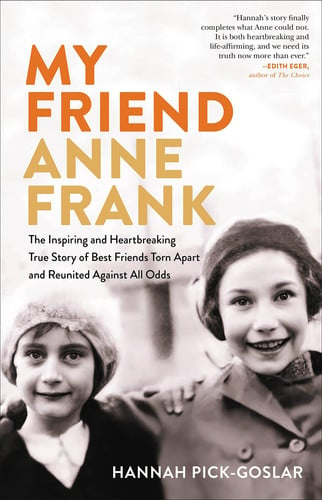
My friend Anne Frank: the inspiring and heartbreaking true story of best friends torn apart and reunited against all odds

Pick-Goslar, Hannah,Kraft, Dina
"In 1933, Hannah Pick-Goslar and her family fled Nazi Germany to live in Amsterdam, where she struck up a close friendship with her next-door neighbor, an outspoken and fun-loving young girl named Anne Frank. For several years, the inseparable pair enjoyed a carefree childhood of games, sleepovers, and treats with the other children in their neighborhood of Rivierenbuurt. But in 1942, Hannah and Anne's lives abruptly changed forever. As the Nazi occupation of Amsterdam progressed, Anne and the Frank family seemingly vanished, leaving behind unmade beds and dishes in the sink--but no trace of Anne's precious diary. Torn from her dear friend without warning, Hannah spent the next two years tormented by questions about Anne's fate, wondering if she had, by some miracle, managed to escape danger. In this long-awaited memoir, Hannah shares the story of her childhood during the Holocaust, from the introduction of anti-Jewish laws in Amsterdam to the gradual disappearance of classmates and, eventually, the Frank family, to Hannah and her family's imprisonment in the Bergen-Belsen concentration camp. As Hannah chronicles the experiences of her own life during and after the war, she provides a searing look at what countless children endured at the hands of the Nazi regime, as well as an intimate, never-before-seen portrait of the most recognizable victim of the Holocaust. Culminating in an astonishing fateful reunion, My Friend Anne Frank is the profoundly moving story of childhood and friendship during one of the darkest periods in the world's history"--Dust jacket flap.
Little, Brown Spark 2023 313 pages

Rembrandt's Jews

Nadler, Steven M.
There is a popular and romantic myth about Rembrandt and the Jewish people. One of history's greatest artists, we are often told, had a special affinity for Judaism. With so many of Rembrandt's works devoted to stories of the Hebrew Bible, and with his apparent penchant for Jewish themes and the sympathetic portrayal of Jewish faces, it is no wonder that the myth has endured for centuries. Rembrandt's Jews puts this myth to the test as it examines both the legend and the reality of Rembrandt's relationship to Jews and Judaism. In his elegantly written and engrossing tour of Jewish Amsterdam—which begins in 1653 as workers are repairing Rembrandt's Portuguese-Jewish neighbor's house and completely disrupting the artist's life and livelihood—Steven Nadler tells us the stories of the artist's portraits of Jewish sitters, of his mundane and often contentious dealings with his neighbors in the Jewish quarter of Amsterdam, and of the tolerant setting that city provided for Sephardic and Ashkenazic Jews fleeing persecution in other parts of Europe. As Nadler shows, Rembrandt was only one of a number of prominent seventeenth-century Dutch painters and draftsmen who found inspiration in Jewish subjects. Looking at other artists, such as the landscape painter Jacob van Ruisdael and Emmanuel de Witte, a celebrated painter of architectural interiors, Nadler is able to build a deep and complex account of the remarkable relationship between Dutch and Jewish cultures in the period, evidenced in the dispassionate, even ordinary ways in which Jews and their religion are represented—far from the demonization and grotesque caricatures, the iconography of the outsider, so often found in depictions of Jews during the Middle Ages and the Renaissance. Through his close look at paintings, etchings, and drawings; in his discussion of intellectual and social life during the Dutch Golden Age; and even through his own travels in pursuit of his subject, Nadler takes the reader through Jewish Amsterdam then and now—a trip that, under ever-threatening Dutch skies, is full of colorful and eccentric personalities, fiery debates, and magnificent art.
The University of Chicago Press 2003-11-03 250 pages

Brilliant orange: the neurotic genius of Dutch soccer

Winner, David
"A brilliant, thorough, utterly mad book, the product of the most admirable sort of enthusiasm: total. You like soccer, you don't like soccer, it doesn't matter. If you think of yourself as a serious fan, if you want to continue on the path towards enlightenment and take your devotion to another level, you'd best check out the standard being set here." --ESPN.com On one level, Brilliant Orange is about a people whose unique point of view has led to the most enduring arts, the weirdest architecture, and a bizarrely cerebral form of soccer--Total Football--that led in 1974 to a World Cup finals match with arch-rival Germany, as well as to a devastating loss against Spain in 2010. On another, the book also offers, as a 5-star reviewer put it: "insight into the Dutch mindset beyond football. You learn about Dutch history, art, and society while learning about their great players and the total football. You don't actually need to be a football fan to enjoy the book." "One of those strangely informative books that will entertain those who have little interest in either soccer or the Netherlands." -- The Economist "Wry, obsessional, digressive, deep. This is football as art, metaphor, and cultural signifier." -- The Guardian
Overlook Press 2008-07-29 288 pages

Dutch primacy in world trade 1585-1740

Israel, Jonathan
For nearly two centuries the Dutch Republic, despite its small size and population, functioned as the hub of world trade, shipping, and finance. This is the first detailed general account of that hegemony from its origins in the sixteenth century to the final collapse of the Dutch trading system in the eighteenth century. The economic structure of the early modern world was such that the Dutch Republic--particularly its chief business emporium, Amsterdam--was able to dominate the world economy to a far greater degree than any commercial power before or since. Using archival and secondary sources, this book explains how one small nation was able to maintain this ascendancy for so long, and details the mechanisms by which this was achieved and sustained, as well as the stages of its evolution.
Clarendon 1989-07-20 462 pages

The emergence of tolerance in the Dutch Republic

Christiane Berkvens-Stevelinck,Jonathan Jonathan Irvine Israel,Guillaume Henri Marie Posthumus Meyjes
This volume is the fruit of the colloquium ""Les Pays-Bas, carrefour de la tolerance aux Temps Modernes,"" held in Wassenaar, the Netherlands, in 1994. Toleration in the strict sense of the word was very much against the grain of sixteenth-century European history. This volume charts the emergence and vicissitudes of the concept of tolerance and its practical implications in the Dutch Republic, from the revolt against Spain in the sixteenth century to the early eighteenth century. The various contributions, all by distinguished scholars, address such issues as Erasmus' views on toleration, the relation between tolerance and irenism, and the contemporary intellectual debate about toleration in the Dutch Republic. This important volume will prove indispensable to historians of the Low Countries, students of humanism and all those interested in the intellectual history of the 16th-18th centuries.
E.J. Brill 1997-07-01 278 pages

At the edge of the abyss: a concentration camp diary, 1943-1944

Koker, David
"David Koker's diary is one of the most notable accounts of life in a German concentration camp written by a Jew during the years of the Holocaust. First brought to attention when the Dutch historian Jacob Presser-Koker's history teacher in high school-quoted from Koker's diary in his monumental history, published in English as The Destruction of the Dutch Jews (1968), the diary itself became a part of the Dutch literary canon when it was published in 1977 as Dagboek geschreven in Vught (Diary Written in Vught). It has remained in print ever since, and is notable for its literary qualities, weaving poetry and powerful observations of the emotional life of a camp prisoner, including reflections after an in-person visit by Heinrich Himmler. Surprisingly, the book has never before been translated into English. During his time in the Vught concentration camp, the 21-year-old David recorded on an almost daily basis his observations, thoughts, and feelings. He mercilessly probed the abyss that opened around him and, at times, within himself. David's diary covers almost a year, both charting his daily life in Vught as it developed over time and tracing his spiritual evolution as a writer. Until early February 1944, David was able to smuggle some 73,000 words from the camp to his best friend Karel van het Reve, a non-Jew. With an informative introduction, annotation, and list of dramatis personae by Robert Jan van Pelt, At the Edge of the Abyss offers an immediate and wholly original look into the life of a concentration camp prisoner"--Publisher's description.
Northwestern University Press 2012 396 pages

The upside-down world: meetings with the Dutch masters

Moser, Benjamin
Twenty years ago, Benjamin Moser followed a love affair to an ancient Dutch town. In order to make sense of this new place, he threw himself into the Dutch museums. Soon, he found himself unearthing the strange, inspiring and sometimes terrifying stories of the artists who shaped one of the most luminous moments in the history of human creativity, the Dutch Golden Age. As he explored the hidden world of the Dutch Masters (and one Mistress), Moser met a crowd of fascinating personalities- the stormy Rembrandt, the intimate Ter Borch, the mysterious Vermeer. Through their art, he got to know their country, too- from Pieter Saenredam's translucent churches to Paulus Potter's muddy barnyards, and from Pieter de Hooch's cozy hearths to Jacob van Ruisdael's tragic trees. Over the years, Moser found himself on increasingly intimate terms with these centuries-dead artists, and found that they, too, were struggling with the same questions he was. Why do we make art? What is art, anyway - and what is an artist? What does it mean to succeed as an artist, and what does it mean to fail? The Upside-Down World is an invitation to ask these questions, and to turn them on their heads- to look, and then to look again. It is a brilliant, colourful and learned book for anyone, whether lifelong scholar or curious tourist, who has ever felt the lure of the Dutch galleries. It shows us art, and artists, as we have never seen them before.
Penguin Books 2025-10-30 400 pages

The assault

Mulisch, Harry
It is the winter of 1945, the last dark days of World War II in occupied Holland. A Nazi collaborator, infamous for his cruelty, is assassinated as he rides home on his bicycle. The Germans retaliate by burning down the home of an innocent family; only twelve-year-old Anton survives. Based on actual events, The Assault traces the complex repercussions of this horrific incident on Anton's life. Determined to forget, he opts for a carefully normal existence: a prudent marriage, a successful career, and colorless passivity. But the past keeps breaking through, in relentless memories and in chance encounters with others who were involved in the assassination and its aftermath, until Anton finally learns what really happened that night in 1945—and why.
Pantheon Books 1985 185 pages

Memories: my life as an international leader in health, suffrage, and peace

Jacobs, Aletta H.
"The first of Aletta Jacobs's major works available in English, Memories introduces American readers to a remarkable woman-a key Dutch feminist who herself broke new ground, and who worked alongside world-renowned leaders in the progressive movements of the early twentieth century. Aletta Jacobs learned to lvoe the medical profession from her physician father, who took her on his rounds. Despite a sex-segregated education system, she became the nations's first woman to earn a medical degree. Jacobs's experiences as a doctor led her to pioneering health care reforms for prostitutes and saleswomen, as well as campaigns for the acceptance and availability of reliable birth control. Aletta Jacob's career included equally remarkable achievements in the international woman's suffrage and peace movements, where she worked closely with U.S. activists Jane Addams and Carrie Chapman Catt. Jacobs and Catt made frequent lecture tours together, culminating in a tour of Africa and Asia that combined avid sightseeing with speaking engagements in every country they visited. In Memories, Jacobs recounts all of these experiences, and spiritedly imparts her opinions-such as her disdain for the customs that restricted women to theater balcony seats and chastised them for walking alone at night. By turns witty, impassioned, and poignant, Memories brings to life a time of enormous changes for women-and one of the women who helped bring about the changes."--Book desc. via amazon.ca.
Feminist Press 1996 248 pages

Two roads home: Hitler, Stalin, and the miraculous survival of my family

Finkelstein, Daniel
"An epic and beautifully written World War II family history that spans Europe, telling of two happy families uprooted by war, their incredible suffering in Hitler's and Stalin's camps, and the near-miraculous survival and rescue of the author's parents who met after the war. Daniel Finkelstein's grandfather Alfred Wiener was a German Jewish intellectual leader who tolled an early warning of the impending Holocaust and became an archivist of Nazi crimes. He relocated his family to safety in Amsterdam, where they became close with Anne Frank's family. But they were eventually separated, and Daniel's mother Mirjam was sent to Bergen-Belsen with her mother and sisters while Alfred worked feverishly to free them. Finkelstein's father, Ludwik, grew up in a prosperous Jewish family in Poland where his father was a patriotic hero of the Great War. But when Stalin took control, Finkelstein's grandfather was deported to Siberia, while Ludwik and his mother were sent to Kazahkstan, where they barely survived freezing winters and harrowing forced labor conditions. Love and Murder is a page-turning account of ingenuity, bravery and the almost unbelievable coincidences that brought Daniel's parents together. The story features secret archives, forgery and theft, and sweeps across Europe to show the expanse of the war. Moving, engrossing and inspiring, Love and Murder will profoundly touch all who read it"--
Doubleday 2023 374 pages

Patriots and liberators: revolution in the Netherlands, 1780-1813

Schama, Simon
A reissue of Simon Schama's landmark study of the Netherlands from 1780--1813, this is a tale of a once-powerful nation's desparate struggle to survive the treacheries and brutality of European war and politics. Between 1780 and 1813 the Dutch Republic -- a country once rich enough to be called the cash till of Europe and powerful enough to make war with England -- was stripped of its colonies, invaded by its enemies, driven to the edge of bankruptcy, and, finally, reduced to becoming an appendage of the French empire -- an appendage not even the French seemed to value overmuch. Out of these events Simon Schama has constructed a gripping chronicle of revolution and privateering, constitutions and coups, in a tiny nation desperately struggling to stay afloat in a sea of geopolitics. Like his classics 'The Embarrassment of Riches' and 'Citizens', 'Patriots and Liberators' combines a mastery of historical sources with an unabashed delight in narrative. The result confirms Schama as a historian in the finest tradition -- one whose study of the past reveals volumes about the present. This is one of our most revered historians' greatest works, and this new Perennial edition will reintroduce his genius to a new generation of readers.
Knopf 1977-03-12 745 pages

Menasseh ben Israel: rabbi of Amsterdam

Nadler, Steven M.
An illuminating biography of the great Amsterdam rabbi and celebrated popularizer of Judaism in the seventeenth century Menasseh ben Israel (1604-1657) was among the most accomplished and cosmopolitan rabbis of his time, and a pivotal intellectual figure in early modern Jewish history. He was one of the three rabbis of the "Portuguese Nation" in Amsterdam, a community that quickly earned renown worldwide for its mercantile and scholarly vitality. Born in Lisbon, Menasseh and his family were forcibly converted to Catholicism but suspected of insincerity in their new faith. To avoid the horrors of the Inquisition, they fled first to southwestern France, and then to Amsterdam, where they finally settled. Menasseh played an important role during the formative decades of one of the most vital Jewish communities of early modern Europe, and was influential through his extraordinary work as a printer and his efforts on behalf of the readmission of Jews to England. In this lively biography, Steven Nadler provides a fresh perspective on this seminal figure
Yale University Press 2018 298 pages