4 results for "History"

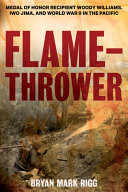
Flamethrower: Medal of Honor recipient Woody Williams, Iwo Jima, and World War II in the Pacific

Rigg, Bryan Mark
"Imagine strapping on a highly flammable 70-pound pack and entering combat as a surefire walking target-and you'd only begin to understand the job, and the horror, of Marine Corps flamethrower man. That's precisely what Hershel "Woody" Williams did in World War II, most importantly in February 1945 on Iwo Jima, one of the Pacific War's toughest battles. A few days into the battle, Marines were fighting hard for an airfield, and his captain asked Woody if he could do anything. He responded, "I'll try"-and for the next four hours, he virtually singlehandedly took on and ultimately destroyed seven enemy pillboxes and helped secure the airfield. Accomplished military historian Bryan Mark Rigg reconstructs Williams' remarkable story, from his youth in West Virginia to his experiences on Guadalcanal, Saipan, Guam, and most significantly Iwo Jima. In Rigg's telling, Williams's Medal of Honor action is not "just" a brave deed, but one of only a few strategically significant brave deeds-one that secured a strategic objective during a major campaign. Rigg tells Williams' story vividly, and objectively, and places it in the context of the broader Pacific theater of World War II."--
Stackpole Books 2020 544 pages

The Eagle and the Rising Sun: the Japanese-American war, 1941-1943, Pearl Harbor through Guadalcanal

Schom, Alan
On Saturday, August 2, 1941, the Washington Post reported that President Franklin D. Roosevelt would depart the next day for a fishing vacation aboard his yacht, Potomac. By the morning of August 5, the Potomac was sailing toward the fishing waters off Cape Cod -- but the president was not on board. Having quietly disembarked in the middle of the night, the president, now joined by his top military advisors, was headed for Newfoundland, where the U.S. and British governments would meet in a secret summit to coordinate their military efforts, although the United States had yet to declare war on Germany. The British were appalled at the state of American preparedness, one British colonel remarking, "They have a long way to go before they can play any decisive part in the war." But ready or not, the United States would be catapulted into World War II within a matter of months. Alan Schom's superb histories and biographies have been lauded for their dramatic sweep, their focus on extraordinary personalities, and their refreshingly iconoclastic perspective. Schom begins this magisterial account of World War II in the Pacific by demonstrating an ironic paradox: on one hand, the American government and people were as inadequately prepared for war as any major power ever has been; on the other, the Japanese high command plunged headlong into the Pacific campaign despite clear evidence -- from their own analysts -- that Japan had too little oil and too feeble an economy to prevail against the United States. It was a war that should not have been fought. Schom recounts a tense saga of diplomatic maneuvering, strategic blunders, and pivotal successes played out in the halls of the White House, Downing Street, and the Imperial Palace, as well as on the seas and shores of the Pacific. Key figures in the war come vividly to life in a series of brilliant biographical sketches: Emperor Hirohito, a devotee of Western pursuits such as golf and jazz, who hungered to expand Japan's global reach; the destructively egotistical General Douglas MacArthur, whose splendid achievements in World War I stood in stark contrast to his incompetent leadership in the Philippines; Rear Admiral Kelly Turner, whose realism and tactical savvy played a crucial role in turning the tide of the war; and the cool-headed Admiral Tanaka Raizo, who repeatedly slipped through the Allied net, transporting troops and supplies to and from Guadalcanal. The Eagle and the Rising Sun embraces the broad strategic concerns of the war and the telling details and turning points of individual engagements. As Rear Admiral Thomas Marfiak, Ret., CEO and publisher of the U.S. Naval Institute, writes in the Foreword: "From time to time, we are privileged to be given extraordinary insights into the history of our age. Alan Schom has given us a tapestry, into which he has woven figures of immense proportions, yet he has not lost sight of their humanity. He writes ... in the grand tradition of Barbara Tuchman's The Guns of August." Book jacket.
W.W. Norton 2004 540 pages

Islands of hell: the U.S. Marines in the Western Pacific, 1944-1945

Hammel, Eric M.
By the summer of 1944 the tide had turned in the Pacific War against the Japanese. The war was not nearly over, however, and the U.S. Marines had their heaviest combat in front of them. Here for the first time is a detailed photographic history for the Fighting Leathernecks' fierce combat for the Marianas, Peleliu, Iwo Jima, and Okinawa. Illustrated with hundreds of never-before-published photographs and supplemented with full-color maps, Islands of Hell is a historical and visual treat.
Zenith 2010-03-01 284 pages

The American aces speak

Hammel, Eric M.
Picking up where he left off in his acclaimed Aces Against Japan and Aces Against Germany, leading combat historian Eric Hammel comes through again with an engrossing new collection of thirty-eight first-person accounts by American World War Il fighter aces. Coupled with a clear overview of America's far-flung air war against Japan and a clear appreciation of the burgeoning industrial might backing the American war effort, Hammel's detailed interviews bring forth the most thrilling in-the-cockpit experiences that World War II's fabled Army, Navy, Marine, and Flying Tiger aces have chosen to tell. Ride with 2d Lieutenant Jack Donalson as he downs three Zeros-over Luzon on the second desperate day of World War II in the Philippines. Share three lonely air battles over Burma and China with Flying Tiger aces RT Smith, Dick Rossi, and Joe Rosbert. Hear the cry of victory as 2d Lieutenant Don McGee survives yet another encounter with Zeros over embattled Port Moresby, New Guinea, in his substandard P-39 Airacobra. Feel your heart beat with anxiety as an injured Ensign Ed Wendorf races against time to land his damaged Helicat aboard the USS Lexington before he bleeds to death. And thrill to the hunt as Pearl Harbor veteran 1st Lieutenant Frank Holmes seeks personal revenge against Admiral Isoroku Yamamoto on one of history's most important and most thrilling fighter missions. Aces Against Japan II is a highly charged excursion into life and death in the air, told by men who excelled at piston-engine aerial combat and lived to tell about it. In sum, it is an emotional rendering of what brave airmen felt and how they fought in the now-dim days of America's living national history.
Presidio 1992 302 pages