
3 results for "History"

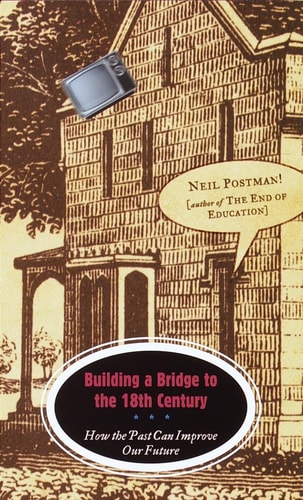
Building a bridge to the 18th century: how the past can improve our future

Postman, Neil
In Building a Bridge to the 18th Century , acclaimed cultural critic Neil Postman offers a cure for the hysteria and hazy values of the postmodern world. Postman shows us how to reclaim that balance between mind and machine in a dazzling celebration of the accomplishments of the Enlightenment-from Jefferson's representative democracy to Locke's deductive reasoning to Rousseau's demand that the care and edification of children be considered an investment in our collective future. Here, too, is the bold assertion that Truth is invulnerable to fashion or the passing of time. Provocative and brilliantly argued, Building a Bridge to the 18th Century illuminates a navigable path through the Information Age-a byway whose signposts, it turns out, were there all along.
Knopf 2000-10-10 213 pages

Metaphysics, facticity, interpretation: phenomenology in the Nordic countries

D. Zahavi,Sara Heinämaa,Hans Ruin
The past decade has witnessed a notable turn in philosophical orientation in the Nordic countries. For the first time, the North has a generation of philosophers who are oriented to phenomenology. This means a vital rediscovery of the phenomenological tradition as a partly hidden conceptual and methodological resource for taking on contemporary philosophical problems.The essays collected in the present volume introduce the reader to the phenomenological work done in the Nordic countries today. The material is organized under three general headings: metaphysics, facticity, and interpretation. The volume is of interest to researchers and students working in the areas of epistemology and ontology as well as philosophy of language, history, and intersubjectivity.The first part, "Metaphysics," asks if phenomenology is, or could be taken as, a metaphysical inquiry. It studies this possibility in a systematic as well as in a historical perspective. The second part, "Facticity," focuses on the double character of the philosophizing subject, on the one hand, as a worldly being bound by a cultural and historical situation, and on the other hand, as the one who thinks this condition and gives it an interpretation. It studies four aspects of facticity in particular: language, dwelling, alterity, and generation. The third part, "Interpretation," clarifies the different notions of interpretation central to phenomenology, understood as hermeneutics.
Kluwer Academic Publishers 2003-12-31 242 pages

Pragmatism's advantage: American and European philosophy at the end of the twentieth century

Margolis, Joseph
This book addresses the rift between major philosophical factions in the United States, which the author describes as a "philosophically becalmed" three-legged creature made up of analytic philosophy, continental philosophy, and pragmatism. Joseph Margolis offers a modified pragmatism as the best way out of this stalemate. Whether he is examining Heidegger or rethinking the foibles of Dewey, Rorty, and Peirce, much of nineteenth- and twentieth-century Western philosophy comes into play as Margolis presents his history of philosophy's evolution and defends his views. He does not, however, mean for philosophy to turn to the pragmatism of yore or even to its revival in the 1970s. Rather, he finds in recent approaches to pragmatism a middle ground between analytic philosophy's scientism (and its disinterest in analyzing human nature)and continental philosophy's reliance on attributing transcendental powers to mere mortals.
Stanford University Press 2010-01-29 172 pages