9 results for "History"

Love, poverty and war: journeys and essays

Hitchens, Christopher
Love, Poverty and War: Journeys and Essays showcases the Hitchens' rejection of consensus and cliché, whether he's reporting from abroad in Indonesia, Kurdistan, Iraq, North Korea, or Cuba, or when his pen is targeted mercilessly at the likes of William Clinton, Mother Theresa ("a fanatic, a fundamentalist and a fraud"), the Dalai Lama, Noam Chomsky, Mel Gibson and Michael Bloomberg. Hitchens began the nineties as a "darling of the left" but has become more of an "unaffiliated radical" whose targets include those on the "left," who he accuses of "fudging" the issue of military intervention in the Balkans, Afghanistan and Iraq. Yet, as Hitchens shows in his reportage, cultural and literary criticism, and opinion essays from the last decade, he has not jumped ship and joined the right but is faithful to the internationalist, contrarian and democratic ideals that have always informed his work.
Atlantic Books 2021-05 475 pages

Men, ideas, and politics

Drucker, Peter F.
This collection of Peter F. Drucker's essays explores the intersection between society, politics, and economics. Despite this lofty goal, however, the essays themselves remain down to earth, highly readable, and full of stories and ideas that make us think differently about the business world around us. The majority of these essays were written in the 1960s, and in them Drucker specifically examines that turbulent decade, yielding conclusions that are as timeless as they are fresh. He places the merger mania of the decade in the context of business history of the twentieth century, and arrives at fundamental questions about mass market economies. He questions the personal and political values of 1960s adolescents, and ends up relating them to the concurrent rise of big complex modern institutions. He examines with equal vigor Japan's management successes, the role of politics and economics in American identity, and the "real" Kirkegaard.
Harvard Business Review Press 2010 271 pages

Facing up to modernity: excursions in society, politics, and religion

Berger, Peter L.
PETER BERGER, renowned sociologist and social critic, theologian and novelist, here brings his many gifts to bear on the endlessly interesting, if also painful, predicament of living in the modern world. In discussions ranging all the way from such private experiences as marriage and psychoanalysis to such public issues as the secularization of religion, the corruptions of pornography, or the growing indifference to murder, he brilliantly demonstrates how that predicament has grown out of the modern disbelief in God and the weakening of the institutions of community. The modernity which constitutes the central preoccupation of this book raises questions of both a very general and a very particular kind: "How," in Peter Berger's own words, "can one understand that peculiar reality we know as modern society?" Beyond understanding it, how can one actually engage in meaningful political action in its American version? And how does modernity constrain or condition a man's religious quest? The author's answers, based on a sure sense of history combined with an infinitely patient yet toughminded grasp of the way societies actually work, bring new illumination to virtually every page. For those who have not accepted Peter Berger's views about the nature of our present predicament as well as for those who have-indeed, for everyone concerned with understanding himself as a modern person and as a citizen of a modern state-Facing Up to Modernity is an experience in self- discovery
Basic Books 1977 233 pages

Preferences and situations: points of intersections between historical and rational choice institutionalism

Ira Katznelson,Barry R. Weingast
A scholarly gulf has tended to divide historians, political scientists, and social movement theorists on how people develop and act on their preferences. Rational choice scholars assumed that people—regardless of the time and place in which they live—try to achieve certain goals, like maximizing their personal wealth or power. In contrast, comparative historical scholars have emphasized historical context in explaining people's behavior. Recently, a common emphasis on how institutions—such as unions or governments—influence people's preferences in particular situations has emerged, promising to narrow the divide between the two intellectual camps. In Preferences and Situations, editors Ira Katnelson and Barry Weingast seek to expand that common ground by bringing together an esteemed group of contributors to address the ways in which institutions, in their wider historical setting, induce people to behave in certain ways and steer the course of history. The contributors examine a diverse group of topics to assess the role that institutions play in shaping people's preferences and decision-making. For example, Margaret Levi studies two labor unions to determine how organizational preferences are established. She discusses how the individual preferences of leaders crystallize and become cemented into an institutional culture through formal rules and informal communication. To explore how preferences alter with time, David Brady, John Ferejohn, and Jeremy Pope examine why civil rights legislation that failed to garner sufficient support in previous decades came to pass Congress in 1964. Ira Katznelson reaches back to the 13th century to discuss how the institutional development of Parliament after the signing of the Magna Carta led King Edward I to reframe the view of the British crown toward Jews and expel them in 1290. The essays in this book focus on preference formation and change, revealing a great deal of overlap between two schools of thought that were previously considered mutually exclusive. Though the scholarly debate over the merits of historical versus rational choice institutionalism will surely rage on, Preferences and Situations reveals how each field can be enriched by the other.
Russell Sage Foundation 2005 345 pages

Selling the people's Cadillac: the Edsel and corporate responsibility

Jan G. Deutsch
This extraordinary book shows that corporate social responsibility should be treated as a legal rather than as an economic problem. Having established the Edsel as a case in point, Deutsch offers a jurisprudence based on that history, presenting law as a process that can be understood only by an awareness of the context in which it takes place.
Yale University Press 1976 261 pages

Behemoth: main currents in the history and theory of political sociology

Horowitz, Irving Louis
The title, Behemoth, derives from the Hebrew word Behemah-a beast, an enormous creature, monstrously huge and vast. It is an apt description of the State on the eve of the twenty-first century. Loved by few, vilified by many from all perspectives, it nonetheless continues to grow; by turns rivaling and co-opting that more pleasant-sounding word: Society. Political sociology aims to define and understand the interrelationship between these two huge terms: State and Society. Continuing in a path begun by Horowitz in the 1950s in The Idea of War and Peace in Contemporary Social and Philosophical Thought, expanded upon in the 1970s with Foundations of Political Sociology, this summing up in the late 1990s is an effort to extract and evolve the canon of political sociology. Starting with Montesquieu, Horowitz proceeds through the European experience of Rousseau, Tocqueville, Hegel, Marx, Durkheim, Sorel, and Weber. He then takes the field on its tangled migration to America with the Frankfurt School in exile, followed by searching chapters on Schumpeter, Mills, Arendt, and Huntington, among others. The result is a stunning revaluation of the intellectual sources of the present day divisions between statists and socialists, welfarists and individualists, advocates of dictatorship and of democracy, mandated rules and voluntary association, hard realists and soft utopians, a world without states and a world with a single state. Horowitz does not offer the usual evolutionary notion of doctrines, but a canon embedded in and embattled with the societies they aim to serve or overthrow in the present as in the past. The result is a major recasting of the theory and practice of social science and normative frameworks. The final chapter offers Horowitz's own prognosis of what we can expect in the recasting of the Welfare State to include the Welfare Society, and its growing nemesis the global economy which threatens to engulf State and Society alike in a return to civilizational concerns. This is an essential text for policy-makers and social scientists interested in macroscopic changes in the political order.
Transaction Publishers 1999 474 pages

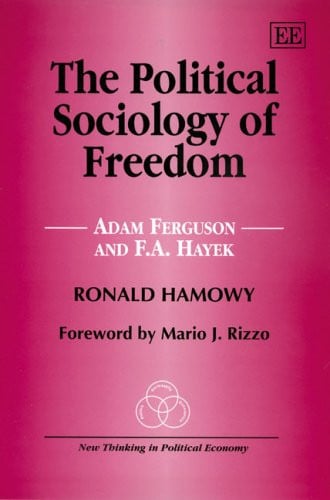
The political sociology of freedom: Adam Ferguson and F.A. Hayek

Hamowy, Ronald
Adam Ferguson and Friedrich Hayek, separated by a period of almost two hundred years, made original but similar contributions to the field of theoretical sociology. In this collection of essays, Ronald Hamowy explores the life and work of these two thinkers, giving special emphasis to their insights into the diffusion of knowledge. Ferguson, a giant of the Scottish Enlightenment, can be credited with laying the foundations of theoretical history by first proposing the idea that social institutions undergo evolutionary change. He theorized that while these institutions are formed by the actions of human beings, they are not the product of human design. Less than two centuries later, Hayek extended this insight to dealing with economic and social interaction, arguing that the knowledge requisite for structuring the social institutions under which we live is far too complex to be comprehended by any one mind or group of thinkers, and that these institutions had in fact evolved over long periods of time without deliberate design. Hayek was also the first to introduce the notion that market processes are a function of all participants contributing the limited knowledge that each possesses, out of which an orderly arrangement of enormous complexity emerges. Scholars and students of sociology, economics, history and political theory will find The Political Sociology of Freedom a unique and provocative read.
Edward Elgar 2005 265 pages