59 results for "History"

The better angels of our nature: why violence has declined

Pinker, Steven
We've all asked, "What is the world coming to?" But we seldom ask, "How bad was the world in the past?" Cognitive scientist Steven Pinker shows that the past was much worse. Evidence of a bloody history has always been around us: genocides in the Old Testament, gory mutilations in Shakespeare and Grimm, monarchs who beheaded their relatives, and American founders who dueled with their rivals. The murder rate in medieval Europe was more than thirty times what it is today. Slavery, sadistic punishments, and frivolous executions were common features of life for millennia, then were suddenly abolished. How could this have happened, if human nature has not changed? Pinker argues that thanks to the spread of government, literacy, trade, and cosmopolitanism, we increasingly control our impulses, empathize with others, debunk toxic ideologies, and deploy our powers of reason to reduce the temptations of violence.
Viking 2011 802 pages

The madwoman in the attic: the woman writer and the nineteenth-century literary imagination

Gilbert, Sandra M.,Gubar, Susan
A pathbreaking book of literary criticism is now reissued with a new introduction by Lisa Appignanesi that speaks to how The Madwoman in the Attic set the groundwork for subsequent generations of scholars writing about women writers, and why the book still feels fresh some four decades later.
Yale University Press 2020-03-17 719 pages

Phishing for phools: the economics of manipulation and deception

Akerlof, George A.,Shiller, Robert J.
Akerlof and Shiller argue that markets harm as well as help us. As long as there is profit to be made, sellers will systematically exploit our psychological weaknesses and our ignorance through manipulation and deception. Based on the intuitive idea that markets both give and take away, they show how phishing affects everyone, in almost every walk of life. We spend our money up to the limit, and then worry about how to pay the next month's bills. The financial system soars, then crashes. In exploring the role of manipulation and deception, the authors explain a paradox: why, at a time when we are better off than ever before in history, all too many of us are leading lives of quiet desperation.
Princeton University Press 2015 272 pages

Mind change: how digital technologies are leaving their mark on our brains

Greenfield, Susan
"Google. Facebook. Twitter. Repeat. We live in a world unimaginable even a few decades ago, one like no other in human history. It's a parallel world where we can be on the move in the real world, yet always hooked into an alternative time and place. And although it's a two-dimensional world of sight and sound, it offers instant information, connected identities, and constant novelty. In this world, our screen technologies are increasingly where we work, where we unwind, where we relieve our boredom and where we learn. The subsequent transformation in how we live and think is a vitally important issue, perhaps even the most important issue of our time. When toddlers are given iPads, and adults spend ten hours a day staring at a screen, can we afford to assume that our brave new screen technologies are harmless tools? Blending a wide range of scientific studies, news events, and cultural criticism with brio and verve, Mind Change presents an incisive snapshot of the global 'now.' Greenfield examines how the dawn of the Digital Age has already altered our cultural landscape, fueled an epidemic of oversharing, and transformed how we learn, remember and spread information -- and how these innovations are changing our physical brains. A warning cry, a shot across the bow, and a call to action, Mind Change explores the social, cultural and physiological ramifications of our new digital lifestyle"--
Random House 2015-02-10 348 pages

The whisperers: private life in Stalin's Russia

Figes, Orlando
Drawing on a huge range of sources - letters, memoirs, conversations - Orlando Figes tells the story of how Russians tried to endure life under Stalin, brilliantly conveying the reality of their terrible choices. Soviet history has generally been seen either as a story of a political system or the story of its victims. The Whisperers is about Russians from across the whole range of experience under Stalin. Those who shaped the political system became, very frequently, its victims. Those who were its victims were frequently quite blameless. The Whisperers recreates the sort of maze in which Russians found themselves, where an unwitting wrong turn could either destroy a family or, perversely, later save it; a society in which everyone spoke in whispers- whether to protect themselves, their families, neighbours or friends - or to inform on them. This is Figes's masterpiece. It is both a gripping and emotional account of lives lived in impossible times and a remarkable example of the power and value of writing history.
Allen Lane 2007 739 pages

The invention of heterosexuality

Katz, Jonathan
Exploring the startling history of the heterosexual concept, Jonathan Ned Katz reveals that as late as the 1920s, heterosexuality was still defined in a major American dictionary as "morbid sexual passion for one of the opposite sex." It was only through a slow process that heterosexuality became this society's dominant norm. Analyzing the work of such pioneering students of sexuality as Sigmund Freud and Richard von Krafft-Ebing, Katz considers the effects of their ideas about the sacred primacy of heterosexuality on both scientific literature and popular culture. He also examines the varied commentaries on heterosexuality by such contemporary writers as James Baldwin, Betty Friedan, Adrienne Rich, Kate Millett, and Michel Foucault.
Dutton 1995 291 pages

Poetry and repression: revisionism from Blake to Stevens

Bloom, Harold
This reinterpretation of the full sweep of English and American romantic poetry offers close readings of poems of Blake, Wordsworth, Shelley, Keats, Tennyson, Browning, Whitman, Yeats, and Stevens. It also reviews the crucial ideas of Emerson, Nietzsche, and in particular Freud, whose psychoanalytic theory of repression and defense Bloom undertakes to revise for purposes of literary criticism. "Bloom offers a fully defined alternative to the principal modes of contemporary criticism, from Freudian literary criticism (which he insists is neither Freudian nor literary criticism) to the New Criticism and structuralist and archetypal approaches. It is an original, vigorous, and passionate study which is both compelling and provocative."-The British Studies Monitor "Show me but one paragraph of Bloom's approaches to texts, and I'm hooked. . . . I find sheer delight in his ingenious ways."-Kenneth Burke "Bloom has made a remarkable contribution to poetic theory."-Phoebe Pettingell, The New Leader
Yale University Press 1976 293 pages

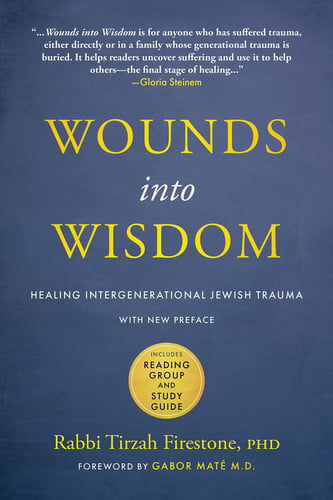
Wounds into wisdom: healing intergenerational Jewish trauma

Firestone, Tirzah
"Our past does not simply disappear. The painful history of our ancestors and their rich cultural wisdom intertwine within us to create the patterns of our future. Even when past trauma remains unspoken or has long been forgotten, it becomes part of us and our children-a legacy of both strength and woundedness that shapes our lives. In this book, Tirzah Firestone brings to life the profound impact of protracted historical trauma through the compelling narratives of those whose lives were marred by racial persecution and displacement. The tragic story of Firestone's own family lays the groundwork for these revealing testimonies of recovery, forgiveness, and moral leadership. Throughout, Firestone interweaves their voices with neuroscientific and psychological findings, as well as relevant and inspiring Jewish teachings. Seven principles emerge from these wise narratives-powerful prescriptive tools that speak to anyone dealing with the effects of past traumatic injury. At the broadest level, these principles are directives for staying morally awake in a world rife with terror"--
Monkfish Book Publishing Company 2022 258 pages

The truth about style

London, Stacy
"The hilarious, beloved cohost of TLC's What Not to Wear examines the universal obstacles all women--including herself--put in their way With her unique talent for seeing past disastrous wardrobes to the core emotional issues that caused these sartorial crises, style savant Stacy London has transformed not only the looks but also the lives of hundreds of guests who have appeared on What Not to Wear. Now for the first time in print, London turns that expert X-ray insight on herself. Like the women she's transformed, London has plenty of emotional baggage. At eleven, she suffered from severe psoriasis that left her with permanent physical and mental scars. During college, she became anorexic on a misguided quest for perfection. By the time she joined the staff at Vogue, London's weight had doubled from binge eating. Although self-esteem and self-consciousness nearly sabotaged a promising career, London learned the hard way that we wear our insecurities every day. It wasn't until she found the self-confidence to develop a strong personal style that she finally became comfortable in her skin. In The Truth About Style, London shares her own often painful history and her philosophy of the healing power of personal style--illustrating it with a series of detailed "start-overs" with eight real women, demonstrating how personal style helps them overcome the emotional obstacles we all face. For anyone who has ever despaired of finding the right clothes, or even taking an objective assessment in a full-length mirror, The Truth About Style will be an inspiring, liberating, and often very funny guide to finding the expression of your truest self. "--
Viking Adult 2012 215 pages

The originality of the avant-garde and other modernist myths

Krauss, Rosalind E.
Co-founder and co-editor of October magazine, a veteran of Artforum of the 1960s and early 1970s, Rosalind Krauss has presided over and shared in the major formulation of the theory of postmodernism. In this challenging collection of fifteen essays, most of which originally appeared in October, she explores the ways in which the break in style that produced postmodernism has forced a change in our various understandings of twentieth-century art, beginning with the almost mythic idea of the avant-garde. Krauss uses the analytical tools of semiology, structuralism, and poststructuralism to reveal new meanings in the visual arts and to critique the way other prominent practitioners of art and literary history write about art. In two sections, "Modernist Myths" and "Toward Postmodernism," her essays range from the problem of the grid in painting and the unity of Giacometti's sculpture to the works of Jackson Pollock, Sol Lewitt, and Richard Serra, and observations about major trends in contemporary literary criticism.
MIT Press 1985 307 pages

The inner history of devices

Turkle,Sherry
"For more than two decades, in such landmark studies as The Second Self and Life on the Screen, Sherry Turkle has challenged our collective imagination with her insights about how technology enters our private worlds. In The Inner History of Devices, she describes her process, an approach that reveals how what we make is woven into our ways of seeing ourselves. She brings together three traditions of listening--that of the memoirist, the clinician, and the ethnographer. Each informs the others to compose an inner history of devices. We read about objects ranging from cell phones and video poker to prosthetic eyes, from Web sites and television to dialysis machines.
MIT Press 2008 208 pages

A terrible love of war

Hillman, James
From world-renowned psychologist and bestselling author of The Soul's Code , a profound examination of the roots of man's primal love/hate relationship with war. War is a timeless force in the human imagination-and, indeed, in daily life. If recent events have taught us anything, it is that peacetime is not nearly so constant and attainable as wartime. During the 5,600 years of recorded history, 14,600 wars have been fought-2 to 3 for every year of human history. War is a constant thing. And yet no one really understands why that is. In A Terrible Love of War , James Hillman, one of the central figures in psychology in the twentieth and twenty-first centuries, fills this great void and undertakes a groundbreaking examination of the origins, needs, and rewards of war. Moreover, in this brilliant inquiry, Hillman explores many other essential questions, such as: € Is war a necessary part of our human soul and, therefore, a necessary part of our lives? € Why do we need enemies? € What scars does warfare carve on the psyche of its soldiers? And why does it have such a permanent effect? € If war is such a "normal" part of our existence, why do we fear it so much? And alternately, how could we ever embrace a force so destructive, so wanton, and so inhuman? € Can the impulse to engage in war be tamed? Hillman asserts that "if we want war's horror to be abated so that life may go on, it is necessary to understand and imagine." A Terrible Love of War is a crucial tool to understanding war-a crucial book for us all.
Penguin Press 2004 256 pages

What's luck got to do with it? the history, mathematics, and psychology behind the gambler's illusion

Mazur, Joseph
"Mazur's book treats luck in a fresh light. The philosophy and emotional aspects (along with a little mathematics) are all there. The reader who delves in will be lucky indeed." --Persi Diaconis, Stanford University "Blending math with memoir, probability with psychology, and heuristics with history, Mazur has written an essential book for anyone who wants to get a better idea of why we consistently bet against the odds. From the betting window to Wall Street, he offers insights into both the mechanics of chance and the enduring appeal that luck holds for those who wager every day, whether they call it gambling, speculation, or just hoping for the best. Engaging and illuminating, this is a guaranteed winner." --David G. Schwartz, director of the Center for Gaming Research at the University of Nevada, Las Vegas, and author of Roll the Bones: The History of Gambling "This is a fascinating book. It's a fresh, funny, philosophical look at gambling by a mathematician who knows what he's talking about, and who has quite obviously thought about gambling for a long time. Mazur isn't afraid to make provocative, opinionated statements. I have not seen a gambling book like this before. I think it will attract a lot of readers." --Paul J. Nahin, author of Digital Dice "This book is significant in that it offers a lively and diverse collection of gambling-related ideas. Mazur's robust blend of anecdotes, history, psychology, and mathematics differs from other attempts to discuss these ideas. He offers plenty of insights into the questions and issues he raises." --Edward Packel, author of The Mathematics of Games and Gambling
Princeton University Press 2010-06-06 277 pages

How magicians think: misdirection, deception, and why magic matters

Jay, Joshua
"Joshua Jay, one of the world's most accomplished magicians, not only opens that door but brings us inside to reveal the artistry and obsessiveness, esoteric history, and long-whispered-about traditions of a subject shrouded in mystery. In 52 short, compulsively readable essays, Jay describes how he does it, whether it's through the making of illusions, the psychology behind them, or the way technology influences the world of magic. He considers the aesthetics of performance, discusses contemporary masters, including David Copperfield, Penn & Teller, and David Blaine, and details how magicians hone their craft. And answers questions like: Can a magic trick be too good? How do you saw a person in half? Is there real magic in the universe? The answers, like so much in magic and life, depend on you."--Amazon.com.
Workman Publishing 2021 310 pages

Between men: English literature and male homosocial desire

Sedgwick, Eve Kosofsky
At the time of its first appearance in 1985 Between Men was viewed as an important intervention into Feminist as well as Gay and Lesbian studies. It was an important book because it argued that "sexuality" and "desire" were not a historical phenomenon but carefully managed social constructs. This insight (that actually originated with Michael Foucault) is often viewed as anti-humanist or post-humanist because it argues that men and women are simply the products of patriarchal power relations over which they have no control. By mobilizing Foucault's theories of the history of sexuality Sedgwick re-fashions Feminism and Gay and Lesbian Studies to make it seem as though Feminism and Gay and Lesbian studies are ideally situated to continue those interventions into the history of sexuality begun by Foucault.
Columbia University Press 2016 244 pages

The protean self: human resilience in an age of fragmentation

Lifton, Robert Jay
”Proteanism”—or the protean self—describes a psychological phenomenon integral to our times. We live in a world marked by breathtaking historical change and instantaneous global communication. Our lives seem utterly unpredictable: there are few absolutes. Rather than collapsing under these threats and pulls, Robert Jay Lifton tells us, the self turns out to be remarkably resilient. Like the Greek god Proteaus, who was able to change shape in response to crisis, we create new psychological combinations, immersing ourselves in fresh and surprising endeavors over our lifetimes.
BasicBooks 1993 262 pages