4 results for "History"

Judaism and other faiths

Cohn-Sherbok, Dan
Examines the attitudes of Judaism toward other religions. Asserts that, in the course of its long history, Judaism became progressively more tolerant toward Christianity. It was the persecutions suffered by Jews in Christian countries - anti-Jewish accusations, pogroms, forced conversions, accusations against the Talmud, theological disputations - and the atmosphere of fear generated by them, as well as the persecution of Conversos by the Inquisition, which impeded improvement in the Jewish perception of Christianity. Ch. 8 (pp. 133-152), "Post-Holocaust Jewish Thinkers, " examines the impact of Christian theology on Jewish theologians of the Holocaust (Schoeps, Rubenstein, Fackenheim, Maybaum, A.A. Cohen).
St. Martin's Press 1994-05-12 186 pages

Jews, Christians and religious pluralism

Cohn-Sherbok, Dan
Provides a basis for considering the claims of a wide variety of Jewish and Christian writers in the Judeo-Christian tradition, from biblical times to the present, who have wrestled with the issues of religious pluralism. In many cases these thinkers have reflected on the merits of one another's faith; alternatively, they have considered the truth-claims of their own faith in relation to the world's religions. Profiles on some 90 thinkers, such as Augustine, Helen Fry, and Baruch Spinoza, provide the type of information most commonly sought by students and general readers, including biographical details, theological position, and samples of work. The author is a professor of Judaism at the University of Wales, and visiting professor of interfaith dialog at Middlesex University. Annotation c. Book News, Inc., Portland, OR (booknews.com)
Edwin Mellen Press 1999 336 pages

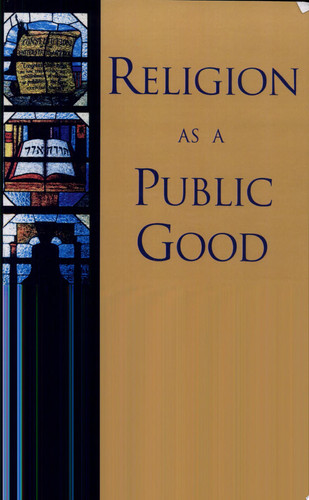
Religion as a public good: Jews and other Americans on religion in the public square

Alan Mittleman
Religion as a Public Good: Jews and Other Americans on Religion in the Public Square explores the often controversial topic of how religion ought to relate to American public life. The sixteen distinguished contributors, both Jewish and Christian, reflect on the topic out of their own disciplines-social ethics, political theory, philosophy, law, history, theology, and sociology. and take a stand based on their religious convictions and political beliefs. The volume is at once scholarly and committed, polemic and civil, reflective and activist. Written in the shadow of 9/11, it invites a new consideration of how religion enhances democratic public life with full awareness of the dangers that religion can sometimes pose. The volume is polemical, as befits the topic, but also civil, as befits a dialogue about an issue of profound significance for democratic citizenship.
Rowman & Littlefield 2003-12-09 336 pages

The divine symphony: the Bible's many voices

Knohl, Israel
In this fascinating book, Knohl shares his understanding of how the Torah was edited into its final form. He bridges the gap between ancient Israel (c.1400-586 B.C.E.) and Second Temple times (c.536 B.C.E.-70 C.E.) by showing the continuity between these eras and the gradual evolution of the biblical worldview, which formed the foundation of later rabbinic Judaism. The book focuses on the editing of the Torah, interpreting the textual evidence, most notably contradictions and redundancies, to show that the idea of a pluralistic understanding of Revelation can be traced back to the editing of the Torah itself. Knohl’s interpretation of biblical composition challenges a popular trend in contemporary biblical scholarship: the idea that ancient Israel never existed as a historical reality, but was invented and “retrojected” back in time by later Israelite priests as part of their national myth.
The Jewish Publication Society 2003-11-01 208 pages