169 results for "History"

Night

Wiesel, Elie,Wiesel, Marion
Born in the town of Sighet, Transylvania, Elie Wiesel was a teenager when he and his family were taken from their home in 1944 to Auschwitz concentration camp, and then to Buchenwald. Night is the terrifying record of Elie Wiesel's memories of the death of his family, the death of his own innocence, and his despair as a deeply observant Jew confronting the absolute evil of man. This new translation by his wife and most frequent translator, Marion Wiesel, corrects important details and presents the most accurate rendering in English of Elie Wiesel's testimony to what happened in the camps and of his unforgettable message that this horror must simply never be allowed to happen again.
Penguin 2016-05-16 144 pages

The Singularity is Near When Humans Transcend Biology

Ray Kurzweil
How Singular? How singular is the Singularity? Will it happen in an instant? Lets consider again the derivation of the word. In mathematics a singularity is a value that is beyond any limit - in essence, infinity. The Singularity as we have discussed it in this book, does not achieve infinite levels of computation, memory, as any other other measurable attribute. But it certainly achieves vast levels of all these qualities, including intelligence. With the reverse engineering of the human brain we will be able to apply the parallel, self-organizing, chaotic, algorithms of human intelligence to enormously powerful computational substrates. This intelligence will then be in a position to improve its own design, both hardware and software, in a rapidly accelerating iterative process.
Viking 2005 652 pages

The Identity Trap

Mounk, Yascha
Named a Best Book of the Year by The Economist , Financial Times , Inc. , Prospect Magazine , and The Conversation “The most comprehensive and reasonable story of this shift that has yet been attempted . . . Mounk has told the story of the Great Awokening better than any other writer who has attempted to make sense of it.” — The Washington Post “An intellectual tour de force about the origins of identity politics and the threat it presents to genuine, honest, old-fashioned liberalism.” — Bret Stephens, The New York Times “Among the most insightful and important books written in the last decade on American democracy and its current torments, because it also shows us a way out of the trap.” —Jonathan Haidt, author of The Righteous Mind , and coauthor of The Coddling of the American Mind “Outstanding.” — David Brooks, The New York Times A fascinating account of the origins of “wokeness”—and a trenchant explanation for why the noble goals of identity politics are doomed to fail For much of history, societies have violently oppressed ethnic, religious, and sexual minorities. It is no surprise that many came to believe that members of mar­ginalized groups need to take pride in their identity to resist injustice. But over the past decades, a healthy appreciation for the culture and heritage of minority groups transformed into our contemporary form of identity politics, a counterproductive obsession with group identity. This new ideology denies that members of different groups can truly understand each other and insists that the way governments treat their citizens should depend on the color of their skin. This, Yascha Mounk argues, is the identity trap. Those who battle for these ideas are often full of good intentions. But they ultimately stand in the way of the genuine equality we desperately need. Mounk was one of the first to warn of the risks that right-wing populists pose to American democracy, a danger that remains as serious as ever. But as he shows here, the identitarian left and the populist right actually reinforce each other; to vanquish one, it is necessary to oppose both. In The Identity Trap , Mounk provides the most ambitious and comprehensive account to date of the origins, consequences, and limitations of “wokeness.” He shows how postmodernism, postcolonialism, and critical race theory conquered many college campuses and forged an “identity synthesis” that gained tremendous influence in business, media, and government by 2020. Finally, Mounk makes a nuanced philosophical case for why these ideas are so counterproductive—and why universal, humanist values can best serve the vital goal of true equality. The Identity Trap provides truth and clarity where they are needed most.
Penguin USA 2025-09-23 432 pages

The Revenge of Geography

Robert D. Kaplan
In this provocative, startling book, Robert D. Kaplan, the bestselling author of Monsoon and Balkan Ghosts, offers a revelatory new prism through which to view global upheavals and to understand what lies ahead for continents and countries around the world. In The Revenge of Geography, Kaplan builds on the insights, discoveries, and theories of great geographers and geopolitical thinkers of the near and distant past to look back at critical pivots in history and then to look forward at the evolving global scene. Kaplan traces the history of the world’s hot spots by examining their climates, topographies, and proximities to other embattled lands. The Russian steppe’s pitiless climate and limited vegetation bred hard and cruel men bent on destruction, for example, while Nazi geopoliticians distorted geopolitics entirely, calculating that space on the globe used by the British Empire and the Soviet Union could be swallowed by a greater German homeland. Kaplan then applies the lessons learned to the present crises in Europe, Russia, China, the Indian subcontinent, Turkey, Iran, and the Arab Middle East. The result is a holistic interpretation of the next cycle of conflict throughout Eurasia. Remarkably, the future can be understood in the context of temperature, land allotment, and other physical certainties: China, able to feed only 23 percent of its people from land that is only 7 percent arable, has sought energy, minerals, and metals from such brutal regimes as Burma, Iran, and Zimbabwe, putting it in moral conflict with the United States. Afghanistan’s porous borders will keep it the principal invasion route into India, and a vital rear base for Pakistan, India’s main enemy. Iran will exploit the advantage of being the only country that straddles both energy-producing areas of the Persian Gulf and the Caspian Sea. Finally, Kaplan posits that the United States might rue engaging in far-flung conflicts with Iraq and Afghanistan
Picador 2012-09-11 432 pages

How Soccer Explains the World

Foer, Franklin
“Step aside Tom Friedman, Sam Huntington, and Amy Chua. Franklin Foer’s dark and witty tale of the soccer world reveals the meaning of globalization in all its joys and horrors.”—Robert Kagan Just in time for the 2026 World Cup in North America—a reissue of the bestselling sports classic, featuring a new preface from the author. With the 2026 World Cup in all three nations of North America, the power and scope of soccer has truly become global. In this remarkably insightful, wide-ranging work, Franklin Foer argues that soccer is much more than a game, or even a way of life. It is a unique window into the crosscurrents of modern globalization, with all of its benefits and pitfalls. Soccer clubs don’t represent geographic areas; they stand for social classes and political ideologies. Unlike baseball or tennis, soccer is freighted with ancient hatreds and history. It’s a sport with real stakes—a catalyst capable of ruining regimes and launching liberation movements. Foer takes us on a surprising tour through the world of soccer, shattering myths and dire predictions. Instead of destroying local cultures, as the left warned, globalization has revived tribalism. Far from the triumph of capitalism that the right anticipated, it has entrenched corruption. From Brazil to Bosnia, Italy to Iraq, How Soccer Explains the World is an eye-opening chronicle of how a beautiful sport and its fanatical followers can illuminate the fault lines of a society, whether it’s terrorism, poverty, anti-Semitism, authoritarianism, or radical Islam—issues that continue to affect all of us. At a time when globalization is under attack and many Americans yearn for retrenchment and retreat from the world, this remarkable book—filled with blazing intelligence, colorful characters, wry humor, and an equal passion for soccer and humanity—continues to make sense of our troubled times.
HarperCollins Publishers LLC 2026-04-07 288 pages

Hard Times -CC (Terkel)

Studs Terkel
First published in 1970, this classic of oral history features the voices of persons who lived through the Great Depression of the 1930s. It includes accounts by congressmen C. Wright Patman & Hamilton Fish, as well as failed presidential candidate Alf M. Landon, who recalls what it was like to be governor of Kansas in 1933: "Men with tears in their eyes begged for an appointment that would help save their homes & farms. I couldn't see them all in my office. But I never let one of them leave without my coming out & shakin' hands with 'em. I listened to all their stories, each one of 'em. But it was obvious I couldn't take care of all their terrible needs." The book includes also the perspectives of ordinary men & women, such as Jim Sheridan, who took part in the 1932 march by WWI veterans to petition for their benefits in Washington, DC, where they were repelled by army troops led by Gen. Douglas MacArthur. Or Edward Santander, who was a child then: "My first memories come about '31. It was simply a gut issue then: eating or not eating, living or not living." Studs Terkel makes history come alive, drawing out experiences & emotions from interviewees to the degree few have ever been able to match.
Pantheon Books 1986

Beyond the Melting Pot The Negroes, Puerto Ricans, Jews, Italians, and Irish of New York City

Nathan Glazer,Daniel Patrick Moynihan
About the Book Books about Ethnic Studies consider issues relating to the history of race and ethnicity within broader "mainstream" populations. Titles include: Anglo-Israel; Or, The British Nation the Lost Tribes of Israel, Irish Emigration to the United States: What It Has Been, and What It Is, Les Français au Canada. La jeunesse de Bougainville et la guerre de sept ans, Scotch-Irish in New England, The Czecho-Slovaks in America, The Greeks in America, The Polish Peasant in Europe and America; Monograph of an Immigrant Group, The Russian immigrant, and Wilson's Naturalization Laws of the United States, Showing how to Become an American Citizen. About us Trieste Publishing's aim is to provide readers with the highest quality reproductions of fiction and non-fiction literature that has stood the test of time. Our titles are produced from scans of the original books and as a result may sometimes have imperfections. To ensure a high-quality product we have: thoroughly reviewed every page of all the books in the catalog repaired some of the text in some cases, and rejected titles that are not of the highest quality. You can look up "Trieste Publishing" in categories that interest you to find other titles in our large collection. Come home to the books that made a difference!
Trieste Publishing Pty Limited 2017-09-27 378 pages

The jazzmen: how Duke Ellington, Louis Armstrong, and Count Basie transformed America

Tye, Larry
"This is the story of three revolutionary American musicians, the maestro jazzmen who orchestrated the chords that throb at the soul of twentieth-century America. Duke Ellington [...], Louis Daniel Armstrong [...], William James Basie [...]. What is far less known about these groundbreakers is that they were bound not just by their music or even the discrimination that they, like nearly all Black performers of their day, routinely encountered. Each defied and ultimately overcame racial boundaries by opening America's eyes and souls to the magnificence of their music. In the process they wrote the soundtrack for the civil rights movement. Based on more than 250 interviews, this exhaustively researched book brings alive the history of Black America in the early- to mid-1900s through the singular lens of the country's most gifted, engaging, and enduring African American musicians." -Från bokens baksida.
Mariner Books 2025-05-13 393 pages

The Only Language They Understand Forcing Compromise in Israel and Palestine

Nathan Thrall
In a myth-busting analysis of the world's most intractable conflict, a star of Middle East reporting, "one of the most important writers" in the field ( The New York Times ), argues that only one weapon has yielded progress: force. Scattered over the territory between the Jordan River and the Mediterranean Sea lie the remnants of failed peace proposals, international summits, secret negotiations, UN resolutions, and state-building efforts. The conventional story is that these well-meaning attempts at peacemaking were repeatedly, perhaps terminally, thwarted by violence. Through a rich interweaving of reportage, historical narrative, and powerful analysis, Nathan Thrall presents a startling counter-history. He shows that force—including but not limited to violence—has impelled each side to make its largest concessions, from Palestinian acceptance of a two-state solution to Israeli territorial withdrawals. This simple fact has been neglected by the world powers, which have expended countless resources on initiatives meant to diminish friction between the parties. By quashing any hint of confrontation, promising an imminent negotiated solution, facilitating security cooperation, developing the institutions of a still unborn Palestinian state, and providing bounteous economic and military assistance, the United States and Europe have merely entrenched the conflict by lessening the incentives to end it. Thrall’s important book upends the beliefs steering these failed policies, revealing how the aversion of pain, not the promise of peace, has driven compromise for Israelis and Palestinians alike. Published as Israel's occupation of East Jerusalem, the West Bank, and Gaza reaches its fiftieth anniversary, which is also the centenary of the Balfour Declaration that first promised a Jewish national home in Palestine, The Only Language They Understand advances a bold thesis that shatters ingrained positions of both left and right and provides a new and eye-opening understanding of this most vexed of lands.
Henry Holt and Company 2018-05-15 336 pages

100 people who are screwing up America

Goldberg, Bernard
The number one New York Times bestselling author of Bias delivers another bombshell—this time aimed at . . . 100 People Who Are Screwing Up America No preaching. No pontificating. Just some uncommon sense about the things that have made this country great—and the culprits who are screwing it up. Bernard Goldberg takes dead aim at the America Bashers (the cultural elites who look down their snobby noses at "ordinary" Americans) . . . the Hollywood Blowhards (incredibly ditzy celebrities who think they're smart just because they're famous) . . . the TV Schlockmeisters (including the one whose show has been compared to a churning mass of maggots devouring rotten meat) . . . the Intellectual Thugs (bigwigs at some of our best colleges, whose views run the gamut from left wing to far left wing) . . . and many more. Goldberg names names, counting down the villains in his rogues' gallery from 100 all the way to 1—and, yes, you-know-who is number 37. Some supposedly "serious" journalists also made the list, including the journalist-diva who sold out her integrity and hosted one of the dumbest hours in the history of network television news. And there are those famous miscreants who have made America a nastier place than it ought to be—a far more selfish, vulgar, and cynical place. But Goldberg doesn't just round up the usual suspects we have come to know and detest. He also exposes some of the people who operate away from the limelight but still manage to pull a lot of strings and do all sorts of harm to our culture. Most of all, 100 People Who Are Screwing Up America is about a country where as long as anything goes, as one of the good guys in the book puts it, sooner or later everything will go. This is serious stuff for sure. But Goldberg will also make you laugh as he harpoons scoundrels like the congresswoman who thinks there aren't enough hurricanes named after black people, and the environmentalist to the stars who yells at total strangers driving SUVs—even though she tools around the country in a gas-guzzling private jet. With Bias, Bernard Goldberg took us behind the scenes and exposed the way Big Journalism distorts the news. Now he has written a book that goes even further. This time he casts his eye on American culture at large—and the result is a book that is sure to become the voice of all those Americans who feel that no one is speaking for them on perhaps the most vital issue of all: the kind of country in which we want to live.
HarperCollins 2005-07-05 305 pages

Language City The Fight to Preserve Endangered Mother Tongues in New York

Ross Perlin
From the co-director of the Endangered Language Alliance, a captivating portrait of contemporary New York City through six speakers of little-known and overlooked languages, diving into the incredible history of the most linguistically diverse place ever to have existed on the planet Half of all 7,000-plus human languages may disappear over the next century and--because many have never been recorded--when they're gone, it will be forever. Ross Perlin, a linguist and co-director of the Manhattan-based non-profit Endangered Language Alliance, is racing against time to map little-known languages across the most linguistically diverse city in history: contemporary New York. In Language City , Perlin recounts the unique history of immigration that shaped the city, and follows six remarkable yet ordinary speakers of endangered languages deep into their communities to learn how they are maintaining and reviving their languages against overwhelming odds. Perlin also dives deep into their languages, taking us on a fascinating tour of unusual grammars, rare sounds, and powerful cultural histories from all around the world. Seke is spoken by 700 people from five ancestral villages in Nepal, a hundred of whom have lived in a single Brooklyn apartment building. N'ko is a radical new West African writing system now going global in Harlem and the Bronx. After centuries of colonization and displacement, Lenape, the city's original Indigenous language and the source of the name Manhattan ("the place where we get bows"), has just one fluent native speaker, bolstered by a small band of revivalists. Also profiled in the book are speakers of the Indigenous Mexican language Nahuatl, the Central Asian minority language Wakhi, and the former lingua franca of the Lower East Side, Yiddish. A century after the anti-immigration Johnson-Reed Act closed America's doors for decades and on the 400th anniversary of New York's colonial founding, Perlin raises the alarm about growing political threats and the onslaught of "killer languages" like English and Spanish. Both remarkable social history and testament to the importance of linguistic diversity, Language City is a joyful and illuminating exploration of a city and the world that made it.
Grove/Atlantic, Incorporated 2025-02-11 432 pages

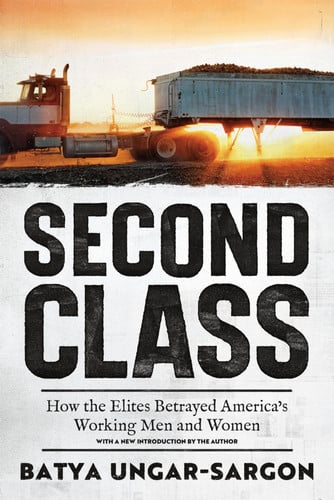
Second class: how the elite betrayed America's working men and women

Ungar-Sargon, Batya
A personal, journalistic ethnography of the modern American working class, based on the travels and interactions of the author through the American heartland. " Second Class is the most important book you will read all year. A political realignment is coming, and it's my hope that the end result will work in favor of our all-too-neglected American working class. When that realignment comes, Batya and her book will help lead the way." --Greg Lukianoff, CEO of the Foundation for Individual Rights in Education, and co-author of The Coddling of the American Mind Who is the American working class? Do they still have a fair shot at the American Dream? What do they think about their chances to secure the hallmarks of a middle-class life? While writing this book, Batya Ungar-Sargon visited states across the nation to speak with members of the American working class who are fighting tooth and nail to survive. In Second Class , working-class Americans of all races, political orientations, and occupations share their stories--cleaning ladies, health care aides, cops, truck drivers, fast food workers, electricians, and more. In their own words, these working-class Americans explain the struggles and triumphs of their increasingly precarious lives--as well as what policies they think would improve them. Second Class combines deep reporting with a look at the data and expert opinions on America's emergent class divide, in which the most basic elements of a secure and stable life are increasingly out of reach for those without a college education. America has broken its contract with its laboring class. So, how do we get back to the American Dream? How do we once again become the land of opportunity, the promised land, where hard work and commitment to family are enough to protect you from poverty? It's not that hard actually. All it would take, as this book illustrates, is for those in power to once again respect the dignity of work--and the American worker.
Encounter Books 2025 248 pages

Stone age economics

Sahlins, Marshall David
Stone Age Economics is a classic study of anthropological economics, first published in 1974. As Marshall Sahlins stated in the first edition, "It has been inspired by the possibility of 'anthropological economics,' a perspective indebted rather to the nature of the primitive economies than to the categories of a bourgeois science." Ambitiously tackling the nature of economic life and how to study it comparatively, the book includes six studies which reflect the author's ideas on revising traditional views of the hunter-gatherer and so-called primitive societies, revealing them to be the original affluent society. The book examines notions of production, distribution and exchange in early communities and examines the link between economics and cultural and social factors. It consists of a set of detailed and closely related studies of tribal economies, of domestic production for livelihood, and of the submission of domestic production to the material and political demands of society at large. Marshall Sahlins is one of the most prominent American anthropologists of our time. He holds the title of Charles F. Grey Distinguished Service Professor of Anthropology at the University of Chicago. His most recent book is How Natives Think: About Captain Cook, for Example.
Transaction Publishers 2011 348 pages

Decolonising my body: a radical exploration of rituals and beauty

Hirsch, Afua
A 2023 POLITICAL BOOK OF THE YEAR (WATERSTONES) 'GROUND-BREAKING' Bernardine Evaristo ' UNIVERSAL AND TIMELY ' Elif Shafak ' IMPORTANT' Sathnam Sanghera ' A GENEROUS OFFERING ' Nana Darkoa Sekiyamah ' QUIETLY RADICAL' Evening Standard ' INTIMATE ' Guardian 'I LEARNT A LOT' Gillian Anderson What can ancestral practices teach us about how to live fuller lives today? Upon turning forty, Afua Hirsch had an encounter that forever altered her preconceived notions of ancestry and body image, making her question everything from body-modification rituals such as tattoos and piercings to the foundations of sexuality, as well as attitudes towards puberty, ageing and death. This book charts her year-long journey of radical unlearning. Bringing together global scholarship, on-the-ground reportage, personal anecdotes and interviews with beauty experts, practitioners and service users, she reassesses notions of body image beyond those of the colonial, patriarchal gaze. Decolonising My Body is a powerful excavation of the Eurocentric beauty standards that have long shaped how, in particular, those from the Global Majority are perceived and view themselves. Taking us from puberty to end-of-life, Hirsch shows us that the ways in which we adorn and present ourselves have spiritual implications and shape the possibilities we see for ourselves in the world. These insights and discoveries will empower you to reconnect with your own ancestry, better understand the link between beauty, history and (respectability) politics, and liberate yourself from mainstream standards and systems that aren't serving you. *Co-host of the LOYALTY podcast with Peter Frankopan*
Vintage 2025 240 pages

Armed Madhouse

Palast, Greg
In his most provocative and caustically funny book yet, Greg Palast, author of the national bestseller The Best Democracy Money Can Buy, once again gives us the straight scoop on the stories that Big Media won?t report. Digging up reams of documents marked ?secret? and ?confidential,? Palast provides the latest lowdown on Bush?s secret plans to seize Iraq?s oil, the fix planned for the 2008 election, who drowned New Orleans, and the horror and the humor of the War on Terror. With diligent detective work, moral outrage, and a keen sense of the absurd, Palast takes on the ?armed and dangerous clowns that rule us? as only he can.
Dutton 2006 368 pages

Last best hope: America in crisis and renewal

Packer, George
2020: A ruthless pandemic, an inept and malign government response, polarizing protests, and an election marred by conspiracy theories left many citizens in despair about their country and its democratic experiment. Packer explores four narratives that now dominate American life: Free America, which imagines a nation of separate individuals and serves the interests of corporations and the wealthy; Smart America, the world view of Silicon Valley and the professional elite; Real America, the white Christian nationalism of the heartland; and Just America, which sees citizens as members of identity groups that inflict or suffer oppression. He shows that none of these narratives can sustain a democracy: we must look for a common American identity and find it in the passion for equality that Americans of diverse persuasions have held for centuries. -- adapted from jacket
Farrar, Straus and Giroux 2021-06-15 226 pages