200 results for "History"

Iron Curtain The Crushing of Eastern Europe, 1944-1956

Anne Applebaum
At the end of WWII, the Soviet Union, to its surprise and delight, found itself in control of a huge swath of territory in Central Europe. It set out to convert a dozen radically different countries to a completely new political and moral system, Communism. Iron Curtain describes how the communist regimes of Eastern Europe were created, and what daily life was like once they were complete. Applebaum draws on newly opened European archives and personal accounts translated for the first time to portray in devestating detail millions of individuals trying to adjust to a way of life that challenged their every belief, rendered worthless their every qualification, and took everything away they had accumulated. Today the Soviet Block is a lost civilization, once whose cruelty, paranoia, bizarre morality and strange aethestics Applebaum captures in the electrifying pages of this book.
McClelland & Stewart 2012-10-30 608 pages

Erasing History How Fascists Rewrite the Past to Control the Future

Jason Stanley
From the bestselling author of How Fascism Works , a global call to action that tells us “why the past is a frontline in the struggle for a future free of fascism” (Jeff Sharlet, New York Times bestselling author) as it reveals the far right’s efforts to rewrite history and undo a century of progress on race, gender, sexuality, and class. In the United States, democracy is under attack by an authoritarian movement that has found fertile ground among the country’s conservative politicians and voters, but similar movements have found homes in the hearts and minds of people around the globe. To understand the shape, form, and stakes of this assault, we must go back to extract lessons from our past. In authoritarian countries, critical examination of those nations’ history and traditions is discouraged if not an outright danger to those who do it. And it is no accident that local and global institutions of education have become a battleground, where learning and efforts to upend a hierarchal status quo can be put to end by coercion and threats of violence. Democracies entrust schools and universities to preserve a common memory of positive change, generated by protests, social movements, and rebellions. The authoritarian right must erase this history, and, along with it, the very practice of critical inquiry that has so often been the engine of future progress. In Erasing History , Yale professor of philosophy Jason Stanley exposes the true danger of the authoritarian right’s attacks on education, identifies their key tactics and funders, and traces their intellectual roots. He illustrates how fears of a fascist future have metastasized, from hypothetical threat to present reality. And with his “urgent, piercing, and altogether brilliant” (Johnathan M. Metzl, author of What We’ve Become ) insight, he illustrates that hearts and minds are won in our schools and universities—places that democratic societies across the world are now ill-prepared to defend against the fascist assault currently underway.
Atria/One Signal Publishers 2026-03-17 256 pages

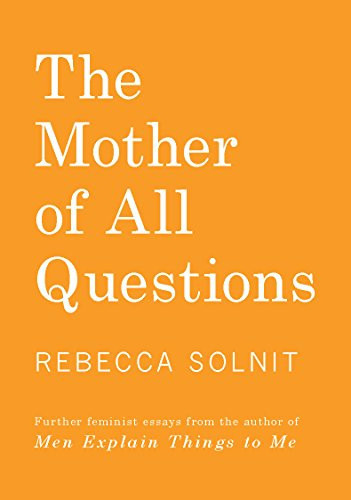
The Mother of All Questions

Rebecca Solnit
In a timely follow-up to her national bestseller Men Explain Things to Me, Rebecca Solnit offers indispensable commentary on women who refuse to be silenced, misogynistic violence, the fragile masculinity of the literary canon, the gender binary, the recent history of rape jokes, and much more. In characteristic style, Solnit mixes humor, keen analysis, and powerful insight in these essays.
Haymarket Books 2019-09-20 192 pages

Call Them by Their True Names American Crises (and Essays)

Rebecca Solnit
National Book Award Longlist Winner of the Kirkus Prize for Nonfiction Winner of the Foreword INDIE Editor's Choice Prize for Nonfiction "Rebecca Solnit is essential feminist reading." --The New Republic "Solnit's exquisite essays move between the political and the personal, the intellectual and the earthy." --Elle Rebecca Solnit is the author of more than twenty books, including the international bestseller Men Explain Things to Me. Called "the voice of the resistance" by the New York Times, she has emerged as an essential guide to our times, through her incisive commentary on feminism, violence, ecology, hope, and everything in between. In this powerful and wide-ranging collection, Solnit turns her attention to battles over meaning, place, language, and belonging at the heart of the defining crises of our time. She explores the way emotions shape political life, electoral politics, police shootings and gentrification, the life of an extraordinary man on death row, the pipeline protest at Standing Rock, and the existential threat posed by climate change. The work of changing the world sometimes requires changing the story, the names, and inventing or popularizing new names and terms and phrases. Calling things by their true names can also cut through the lies that excuse, disguise, avoid, or encourage inaction, indifference, obliviousness in the face of injustice and violence.
Haymarket Books 2018 188 pages

Making Sense Conversations on Consciousness, Morality, and the Future of Humanity

Sam Harris
A New York Times New and Noteworthy Book From the bestselling author of Waking Up and The End of Faith, an adaptation of his wildly popular, often controversial podcast "Civilization rests on a series of successful conversations." --Sam Harris Sam Harris--neuroscientist, philosopher, and bestselling author--has been exploring some of the most important questions about the human mind, society, and current events on his podcast, Making Sense. With over one million downloads per episode, these discussions have clearly hit a nerve, frequently walking a tightrope where either host or guest--and sometimes both--lose their footing, but always in search of a greater understanding of the world in which we live. For Harris, honest conversation, no matter how difficult or controversial, represents the only path to moral and intellectual progress. This book includes a dozen of the best conversations from Making Sense, including talks with Daniel Kahneman, Timothy Snyder, Nick Bostrom, and Glenn Loury, on topics that range from the nature of consciousness and free will, to politics and extremism, to living ethically. Together they shine a light on what it means to "make sense" in the modern world.
HarperCollins Publishers 2021-08-17 464 pages

The Identity Trap

Mounk, Yascha
Named a Best Book of the Year by The Economist , Financial Times , Inc. , Prospect Magazine , and The Conversation “The most comprehensive and reasonable story of this shift that has yet been attempted . . . Mounk has told the story of the Great Awokening better than any other writer who has attempted to make sense of it.” — The Washington Post “An intellectual tour de force about the origins of identity politics and the threat it presents to genuine, honest, old-fashioned liberalism.” — Bret Stephens, The New York Times “Among the most insightful and important books written in the last decade on American democracy and its current torments, because it also shows us a way out of the trap.” —Jonathan Haidt, author of The Righteous Mind , and coauthor of The Coddling of the American Mind “Outstanding.” — David Brooks, The New York Times A fascinating account of the origins of “wokeness”—and a trenchant explanation for why the noble goals of identity politics are doomed to fail For much of history, societies have violently oppressed ethnic, religious, and sexual minorities. It is no surprise that many came to believe that members of mar­ginalized groups need to take pride in their identity to resist injustice. But over the past decades, a healthy appreciation for the culture and heritage of minority groups transformed into our contemporary form of identity politics, a counterproductive obsession with group identity. This new ideology denies that members of different groups can truly understand each other and insists that the way governments treat their citizens should depend on the color of their skin. This, Yascha Mounk argues, is the identity trap. Those who battle for these ideas are often full of good intentions. But they ultimately stand in the way of the genuine equality we desperately need. Mounk was one of the first to warn of the risks that right-wing populists pose to American democracy, a danger that remains as serious as ever. But as he shows here, the identitarian left and the populist right actually reinforce each other; to vanquish one, it is necessary to oppose both. In The Identity Trap , Mounk provides the most ambitious and comprehensive account to date of the origins, consequences, and limitations of “wokeness.” He shows how postmodernism, postcolonialism, and critical race theory conquered many college campuses and forged an “identity synthesis” that gained tremendous influence in business, media, and government by 2020. Finally, Mounk makes a nuanced philosophical case for why these ideas are so counterproductive—and why universal, humanist values can best serve the vital goal of true equality. The Identity Trap provides truth and clarity where they are needed most.
Penguin USA 2025-09-23 432 pages

Wildland The Making of America's Fury

Evan Osnos
INSTANT NEW YORK TIMES BESTSELLER After a decade abroad, the National Book Award – and Pulitzer Prize – winning writer Evan Osnos returns to three places he has lived in the United States—Greenwich, CT; Clarksburg, WV; and Chicago, IL—to illuminate the origins of America’s political fury. Evan Osnos moved to Washington, D.C., in 2013 after a decade away from the United States, first reporting from the Middle East before becoming the Beijing bureau chief at the Chicago Tribune and then the China correspondent for The New Yorker . While abroad, he often found himself making a case for his home country, urging the citizens of Egypt, Iraq, or China to trust that even though America had made grave mistakes throughout its history, it aspired to some foundational moral commitments: the rule of law, the power of truth, the right of equal opportunity for all. But when he returned to the United States, he found each of these principles under assault. In search of an explanation for the crisis that reached an unsettling crescendo in 2020—a year of pandemic, civil unrest, and political turmoil—he focused on three places he knew firsthand: Greenwich, Connecticut; Clarksburg, West Virginia; and Chicago, Illinois. Reported over the course of six years, Wildland follows ordinary individuals as they navigate the varied landscapes of twenty-first-century America. Through their powerful, often poignant stories, Osnos traces the sources of America’s political dissolution. He finds answers in the rightward shift of the financial elite in Greenwich, in the collapse of social infrastructure and possibility in Clarksburg, and in the compounded effects of segregation and violence in Chicago. The truth about the state of the nation may be found not in the slogans of political leaders but in the intricate details of individual lives, and in the hidden connections between them. As Wildland weaves in and out of these personal stories, events in Washington occasionally intrude, like flames licking up on the horizon. A dramatic, prescient examination of seismic changes in American politics and culture, Wildland is the story of a crucible, a period bounded by two shocks to America’s psyche, two assaults on the country’s sense of itself: the attacks of September 11, 2001, and the storming of the U.S. Capitol on January 6, 2021. Following the lives of everyday Americans in three cities and across two decades, Osnos illuminates the country in a startling light, revealing how we lost the moral confidence to see ourselves as larger than the sum of our parts.
Picador 2022-09-13 496 pages

Family Properties Race, Real Estate, and the Exploitation of Black America (10th Anniversary Edition)

Beryl Satter
“Beryl Satter's Family Properties is really an incredible book. It is, by far, the best book I've ever read on the relationship between blacks and Jews. That's because it hones in on the relationship between one specific black community and one specific Jewish community and thus revels in the particular humanity of all its actors.” —Ta-Nehisi Coates, The Atlantic Part family story and part urban history, a landmark investigation of segregation and urban decay in Chicago -- and cities across the nation The "promised land" for thousands of Southern blacks, postwar Chicago quickly became the most segregated city in the North, the site of the nation's worst ghettos and the target of Martin Luther King Jr.'s first campaign beyond the South. In this powerful book, Beryl Satter identifies the true causes of the city's black slums and the ruin of urban neighborhoods throughout the country: not, as some have argued, black pathology, the culture of poverty, or white flight, but a widespread and institutionalized system of legal and financial exploitation. In Satter's riveting account of a city in crisis, unscrupulous lawyers, slumlords, and speculators are pitched against religious reformers, community organizers, and an impassioned attorney who launched a crusade against the profiteers—the author's father, Mark J. Satter. At the heart of the struggle stand the black migrants who, having left the South with its legacy of sharecropping, suddenly find themselves caught in a new kind of debt peonage. Satter shows the interlocking forces at work in their oppression: the discriminatory practices of the banking industry; the federal policies that created the country's shameful "dual housing market"; the economic anxieties that fueled white violence; and the tempting profits to be made by preying on the city's most vulnerable population. Family Properties: Race, Real Estate, and the Exploitation of Black Urban America is a monumental work of history, this tale of racism and real estate, politics and finance, will forever change our understanding of the forces that transformed urban America. "Gripping . . . This painstaking portrayal of the human costs of financial racism is the most important book yet written on the black freedom struggle in the urban North."—David Garrow, The Washington Post
Picador 2021-04-27 544 pages

The New York nobody knows: walking 6,000 miles in the city

Helmreich, William B.
As a child growing up in Manhattan, William Helmreich played a game with his father called "Last Stop." They would pick a subway line, ride it to its final destination, and explore the neighborhood. Decades later, his love for exploring the city is as strong as ever.Putting his feet to the test, he decided that the only way to truly understand New York was to walk virtually every block of all five boroughs-an astonishing 6,000 miles. His journey took him to every corner of Manhattan, Brooklyn, Queens, the Bronx, and Staten Island. Helmreich spoke with hundreds of New Yorkers from every part of the globe and all walks of life. He finds that to be a New Yorker is to struggle to understand the place and to make a life that is as highly local as it is dynamically cosmopolitan.Truly unforgettable, The New York Nobody Knows will forever change how you view the world's greatest city.
Princeton University Press 2015-08-25 480 pages

The Fall of Roe

Lerer, Lisa,Dias, Elizabeth
Two New York Times journalists, Lisa Lerer and Elisabeth Dias, have written the definitive book on the end of Roe, revealing how the strategic battle over the most contentious topic in politics helps us understand the battle for control over America. They look at the playbook for how the religious right came to dominate American politics, a strategy that has vaulted anti-abortion activists into central roles in the conservative movement. And unless Democrats shift their strategy, it is those activists who will be the power brokers who determine the future of America. Furthermore, given that these debates and strategies have influence here and throughout the world, 'The Fall of Roe' will be essential not only for understanding America but also informing our own future.
Manilla Press 2024-07 448 pages

The encyclopedia of trouble and spaciousness

Solnit, Rebecca
The incomparable Rebecca Solnit, author of more than a dozen acclaimed, prizewinning books of nonfiction including Men Explain Things To Me , brings the same dazzling writing to the essays in The Encyclopedia of Trouble and Spaciousness ; hailed by the Los Angeles Times as "globally wide-ranging and topically urgent and the Boston Globe as "luminous and precise.". As the title suggests, the territory of Solnit's concerns is vast, and in her signature alchemical style she combines commentary on history, justice, war and peace, and explorations of place, art, and community, all while writing with the lyricism of a poet to achieve incandescence and wisdom. Gathered here are celebrated iconic essays along with little-known pieces that create a powerful survey of the world we live in, from the jungles of the Zapatistas in Mexico to the splendors of the Arctic. This rich collection tours places as diverse as Haiti and Iceland; movements like Occupy Wall Street and the Arab Spring; an original take on the question of who did Henry David Thoreau's laundry; and a searching look at what the hatred of country music really means. Solnit moves nimbly from Orwell to Elvis, to contemporary urban gardening to 1970s California macramé and punk rock, and on to searing questions about the environment, freedom, family, class, work, and friendship. It's no wonder she's been compared in Bookforum to Susan Sontag and Annie Dillard and in the San Francisco Chronicle to Joan Didion. The Encyclopedia of Trouble and Spaciousness proves Rebecca Solnit worthy of the accolades and honors she's received. Rarely can a reader find such penetrating critiques of our time and its failures leavened with such generous heapings of hope. Solnit looks back to history and the progress of political movements to find an antidote to despair in what many feel as lost causes. In its encyclopedic reach and its generous compassion, Solnit's collection charts a way through the thickets of our complex social and political worlds. Her essays are a beacon for readers looking for alternative ideas in these imperiled times.
Trinity University Press 2015 334 pages

How Soccer Explains the World

Foer, Franklin
“Step aside Tom Friedman, Sam Huntington, and Amy Chua. Franklin Foer’s dark and witty tale of the soccer world reveals the meaning of globalization in all its joys and horrors.”—Robert Kagan Just in time for the 2026 World Cup in North America—a reissue of the bestselling sports classic, featuring a new preface from the author. With the 2026 World Cup in all three nations of North America, the power and scope of soccer has truly become global. In this remarkably insightful, wide-ranging work, Franklin Foer argues that soccer is much more than a game, or even a way of life. It is a unique window into the crosscurrents of modern globalization, with all of its benefits and pitfalls. Soccer clubs don’t represent geographic areas; they stand for social classes and political ideologies. Unlike baseball or tennis, soccer is freighted with ancient hatreds and history. It’s a sport with real stakes—a catalyst capable of ruining regimes and launching liberation movements. Foer takes us on a surprising tour through the world of soccer, shattering myths and dire predictions. Instead of destroying local cultures, as the left warned, globalization has revived tribalism. Far from the triumph of capitalism that the right anticipated, it has entrenched corruption. From Brazil to Bosnia, Italy to Iraq, How Soccer Explains the World is an eye-opening chronicle of how a beautiful sport and its fanatical followers can illuminate the fault lines of a society, whether it’s terrorism, poverty, anti-Semitism, authoritarianism, or radical Islam—issues that continue to affect all of us. At a time when globalization is under attack and many Americans yearn for retrenchment and retreat from the world, this remarkable book—filled with blazing intelligence, colorful characters, wry humor, and an equal passion for soccer and humanity—continues to make sense of our troubled times.
HarperCollins Publishers LLC 2026-04-07 288 pages

Scoundrel

Weinman, Sarah
A Recommended Read from: The Los Angeles Times * Town and Country * The Seattle Times * Publishers Weekly * Lit Hub * Crime Reads * Alma From the author of The Real Lolita and editor of Unspeakable Acts, the astonishing story of a murderer who conned the people around him—including conservative thinker William F. Buckley—into helping set him free In the 1960s, Edgar Smith, in priso[Bokinfo]
HarperCollins UK Publishers 2023 464 pages

Freedom

Sebastian Junger
A profound rumination on the concept of freedom from the bestselling author of The Perfect Storm 'Sebastian Junger bears witness to a hard-won and an uncertain new world, framed in vital and brilliant prose: a true and honest accounting of everything that underlies the frantic performance of life' Philip Hoare, author of Albert and the Whale Throughout history, humans have been driven by the quest for two cherished ideals: community and freedom. The two don't coexist easily: we value individuality and self-reliance, yet are utterly dependent on community for our most basic needs. In this intricately crafted and thought-provoking book, Sebastian Junger examines this tension that lies at the heart of what it means to be human. For much of a year, Junger and three friends--a conflict photographer and two Afghan war vets--walked the railroad lines of the east coast. It was an experiment in personal autonomy, but also in interdependence. Dodging railroad cops, sleeping under bridges, cooking over fires and drinking from creeks and rivers, the four men forged a unique reliance on one another. In Freedom, Junger weaves his account of this journey together with primatology and boxing strategy, the role of women in resistance movements and apache renegrades, and the brutal reality of life on the Pennsylvania frontier. Written in exquisite, razor-sharp prose, the result is a powerful examination of the primary desire that defines us.
HarperCollins Publishers Limited 2021-05 160 pages

The traitors circle: the true story of a secret resistance network in Nazi Germany--and the spy who betrayed them

Freedland, Jonathan
"When the whole world is lying, someone must tell the truth. Berlin, 1943: A group of high society anti-Nazi dissenters meet for a tea party one late summer's afternoon. They do not know that, sitting around the table, is someone poised to betray them all to the Gestapo. They form a circle of unlikely rebels, drawn from the German elite: two countesses, a diplomat, an intelligence officer, an ambassador's widow and a pioneering headmistress. What unites every one of them is a shared loathing of the Nazis, a refusal to bow to Hitler, and the courage to perform perilous acts of resistance: meeting in the shadows, rescuing Jews or plotting for a future Germany freed from the Führer's rule. Or so they believe. How did a group of brave, principled rebels, who had successfully defied Adolf Hitler for more than a decade, come to fall into such a lethal trap? Undone from within and pursued to near-destruction by one of the Reich's cruelest men, they showed a heroism in the face of the most vengeful regime in history that raises the question: what kind of person does it take to risk everything and stand up to tyranny?"-- Provided by publisher.
Harper, an imprint of HarperCollinsPublishers 2025-10-28 456 pages

The Elementary Forms of Religious Life

Emile Durkheim
The French Sociologist Émile Durkheim is commonly cited as the father of sociology. Principle to the work of Durkheim was his concern with regard to how modernity was effecting traditional social and religious institutions, more specifically with how societies could maintain their integrity and coherence in an era in which new social institutions were coming into being. One of his principles works, "The Elementary Forms of Religious Life" is a comparative theory of the religious lives of ancient and modern societies and the sociological influence of their respective religious institutions. Durkheim argues that the essence of religion is the concept of the sacred and it is this single phenomenon that is common to all religions. The work extensively discusses the concept of the sacred by examining the worship of totems in ancient religions and by arguing that modern societies have displaced this totemism by ascribing a new form of sacredness to the individual and individual rights. "The Elementary Forms of Religious Life" is a compelling exposition on the impact of religious institutions in ancient and modern life and a worthy read for anyone interested in religious or sociological studies. This edition is printed on premium acid-free paper.
Neeland Media 2019-08-23 414 pages

Christ Stopped at Eboli

Carlo Levi
It was to Lucania, a desolate land in southern Italy, that Carlo Levi--a doctor, painter, philosopher, and man of letters--was confined as a political prisoner because of his opposition to Italy's Fascist government at the start of the Ethiopian war in 1935. While there, Levi reflected on the harsh landscape and its inhabitants, peasants who lived the same lives their ancestors had, constantly fearing black magic and the near presence of death. In so doing, Levi offered a starkly beautiful and moving account of a place and a people living outside the boundaries of progress and time.
Penguin Books 1947 253 pages

World of Our Fathers

Irving Howe
A new 30th Anniversary paperback edition of an award-winning classic. Winner of the National Book Award, 1976 World of Our Fathers traces the story of Eastern Europe's Jews to America over four decades. Beginning in the 1880s, it offers a rich portrayal of the East European Jewish experience in New York, and shows how the immigrant generation tried to maintain their Yiddish culture while becoming American. It is essential reading for those interested in understanding why these forebears to many of today's American Jews made the decision to leave their homelands, the challenges these new Jewish Americans faced, and how they experienced every aspect of immigrant life in the early part of the twentieth century. This invaluable contribution to Jewish literature and culture is now back in print in a new paperback edition, which includes a new foreword by noted author and literary critic Morris Dickstein.
Galahad Books 1994 714 pages

Your Move What Board Games Teach Us about Life

Jonathan Kay,Joan Moriarity
The great board game revolution is here-- What do these games tell us about our society, our relationships, and ourselves? "Games, Jonathan Kay and Joan Moriarity show in this lively and insightful book, are not just fun and games: they allow us to explore the complexities of the world, from evolution to war to climate." - STEVEN PINKER, Johnstone Professor of Psychology, Harvard University, and author of Enlightenment Now: The Case for Reason, Science, Humanism, and Progress "Kay and Moriarity are both skilled writers and elucidators, and their voices are distinct enough to provide the book with a pleasing yin and yang. It's a far more perceptive and intriguing book than it appears at first blush, particularly for those readers who have never thought of games as an artistic medium - at least not one that comments on society." - KIRKUS REVIEWS Board games are among our most ancient and beloved art forms. During the rise of digital media, they fell from prominence for a decade or two but today they are in a new golden age. They're ingeniously designed, beautiful to look at, and exhilarating to play. Games are reclaiming their place in our culture, as entertainment, social activity, and intellectual workout equipment. Alone among all art forms, games require their audience (called "players") to participate. If nobody's playing, there is no game. As a result, games can tell far more about us than our TV shows, movies or music ever could. How does The Game of Life illustrate our changing attitudes about virtue? How does a World War II conflict simulation game explain the shortcomings of a failed novelist? Each chapter of Your Move examines one game, and what it reveals about our culture, history, society, and relationships. The book's two co-authors bring the perspectives of a writer who plays, and a player who writes. Before Jonathan Kay began his distinguished career as an author and commentator, he had a passion for games, and in recent years he has rediscovered them. Meanwhile, Joan Moriarity's career has been spent designing, developing, distributing, art directing, recommending and teaching board games and, recently, writing about them for a wider audience. With its short, punchy essays, and beautiful photographs of the games themselves, every chapter will be a worthwhile read in itself, and the book overall will leave you inspired to discover the truths of your own inner and outer world through play -- whether you're a seasoned veteran or a total newcomer.
Sutherland House Incorporated 2019-09-11 180 pages