62 results for "History"

American Marxism

Mark R. Levin
#1 NEW YORK TIMES BESTSELLER The seven-time #1 New York Times bestselling author, Fox News star, and radio host Mark R. Levin explains how the dangers he warned against in the "timely yet timeless" (David Limbaugh, author of Jesus Is Risen) bestseller Liberty and Tyranny have come to pass. In 2009, Mark R. Levin galvanized conservatives with his unforgettable manifesto Liberty and Tyranny, by providing a philosophical, historical, and practical framework for halting the liberal assault on Constitution-based values. That book was about standing at the precipice of progressivism's threat to our freedom and now, over a decade later, we're fully over that precipice and paying the price. In American Marxism, Levin explains how the core elements of Marxist ideology are now pervasive in American society and culture-from our schools, the press, and corporations, to Hollywood, the Democratic Party, and the Biden presidency-and how it is often cloaked in deceptive labels like "progressivism," "democratic socialism," "social activism," and more. With his characteristic trenchant analysis, Levin digs into the psychology and tactics of these movements, the widespread brainwashing of students, the anti-American purposes of Critical Race Theory and the Green New Deal, and the escalation of repression and censorship to silence opposing voices and enforce conformity. Levin exposes many of the institutions, intellectuals, scholars, and activists who are leading this revolution, and provides us with some answers and ideas on how to confront them. As Levin writes: "The counter-revolution to the American Revolution is in full force. And it can no longer be dismissed or ignored for it is devouring our society and culture, swirling around our everyday lives, and ubiquitous in our politics, schools, media, and entertainment." And, like before, Levin seeks to rally the American people to defend their liberty.
Mark R. Levin 2021 262 pages

Countdown 1960 - The Behind-the-Scenes Story of the 312 Days that Changed America's Politics Forever

Chris Wallace
Instant New York Times Bestseller The riveting new book on the momentous year, campaign, and election that shaped American history It’s January 2, 1960: the day that Massachusetts Senator John F. Kennedy declared his candidacy; and with this opening scene, Chris Wallace offers readers a front-row seat to history. From the challenge of primary battles in a nation that had never elected a Catholic president, to the intense machinations of the national conventions—where JFK chose Lyndon Johnson as his running mate over the impassioned objections of his brother Bobby—this is a nonfiction political thriller filled with intrigue, cinematic action, and fresh reporting. Like with many popular histories, readers may be familiar with the story, but few will know the behind-the-scenes details, told here with gripping effect. Featuring some of history’s most remarkable characters, page-turning action, and vivid details, Countdown 1960 follows a group of extraordinary politicians, civil rights leaders, Hollywood stars, labor bosses, and mobsters during a pivotal year in American history. The election of 1960 ushered in the modern era of presidential politics, with televised debates, private planes, and slick advertising. In fact, television played a massive role. More than 70 million Americans watched one or all four debates. The public turned to television to watch campaign rallies. And on the night of the election, the contest between Kennedy and Nixon was so close that Americans were glued to their televisions long after dawn to see who won. The election of 1960 holds stunning parallels to our current political climate. There were—potentially valid—claims of voter fraud and a stolen election. There was also a presidential candidate faced with the decision of whether to contest the result or honor the peaceful transfer of power.
Penguin Group 2026-05-19 448 pages

The Jewish State

Herzl, Theodor
Explore the visionary ideas that laid the groundwork for the modern state of Israel with “The Jewish State” by Theodor Herzl. Written at the turn of the 20th century, Herzl’s seminal work is a passionate and prescient call for the establishment of a Jewish homeland. In this groundbreaking manifesto, Herzl outlines the challenges faced by Jews in Europe and proposes a radical solution: the creation of a Jewish state. Drawing on historical precedents and envisioning a future where Jews could live free from persecution, Herzl’s ideas ignited the Zionist movement. Herzl’s writing is both prophetic and pragmatic, anticipating the geopolitical realities that would shape the 20th century. His advocacy for a Jewish state not only sparked a political movement but also paved the way for the eventual establishment of Israel. “The Jewish State” is more than a political treatise; it’s a passionate plea for justice and a testament to Herzl’s dedication to the well-being of his people. Delve into the thoughts of a visionary whose ideas transformed the course of history, and whose influence is felt to this day in the ongoing story of the State of Israel.
East India Publishing Company 2024-02-09 101 pages

The great transformation: the political and economic origins of our time

Polanyi, Karl
"In this classic work of economic history and social theory, Karl Polanyi tracks the economic and social changes brought about by the "great transformation" of the Industrial Revolution. He pays particular attention to capitalism's rise and its role in fundamentally altering life after the Industrial Revolution. This seminal analysis explains not only the deficiencies of the self-regulating market, but the potentially dire social consequences of untempered market capitalism"-- Provided by publisher.
Beacon Press 2025-07-08 360 pages

ISIS: Inside the Army of Terror

Weiss, Michael,Hassan, Hassan
With brutal attacks in last year across the globe—Brussels, Paris, Beirut, Egypt, Turkey—the Islamic State of Iraq and Syria (ISIS) has proved itself the greatest terrorist threat in the world today. They have conquered massive territories in Syria and Iraq in a bid to create a new Muslim caliphate under the strict dictates of Sharia law. In this fully revised and updated edition of ISIS: Inside the Army of Terror, American journalist Michael Weiss and Syrian analyst Hassan Hassan explain how these violent extremists evolved from a nearly defeated Iraqi insurgent group into a jihadi army of international volunteers who, with slickly produced murder videos, are spreading violence and mayhem across the globe. Beginning with the early days of Abu Musab al-Zarqawi, the founder of ISIS’s first incarnation, Weiss and Hassan explain who the key players are—from their leader Abu Bakr al-Baghdadi to the former Saddam Baathists in their ranks—where they come from, how they have attracted both local and global support, and how they operate—from their social media strategy to their illicit oil revenues. As money and matériel continue to flow into the region to combat the ISIS’s spreading terror, other forces—Assad’s regime, Russian planes, Iranian Quds Forces, and other Shiite militias—are gaining power and using the fight against ISIS as a means to leverage their agenda in the region. Political and military maneuvering by the United States, Iraq, Iran, Syria, and Russia have fueled ISIS’s explosive expansion. In five new chapters, the authors delve further into the inner workings of the Army of Terror and what it is like to live under their ever-tightening rule. With invaluable and exclusive insider information, the authors explore the Islamic State’s enigmatic recruitment and training methods, the impact of their military successes and failures, and how they structure and empower home-grown cells worldwide to carry out their terror. Drawing on original interviews with former US military officials and current ISIS fighters—and brand-new interviews with a former ISIS spy, as well as Kurdish and Yazidi survivors of the ISIS’s assault on northern Iraq—the authors reveal the internecine struggles within the movement itself, as well as ISIS’s bloody hatred of Shiite Muslims, which is generating another sectarian war in the region. A new generation of terror has dawned in the world and to understand how to stop it, we must understand who they are.
Regan Arts 2020-10-09 435 pages

How Soccer Explains the World

Foer, Franklin
“Step aside Tom Friedman, Sam Huntington, and Amy Chua. Franklin Foer’s dark and witty tale of the soccer world reveals the meaning of globalization in all its joys and horrors.”—Robert Kagan Just in time for the 2026 World Cup in North America—a reissue of the bestselling sports classic, featuring a new preface from the author. With the 2026 World Cup in all three nations of North America, the power and scope of soccer has truly become global. In this remarkably insightful, wide-ranging work, Franklin Foer argues that soccer is much more than a game, or even a way of life. It is a unique window into the crosscurrents of modern globalization, with all of its benefits and pitfalls. Soccer clubs don’t represent geographic areas; they stand for social classes and political ideologies. Unlike baseball or tennis, soccer is freighted with ancient hatreds and history. It’s a sport with real stakes—a catalyst capable of ruining regimes and launching liberation movements. Foer takes us on a surprising tour through the world of soccer, shattering myths and dire predictions. Instead of destroying local cultures, as the left warned, globalization has revived tribalism. Far from the triumph of capitalism that the right anticipated, it has entrenched corruption. From Brazil to Bosnia, Italy to Iraq, How Soccer Explains the World is an eye-opening chronicle of how a beautiful sport and its fanatical followers can illuminate the fault lines of a society, whether it’s terrorism, poverty, anti-Semitism, authoritarianism, or radical Islam—issues that continue to affect all of us. At a time when globalization is under attack and many Americans yearn for retrenchment and retreat from the world, this remarkable book—filled with blazing intelligence, colorful characters, wry humor, and an equal passion for soccer and humanity—continues to make sense of our troubled times.
HarperCollins Publishers LLC 2026-04-07 288 pages

Jinnah of Pakistan

Stanley A. Wolpert
“Few individuals significantly alter the course of history. Fewer still modify the map of the world. Hardly anyone can be credited with creating a nation-state. Muhammad Ali Jinnah did all three.” Stanley Wolpert These are the opening lines of the preface of Stanley Wolpert’s book, “Jinnah of Pakistan” and serves to entice you to read an extremely thorough, comprehensive and detailed study about one of the most pragmatic and charismatic leaders of South Asia, Muhammad Ali Jinnah. Stanley Wolpert is an American academic who is considered to be one of the world's foremost authorities on the political history of modern South Asia. During a trip to Bombay in 1948, he became interested in the complexities of Indian culture, history and politics. Since 1962, he has published many fictional and non-fictional books on his favorite subject. In the preface, Wolpert “For more than a quarter century, I have been intrigued by the apparent paradox of Jinnah’s strange story which has to date never been told in all the fascinating complexity of its brilliant light and tragic darkness.” “Jinnah of Pakistan” was published in 1984. This unique and insightful biography explores the fascinating public and private life of founder of Pakistan, Muhammad Ali Jinnah from his birth in 1876 till his death in 1948. In recording the events that unfold and shape Jinnah’s life, Wolpert also chronicles almost eight decades of Indian history to the point where India achieves independence from British rule amid growing Muslim-Hindu antagonism. It is a tragedy that the new generation of Pakistan knows about the founder of their country only through text books, a few websites and television programs. These limited resources do not tell the complete picture of a very intelligent, shrewd and resilient lawyer, politician and statesman who altered the map of South Asia through his sheer indomitable will against all odds. It is almost a standard statement in Pakistani text books that Muhammad Ali Jinnah was a great man but after reading Stanley Wolpert’s “Jinnah of Pakistan” one can get a better understanding of why Jinnah can be….. and should be…. regarded as such a great leader. Physically a frail man, he alone gave courage, hope, strength and voice to millions of Muslims of South Asia who were dismissed as second class citizens in United India before partition in 1947. The biography is placed on a huge canvas and takes the readers to the bustling port of Karachi where Jinnah was born and follows him to London, Bombay, Calcutta, Lucknow, Nagpur, Amritsar, New Delhi, Simla, Lahore, Peshawar, Quetta, Ziarat and finally Karachi again where lies buried “ one of history’s most remarkable, tenacious, enigmatic figures.” The book reveals Jinnah’s failings, his loneliness, his pain, his broken marriage, his estrangement from his only daughter, his long and fatal disease which he kept under wraps and yet the true worth of his gigantic accomplishment can only be more appreciated when viewed alongside his human weaknesses. The book also brings under spotlight, Jinnah’s love and marriage to the beautiful and vivacious “flower of Bombay" Ruttie. The whole episode is dealt with great deal of compassion as Wolpert gives a rare glimpse into Jinnah’s most private moments and thoughts___ and his ultimate pain when due to Jinnah’s extremely demanding political and legal career, the marriage breaks down and ends with Ruttie’s tragic death when she was only 29. An excerpt from the “It (the funeral) was a painfully slow ritual. Jinnah sat silent through all of its five hours. As Ruttie’s body was being lowered into the grave, Jinnah as the nearest relative was the first to throw the earth on the grave. He broke down suddenly and wept and sobbed like a child for minutes together. That was the only time when I found Jinnah betraying some shadow of human weakness.” The best thing about the book is that is very impartial and does not gloss over any facts or resort to hyperbole. Li
Oxford University Press 1989 421 pages

The coming of post-industrial society: a venture in social forecasting

Bell, Daniel
In 1976, Daniel Bell€™s historical work predicted a vastly different society developing—one that will rely on the “economics of information€ rather than the “economics of goods.€ Bell argued that the new society would not displace the older one but rather overlie some of the previous layers just as the industrial society did not completely eradicate the agrarian sectors of our society. The post-industrial society€™s dimensions would include the spread of a knowledge class, the change from goods to services and the role of women. All of these would be dependent on the expansion of services in the economic sector and an increasing dependence on science as the means of innovating and organizing technological change.Bell prophetically stated in The Coming of the Post-Industrial Society that we should expect “ new premises and new powers, new constraints and new questions—with the difference that these are now on a scale that had
Basic Books 1973-07-12 507 pages

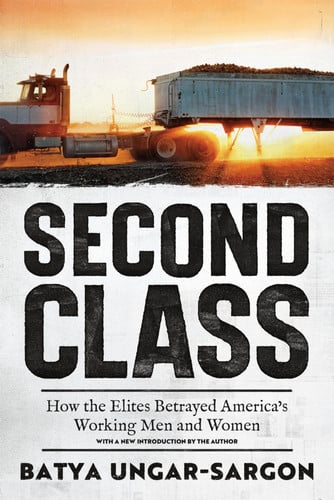
Second class: how the elite betrayed America's working men and women

Ungar-Sargon, Batya
A personal, journalistic ethnography of the modern American working class, based on the travels and interactions of the author through the American heartland. " Second Class is the most important book you will read all year. A political realignment is coming, and it's my hope that the end result will work in favor of our all-too-neglected American working class. When that realignment comes, Batya and her book will help lead the way." --Greg Lukianoff, CEO of the Foundation for Individual Rights in Education, and co-author of The Coddling of the American Mind Who is the American working class? Do they still have a fair shot at the American Dream? What do they think about their chances to secure the hallmarks of a middle-class life? While writing this book, Batya Ungar-Sargon visited states across the nation to speak with members of the American working class who are fighting tooth and nail to survive. In Second Class , working-class Americans of all races, political orientations, and occupations share their stories--cleaning ladies, health care aides, cops, truck drivers, fast food workers, electricians, and more. In their own words, these working-class Americans explain the struggles and triumphs of their increasingly precarious lives--as well as what policies they think would improve them. Second Class combines deep reporting with a look at the data and expert opinions on America's emergent class divide, in which the most basic elements of a secure and stable life are increasingly out of reach for those without a college education. America has broken its contract with its laboring class. So, how do we get back to the American Dream? How do we once again become the land of opportunity, the promised land, where hard work and commitment to family are enough to protect you from poverty? It's not that hard actually. All it would take, as this book illustrates, is for those in power to once again respect the dignity of work--and the American worker.
Encounter Books 2025 248 pages

SNCC: The New Abolitionists

Howard Zinn
Howard Zinn tells the story of one of the most important political groups in American history. SNCC: The New Abolitionists influenced a generation of activists struggling for civil rights and seeking to learn from the successes and failures of those who built the fantastically influential Student Nonviolent Coordinating Committee. It is considered an indispensable study of the organization, of the 1960s, and of the process of social change. Includes a new introduction by the author.
Beacon Press 1965 286 pages

The mission: the CIA in the 21st century

Weiner, Tim
"... Tells the gripping, high-stakes story of the CIA through the first quarter of the twenty-first century, revealing how the agency fought to rebuild the espionage powers it lost during the war on terror--and finally succeeded in penetrating the Kremlin. The struggle has life-and-death consequences for America and its allies. The CIA must reclaim its original mission: know thy enemies. The fate of the free world hangs in the balance"-- Provided by publisher.
Mariner Books 2025-07-15 454 pages

The Idealist Jeffrey Sachs and the Quest to End Poverty

Nina Munk
A powerful portrayal of Jeffrey Sachs's ambitious quest to end extreme global poverty, now a Signal paperback. "The poor you will always have with you," according to Matthew 26:11. But Jeffrey Sachs, economics superstar, special advisor to the Secretary General of the UN and the author of The End of Poverty , vehemently disagrees. In his view, poverty -- especially the extreme deprivation of sub-Saharan Africa -- can easily be eradicated. The vast sums spent in foreign aid over the decades has not come close to alleviating the dire subsistence problems of Africans. Sachs believed he knew the reason: the developed world simply hadn't spent enough. In 2006, Sachs, backed by tens of millions of donor dollars, launched the five-year Millennium Villages Project. Sachs would test his theories in villages in different African countries, then, with each success, scale up until until the program was continent-wide. His first village "make-over" was a small community in Sauri, Kenya, and the immediate effect was encouraging. With that first inkling of success achieved, Sachs rolled out a dozen model Millennium villages in ten countries. For the past six years, Nina Munk has reported deeply on the Project, following Sachs on official trips and listening in on conversations with heads of states, rival organisations and potential donors. And she has immersed herself in the lives of people in two of the remote villages: Ruhiira, in southwest Uganda, and Dertu, in the arid borderland between Kenya and Somalia. Accepting hospitality from these camel herders and smallhold farmers, and sharing in their struggles, Munk came to understand the on-the-ground issues challenging Sachs' one-size-fits-all approach to global poverty. The Idealist is the profound and moving story of what happened when the abstract theories of a brilliant, driven man met messy human reality.
McClelland & Stewart 2014-10-07 288 pages

Drone Warfare: Killing by Remote Control

Medea Benjamin
The CIA chief, Leon Panetta, calls drones the ‘only game in town’. The figures bear him out. Between 2004 and 2012, the US reportedly conducted over 350 drone strikes in Pakistan, killing between 2,600 and 3,400 people. Drone strikes have killed more than 200 children alone in Pakistan and Yemen. In 2000, the Americans had fewer than fifty aerial drones; ten years later, it had a fleet of nearly 7,500, and the US Air Force now trains more drone ‘pilots’ than bomber and fighter pilots combined. Drones are already a $ 5 billion business in the US alone. American activist Medea Benjamin, a co-founder of the peace group CODEPINK and the international human rights organization Global Exchange, provides the first extensive analysis of who is producing the drones, where they are being used, who controls these unmanned places, and what are the legal and moral implications of their use. Benjamin also looks at what activists, lawyers, and scientists across the globe are doing to ground these weapons.
Daily Star Books 2013 241 pages