11 results for "History"

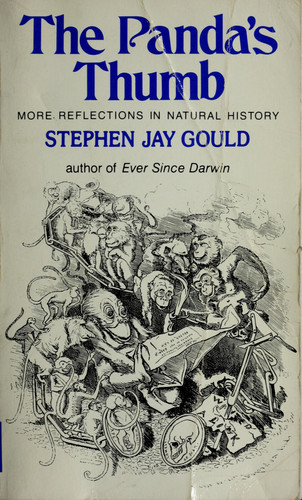
The panda's thumb: more reflections in natural history

Gould, Stephen Jay
A collection of essays by reknown scientist Jay Stephen Gould drawn from his columns in Natural History. The essays deal with topics such as: evolutionary opportunism (nature is a tinkerer, making the most of what's available in the course of adapting to the environment); new information on Darwin and his contemporaries; racism and cultural relativism; the evolutionary pattern of sudden rapid change; the origin of birds or the warm-bloodedness of dinosaurs; and, Teilhard de Chardin as a co-conspirator in the Piltdown hoax.
Norton 1980 343 pages

Anthropology and myth: lectures 1951-1982

Lévi-Strauss, Claude
The published work of Claude Levi-Strauss over the last three and a half decades has established him as one of the world′s most innovative anthropologists. Yet throughout this period he was maintaining a full taching commitment in Paris. The pieces in Anthropology and Myth illustrate (in his own words) ′the efforts, the tentative advances and retreats and now and again the achievements of a thought process during some thirty-two years that amount to a large propotion of an individual life and the span of a generation′. Levi-Strauss used to the lecture theatre as a workshop in which to try out and develop new ideas, and many of the familiar themes of his books will be found here: analysis of myth and ritual, totemism, kinship, marriage and social structure. Offering a unique glimpse of the genesis of such subjects throughout his teaching career, this book provides a sketchbook of the themes painted elsewhere in larger, more finished form, and thus forms a document of vital importance for the history of anthropological thought.
Basil Blackwell 1987-01 232 pages

A history of political thought: the Middle Ages

Ullmann, Walter
Entre los siglos V y XII, cuando aún había vastos territorios deshabitados en Europa, se desarrolló una sociedad que tuvo que aprender los rudimentos de la admnistración de la vidá pública. En ese período se formaron, y plasmaron, numerosos conceptos políticos básicos que continúan vigentes en nuestro tiempo. En este libro, el profesor Ullmann traza los orígenes de las ideas políticas de Occidente, ideas tan fundamentales como la soberanía, el parlamento, la ciudadanía, el imperio de la ley y el Estado. Demuestra que el desarrollo de estos conceptos surgen del conflicto entre tesis descendientes y ascendientes de gobierno (con sus fuentes romanas y griegas), y explica el dominio del eclesiástico en la sociedad medieval. Walter Ullmann fue profesor de Historia eclesiástica medieval en la Universidad de Cambridge. Su extensa obra representa un hito en la historiografía de su especialidad. Miembro de la Academia Británica, también fue editor general de los famosos 'Cambridge Studies in Medieval Life and Thought'.
Penguin 1970 253 pages

The astronomical revolution: Copernicus, Kepler, Borelli

Koyré, Alexandre
In these three studies-Copernicus, Kepler, Borelli- which are brought together in this volume, it is not my intention to review the history of astronomy in the sixteenth and seventeenth centuries from Corperius to Newton, but only the history of the 'astronomical revolution', that is to say, the history of the evolution and transformation the key-concepts by means of which endeavors to reduce to order, of to save, phenomena-by clearly setting forth the facts that underlie and explain the chaos of sentient appearances.
Hermann 1973 530 pages

Milton Friedman's monetary framework: a debate with his critics

Brunner, Karl,Davidson, Paul,Friedman, Milton,Meltzer, Allan H.,Patinkin, Don,Tobin, James
In response to widespread interest in a formal complete statement analyzing aspects of the money-income relationship and clarification of his quantity theory, Milton Friedman in 1970 published "A Theoretical Framework for Monetary Analysis," and a year later "A Monetary Theory of Nominal Income," both in the Journal of Political Economy. A combined version of these essays, first published by the National Bureau of Economic Research, begins this volume. Because his statement was important and controversial both as a commentary on the history of economic thought and as a theoretical contribution in its own right, the Journal of Political Economy in 1972 presented critical reviews from noted monetary theorists, including Karl Brunner and Allan H. Meltzer, James Tobin, Paul Davidson, and Don Patinkin. Their studies, which are printed in the present volume, focus on substantive issues, covering a variety of topics. All of their major points are discussed in Friedman's reply, which clarifies and expands upon his original themes and introduces interesting new material. Thus the synthesis of his two articles, the critical comments, and his response, together with an introduction by Robert J. Gordon, are combined in one volume for the convenience of scholars and students
University of Chicago Press 1974-01 192 pages

Non-market socialism in the nineteenth and twentieth centuries

Maximilien Rubel
Everyone knows that in socialism private companies are replaced by state enterprises which employ wage-workers in order to produce profits which accrue to the state. 'Not so!' say the authors of this book. In the nineteenth century, socialists as different as Marx and Kropotkin were agreed that socialism means a marketless, moneyless, wageless, classless, stateless world society. Subsequently this vision of non-market socialism has been developed by currents such as the Anarcho-Communists, Impossibilists, Council Communists, Bordigists and Situationists. By tracing this development, this book challenges the assumptions of both supporters and opponents of what is conventionally regarded as socialism.
Macmillan 1987 187 pages

Conflict in man-made environment

Rapoport, Anatol
"How the environment causes, or contributes to, psychic and social conflict is frequently discussed. Less often considered is the theme developed in this Pelican by Professor Rapoport--that human conflict intimately affects the 'symbolic' environment, which may be a more powerful determinant of man's condition than pollution, war or urbanization. By 'symbolic' environment is meant the whole non-material body of knowledge, science, art, history, language, beliefs and ideas which human intelligence has amassed. Outlining various theories of aggression, progress, evolution and the struggle for existence, Professor Rapoport examines in detail the systemic philosophies advanced by Hobbes, Hegel, Clausewitz, Marx, Lenin and the modern 'think-tanks'. He concludes--in a book which from the start is concerned with the functioning of systems--that the 'mind' of a system, backed by power, may be disastrously different from the psychology of any of its members. In this context Professor Rapoport detects a gleam of hope in the growing scepticism about all and any concentrations of power"--Back cover.
Penguin 1974 272 pages