9 results for "History"

Reign of terror: how the 9/11 era destabilized America and produced Trump

Ackerman, Spencer
"An examination of the profound impact that the War on Terror had in pushing American politics and society in an authoritarian direction for an entire generation, at home and abroad, the United States has waged an endless conflict known as the War on Terror. In addition to multiple ground wars, it has pioneered drone strikes and industrial-scale digital surveillance, as well as detaining people indefinitely and torturing them. These conflicts have yielded neither peace nor victory, but they have transformed America. What began as the persecution of Muslims and immigrants has become a normalized, paranoid feature of American politics and security, expanding the possibilities for applying similar or worse measures against other targets at home. A politically divided country turned the War on Terror into a cultural and then tribal struggle, first on the ideological fringes and ultimately expanding to conquer the Republican Party, often with the timid acquiescence of the Democratic Party. Today's nativist resurgence walked through a door opened by the 9/11 era. Reign of Terror will show how these policies created a foundation for American authoritarianism and, though it is not a book about Donald Trump, it will provide a critical explanation of his rise to power and the sources of his political strength. It will show that Barack Obama squandered an opportunity to dismantle the War on Terror after killing Osama bin Laden. That mistake turns out to have been portentous. By the end of his tenure, the war metastasized into a broader and bitter culture struggle in search of a demagogue like Trump to lead it. A union of journalism and intellectual history, Reign of Terror will be a pathbreaking and definitive book with the power to transform how America understands its national security policies and their catastrophic impact on its civic life"--
Viking, an imprint of Penguin Random House LLC 2021 428 pages

Imperial grunts: the American military on the ground

Kaplan, Robert D.
Veteran correspondent Kaplan shows how American imperialism and the Global War on Terrorism are implemented on the ground, mission by mission, in the most exotic landscapes around the world. Kaplan takes us from the jungles of the southern Philippines to the dust bowls of Mongolia, from the forts of Afghanistan to the forests of South America--not to mention Iraq--to show us Army Special Forces, Marines, and other uniformed Americans carrying out the many facets of U.S. foreign policy: negotiating with tribal factions, storming terrorist redoubts, performing humanitarian missions and training foreign soldiers. Kaplan provides an insider's account of where America, including the culture of its officers and enlisted men, is headed. This book has the potential to change the way readers view the men and women of the military, war, and the global reach of America today.--From publisher description.
Random House 2005 421 pages

After 9/11: America's war on terror (2001-)

Jacobson, Sid
Having made The 9/11 Commission Report understandable for everyone, the award-winning, bestselling graphic novel team of Sid Jacobson and Ernie Colón use all their considerable talents to explain the post-9/11 world. Working from news reports drawn from multiple international media, Jacobson and Colón depict the critical events, decision makers, and consequences of America's "war on terror," and, most important, the context in which the war began, unfolded, and unraveled. The most demanding story they have ever tackled, After 9/11 is also the most tailor-made for their medium, capturing simultaneous events, geographic complexity, numerous participants, and a vast array of economic, statistical, and quantitative information—compellingly told through the sequential panel art narrative form unique to graphic books. Proving yet again that graphic novels best meet the challenge of giving the most information with the least amount of ink, Jacobson and Colón answer with clarity and unforgettable imagery the question: How the hell did we end up where we are?
Hill and Wang 2008-08-19 28 pages

Artists in times of war

Zinn, Howard
"Political power," says Howard Zinn, "is controlled by the corporate elite, and the arts are the locale for a kind of guerilla warfare in the sense that guerillas look for apertures and opportunities where they can have an effect." In Artists in Times of War, Zinn looks at the possibilities to create such apertures through art, film, activism, publishing and through our everyday lives. In this collection of four essays, the author of A People's History of the United States writes about why "To criticize the government is the highest act of patriotism." Filled with quotes and examples from the likes of Bob Dylan, Mark Twain, e. e. cummings, Thomas Paine, Joseph Heller, and Emma Goldman, Zinn's essays discuss America's rich cultural counternarratives to war, so needed in these days of unchallenged U.S. militarism.
Seven Stories Press 2003 112 pages

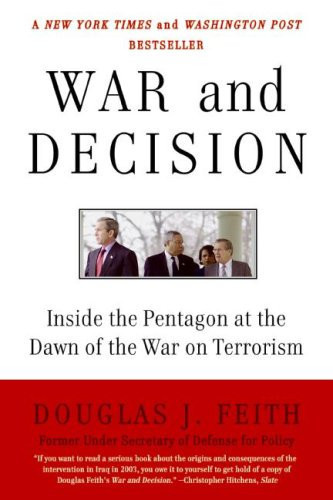
War and decision: inside the Pentagon at the dawn of the War on Terrorism

Feith, Douglas J.
Of all the players in the planning and evolution of the Bush Administration's war on terrorism, few were more integral--or more controversial--than Douglas Feith, the chief strategist on Donald Rumsfeld's Pentagon policy team. A highly influential international policy analyst for more than a quarter century, Feith worked closely with Rumsfeld, Paul Wolfowitz, Colin Powell, Condoleezza Rice, Vice President Cheney, and President Bush in defining the U.S. response to the attacks of 9/11--from the successful war on Afghanistan to the more challenging invasion of Iraq and its aftermath. Now, in this candid and revealing memoir, Feith--a charter member of the neoconservative movement and an architect of the administration's preventive strategy in the war on terrorism--offers the most in-depth and authoritative account yet of the Pentagon's evolving stance during one of the most controversial eras of American history. Drawing upon a unique trove of documents and records, this extraordinary chronicle will put the reader in the room for scores of previously unreported senior-level meetings, showing how hundreds of critical decisions were made in defense of American interests during and after the crisis of 9/11--decisions both successful and controversial. Where journalists like Bob Woodward could only speculate, Feith is the first inside player to reveal the inner workings of the Pentagon, at a time when history hung in the balance.--From publisher description.
HarperCollins 2009-02-03 674 pages

The trial of Donald Rumsfeld: a prosecution by book

Ratner, Michael
The Case Against Donald Rumsfeld lays out the evidence that high–level officials of the Bush administration ordered, authorized, implemented, and permitted war crimes, in particular the crimes of torture and cruel, inhuman, and degrading treatment. Using primary source documents ranging from Rumsfeld's "techniques chart" and Iraqi plaintiffs' statements to the testimony of whistleblowers and key pieces of reportage, the book sets forth evidence of a torture program that took place throughout the world: in Afghanistan, Iraq, Guantánamo, secret CIA prisons, and other places unknown. The accused are accorded a defense drawn from their memos and public statements. Readers are allowed to judge whether the Bush administration has engaged in torture and whom among the administration to hold responsible. Reminiscent of Christopher Hitchens's bestselling The Trial of Henry Kissinger, The Case Against Donald Rumsfeld constitutes one of the only attempts to hold high–ranking Bush administration officials criminally responsible for their actions.
New Press 2008 242 pages

The pre-emptive empire: a guide to Bush's kingdom

Landau, Saul
Saul Landau is an internationally known scholar, author, journalist, poet and activist. An Emmy-award-winning film maker, he does frequent radio and TV shows, and his work on human rights and Latin America have won him acclaim the world over. This, his latest book, is a scathing account of George W. Bush's world before and after the 9/11 terrorist attacks that will appeal to anyone who is disenchanted with the cynicism of Bush's government, and the blatant imperialism U.S. international policy -- or those who just want to learn about what's happening in US politics. Landau covers the topical and controversial issues -- from terrorism and US foreign policy to Bush's wondrous election victory; from Enron, Chile and Pinochet to Cuba, the Middle East, the IMF, the environment and sexual and cultural politics. He delves into the erosion of civil liberties and the proliferation of empire under the guise of pre-empting the scourge of terrorism. Landau reveals how Bush protects "his" terrorists -- those who perpetrate violence against Castro’s Cuba, and to whom he owes his presidency. He also examines how Bush has appointed former officials to high level posts in his cabinet despite their membership in a conspiracy to sell weapons of mass destruction to Iran in the 1980s. In "declassifying" Bush’s Empire, Landau dissects a post-9/11 world where deference to patriotism obliterates debate in Congress and the media. How can the notion of empire happily co-exist with the notion of a republic? In times like these, as dissenting voices are stifled and the public are denied access to the facts about their own security, Landau shows how democracy itself is under threat. He asks whether the already fragile world economy can survive in the new "security" culture of the post-9/11 world. This is an entertaining read from one of America's foremost cultural and political commentators. Above all, Landau makes a convincing case for the necessity of activism -- the book is not only funny but is also a ringing call for citizens to participate in making their own history.
Pluto Press 2003 182 pages

The war at home: the domestic costs of Bush's militarism

Piven, Frances Fox
Frances Fox Piven, one of the country's most celebrated social scientists, raises questions others have not. She examines the ways the war on terror served to shore up the Bush administration's political base and analyzes the manner in which flag-waving politicians used the emotional fog of war to further their regressive social and economic agendas. Always in the past governments that made war sooner or later tried to reward their peoples for the blood and wealth they were forced to sacrifice. During World War II, tax rates on the wealthy rose to 90 percent; toward the end of the Vietnam War, eighteen-year-olds were given the right to vote. In this war, taxes on the rich have been slashed, and democratic rights are being rolled back. Even veteran's benefits have been sharply reduced. The War at Home makes sense of these developments by putting the current domestic fallout of war in the context of history - and by turning an unsentimental eye on the domestic motivations of American militarism.
New Press 2004 165 pages