11 results for "Innovation"

Steve Jobs

Walter Isaacson
Walter Isaacson’s “enthralling” ( The New Yorker ) worldwide bestselling biography of Apple cofounder Steve Jobs. Based on more than forty interviews with Steve Jobs conducted over two years—as well as interviews with more than 100 family members, friends, adversaries, competitors, and colleagues—Walter Isaacson has written a riveting story of the roller-coaster life and searingly intense personality of a creative entrepreneur whose passion for perfection and ferocious drive revolutionized six industries: personal computers, animated movies, music, phones, tablet computing, and digital publishing. At a time when America is seeking ways to sustain its innovative edge, Jobs stands as the ultimate icon of inventiveness and applied imagination. He knew that the best way to create value in 21st century was to connect creativity with technology. He built a company where leaps of the imagination were combined with remarkable feats of engineering. Although Jobs cooperated with the author, he asked for no control over what was written. He put nothing off-limits. He encouraged the people he knew to speak honestly. And Jobs speaks candidly, sometimes brutally so, about the people he worked with and competed against. His friends, foes, and colleagues provide an unvarnished view of the passions, perfectionism, obsessions, artistry, devilry, and compulsion for control that shaped his approach to business and the innovative products that resulted. Driven by demons, Jobs could drive those around him to fury and despair. But his personality and products were interrelated, just as Apple’s hardware and software tended to be, as if part of an integrated system. His tale is instructive and cautionary, filled with lessons about innovation, character, leadership, and values. Steve Jobs is the inspiration for the movie of the same name starring Michael Fassbender, Kate Winslet, Seth Rogen, and Jeff Daniels, directed by Danny Boyle with a screenplay by Aaron Sorkin.
Simon and Schuster 2021-10-05 672 pages

How to Lead Wisdom from the World's Greatest CEOs, Founders, and Game Changers

David M. Rubenstein
The New York Times Bestseller #1 Wall Street Journal Bestseller The essential leadership playbook. Learn the principles and guiding philosophies of Bill Gates, Jeff Bezos, Ruth Bader Ginsburg, Warren Buffett, Oprah Winfrey, and many others through illuminating conversations about their remarkable lives and careers. For the past five years, David M. Rubenstein—author of The American Story , visionary cofounder of The Carlyle Group, and host of The David Rubenstein Show —has spoken with the world’s highest performing leaders about who they are and how they became successful. How to Lead distills these revealing conversations into an indispensable leadership guidebook. Gain advice and wisdom from CEOs, presidents, founders, and master performers from the worlds of finance ( Warren Buffett, Jamie Dimon, Christine Lagarde, Ken Griffin ), tech ( Jeff Bezos, Bill Gates, Eric Schmidt, Tim Cook ), entertainment ( Oprah Winfrey, Lorne Michaels, Renee Fleming, Yo-Yo Ma ), sports ( Jack Nicklaus, Adam Silver, Coach K, Phil Knight ), government ( President Bill Clinton, President George W. Bush, Ruth Bader Ginsburg, Nancy Pelosi ), and many others. - Jeff Bezos harnesses the power of wandering, discovering that his best decisions have been made with heart and intuition, rather than analysis. - Richard Branson never goes into a venture looking to make a profit. He aims to make the best in field. - Phil Knight views Nike as a marketing company whose product is its most important marketing tool. - Marillyn Hewson , who grew up in a fatherless home with four siblings in Kansas, quickly learned the importance of self-reliance and the value of a dollar. How to Lead shares the extraordinary stories of these pioneering agents of change. Discover how each luminary got started and how they handle decision making, failure, innovation, change, and crisis. Learn from their decades of experience as pioneers in their field. No two leaders are the same.
Simon and Schuster 2020-09-01 448 pages

Dilla Time The Life and Afterlife of J Dilla, the Hip-Hop Producer Who Reinvented Rhythm

Dan Charnas
WINNER OF THE PEN/ JACQUELINE BOGRAD WELD AWARD FOR BIOGRAPHY NEW YORK TIMES BESTSELLER “This book is a must for everyone interested in illuminating the idea of unexplainable genius.” —QUESTLOVE Equal parts biography, musicology, and cultural history, Dilla Time chronicles the life and legacy of J Dilla, a musical genius who transformed the sound of popular music for the twenty-first century. He wasn’t known to mainstream audiences, even though he worked with renowned acts like D’Angelo and Erykah Badu and influenced the music of superstars like Michael Jackson and Janet Jackson. He died at the age of thirty-two, and in his lifetime he never had a pop hit. Yet since his death, J Dilla has become a demigod: revered by jazz musicians and rap icons from Robert Glasper to Kendrick Lamar; memorialized in symphonies and taught at universities. And at the core of this adulation is innovation: a new kind of musical time-feel that he created on a drum machine, but one that changed the way “traditional” musicians play. In Dilla Time , Dan Charnas chronicles the life of James DeWitt Yancey, from his gifted childhood in Detroit, to his rise as a Grammy-nominated hip-hop producer, to the rare blood disease that caused his premature death; and follows the people who kept him and his ideas alive. He also rewinds the histories of American rhythms: from the birth of soul in Dilla’s own “Motown,” to funk, techno, and disco. Here, music is a story of Black culture in America and of what happens when human and machine times are synthesized into something new. Dilla Time is a different kind of book about music, a visual experience with graphics that build those concepts step by step for fans and novices alike, teaching us to “see” and feel rhythm in a unique and enjoyable way. Dilla’s beats, startling some people with their seeming “sloppiness,” were actually the work of a perfectionist almost spiritually devoted to his music. This is the story of the man and his machines, his family, friends, partners, and celebrity collaborators. Culled from more than 150 interviews about one of the most important and influential musical figures of the past hundred years, Dilla Time is a book as delightfully detail-oriented and unique as J Dilla’s music itself.
Picador 2023-01-31 480 pages

Capitalism in America A History

Alan Greenspan,Adrian Wooldridge
From the legendary former Fed Chairman and the acclaimed Economist writer and historian, the full, epic story of America's evolution from a small patchwork of threadbare colonies to the most powerful engine of wealth and innovation the world has ever seen. Shortlisted for the 2018 Financial Times and McKinsey Business Book of the Year Award From even the start of his fabled career, Alan Greenspan was duly famous for his deep understanding of even the most arcane corners of the American economy, and his restless curiosity to know even more. To the extent possible, he has made a science of understanding how the US economy works almost as a living organism--how it grows and changes, surges and stalls. He has made a particular study of the question of productivity growth, at the heart of which is the riddle of innovation. Where does innovation come from, and how does it spread through a society? And why do some eras see the fruits of innovation spread more democratically, and others, including our own, see the opposite? In Capitalism in America , Greenspan distills a lifetime of grappling with these questions into a thrilling and profound master reckoning with the decisive drivers of the US economy over the course of its history. In partnership with the celebrated Economist journalist and historian Adrian Wooldridge, he unfolds a tale involving vast landscapes, titanic figures, triumphant breakthroughs, enlightenment ideals as well as terrible moral failings. Every crucial debate is here--from the role of slavery in the antebellum Southern economy to the real impact of FDR's New Deal to America's violent mood swings in its openness to global trade and its impact. But to read Capitalism in America is above all to be stirred deeply by the extraordinary productive energies unleashed by millions of ordinary Americans that have driven this country to unprecedented heights of power and prosperity. At heart, the authors argue, America's genius has been its unique tolerance for the effects of creative destruction, the ceaseless churn of the old giving way to the new, driven by new people and new ideas. Often messy and painful, creative destruction has also lifted almost all Americans to standards of living unimaginable to even the wealthiest citizens of the world a few generations past. A sense of justice and human decency demands that those who bear the brunt of the pain of change be protected, but America has always accepted more pain for more gain, and its vaunted rise cannot otherwise be understood, or its challenges faced, without recognizing this legacy. For now, in our time, productivity growth has stalled again, stirring up the populist furies. There's no better moment to apply the lessons of history to the most pressing question we face, that of whether the United States will preserve its preeminence, or see its leadership pass to other, inevitably less democratic powers.
National Geographic Books 2018-10-16 768 pages

Disciplined Dreaming A Proven System to Drive Breakthrough Creativity

Josh Linkner
A 5-part process that will transform your organization -- or your career -- into a non-stop creativity juggernaut We live in an era when business cycles are measured in months, not years. The only way to sustain long term innovation and growth is through creativity-at all levels of an organization. Disciplined Dreaming shows you how to create profitable new ideas, empower all your employees to be creative, and sustain your competitive advantage over the long term. Linkner distills his years of experience in business and jazz -- as well as hundreds of interviews with CEOs, entrepreneurs, and artists -- into a 5-step process that will make creativity easy for you and your organization. The methodology is simple, backed by proven results. Empowers individuals, teams, and organizations to meet creative challenges posed by the marketplace Turns the mystery of creativity into a simple-to-use process Shows how creativity can be used for everything from innovative, game-shifting breakthroughs to incremental advances and daily improvements to business processes Offers dozens of practical exercises, thought-starters, workouts to grow "creative muscles," and case studies Disciplined Dreaming shows even the stuffiest corporate bureaucracies how to cultivate creativity in order to become more competitive in today's shifting marketplace.
John Wiley & Sons, Incorporated 2014-06-06

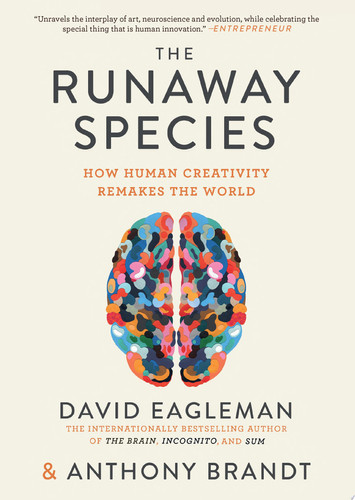
The Runaway Species How Human Creativity Remakes the World

David Eagleman,Anthony Brandt
This enlightening examination of creativity looks “at art and science together to examine how innovations . . . build on what already exists and rely on three brain operations: bending, breaking and blending” ( The Wall Street Journal ) The Runaway Species is a deep dive into the creative mind, a celebration of the human spirit, and a vision of how we can improve our future by understanding and embracing our ability to innovate. David Eagleman and Anthony Brandt seek to answer the question: what lies at the heart of humanity’s ability—and drive—to create? Our ability to remake our world is unique among all living things. But where does our creativity come from, how does it work, and how can we harness it to improve our lives, schools, businesses, and institutions? Eagleman and Brandt examine hundreds of examples of human creativity through dramatic storytelling and stunning images in this beautiful, full–color volume. By drawing out what creative acts have in common and viewing them through the lens of cutting–edge neuroscience, they uncover the essential elements of this critical human ability, and encourage a more creative future for all of us. “ The Runaway Species approach[es] creativity scientifically but sensitively, feeling its roots without pulling them out.” — The Economist
Catapult 2018-06-19 304 pages

Leaning Forward Surviving/Winning in the Future of Interactive Marketing

Josh Linkner
"Josh Linkner, CEO of ePrize, is a tremendous business leader who has established a successful and sustainable company, as well as a culture that nurtures employees to help them maximize their potential." - Jennifer M. Granholm, Governor, State of Michigan "Leaning Forward is a deep and highly aware look into the future of interactive marketing. A must-read for anybody who plans to compete and win in the brain age." - Dan Gilbert, Chairman and Founder, Quicken Loans and Majority Owner, Cleveland Cavaliers "Josh has given you reason to fear the programmed nature of obsolescence but more importantly his deep consumer knowledge will give you hope This book will never be obsolete " - David Sable, Vice Chairman/Chief Operating Officer, Wunderman (largest direct marketing company in the world) Leaning Forward takes a penetrating look at the future of Interactive marketing. Major brands throughout the world have embraced the 'Digital Revolution', and have fundamentally changed the way they interact with their consumers. As a marketer, you will learn what you need to know to stay ahead of the curve and compete in this dramatically changed landscape. Renowned entrepreneur Josh Linkner shows you real world examples of what the best marketers are doing today and where the trends are heading. You'll learn how the most savvy marketers: . Establish and nurture direct, one-to-one relationships . Motivate specific consumer behavior . Get marketing messages heard above the non-stop "noise" . Combine brand immersive experiences with proven direct-marketing techniques . Generate "hand-raisers" . Increase relevancy, response-rates, and overall performance . Drive immediate and measurable results By examining the major sea of change that has happened over the last ten years, Linkner shares best practices, trends, and helps readers avoid common pitfalls. A must-read for today's marketing professional, business owner, or aspiring entrepreneur. Josh Linkner --Founder and CEO, ePrize As a pioneer in interactive marketing and promotions, Josh has been involved in the development of thousands of digital marketing strategies over the last 14 years. As the founder and CEO of ePrize, he has led the firm from inception to being ranked the #1 fastest growing and #3 overall promotion agency by PROMO Magazine. ePrize has produced an industry-leading 4,000 interactive promotions for clients including Coca-Cola, American Express, The Gap, Procter & Gamble, Warner Bros. Dell, adidas, Citibank and General Motors. Josh has been featured in the Wall Street Journal, Fast Company, AdAge, Inc. magazine, Entrepreneur, and Adweek, and is a regular keynote speaker at industry events and conferences. Josh has won several business, technology, and design awards. He is also an accomplished and well-respected Jazz musician from which he draws the same passion and excitement toward business, and creating a culture of innovation, discipline, and creativity.
Dog Ear Publishing 2007-11 120 pages

Evolutionary Psychology in the Business Sciences

Gad Saad
All individuals who operate in the business sphere, whether as consumers, employers, employees, entrepreneurs, or financial traders to name a few constituents, share a common biological heritage and are defined by a universal human nature. As such, it is surprising that so few business scholars have incorporated biological and evolutionary-informed theories within their conceptual toolboxes. This edited book addresses this lacuna by culling chapters at the intersection of the evolutionary behavioral sciences and specific business contexts including in marketing, consumer behavior, advertising, innovation and creativity, intertemporal choice, negotiations, competition and cooperation in organizational settings, sex differences in workplace patterns, executive leadership, business ethics, store design, behavioral decision making, and electronic communication. To reword the famous aphorism of T. G. Dobzhansky, nothing in business makes sense except in the light of evolution.
Springer Berlin Heidelberg 2014-09-28 371 pages

Trade Is Not a Four-Letter Word How Six Everyday Products Make the Case for Trade

Fred P. Hochberg
“A sprightly and clear-eyed testimonial to the value of globalization” ( The Wall Street Journ al ) as seen through six surprising everyday goods—the taco salad, the Honda Odyssey, the banana, the iPhone, the college degree, and the blockbuster HBO series Game of Thrones. Trade allows us to sell what we produce at home and purchase what we don’t. It lowers prices and gives us greater variety and innovation. Yet understanding our place in the global trade network is rarely simple. Trade has become an easy excuse for struggling economies, a scapegoat for our failures to adapt to a changing world, and—for many Americans on both the right and the left—nothing short of a four-letter word. But as Fred P. Hochberg reminds us, trade is easier to understand than we commonly think. In Trade Is Not a Four-Letter Word , you’ll learn how NAFTA became a populist punching bag on both sides of the aisle. You’ll learn how Americans can avoid the grim specter of the $10 banana. And you’ll finally discover the truth about whether or not, as President Trump has famously tweeted, “trade wars are good and easy to win.” (Spoiler alert—they aren’t.) Hochberg debunks common trade myths by pulling back the curtain on six everyday products, each with a surprising story to tell: the taco salad, the Honda Odyssey, the banana, the iPhone, the college degree, and the smash hit HBO series Game of Thrones . Behind these six examples are stories that help explain not only how trade has shaped our lives so far but also how we can use trade to build a better future for our own families, for America, and for the world. Trade Is Not a Four-Letter Word is the antidote to today’s acronym-laden trade jargon pitched to voters with simple promises that rarely play out so one-dimensionally. Packed with colorful examples and highly digestible explanations, Trade Is Not a Four-Letter Word is “an accessible, necessary book that will increase our understanding of trade and economic policies and the ways in which they impact our daily lives” ( Library Journal , starred review).
Simon and Schuster 2021-01-26 336 pages

A Whole New Engineer The Coming Revolution in Engineering Education

Mark Somerville,David Edward Goldberg
A Revolution Is Coming. It Isn't What You Think.This book tells the improbable stories of Franklin W. Olin College of Engineering, a small startup in Needham, Massachusetts, with aspirations to be a beacon to engineering education everywhere, and the iFoundry incubator at the University of Illinois, an unfunded pilot program with aspirations to change engineering at a large public university that wasn't particularly interested in changing. That either one survived is story enough, but what they found out together changes the course of education transformation forever: - How joy, trust, openness, and connec- tion are the keys to unleashing young, courageous engineers.- How engineers educated in narrow technical terms with a fixed mindset need an education that actively engages six minds-analytical, design, people, linguistic, body, and mindful- using a growth mindset.- How emotion and culture are the crucial elements of change, not content, curriculum, and pedagogy.- How four technologies of trust are well established and widely available to promote more rapid academic change.- How all stakeholders can join together in a movement of open innovation to accelerate collaborative disruption of the status quo.Read this book and get a glimpse inside the coming revolution in engineering. Feel the engaging stories in this book and understand the depth of change that is coming. Use this book to help select, shape, demand, and create educational experiences aligned with the creative imperative of the twenty-first century.
Threejoy Associates, Incorporated 2019 290 pages

Advances on Information Technologies in the Financial Services Industry A Special Issue of the Journal of Organizational Computing and Electronic Commerce

Robert J. Kauffman,Bruce W. Weber
The financial services industry is changing under the stimulus of advances in information technology (IT), telecommunications, and the Internet. Technological innovations and growing customer demand and sophistication have led to the emergence of new electronic financial markets, organizational forms for financial services firms, products, and product delivery capabilities. This special issue highlights Information Systems (IS) research on management topics in the financial services that involve IT. The authors utilize a mix of research methodologies to examine a range of innovative applications of IT in the financial services industry.
Taylor & Francis Group 2002-04 104 pages