17 results for "Innovation"

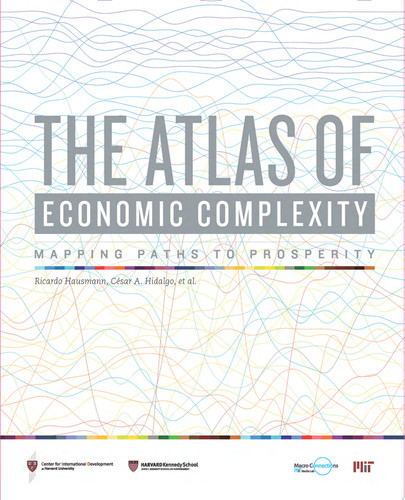
The atlas of economic complexity: mapping paths to prosperity

Ricardo Hausmann,Cesar A. Hidalgo,Sebastian Bustos,Michele Coscia,Alexander Simoes
Maps capture data expressing the economic complexity of countries from Albania to Zimbabwe, offering current economic measures and as well as a guide to achieving prosperity Why do some countries grow and others do not? The authors of The Atlas of Economic Complexity offer readers an explanation based on "Economic Complexity," a measure of a society's productive knowledge. Prosperous societies are those that have the knowledge to make a larger variety of more complex products. The Atlas of Economic Complexity attempts to measure the amount of productive knowledge countries hold and how they can move to accumulate more of it by making more complex products. Through the graphical representation of the "Product Space," the authors are able to identify each country's "adjacent possible," or potential new products, making it easier to find paths to economic diversification and growth. In addition, they argue that a country's economic complexity and its position in the product space are better predictors of economic growth than many other well-known development indicators, including measures of competitiveness, governance, finance, and schooling. Using innovative visualizations, the book locates each country in the product space, provides complexity and growth potential rankings for 128 countries, and offers individual country pages with detailed information about a country's current capabilities and its diversification options. The maps and visualizations included in the Atlas can be used to find more viable paths to greater productive knowledge and prosperity.
The MIT Press 2013 367 pages

Unjust deserts: how the rich are taking our common inheritance

Alperovitz, Gar
Warren Buffett is worth nearly $50 billion. Does he “deserve” all this money? Buffett himself will tell you that “society is responsible for a very significant percentage of what I’ve earned.” Unjust Deserts offers an entirely new approach to the wealth question. In a lively synthesis of modern economic, technological, and cultural research, Gar Alperovitz and Lew Daly demonstrate that up to 90 percent (and perhaps more) of current economic output derives not from individual ingenuity, effort, or investment but from our collective inheritance of scientific and technological knowledge: an inheritance we all receive as a “free lunch.” Alperovitz and Daly then pursue the implications of this research, persuasively arguing that there is no reason any one person should be entitled to that inheritance. Recognizing the true dimensions of our unearned inheritance leads inevitably to a new and powerful moral case for wealth redistribution—and to a series of practical policies to achieve it in an era when the disparities have become untenable.
New Press 2008 230 pages

The pro-growth progressive: an economic strategy for shared prosperity

Sperling, Gene B.
After two consecutive elections in which Democratic candidates failed to turn economic advantages into electoral victory, a debate is raging over what the Democrats should do now. Here, Clinton's economic advisor Sperling argues that the best strategy for our nation--and the best strategy for progressives whether they be Democrat, Republican, or Independent--is to pursue policies that are both progressive and pro-growth, that promote progressive values of upward mobility, fair starts, and economic dignity as well as embrace markets and innovation. Democrats too often pretend that the way to promote progressive values is to slow the pace of the global economy, stop outsourcing, and intervene in the market. Republicans hold fast to the bankrupt vision that the best thing for economic growth is the smallest government possible. Sperling lays out a third way, a realistic vision in which government can improve education, reduce poverty, and restore the country to fiscal sanity.--From publisher description.
Simon & Schuster 2005 354 pages

The gifts of Athena

Mokyr, Joel
The growth of technological and scientific knowledge in the past two centuries has been the overriding dynamic element in the economic and social history of the world. Its result is now often called the knowledge economy. But what are the historical origins of this revolution and what have been its mechanisms? In The Gifts of Athena , Joel Mokyr constructs an original framework to analyze the concept of "useful" knowledge. He argues that the growth explosion in the modern West in the past two centuries was driven not just by the appearance of new technological ideas but also by the improved access to these ideas in society at large--as made possible by social networks comprising universities, publishers, professional sciences, and kindred institutions. Through a wealth of historical evidence set in clear and lively prose, he shows that changes in the intellectual and social environment and the institutional background in which knowledge was generated and disseminated brought about the Industrial Revolution, followed by sustained economic growth and continuing technological change. Mokyr draws a link between intellectual forces such as the European enlightenment and subsequent economic changes of the nineteenth century, and follows their development into the twentieth century. He further explores some of the key implications of the knowledge revolution. Among these is the rise and fall of the "factory system" as an organizing principle of modern economic organization. He analyzes the impact of this revolution on information technology and communications as well as on the public's state of health and the structure of households. By examining the social and political roots of resistance to new knowledge, Mokyr also links growth in knowledge to political economy and connects the economic history of technology to the New Institutional Economics. The Gifts of Athena provides crucial insights into a matter of fundamental concern to a range of disciplines including economics, economic history, political economy, the history of technology, and the history of science.
Princeton University Press 2002 359 pages

Favorites of fortune: technology, growth, and economic development since the Industrial Revolution

Patrice L. R. Higonnet,David S. Landes,Henry Rosovsky
A galaxy of distinguished international economists and historians pit economic history against the shaky assumptions of the classical economic theory of natural growth. Their explanations consider the factors of technology, entrepreneurialism, and paths to economic growth, but each reflects an ideological wave of explanation that has marked the last two hundred years.
Harvard University Press 1991-01 558 pages

Ruling the waves: cycles of discovery, chaos, and wealth from the compass to the internet

Spar, Debora L.
Beginning with the development of the compass, Ruling the Waves examines a series of technological revolutions that promised, in their time, to transform the world's politics and business. With Debora Spar's gifted storytelling, each chapter reads like an adventure tale as she recounts the histories of the printing press and maps; of the telegraph, radio, and satellite television; of software, encryption, and the advent of digital music. At each of these junctures Spar suggests that invention led to both a wave of commerce and of chaos. Entrepreneurs such as Samuel Morse and Rupert Murdoch carved new markets from the emerging technology and proclaimed that the old rules no longer applied. And for a while, they were right. But eventually--and inevitably--even cowboys need rules: rules of property, rules of coordination, rules of competition. The erstwhile pioneers thus turn to government, lobbying for order and setting the stage for the next wave of discovery. A fascinating history of business, Ruling the Waves is also an original, thought-provoking analysis of the parallels between past innovations and inventions and our own tumultuous times.
Harcourt 2001 403 pages

Globalization and inequality

Helpman, Elhanan
Helpman summarizes two decades of research about the connections among international trade, offshoring, immigration, and changes in net income. The overwhelming conclusion is that globalization has created a small rise in inequality. Other factors must be responsible for most of the rise; evidence suggests the chief culprit is technological change that heavily favors highly skilled workers.--
Harvard University Press 2018 213 pages

Entrepreneurship in the global economy: engine for economic growth

Kressel, Henry
"Entrepreneurs have long been drivers of innovation in developed countries. They start companies and create new industries that keep economies strong and prosperous. Today, however, in developing nations such as China, state-controlled economies are building robust industries at stunning speed and siphoning off jobs from the West. How can entrepreneurs function in the face of this challenge? Can they continue to create economic value in a globalized business environment? This book addresses the crucial issue of state planning vs. free enterprise and examines specific problems surrounding entrepreneurship in the global economy through nine case histories of entrepreneurial companies. It also looks at how and why government gets involved in economic growth and how entrepreneurs contribute to economic value. Based on this analysis, the authors argue that companies can succeed, even in controlled economies, by understanding the customs and policies of countries where they do business"--
Cambridge University Press 2012-07-19 266 pages

Who owns the world's media? media concentration and ownership around the world

Noam, Eli M.
Media ownership and concentration has major implications for politics, business, culture, regulation, and innovation. It is also a highly contentious subject of public debate in many countries around the world. In Italy, Silvio Berlusconi's companies have dominated Italian politics. Televisa has been accused of taking cash for positive coverage of politicians in Mexico. Even in tiny Iceland, the regulation of media concentration led to that country's first and only public referendum. Who Owns the World's Media? moves beyond the rhetoric of free media and free markets to provide a dispassionate and data-driven analysis of global media ownership trends and their drivers. Based on an extensive data collection effort from scholars around the world, the book covers thirteen media industries, including television, newspapers, book publishing, film, search engines, ISPs, wireless telecommunication and others, across a ten to twenty-five year period in thirty countries. In many countries--like Egypt, China, or Russia--little to no data exists and the publication of these chapters will become authoritative resources on the subject in those regions. After examining each country, Noam and his collaborators offer comparisons and analysis across industries, regions, and development levels. They also calculate overall national concentration trends beyond specific media industries, the market share of individual companies in the overall national media sector, and the size and trends of transnational companies in overall global media. This definitive global study of the extent and impact of media concentration will be an invaluable resource for communications, public policy, law, and business scholars in doing research and also for media, telecom, and IT companies and financial institutions in the private sector.
Oxford University Press 2016 1412 pages

Wrong number: resolving Australia's telecommunications impasse

Ergas, Henry
"Australia's telecommunications policy has hit an impasse. Government attempted to turn a monopoly into a competitive market with multiple players. A decade later, the result has been underinvestment and services which are falling behind other countries. This book explains how and why that has occurred. A flawed regulatory regime has distorted prices, deterred investment and privileged rent-seeking over genuine competition. The ACCC's administration of that regime has made matters worse, setting access charges below cost while extending the reach of regulation far beyond any reasonable bounds. As investment and innovation have stalled, government, rather than reforming the regulatory arrangements, has staggered from one poorly conceived half-measure to the next. In the process, billions of dollars of taxpayers' money have been spent, with much of that money wasted."--Provided by publisher.
Allen & Unwin 2008 242 pages