9 results for "Innovation"

Start-up nation: the story of Israel's economic miracle

Senor, Dan,Singer, Saul
START-UP NATION addresses the trillion dollar question: How is it that Israel - a country of 7.1 million, only 60 years old, surrounded by enemies, in a constant state of war since its founding, with no natural resources-- produces more start-up companies than large, peaceful and stable nations like Japan, China, India, Korea, Canada and the UK? With the savvy of foreign policy insiders, Senor and Singer examine the lessons of the country's adversity-driven culture, which flattens hierarchy and elevates informality - all backed up by government policies focused on innovation. In a world where economies as diverse as Ireland, Singapore and Dubai have tried to re-create the Israel effect, there are entrepreneurial lessons well worth noting. As America reboots its own economy and can-do spirit, there's never been a better time to look at this remarkable and resilient nation for some impressive, surprising clues.
Twelve 2011 378 pages

Capitalism in America A History

Alan Greenspan,Adrian Wooldridge
From the legendary former Fed Chairman and the acclaimed Economist writer and historian, the full, epic story of America's evolution from a small patchwork of threadbare colonies to the most powerful engine of wealth and innovation the world has ever seen. Shortlisted for the 2018 Financial Times and McKinsey Business Book of the Year Award From even the start of his fabled career, Alan Greenspan was duly famous for his deep understanding of even the most arcane corners of the American economy, and his restless curiosity to know even more. To the extent possible, he has made a science of understanding how the US economy works almost as a living organism--how it grows and changes, surges and stalls. He has made a particular study of the question of productivity growth, at the heart of which is the riddle of innovation. Where does innovation come from, and how does it spread through a society? And why do some eras see the fruits of innovation spread more democratically, and others, including our own, see the opposite? In Capitalism in America , Greenspan distills a lifetime of grappling with these questions into a thrilling and profound master reckoning with the decisive drivers of the US economy over the course of its history. In partnership with the celebrated Economist journalist and historian Adrian Wooldridge, he unfolds a tale involving vast landscapes, titanic figures, triumphant breakthroughs, enlightenment ideals as well as terrible moral failings. Every crucial debate is here--from the role of slavery in the antebellum Southern economy to the real impact of FDR's New Deal to America's violent mood swings in its openness to global trade and its impact. But to read Capitalism in America is above all to be stirred deeply by the extraordinary productive energies unleashed by millions of ordinary Americans that have driven this country to unprecedented heights of power and prosperity. At heart, the authors argue, America's genius has been its unique tolerance for the effects of creative destruction, the ceaseless churn of the old giving way to the new, driven by new people and new ideas. Often messy and painful, creative destruction has also lifted almost all Americans to standards of living unimaginable to even the wealthiest citizens of the world a few generations past. A sense of justice and human decency demands that those who bear the brunt of the pain of change be protected, but America has always accepted more pain for more gain, and its vaunted rise cannot otherwise be understood, or its challenges faced, without recognizing this legacy. For now, in our time, productivity growth has stalled again, stirring up the populist furies. There's no better moment to apply the lessons of history to the most pressing question we face, that of whether the United States will preserve its preeminence, or see its leadership pass to other, inevitably less democratic powers.
National Geographic Books 2018-10-16 768 pages

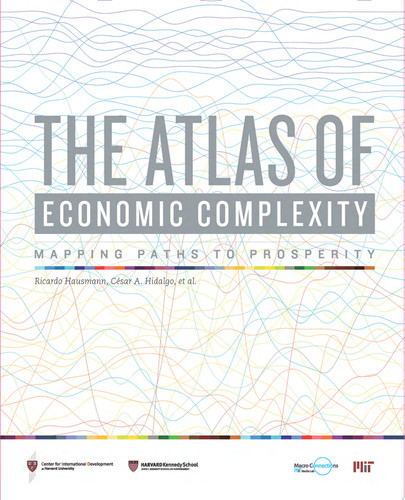
The atlas of economic complexity: mapping paths to prosperity

Ricardo Hausmann,Cesar A. Hidalgo,Sebastian Bustos,Michele Coscia,Alexander Simoes
Maps capture data expressing the economic complexity of countries from Albania to Zimbabwe, offering current economic measures and as well as a guide to achieving prosperity Why do some countries grow and others do not? The authors of The Atlas of Economic Complexity offer readers an explanation based on "Economic Complexity," a measure of a society's productive knowledge. Prosperous societies are those that have the knowledge to make a larger variety of more complex products. The Atlas of Economic Complexity attempts to measure the amount of productive knowledge countries hold and how they can move to accumulate more of it by making more complex products. Through the graphical representation of the "Product Space," the authors are able to identify each country's "adjacent possible," or potential new products, making it easier to find paths to economic diversification and growth. In addition, they argue that a country's economic complexity and its position in the product space are better predictors of economic growth than many other well-known development indicators, including measures of competitiveness, governance, finance, and schooling. Using innovative visualizations, the book locates each country in the product space, provides complexity and growth potential rankings for 128 countries, and offers individual country pages with detailed information about a country's current capabilities and its diversification options. The maps and visualizations included in the Atlas can be used to find more viable paths to greater productive knowledge and prosperity.
The MIT Press 2013 367 pages

The mystery of economic growth

Helpman, Elhanan
Far more than an intellectual puzzle for pundits, economists, and policymakers, economic growth--its makings and workings--is a subject that affects the well-being of billions of people around the globe. In The Mystery of Economic Growth , Elhanan Helpman discusses the vast research that has revolutionized understanding of this subject in recent years, and summarizes and explains its critical messages in clear, concise, and accessible terms. The tale of growth economics, as Helpman tells it, is organized around a number of themes: the importance of the accumulation of physical and human capital; the effect of technological factors on the rate of this accumulation; the process of knowledge creation and its influence on productivity; the interdependence of the growth rates of different countries; and, finally, the role of economic and political institutions in encouraging accumulation, innovation, and change. One of the leading researchers of economic growth, Helpman succinctly reviews, critiques, and integrates current research--on capital accumulation, education, productivity, trade, inequality, geography, and institutions--and clarifies its relevance for global economic inequities. In particular, he points to institutions--including property rights protection, legal systems, customs, and political systems--as the key to the mystery of economic growth. Solving this mystery could lead to policies capable of setting the poorest countries on the path toward sustained growth of per capita income and all that that implies--and Helpman's work is a welcome and necessary step in this direction.
Belknap Press of Harvard University Press 2004-09-30 223 pages

The gifts of Athena

Mokyr, Joel
The growth of technological and scientific knowledge in the past two centuries has been the overriding dynamic element in the economic and social history of the world. Its result is now often called the knowledge economy. But what are the historical origins of this revolution and what have been its mechanisms? In The Gifts of Athena , Joel Mokyr constructs an original framework to analyze the concept of "useful" knowledge. He argues that the growth explosion in the modern West in the past two centuries was driven not just by the appearance of new technological ideas but also by the improved access to these ideas in society at large--as made possible by social networks comprising universities, publishers, professional sciences, and kindred institutions. Through a wealth of historical evidence set in clear and lively prose, he shows that changes in the intellectual and social environment and the institutional background in which knowledge was generated and disseminated brought about the Industrial Revolution, followed by sustained economic growth and continuing technological change. Mokyr draws a link between intellectual forces such as the European enlightenment and subsequent economic changes of the nineteenth century, and follows their development into the twentieth century. He further explores some of the key implications of the knowledge revolution. Among these is the rise and fall of the "factory system" as an organizing principle of modern economic organization. He analyzes the impact of this revolution on information technology and communications as well as on the public's state of health and the structure of households. By examining the social and political roots of resistance to new knowledge, Mokyr also links growth in knowledge to political economy and connects the economic history of technology to the New Institutional Economics. The Gifts of Athena provides crucial insights into a matter of fundamental concern to a range of disciplines including economics, economic history, political economy, the history of technology, and the history of science.
Princeton University Press 2002 359 pages

Competition and growth: reconciling theory and evidence

Aghion, Philippe
Though competition occupies a prominent place in the history of economic thought, among economists today there is still a limited, and sometimes contradictory, understanding of its impact. In Competition and Growth , Philippe Aghion and Rachel Griffith offer the first serious attempt to provide a unified and coherent account of the effect competition policy and deregulated entry has on economic growth. The book takes the form of a dialogue between an applied theorist calling on "Schumpeterian growth" models and a microeconometrician employing new techniques to gauge competition and entry. In each chapter, theoretical models are systematically confronted with empirical data, which either invalidates the models or suggests changes in the modeling strategy. Aghion and Griffith note a fundamental divorce between theorists and empiricists who previously worked on these questions. On one hand, existing models in industrial organization or new growth economics all predict a negative effect of competition on innovation and growth: namely, that competition is bad for growth because it reduces the monopoly rents that reward successful innovators. On the other hand, common wisdom and recent empirical studies point to a positive effect of competition on productivity growth. To reconcile theory and evidence, the authors distinguish between pre- and post-innovation rents, and propose that innovation may be a way to escape competition, an idea that they confront with microeconomic data. The book's detailed analysis should aid scholars and policy makers in understanding how the benefits of tougher competition can be achieved while at the same time mitigating the negative effects competition and imitation may have on some sectors or industries.
MIT 2008-01-25 104 pages

Entrepreneurship in the global economy: engine for economic growth

Kressel, Henry
"Entrepreneurs have long been drivers of innovation in developed countries. They start companies and create new industries that keep economies strong and prosperous. Today, however, in developing nations such as China, state-controlled economies are building robust industries at stunning speed and siphoning off jobs from the West. How can entrepreneurs function in the face of this challenge? Can they continue to create economic value in a globalized business environment? This book addresses the crucial issue of state planning vs. free enterprise and examines specific problems surrounding entrepreneurship in the global economy through nine case histories of entrepreneurial companies. It also looks at how and why government gets involved in economic growth and how entrepreneurs contribute to economic value. Based on this analysis, the authors argue that companies can succeed, even in controlled economies, by understanding the customs and policies of countries where they do business"--
Cambridge University Press 2012-07-19 266 pages