
5 results for "Internet"

The News A User's Manual

Alain De Botton
From the author of The Architecture of Happiness , a thought-provoking look at the position that news has achieved in our lives. The news is everywhere. We can't stop constantly checking it on our computer screens, but what is this doing to our minds? We are never really taught how to make sense of the torrent of news we face every day, writes Alain de Botton, but this has a huge impact on our sense of what matters and of how we should lead our lives. In his dazzling new book, de Botton takes twenty-five archetypal news stories--including an airplane crash, a murder, a celebrity interview and a political scandal--and submits them to unusually intense analysis with a view to helping us navigate our news-soaked age. He raises such questions as: Why are disaster stories often so uplifting? What makes the love lives of celebrities so interesting? Why do we enjoy watching politicians being brought down? Why are upheavals in far-off lands often so boring? In The News: A User's Manual , de Botton has written the ultimate guide for our frenzied era, certain to bring calm, understanding and a measure of sanity to our daily (perhaps even hourly) interactions with the news machine.
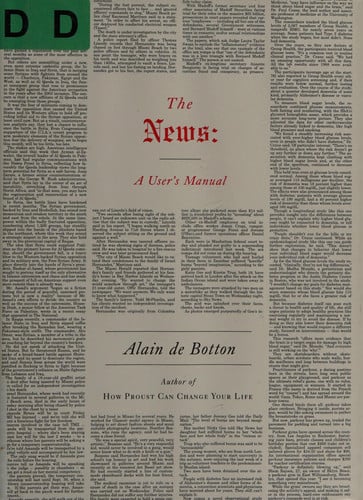
McClelland & Stewart 2014-12-02 272 pages

The Linguist A Personal Guide to Language Learning

Steve Kaufmann
It is now a cliché that the world is a smaller place. We think nothing of jumping on a plane to travel to another country or continent. The most exotic locations are now destinations for mass tourism. Small business people are dealing across frontiers and language barriers like never before. The Internet brings different languages and cultures to our finger-tips. English, the hybrid language of an island at the western extremity of Europe seems to have an unrivalled position as an international medium of communication. But historically periods of cultural and economic domination have never lasted forever. Do we not lose something by relying on the wide spread use of English rather than discovering other languages and cultures? As citizens of this shrunken world, would we not be better off if we were able to speak a few languages other than our own? The answer is obviously yes. Certainly Steve Kaufmann thinks so, and in his busy life as a diplomat and businessman he managed to learn to speak nine languages fluently and observe first hand some of the dominant cultures of Europe and Asia. Why do not more people do the same? In his book The Way of The Linguist, A language learning odyssey, Steve offers some answers. Steve feels anyone can learn a language if they want to. He points out some of the obstacles that hold people back. Drawing on his adventures in Europe and Asia, as a student and businessman, he describes the rewards that come from knowing languages. He relates his evolution as a language learner, abroad and back in his native Canada and explains the kind of attitude that will enable others to achieve second language fluency. Many people have taken on the challenge of language learning but have been frustrated by their lack of success. This book offers detailed advice on the kind of study practices that will achieve language breakthroughs. Steve has developed a language learning system available online at: www.thelinguist.com.
The Linguist 2003 146 pages

Ascent of the A-Word Assholism, the First Sixty Years

Geoffrey Nunberg
It first surfaced in the gripes of GIs during World War II and was captured early on by the typewriter of a young Norman Mailer. Within a generation it had become a basic notion of our everyday moral life, replacing older reproaches like lout and heel with a single inclusive category––a staple of country outlaw songs, Neil Simon plays, and Woody Allen movies. Feminists made it their stock rebuke for male insensitivity, the est movement used it for those who didn’t “get it,” and Dirty Harry applied it evenhandedly to both his officious superiors and the punks he manhandled. The asshole has become a focus of collective fascination for us, just as the phony was for Holden Caulfield and the cad was for Anthony Trollope. From Donald Trump to Ann Coulter, from Mel Gibson to Anthony Weiner, from the reality TV prima donnas to the internet trolls and flamers, assholism has become the characteristic form of modern incivility, which implicitly expresses our deepest values about class, relationships, authenticity, and fairness. We have conflicting attitudes about the A-word––when a presidential candidate unwittingly uttered it on a live mic in 2000, it confirmed to some that he was a man of the people and to others that he was a boor. But considering how much the word does for us, and to us, it hasn’t gotten nearly the attention it deserves––at least until now.
PublicAffairs 2013-06-11 272 pages

Gossip The Untrivial Pursuit

Joseph Epstein
Gossip is no trivial matter; despite its reputation, Epstein argues, it is an eternal and necessary human enterprise. Proving that he himself is a master of the art, Epstein serves up delightful mini-biographies of the Great Gossips of the Western World, along with many choice bits from his own experience. He also makes a powerful case that gossip has morphed from its old-fashioned best--clever, mocking, a great private pleasure--to a corrosive new-school version, thanks to the reach of the mass media and the Internet. Written in his trademark erudite and witty style, Gossip captures the complexity of this immensely entertaining subject.
HarperCollins Publishers 2012-11 256 pages

Live from Downing Street

Robinson, Nick
The Inside Story of Politics, Power and the Media. The relationship between those who wield power and those whose job it is to tell us what they are doing has always been fraught with tension. Politicians now expect to be on camera and facing aggressive questions from the moment they open their front door to the moment they return home at night. Everything they say and do is instantly broadcast and dissected on 24-hour rolling news channels, blogs and Twitter. It was not always this way. "Live from Downing Street" takes us on an absorbing journey through the hard-fought battles for the right to tell the public about the decisions taken on their behalf. Parliament once imprisoned those who dared to report what MPs had said. Broadcasters used to be banned by law from debating anything newsworthy and even from covering elections. Since that censorship ended, the two sides have clashed repeatedly. We follow the fluctuations of the power struggle from Walpole to modern times, dwelling in fascinating detail on those who fought back -- Churchill, Wilson, Thatcher and Blair. At the same time we learn of the emergence of the equally charismatic key players from radio and television: the Dimblebys, Day, Frost, Walden, Paxman and Humphrys. Nick Robinson provides a colourful and personal examination of what life is like as the BBC's Political Editor -- a role described in a report for the White House as 'the most important job in British political journalism'. Peppered with informative but witty anecdotes, his account reveals his own considered view of the controversial issue of impartial reporting. "Live from Downing Street" is a gripping story written by someone uniquely placed to add his own perceptive insights and observations.
Bantam Books (Transworld Publishers a division of the Random House Group) 2013 560 pages