9 results for "Internet"

The Panic Virus Fear, Myth and the Vaccination Debate

Seth Mnookin
In 1998 Andrew Wakefield published a paper containing a shocking allegation- the measles-mumps-rubella vaccine might cause autism. Wakefield based his findings on a study of just a dozen children, and his methods and conclusions immediately came under fire. The media, however, seized on the story - and so helped launch one of the most devastating health scares of modern times. Within months, vaccination rates across the West had started to fall, resulting in deaths from diseases previously thought to be disappearing. Wakefield eventually lost his medical licence, yet the myth that vaccines cause developmental disorders lives on. In The Panic Virus Seth Mnookin examines how the anti-immunisation panic spread and looks at a controversial Australian case that exposed the claims and tactics of the movement to new scrutiny. Sorting fact from rumour, he confronts fundamental questions- with more facts at our fingertips than ever, why is our trust in science so fragile? Has the internet made us better informed, or simply enabled panic to spread more quickly? And how might we balance fact and intuition when it comes to decisions about children's health? The Panic Virus is a riveting and sometimes heartbreaking medical detective story, a gripping work of investigative journalism and a cautionary tale for our times.
Black Incorporated 2011 425 pages

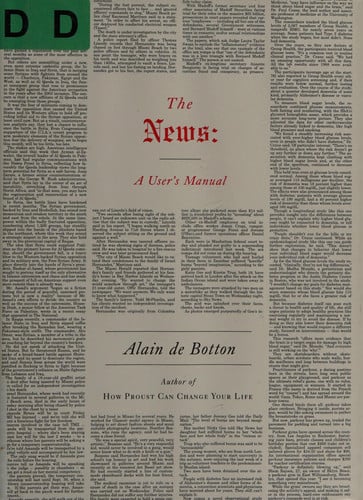
The News A User's Manual

Alain De Botton
From the author of The Architecture of Happiness , a thought-provoking look at the position that news has achieved in our lives. The news is everywhere. We can't stop constantly checking it on our computer screens, but what is this doing to our minds? We are never really taught how to make sense of the torrent of news we face every day, writes Alain de Botton, but this has a huge impact on our sense of what matters and of how we should lead our lives. In his dazzling new book, de Botton takes twenty-five archetypal news stories--including an airplane crash, a murder, a celebrity interview and a political scandal--and submits them to unusually intense analysis with a view to helping us navigate our news-soaked age. He raises such questions as: Why are disaster stories often so uplifting? What makes the love lives of celebrities so interesting? Why do we enjoy watching politicians being brought down? Why are upheavals in far-off lands often so boring? In The News: A User's Manual , de Botton has written the ultimate guide for our frenzied era, certain to bring calm, understanding and a measure of sanity to our daily (perhaps even hourly) interactions with the news machine.
McClelland & Stewart 2014-12-02 272 pages

The Glass Teat Essays

Harlan Ellison
The classic collection of criticism about television and American culture from the late, multi-award-winning legend. From 1968 through 1972, Harlan Ellison penned a series of weekly columns, sharing his uncompromising thoughts about contemporary television programming for the Los Angeles Free Press , a.k.a. "The Freep," a countercultural, underground newspaper. Sitcoms and variety shows, westerns and cop dramas, newscasts and commercials, Ellison left no pixilated stone unturned, expounding on the insipidness, hypocrisy, and malaise found in the glowing images projected into the faces of American audiences. The Glass Teat: Essays of Opinion on the Subject of Television collects fifty-two of Ellison's columns--including his 2011 introduction "Welcome to the Gulag," his unapologetic commentary about how cellphones and the internet have extended television's reach, eroding intelligence and freedom and creating a legion of bloodshot eyed zombies unable to communicate beyond their screens or think for themselves. Provocative and prescient, irreverent and insightful, Ellison's critical analyses of the glowing box that became the center of American life are even more relevant in the twenty-first century. Also available: The Other Glass Teat: Further Essays of Opinion on the Subject of Television
Open Road Integrated Media, Incorporated 2014-06 276 pages

The app generation: how today's youth navigate identity, intimacy, and imagination in a digital world

Gardner, Howard
"No one has failed to notice that the current generation of youth is deeply-some would say totally-involved with digital media. Professors Howard Gardner and Katie Davis name today's young people The App Generation, and in this spellbinding book they explore what it means to be "app-dependent" versus "app-enabled" and how life for this generation differs from life before the digital era. Gardner and Davis are concerned with three vital areas of adolescent life: identity, intimacy, and imagination. Through innovative research, including interviews of young people, focus groups of those who work with them, and a unique comparison of youthful artistic productions before and after the digital revolution, the authors uncover the drawbacks of apps: they may foreclose a sense of identity, encourage superficial relations with others, and stunt creative imagination. On the other hand, the benefits of apps are equally striking: they can promote a strong sense of identity, allow deep relationships, and stimulate creativity. The challenge is to venture beyond the ways that apps are designed to be used, Gardner and Davis conclude, and they suggest how the power of apps can be a springboard to greater creativity and higher aspirations"--
Yale University Press 2013-10-22 244 pages

Gossip The Untrivial Pursuit

Joseph Epstein
Gossip is no trivial matter; despite its reputation, Epstein argues, it is an eternal and necessary human enterprise. Proving that he himself is a master of the art, Epstein serves up delightful mini-biographies of the Great Gossips of the Western World, along with many choice bits from his own experience. He also makes a powerful case that gossip has morphed from its old-fashioned best--clever, mocking, a great private pleasure--to a corrosive new-school version, thanks to the reach of the mass media and the Internet. Written in his trademark erudite and witty style, Gossip captures the complexity of this immensely entertaining subject.
HarperCollins Publishers 2012-11 256 pages

Don't Burn Anyone at the Stake Today

Alderman, Naomi
What’s the most useful thing you could know about your own life? In this era-defining book, developed from her groundbreaking Radio 4 essay series, Naomi Alderman turns her boundless curiosity and incisive thinking to a question that affects us all: how do we understand, and navigate, the epoch we’re living through? She calls this epoch the Information Crisis. The internet has flooded us with more knowledge, opinions, ideas, opportunities, as well as verbal attacks and misinformation, than ever before. It lets us learn more quickly and also spread falsehood more quickly, it brings us together and also divides us in new ways, it is now the lens through which we perceive and understand the world. There is no going back. But we have been here before. In fact, this is humanity’s third information crisis. The first, the invention of writing 5,000 years ago, and the second, the invention of the printing press 600 years ago, drastically reshaped our perceptions, interactions and mental landscapes in ways that feel acutely familiar. Overwhelmed by information, people become afraid and angry, unsettled and distressed, as well as more knowledgeable, educated and curious. By looking at those previous information crises, both the turmoil and the advances, Alderman asks what we can learn from the past to better understand our present, and prepare for our future. Drawing on the work of philosophers and historians, Don’t Burn Anyone at the Stake Today explores how new technology opens up new ways of being and helps us chart a way forward (once again), through the turbulent seas of information overload.[Bokinfo]
Penguin 2026-05-07 224 pages

Inside the Presidential Debates Their Improbable Past and Promising Future

Newton N. Minow,Craig L. LaMay
Newton Minow’s long engagement with the world of television began nearly fifty years ago when President Kennedy appointed him chairman of the Federal Communications Commission. As its head, Minow would famously dub TV a “vast wasteland,” thus inaugurating a career dedicated to reforming television to better serve the public interest. Since then, he has been chairman of PBS and on the board of CBS and elsewhere, but his most lasting contribution remains his leadership on televised presidential debates. He was assistant counsel to Illinois governor Adlai Stevenson when Stevenson first proposed the idea of the debates in 1960; he served as cochair of the presidential debates in 1976 and 1980; and he helped create and is currently vice chairman of the Commission on Presidential Debates, which has organized the debates for the last two decades. Written with longtime collaborator Craig LaMay, this fascinating history offers readers for the first time a genuinely inside look into the origins of the presidential debates and the many battles—both legal and personal—that have determined who has been allowed to debate and under what circumstances. The authors do not dismiss the criticism of the presidential debates in recent years but do come down solidly in favor of them, arguing that they are one of the great accomplishments of modern American electoral politics. As they remind us, the debates were once unique in the democratic world, are now emulated across the globe, and they offer the public the only real chance to see the candidates speak in direct response to one another in a discussion of major social, economic, and foreign policy issues. Looking to the challenges posed by third-party candidates and the emergence of new media such as YouTube, Minow and LaMay ultimately make recommendations for the future, calling for the debates to become less formal, with candidates allowed to question each other and citizens allowed to question candidates directly. They also explore the many ways in which the Internet might serve to broaden the debates’ appeal and informative power. Whether it’s Clinton or Obama vs. McCain, Inside the Presidential Debates will be welcomed in 2008 by anyone interested in where this crucial part of our democracy is headed—and how it got there.
University of Chicago Press 2016-07-28 237 pages

Cultural Forms of Protest in Russia

Birgit Beumers,Alexander Etkind,Olga Gurova,Sanna Turoma
Alongside the Arab Spring, the 'Occupy' anti-capitalist movements in the West, and the events on the Maidan in Kiev, Russia has had its own protest movements, notably the political protests of 2011-12. As elsewhere in the world, these protests had unlikely origins, in Russia's case spearheaded by the 'creative class'. This book examines the protest movements in Russia. It discusses the artistic traditions from which the movements arose; explores the media, including the internet, film, novels, and fashion, through which the protesters have expressed themselves; and considers the outcome of the movements, including the new forms of nationalism, intellectualism, and feminism put forward. Overall, the book shows how the Russian protest movements have suggested new directions for Russian - and global - politics.
Routledge 2019 248 pages