21 results for "Internet"

Irreversible Damage The Transgender Craze Seducing Our Daughters

Abigail Shrier
NAMED ONE OF THE BEST BOOKS OF 2021 BY THE TIMES AND THE SUNDAY TIMES Until just a few years ago, gender dysphoria—severe discomfort in one’s biological sex—was vanishingly rare. It was typically found in less than .01 percent of the population, emerged in early childhood, and afflicted males almost exclusively. But today whole groups of female friends in colleges, high schools, and even middle schools across the country are coming out as “transgender.” These are girls who had never experienced any discomfort in their biological sex until they heard a coming-out story from a speaker at a school assembly or discovered the internet community of trans “influencers.” Unsuspecting parents are awakening to find their daughters in thrall to hip trans YouTube stars and “gender-affirming” educators and therapists who push life-changing interventions on young girls—including medically unnecessary double mastectomies and puberty blockers that can cause permanent infertility. Abigail Shrier, a writer for the Wall Street Journal, has dug deep into the trans epidemic, talking to the girls, their agonized parents, and the counselors and doctors who enable gender transitions, as well as to “detransitioners”—young women who bitterly regret what they have done to themselves. Coming out as transgender immediately boosts these girls’ social status, Shrier finds, but once they take the first steps of transition, it is not easy to walk back. She offers urgently needed advice about how parents can protect their daughters. A generation of girls is at risk. Abigail Shrier’s essential book will help you understand what the trans craze is and how you can inoculate your child against it—or how to retrieve her from this dangerous path.
Skyhorse Publishing 2021-06-29 276 pages

Among The Truthers North America's Growing Conspiracist Undergro

Jonathan Kay
Millions of people around the world have convinced themselves that the perpetrators of 9/11 were not al-Qaeda terrorists but elements within the U.S. government seeking a pretext to launch wars abroad and enact draconian laws at home. These “9/11 Truthers” are not alone. They are part of a vast conspiracist subculture that is spreading like wildfire on the Internet, is deeply distrustful of mainstream media and is beginning to influence mainstream politics. For two years, Canadian journalist Jonathan Kay has been researching the underground world of conspiracy theorists by attending their conventions, infiltrating their Internet discussion boards and surfing their websites. While many individual conspiracy theories seem harmless, even amusing, the phenomenon is doing real damage to the unity and health of North American society. Since the assassination of JFK, conspiracy thinking has proliferated, and the Internet has fostered the growth of numerous alternate mental worlds in which traditional media and academia have no authority. 9/11 was a death blow to this older consensual view of reality, and as a result, North Americans no longer inhabit one cognitive universe. What this means for the future of politics, and our society at large, is the ultimate subject of this book.
HarperCollins 2012-05-08 368 pages

Age of Propaganda: The Everyday Use & Abuse of Persuasion

Anthony Pratkanis,Elliott Aronson
Amer. consume 57% of the world's advertising while representing only 6% of the population, & half of our waking hours are spent immersed in the mass media. Drawing on the history of propaganda as well as on contemporary res. in social psychol., this book shows how the tactics used by political campaigners, sales agents, advertisers, televangelists, demagogues, & others often take advantage of our emotions by appealing to our deepest fears & most irrational hopes, creating a distorted vision of the world we live. This updated ed. includes coverage of the Clinton/Lewinsky scandal, recent election campaigns, talk radio, teen suicide, UFO abductions, the Columbine shootings, & novel propaganda tactics based on hypocrisy & false allegations.
Diane Pub Co 2001-01-01 416 pages

World Without Mind

Franklin Foer
Over the past few decades there has been a revolution in terms of who controls knowledge and information. This rapid change has imperilled the way we think. Without pausing to consider the cost, the world has rushed to embrace the products and services of four titanic corporations. We shop with Amazon; socialise on Facebook; turn to Apple for entertainment; and rely on Google for information. These firms sell their efficiency and purport to make the world a better place, but what they have done instead is to enable an intoxicating level of daily convenience. As these companies have expanded, marketing themselves as champions of individuality and pluralism, their algorithms have pressed us into conformity and laid waste to privacy. They have produced an unstable and narrow culture of misinformation, and put us on a path to a world without private contemplation, autonomous thought, or solitary introspection - a world without mind. In order to restore our inner lives, we must avoid being co-opted by these gigantic companies, and understand the ideas that underpin their success. Elegantly tracing the intellectual history of computer science - from the Descartes and the enlightenment to Alan Turing to Stuart Brand and the hippie origins of today's Silicon Valley - Foer exposes the dark underpinnings of our most idealistic dreams for technology. The corporate ambitions of Google, Facebook, Apple, and Amazon, he argues, are trampling longstanding liberal values, especially intellectual property and privacy. This is a nascent stage in the total automation and homogenization of social, political, and intellectual life. By reclaiming our private authority over how we intellectually engage with the world, we have the power to stem the tide. At stake is nothing less than who we are, and what we will become. There have been monopolists in the past but today's corporate giants have far more nefarious aims. They're monopolists who want access to every facet of our identities and influence over every corner of our decision-making. Until now few have grasped the sheer scale of the threat. Foer explains not just the looming existential crisis but the imperative of resistance.
Jonathan Cape Ltd 2017-09-28 272 pages

Media madness: Donald Trump, the press, and the war over the truth

Kurtz, Howard
"According to the media, Donald Trump could never become president. Now many are on a mission to prove he shouldn't be president. The Trump administration and the press are at war -- and as in any war, the first casualty has been truth. Bestselling author Howard Kurtz, host of Fox News's Media Buzz and former Washington Post columnist, offers a stunning exposé of how supposedly objective journalists, alarmed by Trump's success, have moved into the opposing camp. Kurtz's exclusive, in-depth, behind-the-scenes interviews with reporters, anchors, and insiders within the Trump White House reveal the unprecedented hostility between the media and the president they cover."--Jacket.
Regnery Publishing, a division of Salem Media Group 2018-01-29 288 pages

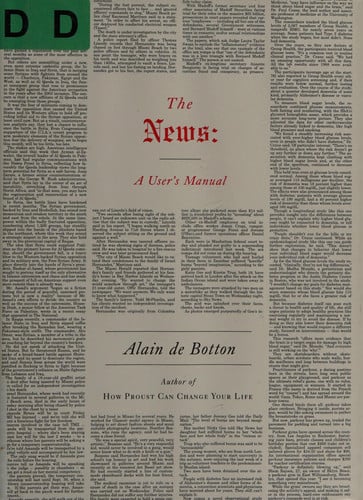
The News A User's Manual

Alain De Botton
From the author of The Architecture of Happiness , a thought-provoking look at the position that news has achieved in our lives. The news is everywhere. We can't stop constantly checking it on our computer screens, but what is this doing to our minds? We are never really taught how to make sense of the torrent of news we face every day, writes Alain de Botton, but this has a huge impact on our sense of what matters and of how we should lead our lives. In his dazzling new book, de Botton takes twenty-five archetypal news stories--including an airplane crash, a murder, a celebrity interview and a political scandal--and submits them to unusually intense analysis with a view to helping us navigate our news-soaked age. He raises such questions as: Why are disaster stories often so uplifting? What makes the love lives of celebrities so interesting? Why do we enjoy watching politicians being brought down? Why are upheavals in far-off lands often so boring? In The News: A User's Manual , de Botton has written the ultimate guide for our frenzied era, certain to bring calm, understanding and a measure of sanity to our daily (perhaps even hourly) interactions with the news machine.
McClelland & Stewart 2014-12-02 272 pages

Rising Out of Hatred The Awakening of a Former White Nationalist

Eli Saslow
From a Pulitzer Prize-winning reporter, the powerful story of how a prominent white supremacist changed his heart and mind. This is a book to help us understand the American moment and to help us better understand one another. "The story of Derek Black is the human being at his gutsy, self-reflecting, revolutionary best, told by one of America's best storytellers at his very best. Rising Out of Hatred proclaims if the successor to the white nationalist movement can forsake his ideological upbringing, can rebirth himself in antiracism, then we can too no matter the personal cost. This book is an inspiration." --Ibram X. Kendi, National Book Award-winning author of Stamped from the Beginning: The Definitive History of Racist Ideas in America Derek Black grew up at the epicenter of white nationalism. His father founded Stormfront, the largest racist community on the Internet. His godfather, David Duke, was a KKK Grand Wizard. By the time Derek turned nineteen, he had become an elected politician with his own daily radio show--already regarded as the the leading light of the burgeoning white nationalist movement. We can infiltrate, Derek once told a crowd of white nationalists. We can take the country back. Then he went to college. At New College of Florida, he continued to broadcast his radio show in secret each morning, living a double life until a classmate uncovered his identity and sent an email to the entire school. Derek Black ... white supremacist, radio host ... New College student The ensuing uproar overtook one of the most liberal colleges in the country. Some students protested Derek's presence on campus, forcing him to reconcile for the first time with the ugliness of his beliefs. Other students found the courage to reach out to him, including an Orthodox Jew who invited Derek to attend weekly Shabbat dinners. It was because of those dinners--and the wide-ranging relationships formed at that table--that Derek started to question the science, history, and prejudices behind his worldview. As white nationalism infiltrated the political mainstream, Derek decided to confront the damage he had done. Rising Out of Hatred tells the story of how white-supremacist ideas migrated from the far-right fringe to the White House through the intensely personal saga of one man who eventually disavowed everything he was taught to believe, at tremendous personal cost. With great empathy and narrative verve, Eli Saslow asks what Derek Black's story can tell us about America's increasingly divided nature.
Diversified Publishing 2018-09-18 368 pages

DarkMarket

Misha Glenny
Shortlisted for the Orwell Prize and the CWA Gold Dagger for Non-Fiction Award The benefits of living in a digital, globalised society are enormous; so too are the dangers. The world has become a law enforcer's nightmare and every criminal's dream. We bank online, shop online, date, learn, work and live online. But have the institutions that keep us safe on the streets learned to protect us in the burgeoning digital world?Ê Have we become complacent about our personal security Ñ sharing our thoughts, beliefs and the details of our daily lives with anyone who cares to relieve us of them? In this fascinating and compelling book, Misha Glenny, author of the international bestseller McMafia, explores the three fundamental threats facing us in the twenty-first century: cyber crime, cyber warfare and cyber industrial espionage. Governments and the private sector are losing billions of dollars each year, fighting an ever-morphing, often invisible, and highly intelligent new breed of criminal: the hacker. Glenny has travelled and trawled the world. And by exploring the rise and fall of the criminal website, DarkMarket, he has uncovered the most vivid, alarming and illuminating stories.ÊWhether JiLsi or Matrix, Iceman, Master Splynter or Lord Cyric; whether Detective Sergeant Chris Dawson in Bolton or Agent Keith Mularski in Pittsburgh, Glenny has tracked down and interviewed all the players Ñ the criminals, the geeks, the police, the security experts and the victims Ñ and he places everyone and everything in a rich brew of politics, economics and history. The result is simply unputdownable. DarkMarketis authoritative and completely engrossing. It's a must-read for everyone who uses a computer: the essential crime book for our times.
House of Anansi 2011-09-20 320 pages

Vote.com Influence, and the Internet is Giving Power Back to the People

Dick Morris
As the print and broadcast media-commonly referred to as the Fourth Estate-falters and fails, a new social and political force is rising in power. The Fifth Estate, as Morris has dubbed it, is made up of the rapidly growing number of voters who use Internet technology. This army of younger citizens with easy access to information and a direct link to their representatives heralds a new dawning of democracy, putting political power back into the hands of the people.
St. Martin's Press 2000-09-16 256 pages

Loomered How I Became the Most Banned Woman in the World

Laura Loomer
Laura Loomer is the most banned woman in America. An investigative journalist, activist, and truth-teller who has earned many powerful enemies in Silicon Valley and the media, Loomer has been banned from Facebook, Twitter, Instagram, Uber, Lyft, Uber Eats, PayPal, Venmo, GoFundMe, Periscope, Medium, and TeeSpring…so far. Loomer works tirelessly for Americans banned from essential online services for having the wrong political opinions. In addition to filing lawsuits against the companies that have wrongfully ostracized and defamed her, she is running for Congress in Florida’s 21st District. This is her story.
Bombardier Books 2021-10-19 408 pages

Humanity on a Tightrope Thoughts on Empathy, Family, and Big Changes for a Viable Future

Paul R. Ehrlich,Robert E. Ornstein
When we think of family, we most often think of our sisters and brothers, our cousins and grandparents, rather than our world family or even our community connections. We still identify with our differences more than our similarities, unless it's convenient to do otherwise. Here, two seasoned authors tackle the question of family and what it means to us now and how it might change to help us address the problems that affect us all. Using specific examples throughout the work, they present a unique approach to what it means to belong to one human family. Beginning with a consideration of how the family unit has begun to be defined by allegiances, by common ties and empathy, the authors then discuss the evolution of the family unit and how the "us" vs. "them" mentality gave way to a way of life that separated peoples rather than brought them together. They consider family values, how they arose, developed, were perverted or perfected to suit the family unit's needs, and the confusion that followed. Humanity on a Tightrope focuses on what families and family values are, and how they often create an "us versus them" mentality that is at the root of many of today's most crucial problems from terrorism, racism, and war to the failure of humanity to come to grips with potentially lethal global environmental problems. The book underlines a basic element for solving the human predicament - quickly spreading the domain of empathy. It takes a close look at how we can do that, building on the findings of both social and natural science and using tools ranging from brain imaging to the internet. It explains how civilization is unlikely to persist unless many more people learn to put themselves in the shoes of others to keep society balancing on the tightrope to sustainability - a tightrope suspended over the collapse of civilization.
Bloomsbury Academic 2012-03-16 210 pages

The Jewish Defense Organization's A History of Islamist Terrorism in America

Jewish Organization
Secret history of Islamist terrorism in America from Sirhan Sirhan to Major Hasan and how the JDO fights it. The JDO was founded in March 1982 in reaction to the demise of the Jewish Defense League (JDL). The JDO was never and never will be a Kahanist organization; instead it is based on principles first set forth by the Honorable Zev Jabotinsky, the founder of Revisionist Zionism. Jabotinsky, poet, statesman and militarist told Jewish audiences prior to the Holocaust to leave Europe. In 2010 JDO was able to get a meeting of the American Renaissance Party that was to be held at the Skyline Motel in Washington, D.C. cancelled despite the insistence of its manager that it take place. In February 2011 JDO quashed another meeting of this racist group with the help of the NAACP and City Council members Patrick Cannon and Councilman Warren Turner. These men had enough self-respect to stop these KKK jackasses from spewing their racial-hatred in Charlotte, North Carolina. Look what happened in Greensboro, North Carolina in 1979 when the Klan mowed down a "Death to the Klan" march staged by Communists. Declassified FBI documents revealed that JDO Chairman Mordechai Levy warned the FBI that the Klan was planning a violent attack but his intelligence was ignored due to his status as a Jewish militant. Just the opposite should have been true. In March 2011 the JDO was able to convince the landlord of the the Nazi-Holocaust revisionist scumy group The Institute of Historical Review not to renew their lease. In May 2011 the JDO held a demonstration in front of Nazi Headquarters on the Upper East Side of Manhattan. These are our latest actions - we've been staging these events and others for years and years. It is from this militant / activist point of view that the JDO research team studied the history of Islamist terrorism on American soil within certain parameters of interest. Rather than using a shotgun approach we zeroed in on terrorist plots in which bombs were actually constructed or shots were fired and excluded numerous conspiracies that the FBI nipped in the bud. Our researchers obtained the documents from every terrorism court case in the United States, conducted interviews, scoured the Internet in all languages, studied declassified government documents, filed FOIA requests then put the puzzle pieces together. We even collected the trash in front of the Permanent Observer Mission of Palestine to the United Nations at 115 East 65th Street in Manhattan and discovered cable traffic that indicated the PLO was using Syrian diplomatic pouches to smuggle bomb parts to various locations throughout the world. JDO turned these cables over to Israeli intelligence who cautioned JDO not to reveal its methodology as it was going to be applied to other hostile diplomatic installations. JDO waited for a year before revealing its discovery on local television. Shortly thereafter a car with two Arabic looking men parked outside JDO headquarters at 6 Bleecker Street in Manhattan. A JDO member displayed his semi-auto Uzi and invited the thugs upstairs. It was just another day in the 1980's at JDO Headquarters.
Jewish Defense Organization Press 2011 465 pages

Inside the Presidential Debates Their Improbable Past and Promising Future

Newton N. Minow,Craig L. LaMay
Newton Minow’s long engagement with the world of television began nearly fifty years ago when President Kennedy appointed him chairman of the Federal Communications Commission. As its head, Minow would famously dub TV a “vast wasteland,” thus inaugurating a career dedicated to reforming television to better serve the public interest. Since then, he has been chairman of PBS and on the board of CBS and elsewhere, but his most lasting contribution remains his leadership on televised presidential debates. He was assistant counsel to Illinois governor Adlai Stevenson when Stevenson first proposed the idea of the debates in 1960; he served as cochair of the presidential debates in 1976 and 1980; and he helped create and is currently vice chairman of the Commission on Presidential Debates, which has organized the debates for the last two decades. Written with longtime collaborator Craig LaMay, this fascinating history offers readers for the first time a genuinely inside look into the origins of the presidential debates and the many battles—both legal and personal—that have determined who has been allowed to debate and under what circumstances. The authors do not dismiss the criticism of the presidential debates in recent years but do come down solidly in favor of them, arguing that they are one of the great accomplishments of modern American electoral politics. As they remind us, the debates were once unique in the democratic world, are now emulated across the globe, and they offer the public the only real chance to see the candidates speak in direct response to one another in a discussion of major social, economic, and foreign policy issues. Looking to the challenges posed by third-party candidates and the emergence of new media such as YouTube, Minow and LaMay ultimately make recommendations for the future, calling for the debates to become less formal, with candidates allowed to question each other and citizens allowed to question candidates directly. They also explore the many ways in which the Internet might serve to broaden the debates’ appeal and informative power. Whether it’s Clinton or Obama vs. McCain, Inside the Presidential Debates will be welcomed in 2008 by anyone interested in where this crucial part of our democracy is headed—and how it got there.
University of Chicago Press 2016-07-28 237 pages

Cultural Forms of Protest in Russia

Birgit Beumers,Alexander Etkind,Olga Gurova,Sanna Turoma
Alongside the Arab Spring, the 'Occupy' anti-capitalist movements in the West, and the events on the Maidan in Kiev, Russia has had its own protest movements, notably the political protests of 2011-12. As elsewhere in the world, these protests had unlikely origins, in Russia's case spearheaded by the 'creative class'. This book examines the protest movements in Russia. It discusses the artistic traditions from which the movements arose; explores the media, including the internet, film, novels, and fashion, through which the protesters have expressed themselves; and considers the outcome of the movements, including the new forms of nationalism, intellectualism, and feminism put forward. Overall, the book shows how the Russian protest movements have suggested new directions for Russian - and global - politics.
Routledge 2019 248 pages

The Blogging Revolution

Antony Loewenstein
The Blogging Revolution is a colourful and revelatory account of bloggers around the globe who live and write under repressive regimes-many of them risking their lives in doing so. Antony Loewenstein's travels take him to private parties in Iran and Egypt, internet cafes in Saudi Arabia and Damascus, to the homes of Cuban dissidents and into newspaper offices in Beijing, where he discovers the ways in which the internet is threatening the rule of governments. Through first-hand investigations, he reveals the complicity of Western multinationals in assisting the restriction of information in these countries and how bloggers are leading the charge for change. This fully updated new edition of the book reveals some of the key players of the Arab Spring and how years of organising, web dissent and bravery led to momentous changes in US-backed dictatorships across the Middle East. The Blogging Revolution is a superb examination about the nature of repression in the twenty-first century and the power of brave individuals to overcome it.
CreateSpace Independent Publishing Platform 2016-07-15 326 pages

The Truth about the Forged Protocols of The Elders of Zion

Lucien Wolf
The Protocols of the Elders of Zion or The Protocols of the Meetings of the Learned Elders of Zion is an antisemitic fabricated text purporting to describe a Jewish plan for global domination. The forgery was first published in Russia in 1903, translated into multiple languages, and disseminated internationally in the early part of the 20th century. According to the claims made by some of its publishers, the Protocols are the minutes of a late 19th-century meeting where Jewish leaders discussed their goal of global Jewish hegemony by subverting the morals of Gentiles, and by controlling the press and the world's economies. Henry Ford funded printing of 500,000 copies that were distributed throughout the US in the 1920s. Adolf Hitler was a major proponent. It was studied, as if factual, in German classrooms after the Nazis came to power in 1933, despite having been exposed as fraudulent by The Times of London in 1921. It is still widely available today in numerous languages, in print and on the Internet, and continues to be presented by some proponents as a genuine document.
CreateSpace Independent Publishing Platform 2016-05-12 50 pages

Beyond the Cold War Soviet and American Media Images

Everette E. Dennis,George Gerbner,Yassen N. Zassoursky
Beyond the Cold War represents the first-ever attempt by media scholars and journalists to dissect the Cold War by examining mutual media images in the United States and the former Soviet Union. The result of a bilateral conference in Moscow in 1989, this volume offers an original journalistic assessment of the Cold War and its aftermath as a communications phenomenon. Discussions include the past and present state of Cold War rhetoric, the portrayal of Russians and Americans on television in the two countries, and images of self and other as portrayed by the two media.
Books on Demand 180 pages

Triumph of the Market

Edward Herman
**** The third edition (1990) is cited in Brandon-Hill. A text that focuses on the decision-making process which precedes and governs the selection of treatment of various pediatric orthopedic conditions. Each author provides the basic science that relates to the condition under discussion and the scientific basis for treatment decisions. This revised and updated edition is also completely reorganized, adding a second editor and 16 new authors. New chapters deal with orthopedic genetics, history taking and examination of the pediatric patient, syndromes and localized disorders affecting bone, neuromuscular disorders, and fracture treatment, a major portion of pediatric orthopedic practice. Thoroughly illustrated in bandw. Annotation copyright by Book News, Inc., Portland, OR
Black Rose Books Ltd. 1997-02-04 276 pages

Hope How Would You Feel If You No Longer Feared Your Government...?

Aaron S. Zelman,L. Neil Smith
What would you do first if you were elected President of the United States? Hope is the story of Alexander Hope, a young American who comes back from Vietnam, falls in love with a bright, beautiful girl, and with her starts a pioneering computer business. Thirty years later he's a billionaire, and alone in life. He decides to leave behind everything he created to write books and teach history at a private college. A handful of admiring students half-jokingly enlist him as a candidate for a third party Presidential nomination. In an astonishing but plausible scenario, Hope wins the Presidency, and commences an ambitious program of enforcing the Constitution and Bill of Rights as they were written. Enemies arise from all sides aiming to obstruct, discredit, impeach, and even assassinate him. It's a story of one man's love for his country -- and for the principles that brought it into being -- for his family, for his friends, and especially for the lovely and brilliant young Internet reporter who believes in him. 440 pages.
Jews For The Preservation of Firearms Ownership, Incorporated 2001 440 pages