3 results for "Internet"

Never again? the threat of the new anti-Semitism

Foxman, Abraham H.
Responding to what is perceived as the reemergence of worldwide antisemitism from 1998-99, and especially from 2000, surveys the new outbreak of this spiritual and psychological illness now thriving globally. After discussing the history of Christian antisemitism and modern racism, proceeds to illuminate aspects of antisemitism in America (on the political and religious Right, among Blacks, and in popular culture), as well as Islamic fundamentalism and antisemitism in the Arab press. Clarifies how racists, including antisemites, exploit the Internet. Foxman also relates his experiences as a hidden child during the Holocaust, and his activities as head of the Anti-Defamation League.
HarperSanFrancisco 2003-10-21 305 pages

The deadliest lies: the Israel lobby and the myth of Jewish control

Foxman, Abraham H.
While the special relationship of all ethnic and religious minorities in the USA with their old countries and the existence of their pressure groups is regarded as normal, the support given by U.S. Jews to Israel and the pro-Israeli lobby causes some Americans to view the Jews as disloyal to the USA. Examines the "paper" by John J. Mearsheimer and Stephen M. Walt, "The Israeli Lobby and U.S. Foreign Policy" (first published in 2006 on the Internet and then in the "London Review of Books"; an expanded book appeared later, in 2007). The authors contend that U.S. support of Israel is harmful to American interests, and is due to pressure exerted by a mighty Israel Lobby which acts to the detriment of the state. They argue that the Israel Lobby had a crucial part in the decision to attack Iraq in 2003. Notes that despite the academic style of their paper, Mearsheimer and Walt have revived the myths of a Jewish conspiracy, of Jewish control of the mass media, and of a Jewish secret power. Dwells, also, on the Tony Judt affair. In 2006 Judt, who supported Mearsheimer and Walt, was to deliver a lecture on a binational alternative for Israel. His lecture was cancelled, which he ascribed to pressure by the Anti-Defamation League. Supporters of Mearsheimer and Walt used it as a demonstration of the Israel Lobby's intervention. Criticizes Jimmy Carter's book "Palestine: Peace Not Apartheid" (2006) for its clear anti-Israel bias.
Palgrave Macmillan 2007-09-04 256 pages

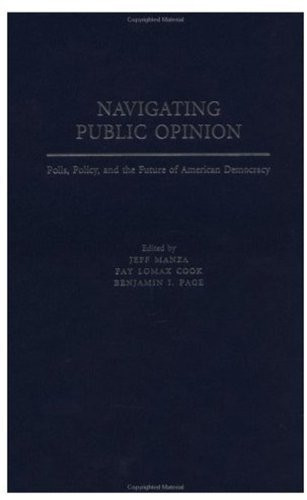
Navigating public opinion: polls, policy, and the future of American democracy

Professor of Sociology Jeff Manza,Jeff Manza,Fay Lomax Cook,Professor of Human Development and Social Policy in the School of Education and Social Policy Fay Lomax Cook,Benjamin I. Page,Gordon Scott Fulcher Professor of Decision Making in the Department of Political Science Benjamin I Page
Do politicians listen to the public? How often and when? Or are the views of the public manipulated or used strategically by political and economic elites? Navigating Public Opinion brings together leading scholars of American politics to assess and debate these questions. It describes how the relationship between opinion and policy has changed over time; how key political actors use public opinion to formulate domestic and foreign policy; and how new measurement techniques might improve our understanding of public opinion in contemporary polling and survey research. The distinguished contributors shed new light on several long-standing controversies over policy responsiveness to public opinion. Featuring a new analysis by Robert Erikson, Michael MacKuen, and James Stimson that builds from their pathbreaking work on how public mood moves policy in a macro-model of policymaking, the volume also includes several critiques of this model by Lawrence Jacobs and Robert Shapiro, another critique by G. William Domhoff, and a rejoinder by Erikson and his coauthors. Other highlights include discussions of how political elites, including state-level policymakers, presidents, and makers of foreign policy, use (or shape) public opinion; and analyses of new methods for measuring public opinion such as survey-based experiments, probabilistic polling methods, non-survey-based measures of public opinion, and the potential and limitations of Internet polls and surveys. Introductory and concluding essays provide useful background context and offer an authoritative summary of what is known about how public opinion influences public policy. A must-have for all students of American politics, public opinion, and polling, this state-of-the-art collection addresses issues that lie at the heart of democratic governance today.
Oxford University Press 2002 376 pages