24 results for "Internet"

Irreversible Damage The Transgender Craze Seducing Our Daughters

Abigail Shrier
NAMED ONE OF THE BEST BOOKS OF 2021 BY THE TIMES AND THE SUNDAY TIMES Until just a few years ago, gender dysphoria—severe discomfort in one’s biological sex—was vanishingly rare. It was typically found in less than .01 percent of the population, emerged in early childhood, and afflicted males almost exclusively. But today whole groups of female friends in colleges, high schools, and even middle schools across the country are coming out as “transgender.” These are girls who had never experienced any discomfort in their biological sex until they heard a coming-out story from a speaker at a school assembly or discovered the internet community of trans “influencers.” Unsuspecting parents are awakening to find their daughters in thrall to hip trans YouTube stars and “gender-affirming” educators and therapists who push life-changing interventions on young girls—including medically unnecessary double mastectomies and puberty blockers that can cause permanent infertility. Abigail Shrier, a writer for the Wall Street Journal, has dug deep into the trans epidemic, talking to the girls, their agonized parents, and the counselors and doctors who enable gender transitions, as well as to “detransitioners”—young women who bitterly regret what they have done to themselves. Coming out as transgender immediately boosts these girls’ social status, Shrier finds, but once they take the first steps of transition, it is not easy to walk back. She offers urgently needed advice about how parents can protect their daughters. A generation of girls is at risk. Abigail Shrier’s essential book will help you understand what the trans craze is and how you can inoculate your child against it—or how to retrieve her from this dangerous path.
Skyhorse Publishing 2021-06-29 276 pages

Ten Arguments for Deleting Your Social Media Accounts Right Now

Jaron Lanier
AS SEEN IN THE NETFLIX DOCUMENTARY THE SOCIAL DILEMMA A WIRED " ALL-TIME FAVORITE BOOK" A FINANCIAL TIMES BEST BOOK "THE CONSCIENCE OF SILICON VALLEY"- GQ “Profound . . . Lanier shows the tactical value of appealing to the conscience of the individual. In the face of his earnest argument, I felt a piercing shame about my own presence on Facebook. I heeded his plea and deleted my account.” - Franklin Foer, The New York Times Book Review “Mixes prophetic wisdom with a simple practicality . . . Essential reading.” - The New York Times (Summer Reading Preview) You might have trouble imagining life without your social media accounts, but virtual reality pioneer Jaron Lanier insists that we’re better off without them. In Ten Arguments for Deleting Your Social Media Accounts Right Now , Lanier, who participates in no social media, offers powerful and personal reasons for all of us to leave these dangerous online platforms. Lanier’s reasons for freeing ourselves from social media’s poisonous grip include its tendency to bring out the worst in us, to make politics terrifying, to trick us with illusions of popularity and success, to twist our relationship with the truth, to disconnect us from other people even as we are more “connected” than ever, to rob us of our free will with relentless targeted ads. How can we remain autonomous in a world where we are under continual surveillance and are constantly being prodded by algorithms run by some of the richest corporations in history that have no way of making money other than being paid to manipulate our behavior? How could the benefits of social media possibly outweigh the catastrophic losses to our personal dignity, happiness, and freedom? Lanier remains a tech optimist, so while demonstrating the evil that rules social media business models today, he also envisions a humanistic setting for social networking that can direct us toward a richer and fuller way of living and connecting with our world.
Picador 2019-08-27 176 pages

Among The Truthers North America's Growing Conspiracist Undergro

Jonathan Kay
Millions of people around the world have convinced themselves that the perpetrators of 9/11 were not al-Qaeda terrorists but elements within the U.S. government seeking a pretext to launch wars abroad and enact draconian laws at home. These “9/11 Truthers” are not alone. They are part of a vast conspiracist subculture that is spreading like wildfire on the Internet, is deeply distrustful of mainstream media and is beginning to influence mainstream politics. For two years, Canadian journalist Jonathan Kay has been researching the underground world of conspiracy theorists by attending their conventions, infiltrating their Internet discussion boards and surfing their websites. While many individual conspiracy theories seem harmless, even amusing, the phenomenon is doing real damage to the unity and health of North American society. Since the assassination of JFK, conspiracy thinking has proliferated, and the Internet has fostered the growth of numerous alternate mental worlds in which traditional media and academia have no authority. 9/11 was a death blow to this older consensual view of reality, and as a result, North Americans no longer inhabit one cognitive universe. What this means for the future of politics, and our society at large, is the ultimate subject of this book.
HarperCollins 2012-05-08 368 pages

The Panic Virus Fear, Myth and the Vaccination Debate

Seth Mnookin
In 1998 Andrew Wakefield published a paper containing a shocking allegation- the measles-mumps-rubella vaccine might cause autism. Wakefield based his findings on a study of just a dozen children, and his methods and conclusions immediately came under fire. The media, however, seized on the story - and so helped launch one of the most devastating health scares of modern times. Within months, vaccination rates across the West had started to fall, resulting in deaths from diseases previously thought to be disappearing. Wakefield eventually lost his medical licence, yet the myth that vaccines cause developmental disorders lives on. In The Panic Virus Seth Mnookin examines how the anti-immunisation panic spread and looks at a controversial Australian case that exposed the claims and tactics of the movement to new scrutiny. Sorting fact from rumour, he confronts fundamental questions- with more facts at our fingertips than ever, why is our trust in science so fragile? Has the internet made us better informed, or simply enabled panic to spread more quickly? And how might we balance fact and intuition when it comes to decisions about children's health? The Panic Virus is a riveting and sometimes heartbreaking medical detective story, a gripping work of investigative journalism and a cautionary tale for our times.
Black Incorporated 2011 425 pages

World Without Mind

Franklin Foer
Over the past few decades there has been a revolution in terms of who controls knowledge and information. This rapid change has imperilled the way we think. Without pausing to consider the cost, the world has rushed to embrace the products and services of four titanic corporations. We shop with Amazon; socialise on Facebook; turn to Apple for entertainment; and rely on Google for information. These firms sell their efficiency and purport to make the world a better place, but what they have done instead is to enable an intoxicating level of daily convenience. As these companies have expanded, marketing themselves as champions of individuality and pluralism, their algorithms have pressed us into conformity and laid waste to privacy. They have produced an unstable and narrow culture of misinformation, and put us on a path to a world without private contemplation, autonomous thought, or solitary introspection - a world without mind. In order to restore our inner lives, we must avoid being co-opted by these gigantic companies, and understand the ideas that underpin their success. Elegantly tracing the intellectual history of computer science - from the Descartes and the enlightenment to Alan Turing to Stuart Brand and the hippie origins of today's Silicon Valley - Foer exposes the dark underpinnings of our most idealistic dreams for technology. The corporate ambitions of Google, Facebook, Apple, and Amazon, he argues, are trampling longstanding liberal values, especially intellectual property and privacy. This is a nascent stage in the total automation and homogenization of social, political, and intellectual life. By reclaiming our private authority over how we intellectually engage with the world, we have the power to stem the tide. At stake is nothing less than who we are, and what we will become. There have been monopolists in the past but today's corporate giants have far more nefarious aims. They're monopolists who want access to every facet of our identities and influence over every corner of our decision-making. Until now few have grasped the sheer scale of the threat. Foer explains not just the looming existential crisis but the imperative of resistance.
Jonathan Cape Ltd 2017-09-28 272 pages

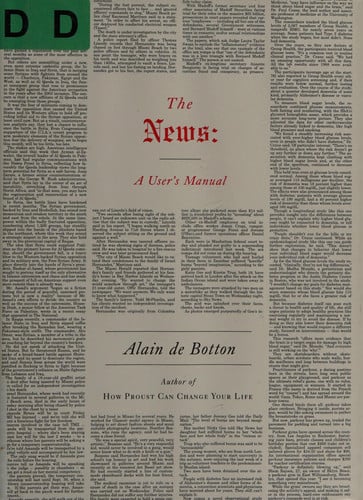
The News A User's Manual

Alain De Botton
From the author of The Architecture of Happiness , a thought-provoking look at the position that news has achieved in our lives. The news is everywhere. We can't stop constantly checking it on our computer screens, but what is this doing to our minds? We are never really taught how to make sense of the torrent of news we face every day, writes Alain de Botton, but this has a huge impact on our sense of what matters and of how we should lead our lives. In his dazzling new book, de Botton takes twenty-five archetypal news stories--including an airplane crash, a murder, a celebrity interview and a political scandal--and submits them to unusually intense analysis with a view to helping us navigate our news-soaked age. He raises such questions as: Why are disaster stories often so uplifting? What makes the love lives of celebrities so interesting? Why do we enjoy watching politicians being brought down? Why are upheavals in far-off lands often so boring? In The News: A User's Manual , de Botton has written the ultimate guide for our frenzied era, certain to bring calm, understanding and a measure of sanity to our daily (perhaps even hourly) interactions with the news machine.
McClelland & Stewart 2014-12-02 272 pages

Give Me Everything You Have On Being Stalked

James Lasdun
A TRUE STORY OF OBSESSIVE LOVE TURNING TO OBSESSIVE HATE IN THE CRUCIBLE OF THE DIGITAL AGE Give Me Everything You Have chronicles author James Lasdun's strange and harrowing ordeal at the hands of a former student, a self-styled "verbal terrorist," who began trying, in her words, to "ruin him." Hate mail, online postings, and public accusations of plagiarism and sexual misconduct were her weapons of choice and, as with more conventional terrorist weapons, proved remarkably difficult to combat. James Lasdun's account, while terrifying, is told with compassion and humor, and brilliantly succeeds in turning a highly personal story into a profound meditation on subjects as varied as madness, race, Middle East politics, and the meaning of honor and reputation in the Internet age.
Macmillan 2014-02-04 224 pages

Rising Out of Hatred The Awakening of a Former White Nationalist

Eli Saslow
From a Pulitzer Prize-winning reporter, the powerful story of how a prominent white supremacist changed his heart and mind. This is a book to help us understand the American moment and to help us better understand one another. "The story of Derek Black is the human being at his gutsy, self-reflecting, revolutionary best, told by one of America's best storytellers at his very best. Rising Out of Hatred proclaims if the successor to the white nationalist movement can forsake his ideological upbringing, can rebirth himself in antiracism, then we can too no matter the personal cost. This book is an inspiration." --Ibram X. Kendi, National Book Award-winning author of Stamped from the Beginning: The Definitive History of Racist Ideas in America Derek Black grew up at the epicenter of white nationalism. His father founded Stormfront, the largest racist community on the Internet. His godfather, David Duke, was a KKK Grand Wizard. By the time Derek turned nineteen, he had become an elected politician with his own daily radio show--already regarded as the the leading light of the burgeoning white nationalist movement. We can infiltrate, Derek once told a crowd of white nationalists. We can take the country back. Then he went to college. At New College of Florida, he continued to broadcast his radio show in secret each morning, living a double life until a classmate uncovered his identity and sent an email to the entire school. Derek Black ... white supremacist, radio host ... New College student The ensuing uproar overtook one of the most liberal colleges in the country. Some students protested Derek's presence on campus, forcing him to reconcile for the first time with the ugliness of his beliefs. Other students found the courage to reach out to him, including an Orthodox Jew who invited Derek to attend weekly Shabbat dinners. It was because of those dinners--and the wide-ranging relationships formed at that table--that Derek started to question the science, history, and prejudices behind his worldview. As white nationalism infiltrated the political mainstream, Derek decided to confront the damage he had done. Rising Out of Hatred tells the story of how white-supremacist ideas migrated from the far-right fringe to the White House through the intensely personal saga of one man who eventually disavowed everything he was taught to believe, at tremendous personal cost. With great empathy and narrative verve, Eli Saslow asks what Derek Black's story can tell us about America's increasingly divided nature.
Diversified Publishing 2018-09-18 368 pages

Content

Cory Doctorow
Readers will discover how America chose Happy Meal toys over copyright, why Facebook is taking a faceplant, how the Internet is basically just a giant Xerox machine, why Wikipedia is a poor cousin of The Hitchhikers Guide to the Galaxy, and how to enjoy free e-books. Notice: This Book is published by Historical Books Limited (www.publicdomain.org.uk) as a Public Domain Book, if you have any inquiries, requests or need any help you can just send an email to [email protected] This book is found as a public domain and free book based on various online catalogs, if you think there are any problems regard copyright issues please contact us immediately via [email protected]
CreateSpace Independent Publishing Platform 2016-04-18 180 pages

Learning to drive: and other life stories

Pollitt, Katha
Learning to Drive • Now a major motion picture starring Patricia Clarkson and Ben Kingsley Celebrated for her award-winning political columns, criticism, and poetry, Katha Pollitt now shows us another side of her talent. Learning to Drive is a surprising, revealing, and entertaining collection of essays drawn from the author’s own life. With deep feeling and sharp insight, Pollitt writes about the death of her father; the sad but noble final days of a leftist study group of which she was a member; and the betrayal and heartbreak inflicted by a man who seriously deceived her. (Her infinitely patient, gentle driving instructor points out her weakness—“Observation, Katha, observation!”) She also offers a candid view of her preoccupation with her ex-lover’s haunting presence on the Internet, and her search there for a secret link that might provide a revelation about him that will Explain Everything. Other topics include the differences between women and men—“More than half the male members of the Donner party died of cold and starvation, but three quarters of the females survived, saved by that extra layer of fat we spend our lives trying to get rid of”—and the practical implications of political theory: “What if socialism—all that warmhearted folderol about community and solidarity and sharing was just an elaborate con job, a way for men to avoid supporting their kids?” Learning to Drive demonstrates that while Katha Pollitt is undeniably one of our era’s most profound observers of culture, society, and politics, she is just as impressively a wise, graceful, and honest observer of her own and others’ human nature. Praise for Learning to Drive “The kind of book you want to look up from at points so you can read aloud certain passages to a friend or lover.” — Chicago Tribune “A powerful personal narrative . . . full of insight and charm . . . Pollitt is her own Jane Austen character . . . haughty and modest, moral and irresponsible, sensible and, happily for us, lost in sensibility.” — The New York Review of Books “With . . . bracing self-honesty, Pollitt takes us through the maddening swirl of contradictions at the heart of being fifty-something: the sense of slowing down, of urgency, of wisdom, of ignorance, of strength, of helplessness, of breakdown, of renewal.” — The Seattle Times “Essays of breathtaking candor and razor-sharp humor . . . [Pollitt] has outdone herself. . . . [Her] observations are acute and her confessions tonic. Forget face-lifts; Pollitt’s essays elevate the spirit.” — Booklist (starred review)
Random House Trade Paperbacks 2008-09-09 207 pages

The Glass Teat Essays

Harlan Ellison
The classic collection of criticism about television and American culture from the late, multi-award-winning legend. From 1968 through 1972, Harlan Ellison penned a series of weekly columns, sharing his uncompromising thoughts about contemporary television programming for the Los Angeles Free Press , a.k.a. "The Freep," a countercultural, underground newspaper. Sitcoms and variety shows, westerns and cop dramas, newscasts and commercials, Ellison left no pixilated stone unturned, expounding on the insipidness, hypocrisy, and malaise found in the glowing images projected into the faces of American audiences. The Glass Teat: Essays of Opinion on the Subject of Television collects fifty-two of Ellison's columns--including his 2011 introduction "Welcome to the Gulag," his unapologetic commentary about how cellphones and the internet have extended television's reach, eroding intelligence and freedom and creating a legion of bloodshot eyed zombies unable to communicate beyond their screens or think for themselves. Provocative and prescient, irreverent and insightful, Ellison's critical analyses of the glowing box that became the center of American life are even more relevant in the twenty-first century. Also available: The Other Glass Teat: Further Essays of Opinion on the Subject of Television
Open Road Integrated Media, Incorporated 2014-06 276 pages

The Hurried Child

David Elkind
With the first edition of The Hurried Child, David Elkind emerged as the voice of parenting reason, calling our attention to the crippling effects of hurrying our children through life. He showed that by blurring the boundaries of what is age appropriate, by expecting--or imposing--too much too soon, we force our kids to grow up too fast, to mimic adult sophistication while secretly yearning for innocence. In the more than two decades since this book first appeared, new generations of parents have inadvertently stepped up the assault on childhood, in the media, in schools, and at home. In the third edition of this classic (2001), Dr. Elkind provided a detailed, up-to-the-minute look at the Internet, classroom culture, school violence, movies, television, and a growing societal incivility to show parents and teachers where hurrying occurs and why. And as before, he offered parents and teachers insight, advice, and hope for encouraging healthy development while protecting the joy and freedom of childhood. In this twenty-fifth anniversary edition of the book, Dr. Elkind delivers important new commentary to put a quarter century of trends and change into perspective for parents today.
ReadHowYouWant.com 2010-09-07 424 pages

One Child at a Time The Global Fight to Rescue Children from Online Predators

Julian Sher
From a renowned investigative reporter, the true story behind a horrifying Internet abuse epidemic - and the heroes who are out to stop it. The Internet has helped make child abuse terrifyingly common - it is the new face of crime in the 21st century. There are tens, probably hundreds of thousands of children whose sexual abuse has been electronically recorded and distributed on the Internet. As Julian Sher reveals, the men perpetrating these crimes include lawyers, priests, doctors and politicians. They pick their victims from the streets of Bangkok to Boy Scout troops in England, while the police - from a crack image analyst with the Toronto police to an FBI agent who poses as a thirteen-year-old girl online - work desperately to nab the predators. One Child at a Time goes behind the headlines to show how law officers are fighting back against this tide of abuse, from daring rescues in homes to the seizures of millions of dollars in the offshore bank accounts of the porn merchants. In riveting detail, Julian Sher shows how clue by clue, and image by image, investigators are using cutting edge tools, turning the technology of the Internet against the perpetrators as they race to find and rescue the victims - children who otherwise have no voice. This important book explores the ramifications of a worldwide struggle, from the need for updated legal powers to the unexpected effects the Internet has had on our social fabric. It also includes a full list of resources for concerned parents. Though sometimes harrowing, One Child at a Time is alsoinspiring - and never less than absolutely relevant. In their efforts to rescue the child victims of one of today's most pervasive and insidious crimes, police must be creative, dogged and go well beyond the borders drawn on any map. . . Canadian cop Paul Gillespie changed the way that police around the world tackle Internet porn. He decided that if the system was broken, he was going to send an email to Bill Gates and ask for help. Gates not only answered, but Microsoft ended up kicking in millions of dollars, working with Gillespie's team to develop the Child Exploitation Tracking System, a searchable database to track and investigate Web predators and their victims. It soon spread across Canada, and then to the UK, Australia and the U.S. Older men pretend to be young and caring, luring lonely young girls in chat rooms. But when they show up to meet their victim, they discover the FBI is waiting to arrest them. Emily Vacher, one of the FBI's top Internet undercover operatives, specializes in trapping the predators at their own game of deception. The photos of the child's abuse were everywhere on the Net, but no one knew who or where she was. In a frantic 36-hour hunt, using CSI-type sleuthing to find clues in the pictures, Canadian, American and European police rescued a girl from North Carolina. Jim Gamble, one of the most senior police officers in the UK, has spearheaded the creation of a Virtual Global Taskforce to patrol the web 24/7. It was time for a sheriff to tame the wild, wild Web, Gamble decided. Now children have a redreport abuse button on chat room software and browsers they can click any time they feel threatened. It is time for the children's stories-too often hidden in the dark corners of the Web-to be told. Their torment has been etched in their memories-and the memories of the police officers dedicated to rescuing them. It is what scars them. But it is also what spurs them on. Because they know behind every picture or video lies a little, frightened child. Detective Sergeant Paul Gillespie of the Toronto Police's Exploited Child Unit can't shake the lingering echoes of some of the worst videos he has seen of shackled children: Sometimes, he says, you can hear the children cry. --from One Child at a Time
Random House Canada 2007 327 pages

Ascent of the A-Word Assholism, the First Sixty Years

Geoffrey Nunberg
It first surfaced in the gripes of GIs during World War II and was captured early on by the typewriter of a young Norman Mailer. Within a generation it had become a basic notion of our everyday moral life, replacing older reproaches like lout and heel with a single inclusive category––a staple of country outlaw songs, Neil Simon plays, and Woody Allen movies. Feminists made it their stock rebuke for male insensitivity, the est movement used it for those who didn’t “get it,” and Dirty Harry applied it evenhandedly to both his officious superiors and the punks he manhandled. The asshole has become a focus of collective fascination for us, just as the phony was for Holden Caulfield and the cad was for Anthony Trollope. From Donald Trump to Ann Coulter, from Mel Gibson to Anthony Weiner, from the reality TV prima donnas to the internet trolls and flamers, assholism has become the characteristic form of modern incivility, which implicitly expresses our deepest values about class, relationships, authenticity, and fairness. We have conflicting attitudes about the A-word––when a presidential candidate unwittingly uttered it on a live mic in 2000, it confirmed to some that he was a man of the people and to others that he was a boor. But considering how much the word does for us, and to us, it hasn’t gotten nearly the attention it deserves––at least until now.
PublicAffairs 2013-06-11 272 pages

The app generation: how today's youth navigate identity, intimacy, and imagination in a digital world

Gardner, Howard
"No one has failed to notice that the current generation of youth is deeply-some would say totally-involved with digital media. Professors Howard Gardner and Katie Davis name today's young people The App Generation, and in this spellbinding book they explore what it means to be "app-dependent" versus "app-enabled" and how life for this generation differs from life before the digital era. Gardner and Davis are concerned with three vital areas of adolescent life: identity, intimacy, and imagination. Through innovative research, including interviews of young people, focus groups of those who work with them, and a unique comparison of youthful artistic productions before and after the digital revolution, the authors uncover the drawbacks of apps: they may foreclose a sense of identity, encourage superficial relations with others, and stunt creative imagination. On the other hand, the benefits of apps are equally striking: they can promote a strong sense of identity, allow deep relationships, and stimulate creativity. The challenge is to venture beyond the ways that apps are designed to be used, Gardner and Davis conclude, and they suggest how the power of apps can be a springboard to greater creativity and higher aspirations"--
Yale University Press 2013-10-22 244 pages

Gossip The Untrivial Pursuit

Joseph Epstein
Gossip is no trivial matter; despite its reputation, Epstein argues, it is an eternal and necessary human enterprise. Proving that he himself is a master of the art, Epstein serves up delightful mini-biographies of the Great Gossips of the Western World, along with many choice bits from his own experience. He also makes a powerful case that gossip has morphed from its old-fashioned best--clever, mocking, a great private pleasure--to a corrosive new-school version, thanks to the reach of the mass media and the Internet. Written in his trademark erudite and witty style, Gossip captures the complexity of this immensely entertaining subject.
HarperCollins Publishers 2012-11 256 pages

Don't Burn Anyone at the Stake Today

Alderman, Naomi
What’s the most useful thing you could know about your own life? In this era-defining book, developed from her groundbreaking Radio 4 essay series, Naomi Alderman turns her boundless curiosity and incisive thinking to a question that affects us all: how do we understand, and navigate, the epoch we’re living through? She calls this epoch the Information Crisis. The internet has flooded us with more knowledge, opinions, ideas, opportunities, as well as verbal attacks and misinformation, than ever before. It lets us learn more quickly and also spread falsehood more quickly, it brings us together and also divides us in new ways, it is now the lens through which we perceive and understand the world. There is no going back. But we have been here before. In fact, this is humanity’s third information crisis. The first, the invention of writing 5,000 years ago, and the second, the invention of the printing press 600 years ago, drastically reshaped our perceptions, interactions and mental landscapes in ways that feel acutely familiar. Overwhelmed by information, people become afraid and angry, unsettled and distressed, as well as more knowledgeable, educated and curious. By looking at those previous information crises, both the turmoil and the advances, Alderman asks what we can learn from the past to better understand our present, and prepare for our future. Drawing on the work of philosophers and historians, Don’t Burn Anyone at the Stake Today explores how new technology opens up new ways of being and helps us chart a way forward (once again), through the turbulent seas of information overload.[Bokinfo]
Penguin 2026-05-07 224 pages

Life in Code A Personal History of Technology

Ellen Ullman
The never-more-necessary return of one of our most vital and eloquent voices on technology and culture, the author of the seminal Close to the Machine The last twenty years have brought us the rise of the internet, the development of artificial intelligence, the ubiquity of once unimaginably powerful computers, and the thorough transformation of our economy and society. Through it all, Ellen Ullman lived and worked inside that rising culture of technology, and in Life in Code she tells the continuing story of the changes it wrought with a unique, expert perspective. When Ellen Ullman moved to San Francisco in the early 1970s and went on to become a computer programmer, she was joining a small, idealistic, and almost exclusively male cadre that aspired to genuinely change the world. In 1997 Ullman wrote Close to the Machine, the now classic and still definitive account of life as a coder at the birth of what would be a sweeping technological, cultural, and financial revolution. Twenty years later, the story Ullman recounts is neither one of unbridled triumph nor a nostalgic denial of progress. It is necessarily the story of digital technology’s loss of innocence as it entered the cultural mainstream, and it is a personal reckoning with all that has changed, and so much that hasn’t. Life in Code is an essential text toward our understanding of the last twenty years—and the next twenty.
Picador 2018-08-07 320 pages

Inside the Presidential Debates Their Improbable Past and Promising Future

Newton N. Minow,Craig L. LaMay
Newton Minow’s long engagement with the world of television began nearly fifty years ago when President Kennedy appointed him chairman of the Federal Communications Commission. As its head, Minow would famously dub TV a “vast wasteland,” thus inaugurating a career dedicated to reforming television to better serve the public interest. Since then, he has been chairman of PBS and on the board of CBS and elsewhere, but his most lasting contribution remains his leadership on televised presidential debates. He was assistant counsel to Illinois governor Adlai Stevenson when Stevenson first proposed the idea of the debates in 1960; he served as cochair of the presidential debates in 1976 and 1980; and he helped create and is currently vice chairman of the Commission on Presidential Debates, which has organized the debates for the last two decades. Written with longtime collaborator Craig LaMay, this fascinating history offers readers for the first time a genuinely inside look into the origins of the presidential debates and the many battles—both legal and personal—that have determined who has been allowed to debate and under what circumstances. The authors do not dismiss the criticism of the presidential debates in recent years but do come down solidly in favor of them, arguing that they are one of the great accomplishments of modern American electoral politics. As they remind us, the debates were once unique in the democratic world, are now emulated across the globe, and they offer the public the only real chance to see the candidates speak in direct response to one another in a discussion of major social, economic, and foreign policy issues. Looking to the challenges posed by third-party candidates and the emergence of new media such as YouTube, Minow and LaMay ultimately make recommendations for the future, calling for the debates to become less formal, with candidates allowed to question each other and citizens allowed to question candidates directly. They also explore the many ways in which the Internet might serve to broaden the debates’ appeal and informative power. Whether it’s Clinton or Obama vs. McCain, Inside the Presidential Debates will be welcomed in 2008 by anyone interested in where this crucial part of our democracy is headed—and how it got there.
University of Chicago Press 2016-07-28 237 pages