16 results for "Investing"

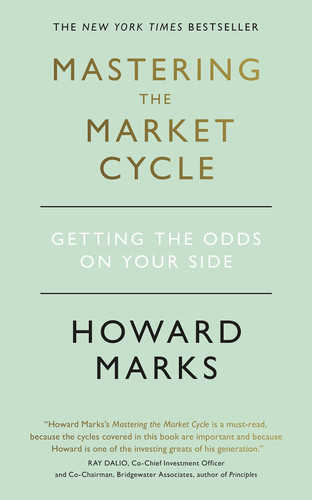
Mastering the market cycle: getting the odds on your side

Marks, Howard
A NEW YORK TIMES , WALL STREET JOURNAL , AND USA TODAY BESTSELLER The legendary investor shows how to identify and master the cycles that govern the financial markets. "A MUST-READ" Ray Dalio, bestselling author of Principles and Co-Chief Investment Officer and Co-Chairman, Bridgewater Associates "WHEN I SEE MEMOS FROM HOWARD MARKS IN MY MAIL, THEY'RE THE FIRST THING I OPEN AND READ" Warren Buffett " HOWARD IS A LEGENDARY INVESTOR" Tony Robbins We all know markets rise and fall, but when should you pull out, and when should you stay in? The answer is never black or white, but is best reached through a keen understanding of the reasons behind the rhythm of cycles. Confidence about where we are in a cycle comes when you learn the patterns of ups and downs that influence not just economics, markets, and companies, but also human psychology and the investing behaviors that result. If you study past cycles, understand their origins and remain alert for the next one, you will become keenly attuned to the investment environment as it changes. You'll be aware and prepared while others get blindsided by unexpected events or fall victim to emotions like fear and greed. By following Marks's insights - drawn in part from his iconic memos over the years to Oaktree's clients - you can master these recurring patterns to have the opportunity to improve your investing results. SEE WHAT REVIEWERS ARE SAYING ABOUT MASTERING THE MARKET CYCLE : ⭐⭐⭐⭐⭐ "This book lays the timeless fundamentals for investment success" ⭐⭐⭐⭐⭐ "A must-read" ⭐⭐⭐⭐⭐ " Excellent book on cycles and psychology"
Nicholas Brealey Publishing 2020-01-23 323 pages

The most important thing illuminated: uncommon sense for the thoughtful investor

Marks, Howard
Howard Marks's The Most Important Thing distilled the investing insight of his celebrated client memos into a single volume and, for the first time, made his time-tested philosophy available to general readers. In this edition, Marks's wisdom is joined by the comments, insights, and counterpoints of four renowned investors and investment educators: Christopher C. Davis (Davis Funds), Joel Greenblatt (Gotham Capital), Paul Johnson (Nicusa Capital), and Seth A. Klarman (Baupost Group). These experts lend insight into such concepts as "second-level thinking," the price/value relationship, patient opportunism, and defensive investing. Marks also adds his own annotations, expanding on his book's original themes and issues. A new chapter addresses the importance of reasonable expectations, and a foreword by Bruce C. Greenwald, called "a guru to Wall Street's gurus" by the New York Times , speaks on value investing, productivity, and the economics of information. *** Howard Marks, the chairman and cofounder of Oaktree Capital Management, is renowned for his insightful assessments of market opportunity and risk. After four decades spent ascending to the top of the investment management profession, he is today sought out by the world's leading value investors, and his client memos brim with insightful commentary and a time-tested, fundamental philosophy. Now for the first time, all readers can benefit from Marks's wisdom, concentrated into a single volume that speaks to both the amateur and seasoned investor. Informed by a lifetime of experience and study, The Most Important Thing explains the keys to successful investment and the pitfalls that can destroy capital or ruin a career. Utilizing passages from his memos to illustrate his ideas, Marks teaches by example, detailing the development of an investment philosophy that fully acknowledges the complexities of investing and the perils of the financial world. Brilliantly applying insight to today's volatile markets, Marks offers a volume that is part memoir, part creed, with a number of broad takeaways. Marks expounds on such concepts as "second-level thinking," the price/value relationship, patient opportunism, and defensive investing. Frankly and honestly assessing his own decisions--and occasional missteps--he provides valuable lessons for critical thinking, risk assessment, and investment strategy. Encouraging investors to be "contrarian," Marks wisely judges market cycles and achieves returns through aggressive yet measured action. Which element is the most essential? Successful investing requires thoughtful attention to many separate aspects, and each of Marks's subjects proves to be the most important thing. "This is that rarity, a useful book."--Warren Buffett
Columbia Business School Pub 2013-01-08 226 pages

The education of a value investor: my transformative quest for wealth, wisdom, and enlightenment

Spier, Guy
"What happens when a young Wall Street investment banker spends a small fortune to have lunch with Warren Buffett? He becomes a real value investor. In this fascinating inside story, Guy Spier details his career from Harvard MBA to hedge fund manager. But the path was not so straightforward. Spier reveals his transformation from a Gordon Gekko wannabe, driven by greed, to a sophisticated investor who enjoys success without selling his soul to the highest bidder. Spier's journey is similar to the thousands that flock to Wall Street every year with their shiny new diplomas, aiming to be King of Wall Street. Yet what Guy realized just in the nick of time was that the King really lived 1,500 miles away in Omaha, Nebraska. Spier determinedly set out to create a new career in his own way. Along the way he learned some powerful lessons which include: why the right mentors and partners are critical to long term success on Wall Street; why a topnotch education can sometimes get in the way of your success; that real learning doesn't begin until you are on your own; and how the best lessons from Warren Buffett have less to do with investing and more to do with being true to yourself. Spier also reveals some of his own winning investment strategies, detailing deals that were winners but also what he learned from deals that went south. Part memoir, part Wall Street advice, and part how-to, Guy Spier takes readers on a ride through Wall Street but more importantly provides those that want to take a different path with the insight, guidance, and inspiration they need to carve out their own definition of success"--
Palgrave Macmillan 2014-09-09 214 pages

The best investment advice I ever received: priceless wisdom from top financial experts

Liz Claman
Wouldn't you like to sit in a room and ask the following people for their investment advice? -John C. Bogle (Founder, Vanguard Group) -Warren Buffett (CEO of Berkshire Hathaway) -Bill Gross (Founder and CIO, PIMCO) -Susan Ivey (CEO, ReynoldsAmerican Inc.) -A.G. Lafley (Chairman, Procter & Gamble) -Georgette Mosbacher (CEO, Borghese Cosmetics) -John Myers (CEO, GE Asset Management) -Suze Orman (bestselling author) -Steve Forbes (President, Forbes magazine) These and dozens of other investment professionals offer their personal secrets of success when it comes to making money. And along the way, they provide their own insights on whether you should diversify your portfolio (or put your cash somewhere else), whether you should pick your own stocks (or let a pro do it for you), if investing in real estate is really the answer to great wealth, if saving a few pennies here and there really do add up, and much, much more. The book is edited by Claman to be extremely accessible to all investors, regardless of their financial background.
Business Plus 2007-11-21 216 pages

How to really ruin your financial life and portfolio

Stein, Benjamin
"Hilarious advice on what NOT to do with money, from financial funny man Ben Stein Everyone's searching for the secrets to financial success, but what about the best ways to lose money. fast?! In How To Really Ruin Your Financial Life and Portfolio, bestselling author, economist, financial commentator, and media personality Ben Stein explains exactly what to do. to go bust! The ultimate "how-NOT-to" guide, the book gives readers invaluable tips that should be avoided at all costs. Written in Stein's own inimitable style, this hilarious guide provides essential financial advice on what not to do when it comes to managing money.From reading and acting upon investing newsletters to trading on a margin, from investing in bonds to breathlessly following CNBC, and from buying stock in firms you do not understand to believing in your own genius at stock picking to keeping as little cash on hand as possible, Stein presents the rules that every would-be investor needs to know, so they can do the exact opposite and actually make money. Fully revised and updated, this new edition presents all-new missteps that can destroy any portfolio. Fully revised and updated edition of the tongue-in-cheek bestseller that shows investors what not to do with their money Written by acclaimed author economist, financial commentator, and media personality Ben Stein Loaded with indispensable pieces of bad advice that readers should avoid at all costs A laugh-out-loud approach to personal finance, How To Really Ruin Your Financial Life and Portfolio is an accessible guide to money from the funniest man in finance"--
Wiley 2012-10-02 132 pages

Making money moral: how a new wave of visionaries is linking purpose and profit

Rodin, Judith,Madsbjerg, Saadia
"In Making Money Moral: How a New Wave of Visionaries Is Linking Purpose and Profit, authors Judith Rodin and Saadia Madsbjerg explore a burgeoning movement of bold and ambitious innovators. These trailblazers are unlocking private-sector investments in new ways to solve global problems, from environmental challenges to social issues such as poverty and inequality. They are earning great returns and reimagining capitalism in the process. Pioneers in the field of sustainable and impact investing, Rodin and Madsbjerg offer first-hand stories of how investors of every type and in every asset class are investing in world-changing solutions--with great success."--Publisher's description
Wharton School Press 2021 160 pages

Trade like Warren Buffett

Altucher, James
"Trading is notoriously tough. But Altucher's new book adds a noteworthy addition to the library on Warren Buffett. He shows a lot of Buffett that isn't readily available in the existing common literature. Definitely required reading for any serious Buffett buff." -Kenneth L. Fisher, Forbes' "Portfolio Strategy" Columnist Founder and CEO, Fisher Investments "Finally, someone blows apart the myth that Warren Buffett is a buy-and-hold investor. Altucher has given us an insightful and well-written commentary on how Buffett has amassed his track record, and what we can do to emulate him. He details the trade-by-trade examples. This is a must read for anyone wanting to learn about how the Master Investor works." -John Mauldin, author, Bull's Eye Investing editor of Thoughts from the Frontline (www.2000wave.com) While Warren Buffett is considered the "world's greatest value investor," there's another side to Buffett that is rarely talked about. Although Buffett has gained recognition for his value investing approach to the markets, the fact is that nobody-over the past fifty years-has traded and invested with a more diverse group of strategies than Buffett. Trade Like Warren Buffett challenges the current coverage of this great investor by including details of all of Buffett's investing and trading methods, including mean reversion, commodities, bonds, arbitrage, market timing, funds, as well as Graham-Dodd. To augment the discussion of each strategy, Trade Like Warren Buffett also includes interviews with leading financial professionals, who reveal in detail how they've successfully used the same techniques. There is no one way to sum up Warren Buffett's investment style. But if you're interested in boosting the performance of your portfolio, Trade Like Warren Buffett can show you how.
Wiley 2005-02-11 246 pages

Miss Independent: a simple 12-step plan to start investing and grow your own wealth

Lapin, Nicole
You've worked hard for your money and now it's time for your money to work for you. You will never earn or budget your way into real wealth. Growing your money significantly doesn't require starting with a lot of money. It requires a little bit of knowledge about taking smart risks and as much time as possible to take advantage of the glorious power of compound interest, which Einstein refers to as the eighth wonder of the world. From automating your savings to easy, no-stress investing strategies, Nicole will teach you how to take your financial knowledge and portfolio to the next level and start you on your journey to your ultimate destination: true financial independence.
HarperCollins Leadership, an imprint of HarperCollins 2022 262 pages

The art of being unreasonable: lessons in unconventional thinking

Broad, Eli
Eli Broad?s embrace of "unreasonable thinking" has helped him build two Fortune 500 companies, amass personal billions, and use his wealth to create a new approach to philanthropy. He has helped to fund scientific research institutes, K-12 education reform, and some of the world?s greatest contemporary art museums. By contrast, "reasonable" people come up with all the reasons something new and different can?t be done, because, after all, no one else has done it that way. This book shares the "unreasonable" principles-from negotiating to risk-taking, from investing to hiring-that have made Eli Broad such a success.
John Wiley & Sons 2012-05-08 192 pages

Yes, you can be a successful income investor! reaching for yield in today's market

Stein, Benjamin
With the bursting of the stock market bubble, and after 13 rate cuts by the Federal Reserve, yields on CDs and Money Market funds tread at historic lows--a negative return after a inflation. Gone are the days when investors could earn 5 percent interest, risk-free. With smaller savings coupled with lower returns on what savings remain, retirees and others living on fixed-income investments watch in horror as their income checks shrink with each passing month. However, there are investments that still earn a significant rate of return--and do so reliably and consistently. These fixed-income securities include bonds, real estate investment trusts, preferred stocks, and emerging market debt, among others. They earn the kind of returns that baby boomers and the retirement community need in the same way they need to draw breath, yet hardly anyone knows anything about them. As 70 million Americans reach retirement age in the next 15 years, fixed-income investing will become a sociologically inevitable megatrend. Yes, You Can Be a Successful Income Investor! shows you how you can safely secure the highest possible yield from your savings, even in a treacherous investment environment.
New Beginnings Press 2005 223 pages

The basics of investing

Krefetz, Gerald
This book and the other three books in Making the Most of Your Money series provide readers with practical and usable information about money. The Basics of Investing offers a clear road map for readers to follow when handling money and making decisions about what to do with it. It answers these fundamental questions: Why is saving not enough? When is the right time to begin investing? What are the goals of investing, and how do they change over the investor's lifetime? What investment alternatives are right for each type of investor? How can a new investor build a solid portfolio? Should investors manage their own porfolios? The Basics of Investing is written for consumers who are confused about their finances and need a well-written, easy-to-understand guide to making safe, sound investments.
Dearborn Financial Pub 1992 196 pages

Investing in dynamic markets: venture capital in the digital age

Kressel, Henry
"Without venture capital, many of the companies whose technical innovations sparked the digital revolution would not exist. Venture investments funded these firms to develop their bright ideas into commercial products that created new business models and established whole new markets. In Profiting from Innovation, Henry Kressel, a partner at multi-billion-dollar global investing company Warburg Pincus, takes you behind the scenes of the private equity process. He draws on his extensive experience to show how venture capital works, why venture capitalists fund certain companies and not others, and what factors influence the success or failure of their high-risk, high-reward investments. He also discusses venture capital's future, now that the commercialization of technology requires larger investments and global market access. Written in clear, non-technical language, the book features informative case studies of venture capital funding in a wide range of industries, including telecommunications, software and services, semiconductors, and the internet"--
Cambridge University Press 2010 264 pages

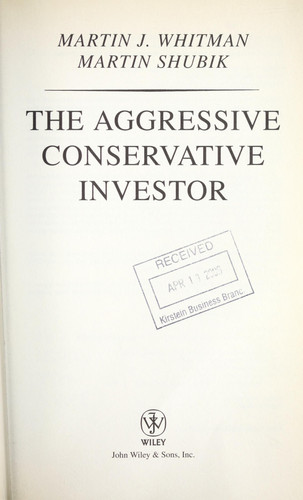
The aggressive conservative investor

Whitman, Martin J.
One of the best books ever written on value investing and distressed securities The Aggressive Conservative Investor is a no-holds-barred presentation of one of the most successful investment strategies of all time-value investing in distressed securities/companies. With painful honesty and terrific storytelling, the authors show investors how to analyze and evaluate stocks just like controlling owners-based on the assumption that stock price rarely reflects real value. Using numerous case studies, Whitman and Shubik present risk-minimizing methods that also provide high rewards. Still relevant today, this classic work includes a new introduction discussing the dramatic changes that have taken place in the value investing world since the book was first published in 1979.
Wiley 2006 426 pages