25 results for "Jewish Children"

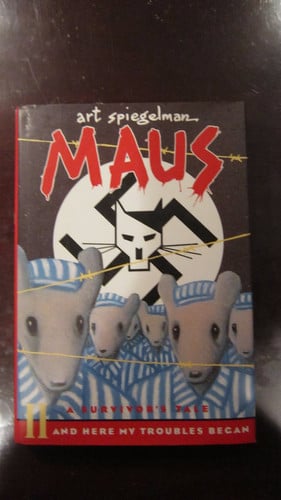
MetaMaus

Spiegelman, Art
Visually and emotionally rich, MetaMaus is as groundbreaking as the masterpiece whose creation it reveals. In the pages of MetaMaus, Art Spiegelman re-enters the Pulitzer prize-winning Maus, the modern classic that has altered how we see literature, comics, and the Holocaust ever since it was first published twenty-five years ago. He probes the questions that Maus most often evokes -- Why the Holocaust? Why mice? Why comics? -- and gives us a new and essential work about the creative process. MetaMaus includes a bonus DVD-R that provides a digitized reference copy of The Complete Maus linked to a deep archive of audio interviews with his survivor father, historical documents, and a wealth of Spiegelman's private notebooks and sketches. Compelling and intimate, MetaMaus is poised to become a classic in its own right. - Publisher.
Pantheon Books 2011-10-04 299 pages

Still alive: a Holocaust girlhood remembered

Klüger, Ruth
Swept up as a child in the events of Nazi-era Europe, Ruth Kluger saw her family's comfortable Vienna existence systematically undermined and destroyed. By age eleven, she had been deported, along with her mother, to Theresienstadt, the first in a series of concentration camps which would become the setting for her precarious childhood. Kluger's story of her years in the camps and her struggle to establish a life after the war as a refugee survivor in New York, has emerged as one of the most powerful accounts of the Holocaust. Interwoven with blunt, unsparing observations of childhood and nuanced reflections of an adult who has spent a lifetime thinking about the Holocaust, Still Alive rejects all easy assumptions about history, both political and personal. Whether describing the abuse she met at her own mother's hand, the life-saving generosity of a woman SS aide in Auschwitz, the foibles and prejudices of Allied liberators, or the cold shoulder offered by her relatives when she and her mother arrived as refugees in New York, Kluger sees and names an unexpected reality which has little to do with conventional wisdom or morality tales. Still Alive is a memoir of the pursuit of selfhood against all odds, a fiercely bittersweet coming-of-age story in which the protagonist must learn never to rely on comforting assumptions, but always to seek her own truth.
Feminist Press at the City University of New York 2001 216 pages

Shores beyond shores: from Holocaust to hope : my true story

Butter, Irene H.,Bidwell, John,Holloway, Kris
As Irene's Pappi fights to save his family during the Holocaust, Irene's childhood is lost. Play is restricted. Family and friends disappear. Finally, with the Dutch police at their door comes the reality that Irene's father has not moved his family far enough from Hitler's Germany. By January 1945, the family is struggling to survive a death camp. Irene tends her ailing parents, cares for starving kids, and even helps bring clothes to her Amsterdam neighbor Anne Frank, before her family is offered a singular chance for freedom...providing the Nazi doctor says they are healthy enough. After two weeks of heart-lifting miracles and heart-breaking tragedies, Irene arrives in the Algerian desert to journey into redemption and womanhood, without her parents or brother. Irene's first person memoir, Shores Beyond Shores, is an account of how the heart keeps its common humanity in the most inhumane and turbulent of times. Irene's hard-earned lessons are a timeless inspiration. ______________________________________________________________________________________________________________________ Following publication of an article on the Holocaust on April 13, 2018, Irene wrote a letter to the Editor which was published April 17, 2018 in The New York Times: Holocaust Survivors 'Have Voices That Matter' April 17, 2018 Re "Getting Facts Wrong on the Holocaust" (news article, April 13): More than four decades passed before I could break the silence about my traumatic experiences during the Holocaust. It is a formidable challenge for survivors to speak and for others to listen. The number of survivors is dwindling; they are getting quite old and their memories are fading. Yet it is ever more important that the signs of authoritarian regimes and how they evolved are brought into the consciousness of youths and adults, as warning signals of what must be prevented from happening again. Survivors, when able, have the responsibility to bear witness and provide evidence so that the six million Jews who were murdered are not forgotten, so that perpetrators are not pardoned for their crimes, and so that deniers don't have a leg to stand on. While the voices of the victims have been silenced forever, we the survivors have voices that matter. After four decades of not speaking, I realized that silence was no longer an option. I told my stories to my children and grandchildren as well as to many students in many schools over a 30-year period. Schools and other organizations should take advantage of every opportunity to engage survivors to tell their stories. IRENE BUTTER, ANN ARBOR, MICH. The writer survived two concentration camps, Westerbork and Bergen-Belsen. She recently published her memoir, "Shores Beyond Shores: From Holocaust to Hope."
White River Press 2018 273 pages

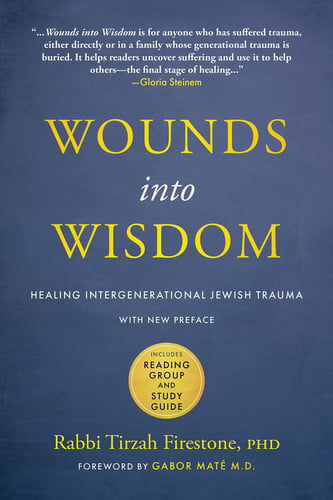
Wounds into wisdom: healing intergenerational Jewish trauma

Firestone, Tirzah
"Our past does not simply disappear. The painful history of our ancestors and their rich cultural wisdom intertwine within us to create the patterns of our future. Even when past trauma remains unspoken or has long been forgotten, it becomes part of us and our children-a legacy of both strength and woundedness that shapes our lives. In this book, Tirzah Firestone brings to life the profound impact of protracted historical trauma through the compelling narratives of those whose lives were marred by racial persecution and displacement. The tragic story of Firestone's own family lays the groundwork for these revealing testimonies of recovery, forgiveness, and moral leadership. Throughout, Firestone interweaves their voices with neuroscientific and psychological findings, as well as relevant and inspiring Jewish teachings. Seven principles emerge from these wise narratives-powerful prescriptive tools that speak to anyone dealing with the effects of past traumatic injury. At the broadest level, these principles are directives for staying morally awake in a world rife with terror"--
Monkfish Book Publishing Company 2022 258 pages

Holocaust literature: a history and guide

Roskies, David G.,Diamant, Naomi
"What is Holocaust literature? When does it begin and how is it changing? Is there an essential core of diaries, eyewitness accounts of the concentration camps, tales of individual survival in hiding? Is it the same everywhere: in the West as in the East, in Australia as in the Americas, in poetry as in prose? Is this literature sacred and sui generis, or can it be studied in the light of other literatures? What of the perpetrators and bystanders, the hidden children, the children of Holocaust survivors: Do they speak with the same authority? What works of Holocaust literature will be read a hundred years from now--and why? Here, for the first time and told from beginning to end, is an historical survey of Holocaust literature in all genres, countries, and major languages. Beginning in wartime, it proceeds from the literature of mobilization and mourning in the Free World to the vast and varied literature produced in the Nazi-occupied ghettos, the bunkers and places of hiding, the transit and concentrations camps. Within weeks of the liberation, in displaced persons camps, a new memorial and testamentary literature begins to take shape. Moving from Europe to Israel, the U.S., and beyond, the authors situate the writings by real and proxy witnesses within three distinct postwar periods: a period of "communal memory," still internal and internecine; a period of "provisional memory" in the '60s and '70s that witnesses the birth of a self-conscious Holocaust genre; to the period of "authorized memory" in which we live today, following the collapse of the Soviet Union (1989-91), and the opening of the US Holocaust Museum (1993). Twenty book covers - first editions in their original languages - and an eminently readable guide to the "first hundred books" together show the multilingual scope, historical depth, the moral and artistic range of this extraordinary body of writing."--Publisher's website.
Brandeis University Press 2012 355 pages

The forgotten

Wiesel, Elie
Distinguished psychotherapist and survivor Elhanan Rosenbaum is losing his memory to an incurable disease. Never having spoken of the war years before, he resolves to tell his son about his past—the heroic parts as well as the parts that fill him with shame—before it is too late. Elhanan's story compels his son to go to the Romanian village where the crime that continues to haunt his father was committed. There he encounters the improbable wisdom of a gravedigger who leads him to the grave of his grandfather and to the truths that bind one generation to another.
Schocken Books 1995-01-31 316 pages

Burned child seeks the fire: a memoir

Edvardson, Cordelia
[A] searing memoir. . . . An enduring, indeed universal, story. Robert Taylor, The Boston Globe Summoned with her mother to Gestapo headquarters in 1943, fourteen-year-old Cordelia Edvardson was given a terrible choice: to acknowledge her secret Jewish heritage and suffer the consequences or to see her mother charged with treason. Burned Child Seeks the Fire is the true story of the love between this mother and daughter, and a piercing example of the tragedies wrought by Nazi Germany. "A lacerating, beautifully translated memoir." Publishers Weekly , starred review "Mesmerizing. . . . [Has] the concise unreality of a horrifying fairy tale." Thomas Frick, Los Angeles Times Book Review "Behind [Edvardson's] deceptively simple prose is a complex and tragic story." Judith Bolton-Fasman, Newsday "Cordelia Edvardson's defiant tone challenges us to eschew simplified encounters with the literature and experiences of Holocaust survivors." Paul H. Hamburg, Jewish Book World "To see the horrors of the Holocaust through a child's eye is to experience hell. Cordelia Edvardson's astonishing story captures, with a terrifying reality, a child's response to the myriad atrocities of the Nazis and their murderous regime. Burned Child Seeks the Fire is compelling, horrifying, poetic in its intensity." Deborah Peifer, Bay Area Reporter
Beacon Press 1997 105 pages

The wall: a novel

Adler, H. G.
NAMED ONE OF THE BEST BOOKS OF THE YEAR BY PUBLISHERS WEEKLY Compared by critics to Kafka, Joyce, and Musil, H. G. Adler is becoming recognized as one of the towering figures of twentieth-century fiction. Nobel Prize winner Elias Canetti wrote that “Adler has restored hope to modern literature,” and the first two novels rediscovered after his death, Panorama and The Journey, were acclaimed as “modernist masterpieces” by The New Yorker . Now his magnum opus, The Wall, the final installment of Adler’s Shoah trilogy and his crowning achievement as a novelist, is available for the first time in English. Drawing upon Adler’s own experiences in the Holocaust and his postwar life, The Wall , like the other works in the trilogy, nonetheless avoids detailed historical specifics. The novel tells the story of Arthur Landau, survivor of a wartime atrocity, a man struggling with his nightmares and his memories of the past as he strives to forge a new life for himself. Haunted by the death of his wife, Franziska, he returns to the city of his youth and receives confirmation of his parents’ fates, then crosses the border and leaves his homeland for good. Embarking on a life of exile, he continues searching for his place within the world. He attempts to publish his study of the victims of the war, yet he is treated with curiosity, competitiveness, and contempt by fellow intellectuals who escaped the conflict unscathed. Afflicted with survivor’s guilt, Arthur tries to leave behind the horrors of the past and find a foothold in the present. Ultimately, it is the love of his second wife, Johanna, and his two children that allows him to reaffirm his humanity while remembering all he’s left behind. The Wall is a magnificent epic of survival and redemption, powerfully told through stream of consciousness and suffused with daydream, fantasy, memory, nightmare, and pure imagination. More than a portrait of a Holocaust survivor’s journey, it is a universal novel about recovering from the traumas of the past and finding a way to live again. Praise for The Wall “[A] majestic novel . . . Adler’s prose is tidal, surge after narrative surge rushing forward and then enigmatically receding, the moment displaced by memory, and memory by introspective soliloquy.” —Cynthia Ozick, The New York Times Book Review “A towering meditation on the self and spirit . . . The writing is sonorous and so entirely devastating that the reader is compelled to pore over every word.” — Publishers Weekly (starred review) “Masterful and utterly unique.” —The Jerusalem Post “Haunting and utterly heart-wrenching . . . a literary masterpiece.” —Historical Novels Review “An epic novel . . . an unforgettable portrait.” —The Jewish Week “[A] pensive portrait of a man struggling to find a place in the world after enduring transformative calamity . . . an eloquent record of suffering—and perhaps of redemption as well.” — Kirkus Reviews Praise for H. G. Adler’s novels The Journey and Panorama, translated by Peter Filkins “Modernist masterpieces worthy of comparison to those of Kafka or Musil.” — The New Yorker “Haunting . . . as remarkable for its literary experimentation as for its historical testimony.” —San Francisco Chronicle , on Panorama
Modern Library 2015-09-08 656 pages

Parallel lines

Lantos, Peter L.
Memoirs of Lantos, born to the Leipniker family in 1939 in Makó, Hungary. In 1944, after his older brother was taken away, the rest of the family was sent to the ghetto of Szeged, but the Jews there were soon deported. He and his parents were first sent to Strasshof in Austria for a short time, then to Wiener Neustadt and to Bergen-Belsen, where his father died. He and his mother were then sent on a death transport, during which they were liberated by American soldiers. They returned to Hungary and found that his brother had perished. Lantos later studied medicine in England, and in 1969 decided to remain there.
Arcadia Books 2006 246 pages

Rescued images: memories of childhood in hiding

Jacobsen, Ruth
Memoirs of a Jew, intended for children. Jacobsen was born as Ruth Katzenstein in the village of Frankenberg, Germany. In 1937 the family moved to Düsseldorf; in 1939 they fled to the Netherlands. Under the German occupation, the family first lived in the village of Oud Zuylen; in 1941 the Dutch resistance movement hid Ruth in Amsterdam and her parents in Roermond. Jacobsen describes the people who hid and helped her. Several years after the war her parents committed suicide; in 1953 she emigrated to the USA. Includes illustrations, and collages made by Jacobsen from family photographs.
Mikaya Press 2001 92 pages

Boy 30529: a memoir

Weinberg, Felix Jiri
At the age of twelve, Weinberg lost everything: hope, home, and even his own identity. In 1938 his father travelled to England, hoping to arrange for his family to emigrate there. His efforts came too late, and his wife and children fell into the hands of the Fascist occupiers. Over the following years, Felix survived five concentration camps, including Terezín, Auschwitz and Birkenau, as well as the Death March from Blechhammer in 1945. An extraordinary meditation on the nature of memory.
Verso 2014-03-04 168 pages

Light from the ashes: social science careers of young Holocaust refugees and survivors

Peter Suedfeld
How did Nazi persecution affect the later lives of children and young adolescents? In Light from the Ashes, eighteen eminent social scientists trace the connection between their early wartime experiences and their adult research careers, personality, and values. Autobiographical essays describe their trauma of fleeing from or surviving the Holocaust during childhood or adolescence, and how this influenced their eventual choice of work and general outlook on life. The introductory and closing chapters set these narratives in historical and theoretical context and discuss their broader psychological and social implications. A unique feature of the book is that its contributors were children or adolescents when they became targets of Nazi persecution. Each chapter covers the contributor's experiences during and after the war, his or her professional education, development, and activities, and the perceived connection between those factors. The wider impact of the early years on adult attitudes, political orientation, ethics, religion, family life, important values, and personality characteristics is also discussed. The book will be of primary interest to psychologists and to literary scholars interested in narrative and autobiography. It will be relevant to historians, sociologists, and philosophers of science, especially social science; and to scholars and researchers of all disciplines interested in the impact of traumatic violence, dislocation, war, persecution, and emigration (particularly, but not only, related to the Holocaust) on the subsequent lives of children and adolescents. It will also be valuable to psychologists, psychiatrists, and other scientists working in the field of stress and coping .For the general reader, the book offers the reminiscences of articulate and introspective people who as children experienced a wide variety of adverse circumstances and responded to them--then and later--in a wide variety of mostly adaptive ways. Readers intrigued by first-person narratives of war, persecution, and resilience will find the book of great interest. Peter Suedfeld is Professor of Psychology, University of British Columbia.
University of Michigan Press 2000 446 pages