103 results for "Jewish Children"

People love dead Jews: reports from a haunted present

Horn, Dara
"A startling exploration of how Jewish history is exploited to comfort the living. Reflecting on subjects as far-flung as the international veneration of Anne Frank, the blockbuster travelling exhibition called "Auschwitz," the Jewish history of the Chinese city of Harbin, and the little known "righteous-gentile" Varian Fry, Dara Horn challenges us to confront the reasons why there might be so much fascination with Jewish deaths, as emblematic of the worst of evils the world has to offer, and so little respect for Jewish lives, as they continue to unfold in the present. Horn draws upon her own family life -- trying to explain Shakespeare's Shylock to a curious 10-year-old, her anger when swastikas are drawn on desks in her children's school in New Jersey, the profound and essential perspective offered by traditional religious practice, prayer, and study -- to assert the vitality, complexity and depth of this life against an anti-Semitism that, far from being disarmed by the mantra of "Never forget," is on the rise"--Provided by publisher.
W. W. Norton & Company 2021 237 pages

Neighbors: the destruction of the Jewish community in Jedwabne, Poland

Gross, Jan Tomasz
One summer day in 1941, half of the Polish town of Jedwabne murdered the other half, 1,600 men, women, and children, all but seven of the town's Jews. Neighbors tells their story. Jan Gross pieces together eyewitness accounts and other evidence into a reconstruction of the horrific July day remembered well by locals but forgotten by history. His investigation reads like a detective story, and its unfolding yields wider truths about Jewish-Polish relations, the Holocaust, and human responses to occupation and totalitarianism. It is a story of surprises: The newly occupying German army did not compel the massacre, and Jedwabne's Jews and Christians had previously enjoyed cordial relations. After the war, the nearby family who saved Jedwabne's surviving Jews was derided and driven from the area. The single Jew offered mercy by the town declined it. Most arresting is the sinking realization that Jedwabne's Jews were clubbed, drowned, gutted, and burned not by faceless Nazis, but by people whose features and names they knew well: their former schoolmates and those who sold them food, bought their milk, and chatted with them in the street. As much as such a question can ever be answered, Neighbors tells us why.
Arrow Books 2003 271 pages

A ceiling made of eggshells

Levine, Gail Carson
In A Ceiling Made of Eggshells, Newbery Honor-winning author Gail Carson Levine tells a moving and ambitious story set during the expulsion of Jews from Spain, about a young Jewish girl full of heart who must play her own role in her people's epic history--no matter the sacrifice. Surrounded by her large family, Loma is happy living in the judería of Alcalá de Henares, Spain, and wants nothing more than to someday have a family of her own. Still, when her intimidating grandfather, her Belo, decides to bring her along on his travels, she's excited to join him. Belo has the ear of King Ferdinand and Queen Isabella, and Loma relishes her adventures with him, adventures that are beyond the scope of most girls of the time. She soon learns just how dangerous the world is for the Jews of Spain, and how her grandfather's influence keeps their people safe. But the older Loma gets, the more she longs to realize her own dreams--if Belo will ever allow her to leave his side.
Quill Tree Books 2021-05-11 416 pages

Child of the Warsaw ghetto

Adler, David A.
Intended for children, relates the Holocaust experiences of Froim Baum, born in Warsaw in April 1926. After his father died in 1932, his mother was left with seven children. Froim, the youngest, was placed in Janusz Korczak's orphanage. While in the ghetto, he was active in crossing to the Aryan side and smuggling food into the ghetto for his family and friends. When the orphanage was liquidated, Baum happened to be visiting his mother and was not taken away with the other children. The Baum family then escaped from the ghetto to Plonsk, but were arrested there and deported to Auschwitz and other camps. Froim was liberated in Dachau; only two of his brothers survived.
Holiday House 1995 32 pages

Jewish wisdom: ethical, spiritual, and historical lessons from the great works and thinkers

Telushkin, Joseph
When, if ever, should lying be permitted? If you've damaged a person's reputation unfairly, can the damage be undone? Is a person who sells weapons responsible for how those weapons are used? if the fetus is not a life, what is it? How, as an adult, can one carry out the command to honor one's parents when they make unreasonable demands? What are the nine biblical challenges a good person must meet? What do the great Jewish writings of the last 3,500 years tell us about these and all other vital questions about our lives? Rabbi Joseph Telushkin has devoted his life to the search for answers within the teachings of Judaism. In Jewish Wisdom, Rabbi Telushkin, the author of the highly acclaimed Jewish Literacy, weaves together a tapestry of stories from the Bible and Talmud, and the insights of Jewish commentators and writers from Maimonides, Rashi, and Hillel to Einstein, Isaac Bashevis Singer, and Elie Wiesel. A richer source of crucial life lessons would be hard to imagine. Accompanying this extraordinary compilation is Teluslikins compelling commentary, which reveals how these texts continue to instruct and challenge Jewsand all people concerned with leading ethical livestoday As he discusses these texts, Rabbi Telushkin addresses issues of fundamental interest to modern readers: how to live with honesty and integrity in an often dishonest world; how to care for the sick and dying; how to teach children to respect both themselves and others, how to understand and confront such great tragedies as antisemitism. and the Holocaust; what God wants from humankind. Within Jewish Wisdom's ninety chapters the reader will find extended sections illuminating Jewish perspectives on sex, romance, and marriage, what kind of belief in God a Jew can have after the Holocaust, how to use language ethically, the conflicting views of the Bible and Talmud on the death penalty, and much, much more. Jewish Wisdom adds a new dimension to the many widely read contemporary books that retell the stones and reveal the essence of classic religious and secular literature. Possibly the most far-ranging volume of stories and quotations from Jewish texts, Jewish Wisdom will itself become a classic, a book that not only has the capacity to transform how you view the world, but one that well might change how you choose to live your life.
W. Morrow 1994-10-21 663 pages

Hitler, my neighbor: memories of a Jewish childhood

Feuchtwanger, E. J.
"An eminent historian recounts the Nazi rise to power from his unique perspective as a young Jewish boy in Munich, living with Adolf Hitler as his neighbor. Watching events unfold from his window, Edgar bore witness to the Night of the Long Knives, the Anschluss, and Kristallnacht. Jews were arrested; his father was imprisoned at Dachau. In 1939 Edgar was sent on his own to England, where he would make a new life, a career, have a family, and strive to forget the nightmare of his past--a past that came rushing back when he decided, at the age of eighty-eight, to tell the story of his buried childhood and his infamous neighbor"--Provided by publisher.
Other Press 2017-11-07 209 pages

Still alive: a Holocaust girlhood remembered

Klüger, Ruth
Swept up as a child in the events of Nazi-era Europe, Ruth Kluger saw her family's comfortable Vienna existence systematically undermined and destroyed. By age eleven, she had been deported, along with her mother, to Theresienstadt, the first in a series of concentration camps which would become the setting for her precarious childhood. Kluger's story of her years in the camps and her struggle to establish a life after the war as a refugee survivor in New York, has emerged as one of the most powerful accounts of the Holocaust. Interwoven with blunt, unsparing observations of childhood and nuanced reflections of an adult who has spent a lifetime thinking about the Holocaust, Still Alive rejects all easy assumptions about history, both political and personal. Whether describing the abuse she met at her own mother's hand, the life-saving generosity of a woman SS aide in Auschwitz, the foibles and prejudices of Allied liberators, or the cold shoulder offered by her relatives when she and her mother arrived as refugees in New York, Kluger sees and names an unexpected reality which has little to do with conventional wisdom or morality tales. Still Alive is a memoir of the pursuit of selfhood against all odds, a fiercely bittersweet coming-of-age story in which the protagonist must learn never to rely on comforting assumptions, but always to seek her own truth.
Feminist Press at the City University of New York 2001 216 pages

Lest Innocent Blood Be Shed

Hallie, Philip
During the most terrible years of World War II, when inhumanity and political insanity held most of the world in their grip and the Nazi domination of Europe seemed irrevocable and unchallenged, a miraculous event took place in a small Protestant town in southern France called Le Chambon. There, quietly, peacefully, and in full view of the Vichy government and a nearby division of the Nazi SS, Le Chambon's villagers and their clergy organized to save thousands of Jewish children and adults from certain death.
HARPERCOLLINS @ PUBLISHERS 1985 313 pages

Tehran children: a Holocaust refugee odyssey

Dekel, Mikhal
"The extraordinary true story of Polish-Jewish child refugees who escaped the Nazis and found refuge in Iran. More than a million Jews escaped east from Nazi occupied Poland to Soviet occupied Poland. There they suffered extreme deprivation in Siberian gulags and "Special Settlements" and then, once "liberated," journeyed to the Soviet Central Asian Republics. The majority of Polish Jews who survived the Nazis outlived the war in Uzbekistan and Kazakhstan; some of them continued on to Iran. The story of their suffering, both those who died and those who survived, has rarely been told. Following the footsteps of her father, one of a thousand refugee children who traveled to Iran and later to Palestine, Dekel fuses memoir with historical investigation in this account of the all-but-unknown Jewish refuge in Muslim lands. Along the way, Dekel reveals the complex global politics behind this journey, discusses refugee aid and hospitality, and traces the making of collective identities that have shaped the postwar world--the histories nations tell and those they forget"--
W.W. Norton & Company 2019 417 pages

Shores beyond shores: from Holocaust to hope : my true story

Butter, Irene H.,Bidwell, John,Holloway, Kris
As Irene's Pappi fights to save his family during the Holocaust, Irene's childhood is lost. Play is restricted. Family and friends disappear. Finally, with the Dutch police at their door comes the reality that Irene's father has not moved his family far enough from Hitler's Germany. By January 1945, the family is struggling to survive a death camp. Irene tends her ailing parents, cares for starving kids, and even helps bring clothes to her Amsterdam neighbor Anne Frank, before her family is offered a singular chance for freedom...providing the Nazi doctor says they are healthy enough. After two weeks of heart-lifting miracles and heart-breaking tragedies, Irene arrives in the Algerian desert to journey into redemption and womanhood, without her parents or brother. Irene's first person memoir, Shores Beyond Shores, is an account of how the heart keeps its common humanity in the most inhumane and turbulent of times. Irene's hard-earned lessons are a timeless inspiration. ______________________________________________________________________________________________________________________ Following publication of an article on the Holocaust on April 13, 2018, Irene wrote a letter to the Editor which was published April 17, 2018 in The New York Times: Holocaust Survivors 'Have Voices That Matter' April 17, 2018 Re "Getting Facts Wrong on the Holocaust" (news article, April 13): More than four decades passed before I could break the silence about my traumatic experiences during the Holocaust. It is a formidable challenge for survivors to speak and for others to listen. The number of survivors is dwindling; they are getting quite old and their memories are fading. Yet it is ever more important that the signs of authoritarian regimes and how they evolved are brought into the consciousness of youths and adults, as warning signals of what must be prevented from happening again. Survivors, when able, have the responsibility to bear witness and provide evidence so that the six million Jews who were murdered are not forgotten, so that perpetrators are not pardoned for their crimes, and so that deniers don't have a leg to stand on. While the voices of the victims have been silenced forever, we the survivors have voices that matter. After four decades of not speaking, I realized that silence was no longer an option. I told my stories to my children and grandchildren as well as to many students in many schools over a 30-year period. Schools and other organizations should take advantage of every opportunity to engage survivors to tell their stories. IRENE BUTTER, ANN ARBOR, MICH. The writer survived two concentration camps, Westerbork and Bergen-Belsen. She recently published her memoir, "Shores Beyond Shores: From Holocaust to Hope."
White River Press 2018 273 pages

The last million: Europe's displaced persons from World War to Cold War

Nasaw, David
"In May of 1945, German forces surrendered to the Allied powers, effectively putting an end to World War II in Europe. But the aftershocks of this global military conflict did not cease with the signing of truces and peace treaties. Millions of lost and homeless POWs, slave laborers, political prisoners, and concentration camp survivors overwhelmed Germany, a country in complete disarray. British and American soldiers gathered the malnourished and desperate foreigners, and attempted to repatriate them to Poland, Estonia, Latvia, Lithuania, Ukraine, and the USSR. But after exhaustive efforts, there remained over a million displaced persons who either refused to go home or, in the case of many, had no home to which to return. They would spend the next three to five years in displaced persons camps, divided by nationalities, temporary homelands in exile, with their own police forces, churches, schools, newspapers, and medical facilities. The international community couldn't agree on the fate of the Last Million, and after a year of fruitless debate and inaction, an International Refugee Organization was created to resettle them in lands suffering from labor shortages. But no nations were willing to accept the 200,000 to 250,000 Jewish men, women, and children who remained trapped in Germany. In 1948, the United States, among the last countries to accept anyone for resettlement, finally passed a Displaced Persons Bill - but as Cold War fears supplanted memories of WWII atrocities, the bill only granted visas to those who were reliably anti-communist, including thousands of former Nazi collaborators, Waffen-SS members, and war criminals, while barring the Jews who were suspected of being Communist sympathizers or agents because they had been recent residents of Soviet-dominated Poland. Only after the passage of the controversial UN resolution for the partition of Palestine and Israel's declaration of independence were the remaining Jewish survivors finally able to leave their displaced persons camps in Germany."--
Penguin Press 2020-09-15 654 pages

The last million: Europe's displaced persons from World War to Cold War

Nasaw, David
"In May of 1945, German forces surrendered to the Allied powers, effectively putting an end to World War II in Europe. But the aftershocks of this global military conflict did not cease with the signing of truces and peace treaties. Millions of lost and homeless POWs, slave laborers, political prisoners, and concentration camp survivors overwhelmed Germany, a country in complete disarray. British and American soldiers gathered the malnourished and desperate foreigners, and attempted to repatriate them to Poland, Estonia, Latvia, Lithuania, Ukraine, and the USSR. But after exhaustive efforts, there remained over a million displaced persons who either refused to go home or, in the case of many, had no home to which to return. They would spend the next three to five years in displaced persons camps, divided by nationalities, temporary homelands in exile, with their own police forces, churches, schools, newspapers, and medical facilities. The international community couldn't agree on the fate of the Last Million, and after a year of fruitless debate and inaction, an International Refugee Organization was created to resettle them in lands suffering from labor shortages. But no nations were willing to accept the 200,000 to 250,000 Jewish men, women, and children who remained trapped in Germany. In 1948, the United States, among the last countries to accept anyone for resettlement, finally passed a Displaced Persons Bill - but as Cold War fears supplanted memories of WWII atrocities, the bill only granted visas to those who were reliably anti-communist, including thousands of former Nazi collaborators, Waffen-SS members, and war criminals, while barring the Jews who were suspected of being Communist sympathizers or agents because they had been recent residents of Soviet-dominated Poland. Only after the passage of the controversial UN resolution for the partition of Palestine and Israel's declaration of independence were the remaining Jewish survivors finally able to leave their displaced persons camps in Germany."--
Penguin Press 2020 654 pages

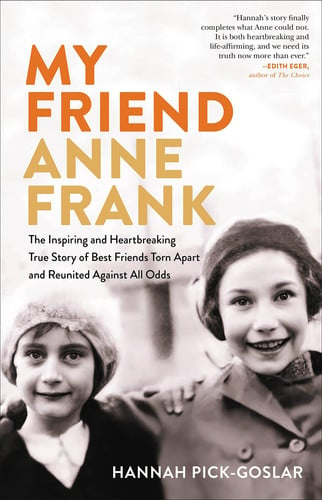
My friend Anne Frank: the inspiring and heartbreaking true story of best friends torn apart and reunited against all odds

Pick-Goslar, Hannah,Kraft, Dina
"In 1933, Hannah Pick-Goslar and her family fled Nazi Germany to live in Amsterdam, where she struck up a close friendship with her next-door neighbor, an outspoken and fun-loving young girl named Anne Frank. For several years, the inseparable pair enjoyed a carefree childhood of games, sleepovers, and treats with the other children in their neighborhood of Rivierenbuurt. But in 1942, Hannah and Anne's lives abruptly changed forever. As the Nazi occupation of Amsterdam progressed, Anne and the Frank family seemingly vanished, leaving behind unmade beds and dishes in the sink--but no trace of Anne's precious diary. Torn from her dear friend without warning, Hannah spent the next two years tormented by questions about Anne's fate, wondering if she had, by some miracle, managed to escape danger. In this long-awaited memoir, Hannah shares the story of her childhood during the Holocaust, from the introduction of anti-Jewish laws in Amsterdam to the gradual disappearance of classmates and, eventually, the Frank family, to Hannah and her family's imprisonment in the Bergen-Belsen concentration camp. As Hannah chronicles the experiences of her own life during and after the war, she provides a searing look at what countless children endured at the hands of the Nazi regime, as well as an intimate, never-before-seen portrait of the most recognizable victim of the Holocaust. Culminating in an astonishing fateful reunion, My Friend Anne Frank is the profoundly moving story of childhood and friendship during one of the darkest periods in the world's history"--Dust jacket flap.
Little, Brown Spark 2023 313 pages

The diary of Dawid Sierakowiak: five notebooks from the Łódź ghetto

Sierakowiak, Dawid
"In the evening I had to prepare food and cook supper, which exhausted me totally. In politics there's absolutely nothing new. Again, out of impatience I feel myself beginning to fall into melancholy. There is really no way out of this for us." This is Dawid Sierakowiak's final diary entry. Soon after writing it, the young author died of tuberculosis, exhaustion, and starvation--the Holocaust syndrome known as "ghetto disease." After the liberation of the Lodz Ghetto, his notebooks were found stacked on a cookstove, ready to be burned for heat. Young Sierakowiak was one of more than 60,000 Jews who perished in that notorious urban slave camp, a man-made hell which was the longest surviving concentration of Jews in Nazi Europe.The diary comprises a remarkable legacy left to humanity by its teenage author. It is one of the most fastidiously detailed accounts ever rendered of modern life in human bondage. Off mountain climbing and studying in southern Poland during the summer of 1939, Dawid begins his diary with a heady enthusiasm to experience life, learn languages, and read great literature. He returns home under the quickly gathering clouds of war. Abruptly Lodz is occupied by the Nazis, and the Sierakowiak family is among the city's 200,000 Jews who are soon forced into a sealed ghetto, completely cut off from the outside world. With intimate, undefended prose, the diary's young author begins to describe the relentless horror of their predicament: his daily struggle to obtain food to survive; trying to make reason out of a world gone mad; coping with the plagues of death and deportation. Repeatedly he rallies himself against fear and pessimism, fighting the cold, disease, and exhaustion which finally consume him. Physical pain and emotional woe hold him constantly at the edge of endurance. Hunger tears Dawid's family apart, turning his father into a thief who steals bread from his wife and children.The wonder of the diary is that every bit of hardship yields wisdom from Dawid's remarkable intellect. Reading it, you become a prisoner with him in the ghetto, and with discomfiting intimacy you begin to experience the incredible process by which the vast majority of the Jews of Europe were annihilated in World War II. Significantly, the youth has no doubt about the consequence of deportation out of the ghetto: "Deportation into lard," he calls it. A committed communist and the unit leader of an underground organization, he crusades for more food for the ghetto's school children. But when invited to pledge his life to a suicide resistance squad, he writes that he cannot become a "professional revolutionary." He owes his strength and life to the care of his family.
Oxford University Press 1996-11-07 271 pages