5 results for "Jewish Children"

The blessing of a skinned knee: using Jewish teachings to raise self-reliant children

Mogel, Wendy
In the trenches of a typical day, every parent encounters a child afflicted with ingratitude and entitlement. Parents want so badly to raise self-disciplined, appreciative, and resourceful children who are not spoiled. But how to accomplish this feat? The answer has eluded the best-intentioned individuals who overprotect, overindulge, and overschedule their children's lives. Sharing stories of everyday parenting problems and examining them through the lens of the Torah, the Talmud, and important Jewish teachings, The Blessing of a Skinned Knee shows parents how to teach children to honor and respect others. Parents will learn to accept that their children are both ordinary and unique, and treasure the power and holiness of the present. Mogel makes these teachings relevant for any era, and any household of any faith. A unique parenting book, The Blessing of a Skinned Knee is both inspiring and effective in the day-to-day challenge of raising self-reliant children --
Penguin Compass 2001 300 pages

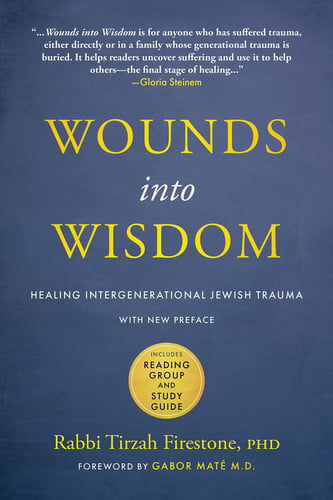
Wounds into wisdom: healing intergenerational Jewish trauma

Firestone, Tirzah
"Our past does not simply disappear. The painful history of our ancestors and their rich cultural wisdom intertwine within us to create the patterns of our future. Even when past trauma remains unspoken or has long been forgotten, it becomes part of us and our children-a legacy of both strength and woundedness that shapes our lives. In this book, Tirzah Firestone brings to life the profound impact of protracted historical trauma through the compelling narratives of those whose lives were marred by racial persecution and displacement. The tragic story of Firestone's own family lays the groundwork for these revealing testimonies of recovery, forgiveness, and moral leadership. Throughout, Firestone interweaves their voices with neuroscientific and psychological findings, as well as relevant and inspiring Jewish teachings. Seven principles emerge from these wise narratives-powerful prescriptive tools that speak to anyone dealing with the effects of past traumatic injury. At the broadest level, these principles are directives for staying morally awake in a world rife with terror"--
Monkfish Book Publishing Company 2022 258 pages

After such knowledge: memory, history, and the legacy of the Holocaust

Hoffman, Eva
Sixty years after the Holocaust, the author of Lost in Translation explores the difficult process of preserving an authentic version of its tragic events. As the Holocaust recedes in time, the guardianship of its legacy is being passed on from its survivors and witnesses to the next generation. How should they, in turn, convey its knowledge to others? What are the effects of a traumatic past on its inheritors? And what are the second generation's responsibilities to its received memories?In this meditation on the long aftermath of atrocity, Eva Hoffman -a child of Polish Jews who survived the Holocaust with the help of neighbors, but whose entire families perished -probes these questions through personal reflections, and through broader explorations of the historical, psychological, and moral implications of the second-generation experience. She examines the subterranean processes through which private memories of suffering are transmitted, and the more willful stratagems of collective memory. She traces the second generation's trajectory from childhood intimations of horror, through its struggles between allegiance and autonomy, and its complex transactions with children of per
Public Affairs 2004-01-07 301 pages

The Holocaust is over, we must rise from its ashes

Burg, Avraham
Modern-day Israel, and the Jewish community, are strongly influenced by the memory and horrors of Hitler and the Holocaust. Burg argues that the Jewish nation has been traumatized and has lost the ability to trust itself, its neighbors or the world around it. He shows that this is one of the causes for the growing nationalism and violence that are plaguing Israeli society and reverberating through Jewish communities worldwide. Burg uses his own family history--his parents were Holocaust survivors--to inform his innovative views on what the Jewish people need to do to move on and eventually live in peace with their Arab neighbors and feel comfortable in the world at large. Thought-provoking, compelling, and original, this book is bound to spark a heated debate around the world.
Palgrave Macmillan 2010 253 pages