6 results for "Jewish Children"

Microtrends: the small forces behind today's big changes

Penn, Mark J.
Mark Penn argues that the biggest trends in America are the Microtrends, the smaller trends that go unnoticed or ignored. One million people can create new market for a business, spark a social movement, or effect political change. In 1996, a microtrend identified by Penn ("soccer moms") was crucial in re-electing President Clinton. With years of experience as one of world's most highly regarded pollsters, Penn identifies the new microtrends sweeping the world: SINGLE WOMEN BY CHOICE: Women aren't waiting for Mr. Right. They are raising children by themselves and buying their own homes. SPLITTERS: A growing number of middle-class residents are shuttling between two homes, creating new communities and dynamics in the real estate market. SUN HATERS: Environmentalists, skin cancer survivors, and parents concerned about the sun's impact on our health. PHILO-SEMITES: A growing number of people want to date Jewish men and women. CLASSICAL MUSIC DADS: Older men who are fathers in their 40's and 50's and taking on a larger role in the nurturing of their children and becoming an important factor in consumer culture for kids. MICROTRENDS highlights everything from religion to politics, from leisure pursuits to relationships and will take the listener into the worlds of polling, targeting, and psychographic analysis, reaching tantalizing conclusions through engaging analysis.
Allen Lane 2007 425 pages

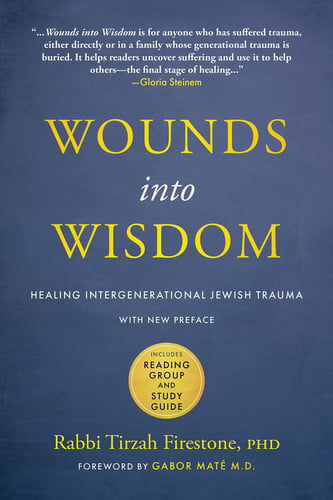
Wounds into wisdom: healing intergenerational Jewish trauma

Firestone, Tirzah
"Our past does not simply disappear. The painful history of our ancestors and their rich cultural wisdom intertwine within us to create the patterns of our future. Even when past trauma remains unspoken or has long been forgotten, it becomes part of us and our children-a legacy of both strength and woundedness that shapes our lives. In this book, Tirzah Firestone brings to life the profound impact of protracted historical trauma through the compelling narratives of those whose lives were marred by racial persecution and displacement. The tragic story of Firestone's own family lays the groundwork for these revealing testimonies of recovery, forgiveness, and moral leadership. Throughout, Firestone interweaves their voices with neuroscientific and psychological findings, as well as relevant and inspiring Jewish teachings. Seven principles emerge from these wise narratives-powerful prescriptive tools that speak to anyone dealing with the effects of past traumatic injury. At the broadest level, these principles are directives for staying morally awake in a world rife with terror"--
Monkfish Book Publishing Company 2022 258 pages

Shaping losses: cultural memory and the Holocaust

Julia Epstein,Lori Hope Lefkovitz
Shaping Losses explores how traumatic loss affects identity and how those who are shaped by loss give shape, in turn, to the empty place where something--relationships, family, culture--was and is no longer. Taking the example of the decimation of European Jewry during the Nazi era, Shaping Losses confronts the problem of transforming trauma into cultural memory. This eloquent volume examines how memoirs, films, photographs, art, and literature, as well as family conversations and personal remembrances, embody the impulse to preserve what is destroyed. The contributors -- all distinguished women scholars, most of them survivors or daughters of survivors--examine classic memorializations such as Claude Lanzmann's film Shoah and Roman Vishniac's photographs of prewar Jews as well as several less-well-known works. They also address ways in which children of survivors of the Holocaust--and of other catastrophic traumas--struggle with inherited or vicarious memory, striving to come to terms with losses that centrally define them although they experience them only indirectly. Shaping Losses considers the limitations of Holocaust representations and testimonies that capture shards of the experience but are necessarily selective and reductive. Contributors discuss artistic efforts to "preserve the rawness" of memory, to resist redemptive closure in Holocaust narratives and public memorials, and to prevent the Holocaust from being sealed in "the cold storage of history." The authors probe the nature of memory and of trauma, studying the use of language within and outside a traumatic context such as Auschwitz and pinpointing the qualities that make traumatic memory ineffable, untransmittable, and perhaps unreliable. Within the "haunted terrain of traumatized memory" that all Holocaust testimonies inhabit, the impulse to give form to emptiness--to shape loss--emerges as a necessary betrayal, a vital effort to bridge the gap between history and memory.
University of Illinois Press 2001 239 pages

Israel and the daughters of the Shoah: reoccupying the territories of silence

Lenṭin, Ronit
The murder of a third of Europe's Jews by the Nazis is unquestionably the worst catastrophe in the history of contemporary Judaism and a formative event in the history of Zionism and the State of Israel. Understandably, therefore, the Shoah, written about, analyzed, and given various political interpretations, has shaped public discourse in the history of the State of Israel. The key element of Shoah in the Israeli context is victimhood and as such it has become a source of shame, shrouded in silence and subordinated to the dominant discourse which, resulting from the construction of a "new Hebrew" active subjectivity, taught the postwar generation of Israelis to reject diaspora Jewry and its alleged passivity in the face of catastrophe. This book is the culmination of years of preoccupation with the meaning of the Shoah for the author, an Israeli woman with a "split subjectivity: - that of a daughter of a family of Shoah survivors, and that of a daughter of the first Israeli-born generation; the culmination of her need to break the silence about the Shoah in a society which constructed itself as the Israeli antithesis to diaspora Jewry, and to excavate a "truth" from underneath the mountain of Zionist nation-building myths. These myths, the author argues, not only had deep implication for the formation of her generation but also a profound impact on the Israeli-Palestinian conflict. Moreover, they are shot through with images of the "masculine" Israeli, constrasted with those of the weak, passive, non-virile Jewish "Other" of the diaspora. This book offers the first gendered analysis of Israeli society and the Shoah. The author employs personal narratives of nine Israeli daughters of Shoah survivors, writers and film makers, and a feminist re-reading of official and unofficial Israeli and Zionist discourses to explore the ways in which the
Berghahn Books 2000 256 pages

Facing the past: looking back at refugee childhood in New Zealand, 1940s-1960s

Beaglehole, Ann
Focuses on the lives of the children of wartime immigrants, whose perceptions and experiences of both the old and the new world were very different from their parents'. At school, in the neighbourhood, or on the sportsfield, many of them were painfully aware of being 'outsiders' in a society unused to cultural diversity. Yet their need to belong was frequently complicated by loyalty to the very different ideals and expectations of their parents. Based on a wide range of interviews as well as documentary evidence from second-generation refugees worldwide, this is an account of the lives of immigrant children growing up in the decades between the 1940s and the 1960s.
Allen & Unwin 1990 209 pages