57 results for "Jewish Children"

The Human Stain: A Novel – The PEN/Faulkner Award Winner of Identity, Race, and Scandal in 1990s America

Roth, Philip
ONE OF THE NEW YORK TIMES’ 100 BEST BOOKS OF THE 21ST CENTURY “A master novelist's haunting parable about our troubled modern moment." —The Wall Street Journal “By turns unnerving, hilarious, and sad. . . . It is a book that shows how the public zeitgeist can shape, even destroy, an individual's life." —The New York Times “The best novel he has written.” —The Times Literary Supplement It is 1998, the year in which America is whipped into a frenzy of prurience by the impeachment of a president, and in a small New England town, an aging classics professor, Coleman Silk, is forced to retire when his colleagues decree that he is a racist. The charge is a lie, but the real truth about Silk would have astonished even his most virulent accuser. Coleman Silk has a secret, one which has been kept for fifty years from his wife, his four children, his colleagues, and his friends, including the writer Nathan Zuckerman. It is Zuckerman who stumbles upon Silk’s secret and sets out to reconstruct the unknown biography of this eminent, upright man, esteemed as an educator for nearly all his life, and to understand how this ingeniously contrived life came unraveled.
Mariner Books Classics 2026-05-26 448 pages

The best minds: a story of friendship, madness, and the tragedy of good intentions

Rosen, Jonathan
"When the Rosens moved to New Rochelle in 1973, Jonathan Rosen and Michael Laudor seemed destined to become inseparable. The boys, both children of college professors, grew up on the same street in intellectually vibrant homes shaped by ideas, liberal Jewish culture, the trauma of the Holocaust, and a shared love of basketball and standup comedy. But the two best friends were also keen competitors bearing the same great expectations, and when Michael and Jonathan both got into Yale, they seemed set to ascend to the heights of the American meritocratic elite. Leaving Jonathan behind, Michael blazed through college in three years, graduating summa cum laude and landing a top-flight consulting job for far more money than their parents had ever made. But all wasn't as it seemed. One day, Jonathan received the fateful call: Michael had suffered a serious psychotic break and was institutionalized at a New York City psychiatric hospital where he was diagnosed with paranoid schizophrenia. He would stay there for nine months before transitioning to a halfway house. Facing the prospect of a life spent bagging groceries, Michael decided to play the one card left to him: just before his break, he had been accepted to Yale Law School, and now, against all odds, he planned to enroll. Still struggling mightily with schizophrenia, Michael made it through the top law school in the country. His extraordinary story soon made the front page of the New York Times; an agent sold his memoir to a major publisher for a large sum; Ron Howard swept in to acquire film rights, with Brad Pitt set to star. It was all a dream come true for Michael and his tirelessly supportive girlfriend Carrie. But then, the unimaginable happened: in the grip of an unshakable paranoid fantasy, Michael stabbed Carrie to death with a kitchen knife. To this day, Michael Laudor remains confined to a maximum-security forensic hospital in upstate New York. The Best Minds is Jonathan Rosen's brilliant and heartbreaking account of what happened to Michael Laudor, and why. Exploring the dramatic transformation of American culture and of society's relationship to mental illness in the second half of the twentieth century, this is a story about the power and limits of the bonds of family, friendship, and community, the lure of the American dream and the promise of academic achievement. At times tender and hilarious, and at times harrowing and almost unbearably sad, The Best Minds is an extreme version of a story that is tragically familiar to all too many. In the hands of a writer of Jonathan Rosen's gifts and dedication, its significance will echo widely"--
Penguin Press 2024-04-16 562 pages

Ella of All-Of-a-Kind Family

Sydney Taylor
In the fifth and final book in the All-of-A-Kind Family series, Ella, the eldest child of the family, has been offered a stage career by a Broadway talent scout. While Ella wants to sing more than anything else in the world, she finds herself torn between Jules, her beloved fiancé who has just returned from World War I, and what's sure to be a tough uphill climb to stardom. Once again, the loving all-of-a-kind-family provides the support needed for Ella to make the right decision. Born in 1904 on New York's Lower East Side, Sydney Taylor was one of the first authors of children's books centered on Jewish characters, and is especially known for the immensely popular All-of-a-Kind Family series. The Sydney Taylor Book Award is given each year by the Jewish Association of Libraries to a book for young people that authentically portrays the Jewish experience.
Ig Publishing, Incorporated 2014-11-04 200 pages

Microtrends: the small forces behind today's big changes

Penn, Mark J.
Mark Penn argues that the biggest trends in America are the Microtrends, the smaller trends that go unnoticed or ignored. One million people can create new market for a business, spark a social movement, or effect political change. In 1996, a microtrend identified by Penn ("soccer moms") was crucial in re-electing President Clinton. With years of experience as one of world's most highly regarded pollsters, Penn identifies the new microtrends sweeping the world: SINGLE WOMEN BY CHOICE: Women aren't waiting for Mr. Right. They are raising children by themselves and buying their own homes. SPLITTERS: A growing number of middle-class residents are shuttling between two homes, creating new communities and dynamics in the real estate market. SUN HATERS: Environmentalists, skin cancer survivors, and parents concerned about the sun's impact on our health. PHILO-SEMITES: A growing number of people want to date Jewish men and women. CLASSICAL MUSIC DADS: Older men who are fathers in their 40's and 50's and taking on a larger role in the nurturing of their children and becoming an important factor in consumer culture for kids. MICROTRENDS highlights everything from religion to politics, from leisure pursuits to relationships and will take the listener into the worlds of polling, targeting, and psychographic analysis, reaching tantalizing conclusions through engaging analysis.
Allen Lane 2007 425 pages

MetaMaus

Spiegelman, Art
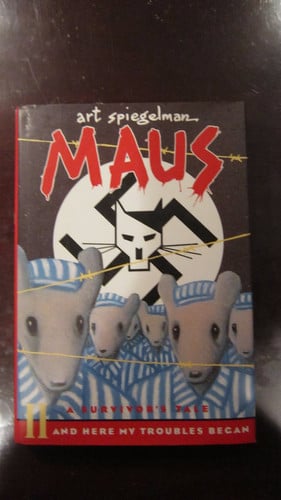
Visually and emotionally rich, MetaMaus is as groundbreaking as the masterpiece whose creation it reveals. In the pages of MetaMaus, Art Spiegelman re-enters the Pulitzer prize-winning Maus, the modern classic that has altered how we see literature, comics, and the Holocaust ever since it was first published twenty-five years ago. He probes the questions that Maus most often evokes -- Why the Holocaust? Why mice? Why comics? -- and gives us a new and essential work about the creative process. MetaMaus includes a bonus DVD-R that provides a digitized reference copy of The Complete Maus linked to a deep archive of audio interviews with his survivor father, historical documents, and a wealth of Spiegelman's private notebooks and sketches. Compelling and intimate, MetaMaus is poised to become a classic in its own right. - Publisher.
Pantheon Books 2011-10-04 299 pages

Mrs. Katz and Tush

Patricia Polacco
Friends from different backgrounds come together in a heartwarming picture book that is perfect for Passover, from beloved children's book author Patricia Polacco. Larnel doesn't know his neighbor, Mrs. Katz, very well, until he asks her to adopt an abandoned kitten. Mrs. Katz agrees on one condition: that Larnel helps her take care of the kitten she names Tush. When Larnel starts spending more and more time with Mrs. Katz to help with Tush, Mrs. Katz tells him stories about coming to America from Poland and about the good times she spent with her late husband. As Larnel grows to love Mrs. Katz, he also learns about the common themes of hardship and triumph in each of their cultures.
Random House Children's Books 1994-03-01 32 pages

The Holocaust and new world slavery: a comparative history

Katz, Steven T.
This volume offers the first, in-depth comparison of the Holocaust and new world slavery. Providing a reliable view of the relevant issues, and based on a broad and comprehensive set of data and evidence, Steven Katz analyzes the fundamental differences between the two systems and re-evaluates our understanding of the Nazi agenda. Among the subjects he examines are: the use of black slaves as workers compared to the Nazi use of Jewish labor; the causes of slave demographic decline and growth in different New World locations; the main features of Jewish life during the Holocaust relative to slave life with regard to such topics as diet, physical punishment, medical care, and the role of religion; the treatment of slave women and children as compared to the treatment of Jewish women and children in the Holocaust. Katz shows that slave women were valued as workers, as reproducers of future slaves, and as sexual objects, and that slave children were valued as commodities. For these reasons, neither slave women nor children were intentionally murdered. By comparison, Jewish slave women and children were viewed as the ultimate racial enemy and therefore had to be exterminated. These and other findings conclusively demonstrate the uniqueness of the Holocaust compared with other historical instances of slavery
Cambridge University Press 2019 852 pages

God's hand on America: divine providence in the modern era

Medved, Michael
The national radio host and bestselling author of The American Miracle reveals the happy accidents, bizarre coincidences, and flat-out miracles that continue to shape America’s destiny. “ A hopeful message for our troubled times . . . Michael Medved has an eye for a story, and a preternatural gift for telling it in beguiling ways.”—Joseph J. Ellis, Pulitzer Prize and National Book Award–winning author of Founding Brothers Has God withdrawn his special blessing from the United States? Americans ponder that painful question in troubled times, as we did during the devastation of the Civil War and after the assassinations of the ’60s, and as we do in our present polarization. Yet somehow—on battlefields, across western wilderness, and in raucous convention halls—astounding events have reliably advanced America, restoring faith in the Republic’s providential protection. In this provocative historical narrative, Michael Medved brings to life ten haunting tales that reveal this purposeful pattern, including: • A near-fatal carriage accident forces Lincoln’s secretary of state into a canvas-and-steel neck brace that protects him from a would-be assassin’s knife thrusts, allowing him two years later to acquire Alaska for the United States. • A sudden tidal wave of Russian Jewish immigration, be­ginning in 1881, coincides with America’s rise to world leadership, fulfilling a biblical promise that those bless­ing Abraham’s children will themselves be blessed. • Campaigning for president, Theodore Roosevelt takes a bullet in the chest, but a folded speech in his jacket pocket slows its progress and saves his life. • At the Battle of Midway, U.S. planes get lost over empty ocean and then miraculously reconnect for five minutes of dive-bombing that wrecks Japan’s fleet, convincing even enemy commanders that higher powers intervened against them. • A behind-the-scenes “conspiracy of the pure of heart” by Democratic leaders forces a gravely ill FDR to replace his sitting vice president—an unstable Stalinist—with future White House great Harry Truman. These and other little-known stories build on themes of The American Miracle, Medved’s bestseller about America’s remarkable rise. The confident heroes and stubborn misfits in these pages shared a common faith in a master plan, which continues to unfold in our time. God’s Hand on America con­firms that the founders were right about America’s destiny to lead and enlighten the world.
Crown Forum 2021-03-09 432 pages

Marked in your flesh: circumcision from ancient Judea to modern America

Glick, Leonard B.
The book of Genesis tells us that God made a covenant with Abraham, promising him a glorious posterity on the condition that he and all his male descendents must be circumcised. For thousands of years thereafter, the distinctive practice of circumcision served to set the Jews apart from their neighbors. The apostle Paul rejected it as a worthless practice, emblematic of Judaism's fixation on physical matters. Christian theologians followed his lead, arguing that whereas Christians sought spiritual fulfillment, Jews remained mired in such pointless concerns as diet and circumcision. As time went on, Europeans developed folklore about malicious Jews who performed sacrificial murders of Christian children and delighted in genital mutilation. But Jews held unwaveringly to the belief that being a Jewish male meant being physically circumcised and to this day even most non-observant Jews continue to follow this practice. In this book, Leonard B. Glick offers a history of Jewish and Christian beliefs about circumcision from its ancient origins to the current controversy. By the turn of the century, more and more physicians in America and England--but not, interestingly, in continental Europe--were performing the procedure routinely. Glick shows that Jewish American physicians were and continue to be especially vocal and influential champions of the practice which, he notes, serves to erase the visible difference between Jewish and gentile males. Informed medical opinion is now unanimous that circumcision confers no benefit and the practice has declined. In Jewish circles it is virtually taboo to question circumcision, but Glick does not flinch from asking whether this procedure should continue to be the defining feature of modern Jewish identity.
Oxford University Press 2005-06-30 370 pages

Shores beyond shores: from Holocaust to hope : my true story

Butter, Irene H.,Bidwell, John,Holloway, Kris
As Irene's Pappi fights to save his family during the Holocaust, Irene's childhood is lost. Play is restricted. Family and friends disappear. Finally, with the Dutch police at their door comes the reality that Irene's father has not moved his family far enough from Hitler's Germany. By January 1945, the family is struggling to survive a death camp. Irene tends her ailing parents, cares for starving kids, and even helps bring clothes to her Amsterdam neighbor Anne Frank, before her family is offered a singular chance for freedom...providing the Nazi doctor says they are healthy enough. After two weeks of heart-lifting miracles and heart-breaking tragedies, Irene arrives in the Algerian desert to journey into redemption and womanhood, without her parents or brother. Irene's first person memoir, Shores Beyond Shores, is an account of how the heart keeps its common humanity in the most inhumane and turbulent of times. Irene's hard-earned lessons are a timeless inspiration. ______________________________________________________________________________________________________________________ Following publication of an article on the Holocaust on April 13, 2018, Irene wrote a letter to the Editor which was published April 17, 2018 in The New York Times: Holocaust Survivors 'Have Voices That Matter' April 17, 2018 Re "Getting Facts Wrong on the Holocaust" (news article, April 13): More than four decades passed before I could break the silence about my traumatic experiences during the Holocaust. It is a formidable challenge for survivors to speak and for others to listen. The number of survivors is dwindling; they are getting quite old and their memories are fading. Yet it is ever more important that the signs of authoritarian regimes and how they evolved are brought into the consciousness of youths and adults, as warning signals of what must be prevented from happening again. Survivors, when able, have the responsibility to bear witness and provide evidence so that the six million Jews who were murdered are not forgotten, so that perpetrators are not pardoned for their crimes, and so that deniers don't have a leg to stand on. While the voices of the victims have been silenced forever, we the survivors have voices that matter. After four decades of not speaking, I realized that silence was no longer an option. I told my stories to my children and grandchildren as well as to many students in many schools over a 30-year period. Schools and other organizations should take advantage of every opportunity to engage survivors to tell their stories. IRENE BUTTER, ANN ARBOR, MICH. The writer survived two concentration camps, Westerbork and Bergen-Belsen. She recently published her memoir, "Shores Beyond Shores: From Holocaust to Hope."
White River Press 2018 273 pages

The last million: Europe's displaced persons from World War to Cold War

Nasaw, David
"In May of 1945, German forces surrendered to the Allied powers, effectively putting an end to World War II in Europe. But the aftershocks of this global military conflict did not cease with the signing of truces and peace treaties. Millions of lost and homeless POWs, slave laborers, political prisoners, and concentration camp survivors overwhelmed Germany, a country in complete disarray. British and American soldiers gathered the malnourished and desperate foreigners, and attempted to repatriate them to Poland, Estonia, Latvia, Lithuania, Ukraine, and the USSR. But after exhaustive efforts, there remained over a million displaced persons who either refused to go home or, in the case of many, had no home to which to return. They would spend the next three to five years in displaced persons camps, divided by nationalities, temporary homelands in exile, with their own police forces, churches, schools, newspapers, and medical facilities. The international community couldn't agree on the fate of the Last Million, and after a year of fruitless debate and inaction, an International Refugee Organization was created to resettle them in lands suffering from labor shortages. But no nations were willing to accept the 200,000 to 250,000 Jewish men, women, and children who remained trapped in Germany. In 1948, the United States, among the last countries to accept anyone for resettlement, finally passed a Displaced Persons Bill - but as Cold War fears supplanted memories of WWII atrocities, the bill only granted visas to those who were reliably anti-communist, including thousands of former Nazi collaborators, Waffen-SS members, and war criminals, while barring the Jews who were suspected of being Communist sympathizers or agents because they had been recent residents of Soviet-dominated Poland. Only after the passage of the controversial UN resolution for the partition of Palestine and Israel's declaration of independence were the remaining Jewish survivors finally able to leave their displaced persons camps in Germany."--
Penguin Press 2020-09-15 654 pages

The last million: Europe's displaced persons from World War to Cold War

Nasaw, David
"In May of 1945, German forces surrendered to the Allied powers, effectively putting an end to World War II in Europe. But the aftershocks of this global military conflict did not cease with the signing of truces and peace treaties. Millions of lost and homeless POWs, slave laborers, political prisoners, and concentration camp survivors overwhelmed Germany, a country in complete disarray. British and American soldiers gathered the malnourished and desperate foreigners, and attempted to repatriate them to Poland, Estonia, Latvia, Lithuania, Ukraine, and the USSR. But after exhaustive efforts, there remained over a million displaced persons who either refused to go home or, in the case of many, had no home to which to return. They would spend the next three to five years in displaced persons camps, divided by nationalities, temporary homelands in exile, with their own police forces, churches, schools, newspapers, and medical facilities. The international community couldn't agree on the fate of the Last Million, and after a year of fruitless debate and inaction, an International Refugee Organization was created to resettle them in lands suffering from labor shortages. But no nations were willing to accept the 200,000 to 250,000 Jewish men, women, and children who remained trapped in Germany. In 1948, the United States, among the last countries to accept anyone for resettlement, finally passed a Displaced Persons Bill - but as Cold War fears supplanted memories of WWII atrocities, the bill only granted visas to those who were reliably anti-communist, including thousands of former Nazi collaborators, Waffen-SS members, and war criminals, while barring the Jews who were suspected of being Communist sympathizers or agents because they had been recent residents of Soviet-dominated Poland. Only after the passage of the controversial UN resolution for the partition of Palestine and Israel's declaration of independence were the remaining Jewish survivors finally able to leave their displaced persons camps in Germany."--
Penguin Press 2020 654 pages

Between worlds: the autobiography of Leo Lionni

Lionni, Leo
Born in Holland, half Jewish, raised in Amsterdam, Brussels, Genoa, Philadelphia - Lionni is a man of many languages and cultures but no real home. His story is one of a constant search, a search that takes him from an ideal early childhood to a strict education in Italy that proved largely irrelevant to his future, and then to exile from Fascist Italy in America; from being a highly political aspiring artist to becoming a highly successful advertising director (he invented the famous "Never underestimate the power of a woman" campaign) and a powerful force in the world of graphics as the art director of Fortune magazine; from life in the affluent commuter world of Connecticut to a return to Italy and the life of an artist. After all this - a full life by any account - he finds yet another successful vocation as the author and illustrator of children's books that have sold millions of copies throughout the world.
Knopf 1997 295 pages

God, faith & identity from the ashes: reflections of children and grandchildren of Holocaust survivors

Menachem Z. Rosensaft
Almost ninety children and grandchildren of Holocaust survivors--theologians, scholars, spiritual leaders, authors, artists, political and community leaders and media personalities--from sixteen countries on six continents reflect on how the memories transmitted to them have affected their lives.--Publisher information.
Jewish Lights Publishing, a division of LongHill Partners, Inc 2014-11-04 309 pages