7 results for "Jewish History"

Traces of God: seeing God in Torah, history and everyday life

Gillman, Neil
A Probing and Powerful Look at the Role You Play in Shaping Your Relationship with God "No matter how hard we look, the God of Israel cannot be seen. Looking is not seeing, and seeing God is not like seeing an apple. It is much more like making a medical diagnosis on the basis of looking at a complex set of symptoms. Each of the symptoms is a dot. We can look at the dots and still miss the pattern." --from Part I The Torah is replete with references to hearing God but precious few references to seeing God. Seeing is complicated. What we look for and see are traces of God's presence in the world and in history, but not God. In order to identify those traces as reflections of divine presence, we need to re-examine how we see, what we see, and how we interpret that information. In this challenging and inspiring look at the dynamics of the religious experience, award-winning author and theologian Neil Gillman guides you into a new way of seeing the complex patterns in the Bible, history, and everyday experiences and helps you interpret what those patterns mean to you and your relationship with God. Examining faith and doubt, revelation and law, suffering and redemption, Gillman candidly deconstructs familiar biblical moments in order to help you develop and refine your own spiritual vision, so that you are able to discern the presence of God in unanticipated ways.
Jewish Lights Pub 2006 216 pages

Jewish perspectives on Hellenistic rulers

Tessa Rajak
This volume gathers sixteen essays on monarchy and power in the Hellenistic period and charts a new approach to Hellenistic history by focusing attention on biblical and Jewish evidence and reading that evidence in new ways. The essays consider the kings, queens, and power figures of the Hellenistic dynasties, as well as ancient Israelite kings, the Babylonian and Persian rulers of the Bible, Parthians, and Romans. The volume also represents a new kind of interpretation of the Greek Bible (Septuagint) and of the Jewish literature of the period, setting them in the context of Hellenistic political thought and practice.
University of California Press 2007 363 pages

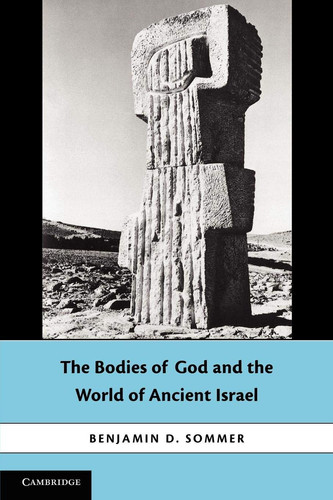
The bodies of God and the world of ancient Israel

Sommer, Benjamin D.
Sommer utilizes a lost ancient Near Eastern perception of divinity according to which a god has more than one body and fluid, unbounded selves. Though the dominant strains of biblical religion rejected it, a monotheistic version of this theological intuition is found in some biblical texts. Later Jewish and Christian thinkers inherited this ancient way of thinking; ideas such as the sefirot in Kabbalah and the trinity in Christianity represent a late version of this theology. This book forces us to rethink the distinction between monotheism and polytheism, as this notion of divine fluidity is found in both polytheistic cultures (Babylonia, Assyria, Canaan) and monotheistic ones (biblical religion, Jewish mysticism, Christianity), whereas it is absent in some polytheistic cultures (classical Greece). The Bodies of God and the World of Ancient Israel has important repercussions not only for biblical scholarship and comparative religion but for Jewish-Christian dialogue.
Cambridge University Press 2011-01-17 334 pages

Jerusalem crucified, Jerusalem risen: the resurrected Messiah, the Jewish people, and the land of promise

Kinzer, Mark
The good news (euangelion) of the crucified and risen Messiah was proclaimed first to Jews in Jerusalem, and then to Jews throughout the land of Israel. In Jerusalem Crucified, Jerusalem Risen, Mark Kinzer argues that this initial audience and geographical setting of the euangelion is integral to the eschatological content of the message itself. While the good news is universal in concern and cosmic in scope, it never loses its particular connection to the Jewish people, the city of Jerusalem, and the land of Israel. The crucified Messiah participates in the future exilic suffering of his people, and by his resurrection offers a pledge of Jerusalem's coming redemption. Basing his argument on a reading of the Acts of the Apostles and the Gospel of Luke, Kinzer proposes that the biblical message requires its interpreters to reflect theologically on the events of post-biblical history. In this context he considers the early emergence of Rabbinic Judaism and the much later phenomenon of Zionism, offering a theological perspective on these historical developments that is biblically-rooted, attentive to both Jewish and Christian tradition, and minimalist in the theological constraints it imposes on the just resolution of political conflict in the Middle East.
Cascade Books, an imprint of Wipf and Stock Publishers 2018-10-30 325 pages

Paul and the law: keeping the commandments of God

Rosner, Brian S.
Preaching's Preacher's Guide to the Best Bible Reference "For neither circumcision counts for anything nor uncircumcision, but keeping the commandments of God" (1 Cor 7:19). The apostle Paul's relationship to the Law of Moses is notoriously complex and much studied. Difficulties begin with questions of definition (of the extent of Paul's corpus and the meanings of "the law") and are exacerbated by numerous problems of interpretation of the key texts. Major positions are entrenched, yet none of them seems to know what to do with all the pieces of the puzzle. Inextricably linked to Paul's view of the law is his teaching concerning salvation history, Israel, the church, anthropology, ethics and eschatology. Understanding "Paul and the law" is critical to the study of the New Testament, because it touches on the perennial question of the relationship between the grace of God in the gift of salvation and the demand of God in the call for holy living. Misunderstanding can lead to distortions of one or both. This New Studies in Biblical Theology volume is something of a breakthrough, bringing neglected evidence to the discussion and asking different questions of the material, while also building on the work of others. Brian Rosner argues that Paul undertakes a polemical re-evaluation of the Law of Moses, which involves not only its repudiation as law-covenant and its replacement by other things, but also its wholehearted re-appropriation as prophecy (with reference to the gospel) and as wisdom (for Christian living). Addressing key issues in biblical theology, the works comprising New Studies in Biblical Theology are creative attempts to help Christians better understand their Bibles. The NSBT series is edited by D. A. Carson, aiming to simultaneously instruct and to edify, to interact with current scholarship and to point the way ahead.
InterVarsity Press 2013-08-19 249 pages

Stones the builders rejected: the Jewish Jesus, his Jewish disciples, and the culmination of history

Kinzer, Mark,Rosner, Jennifer M.
"Since the groundbreaking publication of Postmissionary Messianic Judaism (2005), Mark Kinzer has challenged theologians and religious leaders to consider the essential ecumenical vocation of Jewish disciples of Jesus. Proposing a bilateral ecclesiology in solidarity with Israel, he argued that the overcoming of Christian supersessionism required a robust affirmation of the distinctive calling of Jews within the community of Jesus the Messiah. In this way, Kinzer's work put the issue of Jewish followers of Jesus on the theological agenda for those seeking a reparative reconfiguration of the relationship between the church and the Jewish people. In recent years, Kinzer has attended to the theological implications of this perspective and has widened his focus to include not only the Messianic Jewish movement but also Jews within Catholic, Orthodox, and Protestant churches. The present collection of essays reflects this wider concern. According to Kinzer, the theological stones of contention are Christology conceived of as Messianology, ecclesiology understood as Israelology, and eschatology imagined as Zionology. Moreover, it is the presence of Jewish disciples of Jesus that concretizes these theological abstractions in the form of Jewish flesh and blood, summoning Jews and Christians to rethink their relationship to one another in ways that express their essential mutual dependence." --
Cascade Books 2024-06-04 217 pages

Greed as idolatry: the origin and meaning of a Pauline metaphor

Rosner, Brian S.
What are the origin and meaning of the words "greed is idolatry" found in Ephesians 5:5 and Colossians 3:5? In what sense are the greedy guilty of idolatry? Many different answers have been given to this question throughout the history of interpretation. In fact, a consensus exists on only one score - that the expression serves to vilify greed. Brian Rosner takes on the challenge of interpretation by tackling the phrase as a metaphor, structuring his argument around an intriguing comparison to mountain climbing. From this vantage point, he offers a history of interpretation of the phrase, including a study of the origin of the concept of idolatrous greed in biblical and Jewish sources. Rosner concludes that the comparison of greed with idolatry teaches that to desire to acquire and keep for oneself more money and material things is an attack on God's exclusive right to human love, trust, and obedience. With this work comes an understanding of familiar terms - "greed," "idolatry," and even "God"--Challenging both the church as a whole and individual believers to consider the far-ranging implications of our materialistic world. --From publisher's description.
William B. Eerdmans Pub. Co 2007 214 pages